
Most sales teams are winging it. They chase random leads, forget follow-ups, and watch deals slip through the cracks without knowing why.
A structured sales pipeline fixes this. It shows you exactly where every deal stands, what’s stalling, and what needs to happen next to close. Here’s how to build one from scratch.
What Is a Sales Pipeline?
A sales pipeline is a visual representation of where your prospects are in the buying process. Think of it as a map that shows every sales opportunity from first contact to closed deal.
For SMEs, that map usually lives in a CRM built for smaller teams rather than enterprise suites. Pepper Cloud ties the pipeline view directly into WhatsApp and email conversations, so the deal history sits in one place without the Salesforce learning curve.
It’s different from a sales funnel. A funnel focuses on the buyer journey from the customer’s perspective. A pipeline focuses on the actions your sales team takes to move deals forward.
Each stage in your pipeline represents a specific step in your sales process. When a lead completes the required actions for that stage, they move to the next one. When they don’t, you know exactly where to focus your attention.
📖 What is Pipeline Velocity?
Pipeline velocity measures how quickly deals move through your pipeline and convert to revenue. It factors in the number of opportunities, average deal value, win rate, and sales cycle length. Higher velocity means faster, more predictable revenue.
The real power of a pipeline is visibility. You can see which deals are progressing, which are stalled, and which need immediate attention. This clarity makes revenue forecasting possible and helps your sales team prioritize their time on the deals most likely to close.
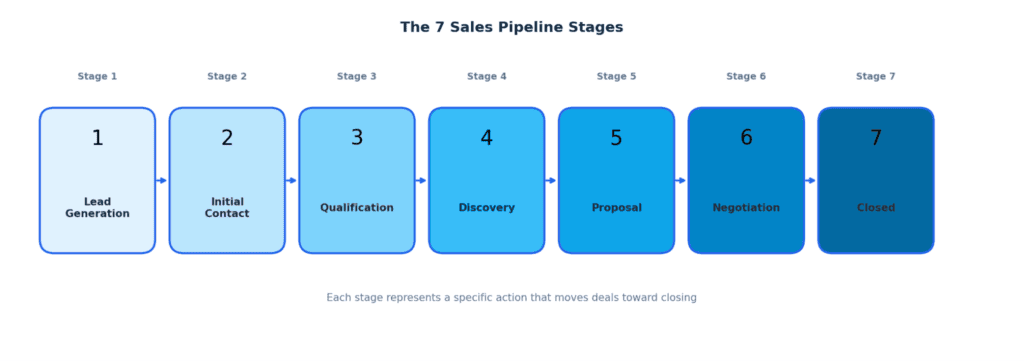
The 7 Essential Sales Pipeline Stages
Every business is different. But most successful pipelines share similar stages. Here’s a framework that works across industries.
You can customize this based on your sales cycle, but don’t overcomplicate it. Five to seven stages is the sweet spot. More than that creates confusion. Fewer leaves gaps.
Stage 1: Lead Generation
This is where prospects enter your pipeline. They might come from inbound marketing, cold outreach, referrals, or events. The source matters less than the quality.
Not every lead deserves a spot in your pipeline. Only add prospects who fit your ideal customer profile. Otherwise, you’ll waste time chasing deals that were never going to close.
Companies that invest in talent sourcing tools understand this principle well. The same logic applies to sales. Better inputs create better outputs.
Stage 2: Initial Contact
You’ve identified a potential fit. Now you need to make contact and start a conversation.
This could be a cold email, a LinkedIn message, a phone call, or a response to their inbound inquiry. The goal isn’t to sell yet. It’s to qualify interest and book a discovery call.
💡 Quick Tip
Personalization matters more than volume. A thoughtful message that references something specific about their business will outperform generic templates every time. Spend five extra minutes on research before hitting send.
Stage 3: Qualification
This is the most important stage in your pipeline. And the one most teams rush through.
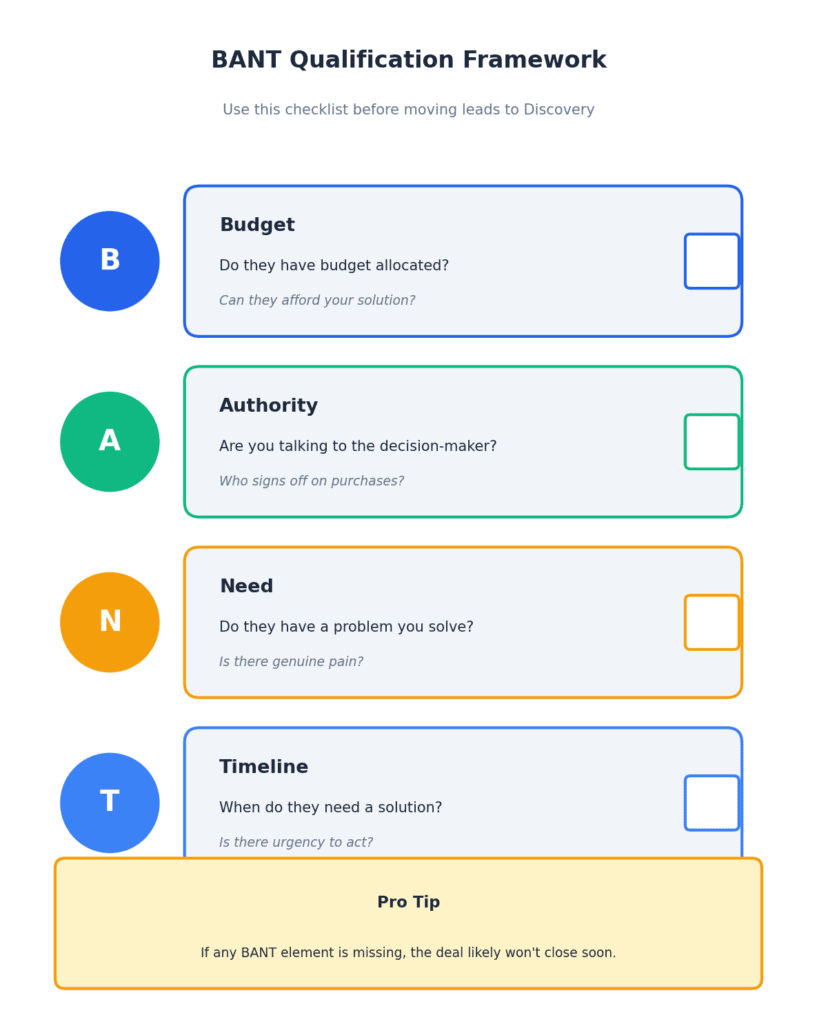
Qualification determines whether a lead is worth pursuing. You’re looking for budget, authority, need, and timeline. If any of these are missing, the deal probably won’t close. At least not anytime soon.
Strong qualification saves your team from wasting weeks on prospects who were never going to buy. It also improves your conversion rate because you’re focusing energy on qualified leads who actually have a problem you can solve.
Stage 4: Discovery and Needs Analysis
Once qualified, you dig deeper. What’s their current situation? What problems are they trying to solve? What does success look like for them?
This stage is about listening, not pitching. The more you understand their needs, the better you can position your solution. Many sales reps skip this step and jump straight to the demo. That’s a mistake.
Organizations building out their talent acquisition process follow a similar approach. Understanding the problem before proposing a solution leads to better outcomes.
Stage 5: Proposal or Presentation
Now you present your solution. This could be a formal proposal, a product demo, or a detailed scope of work.
The key here is tailoring your presentation to what you learned in discovery. Generic pitches don’t close deals. Show them exactly how you’ll solve their specific problems.
| Stage | Goal | Key Action |
| Lead Generation | Fill the pipeline | Identify ideal prospects |
| Initial Contact | Start conversation | Personalized outreach |
| Qualification | Confirm fit | BANT assessment |
| Discovery | Understand needs | Deep-dive questions |
| Proposal | Present solution | Tailored presentation |
| Negotiation | Align terms | Handle objections |
| Closed Won/Lost | Finalize outcome | Contract or debrief |
Stage 6: Negotiation
Proposals rarely get accepted on the first pass. There will be questions, objections, and requests for adjustments.
This is normal. Negotiation isn’t a sign that the deal is falling apart. It’s a sign that the prospect is seriously considering moving forward. Handle objections calmly, address concerns directly, and find compromises where needed.
⚠️ Common Mistake
Don’t discount too quickly just to close the deal. Dropping your price at the first sign of pushback trains prospects to always ask for more. Instead, trade value. If they want a lower price, reduce scope or extend payment terms.
Stage 7: Closed Won or Closed Lost
Every deal ends one of two ways. You either close deals successfully or you lose them to a competitor, the status quo, or bad timing.
Both outcomes matter. Wins generate revenue. Losses generate lessons. Track why deals close and why they don’t. Over time, you’ll spot patterns that help you improve every stage of your pipeline.
How to Set Up Your Pipeline Management System
Having stages defined is just the start. You need a system to track and manage your pipeline daily. Most teams use CRM software for this.
Your CRM becomes the single source of truth for every deal. It shows where each opportunity sits, what actions are needed, and how close you are to hitting your sales goals.
When selecting a CRM, look for something your sales team will actually use. The fanciest tool in the world is worthless if reps don’t update it. Simplicity beats features.
📊 By the Numbers
Companies using CRM systems see an average 29% increase in sales revenue. The visibility alone is worth it. But the real value comes from the process discipline it creates. (Source: Salesforce Research)
Beyond the CRM, establish a regular pipeline review cadence. Weekly reviews with your team help catch stalled deals, identify coaching opportunities, and keep everyone accountable.
Tracking the Right Sales Metrics
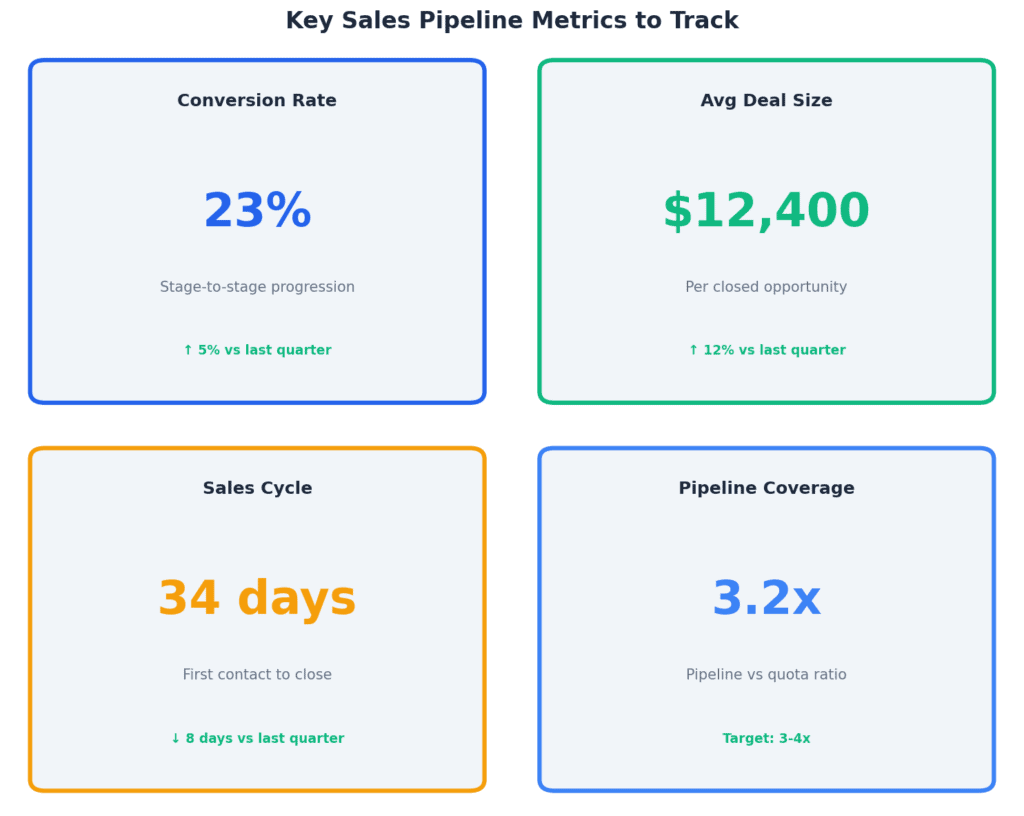
You can’t improve what you don’t measure. Here are the metrics that actually matter for pipeline management.

Conversion rate by stage: What percentage of deals move from one stage to the next? Low conversion between specific stages reveals where your process is breaking down.
Average deal size: Knowing your typical deal value helps with forecasting and prioritization. It also highlights when deals are significantly above or below normal.
Sales cycle length: How long does it take from first contact to closed deal? Longer cycles aren’t always bad, but unexpected delays often signal problems.
Pipeline coverage: Compare your total pipeline value to your quota. Most sales leaders target 3x to 4x coverage. Less than that means you need more lead generation.
These metrics connect directly to your hiring statistics in an interesting way. Both sales and recruiting require tracking conversion rates through a defined process.
Building Your Pipeline: A Step-by-Step Process
Let’s get practical. Here’s how to build your sales pipeline from scratch.
Step 1: Define Your Ideal Customer
Before adding anyone to your pipeline, clarify who you’re targeting. What company size? What industry? What role makes buying decisions?
The tighter your definition, the better your qualification will be. Vague targeting leads to bloated pipelines full of deals that never close.
🎯 Pro Insight
Look at your last 10 closed deals. What do those customers have in common? That pattern is your ideal customer profile. Stop chasing prospects who don’t match it.
Step 2: Map Your Buyer Journey
Understand the steps your customers take before buying. What questions do they ask? What objections come up? What information do they need at each stage?
Your pipeline stages should align with this buyer journey. When the two match, moving deals forward feels natural rather than forced.
Step 3: Assign Clear Actions to Each Stage
Every stage needs defined entry and exit criteria. What must happen for a deal to move from qualification to discovery? What constitutes a completed proposal?
Without clear actions, deals get stuck in limbo. Reps mark things as “in progress” forever because there’s no objective standard for advancement.
Step 4: Build Your Prospecting Engine
A pipeline without new opportunities dries up fast. You need consistent lead generation strategies feeding the top of your funnel.
This might include outbound prospecting, content marketing, referral programs, or partnerships. The best teams use multiple channels so they’re never dependent on a single source.
Step 5: Establish Review Rhythms
Schedule weekly pipeline reviews with your team. Go deal by deal through everything active. Ask what’s happened since last week and what’s the next action.
This rhythm creates accountability and catches problems early. Deals that haven’t moved in two weeks need attention or removal.
4 Common Pipeline Mistakes to Avoid
Building a pipeline is one thing. Keeping it healthy is another. Watch out for these common traps.
Letting stale deals linger. If a deal hasn’t moved in 30 days, something is wrong. Either re-engage aggressively or move it to closed lost. Dead deals clog your pipeline and distort your forecasting.
Skipping qualification. It feels productive to have a full pipeline. But quantity without quality wastes everyone’s time. Be ruthless about who gets in.
Inconsistent stage definitions. If every rep uses stages differently, your pipeline data is meaningless. Align on exactly what each stage means and enforce it.
Ignoring lost deals. Every closed lost deal contains a lesson. Did you lose on price? Features? Timing? Track the reasons and look for patterns.
Companies that excel at talent acquisition and retention follow similar principles. Clear processes, consistent standards, and regular reviews drive results.
📌 Key Takeaway
Your pipeline is only as good as the discipline behind it. The stages don’t matter if reps don’t update them. The metrics don’t help if nobody reviews them. Build the process, then build the habit of following it.
How to Scale Your Sales Pipeline
Once your basic pipeline works, you can start optimizing for scale.
Add sales automation for repetitive tasks like follow-up emails and meeting reminders. This frees your team to focus on actual selling.
Consider expanding your sales team strategically. Hiring for startups requires balancing speed with quality. The same applies when building out a sales organization.
Some startups scale faster by mixing full-time hires with contract closers. ContractorPlus simplifies the paperwork when you’re managing both.
Segment your pipeline by deal size, industry, or product line. Different segments may need different approaches. A $5,000 deal shouldn’t go through the same process as a $500,000 deal.
Finally, invest in talent acquisition analytics thinking for your sales data. The patterns in your numbers tell you exactly where to focus improvement efforts.
Putting It All Together
A sales pipeline isn’t complicated. It’s a simple system with stages, actions, and metrics. The hard part is the discipline to use it consistently.
Start with the seven stages outlined here. Customize them for your business. Set up a CRM your team will actually use. Establish weekly reviews. Track the metrics that matter.
The companies that hit their sales goals aren’t lucky. They have visibility into their pipeline, they know where deals are stuck, and they take action before problems become disasters.
Your next step is simple. Map out your current sales process. Identify the gaps. Then build the pipeline that turns chaos into closed deals.