
Every firm that wants to build a quant team runs into the same wall. The people with the textbook résumé, years inside a systematic fund and a record of live signals, already work for the biggest funds, and those funds can outbid almost anyone. Pulling them out one at a time is slow, expensive, and rarely sticks.
The good news is that the underlying skill set is not exclusive to finance. Quantitative research is a way of working: form a hypothesis, test it against noisy data, and be honest about what the results do and do not prove. People do that in physics labs, machine learning teams, and engineering groups every day.
This guide covers why raiding funds tends to backfire, what you should actually screen for, where strong candidates are hiding, how to assess them, and how to make an offer that wins without matching fund pay.
Why Poaching Hedge Funds Is a Losing Strategy
Direct raids look efficient on paper. In practice, they carry problems that show up late.
Pay is the first one. Researchers at established funds are often compensated through large performance-linked bonuses, and a smaller firm rarely matches that structure. Even if you get close on the headline number, you are asking someone to swap a known payout for a promise.
Timing is the second. Non-competes and garden leave can keep a candidate out of the seat for months, depending on jurisdiction and contract. During that gap, the current employer has plenty of time to make a counteroffer.
Fit is the third. Someone who spent years inside a large fund’s data pipelines, execution stack, and research tooling may struggle when those supports are missing. They are used to infrastructure you may not have built yet.
Retention is the last. A hire who moved for money can move again for money. You end up in a bidding cycle that the larger firm will eventually win.
What a Quant Researcher Actually Does
Strip away the title and the work is fairly consistent. A quant researcher gathers and cleans data, proposes a signal or model, tests it, and decides whether the evidence is strong enough to act on. A large part of the job is skepticism: asking whether a result is real or just an accident of the sample.
That points to a short list of skills worth screening for:
- Probability and statistics, including comfort with uncertainty and sampling error
- Programming ability, usually Python, sometimes C++ for performance-sensitive work
- Research judgment, meaning the ability to frame a question and design a clean test
- Discipline around overfitting, multiple testing, and data snooping
- Clear communication of results to people who did not run the analysis
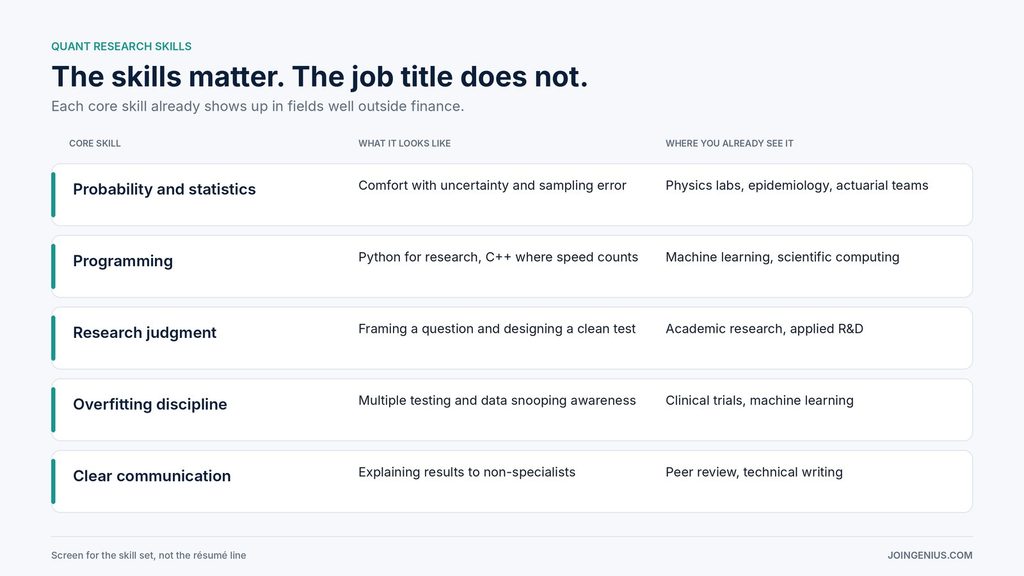
Notice what is missing from that list: a finance job title. Market knowledge can be taught faster than statistical maturity can, so a job spec that demands years at a fund is filtering out people who could do the work.
It also helps to separate the roles that get lumped together. A quant researcher is mostly about finding and validating ideas. A quant developer is mostly about building the systems that run them. A data engineer keeps the inputs clean and available. If your team needs all three but you only write one job description, you will attract confused applicants and lose the ones who know exactly what they want. Decide which seat you are filling first, then hire for that.
Alternative Talent Pools for Quant Research
Most firms search one pond and wonder why it is empty. There are four others worth fishing in.
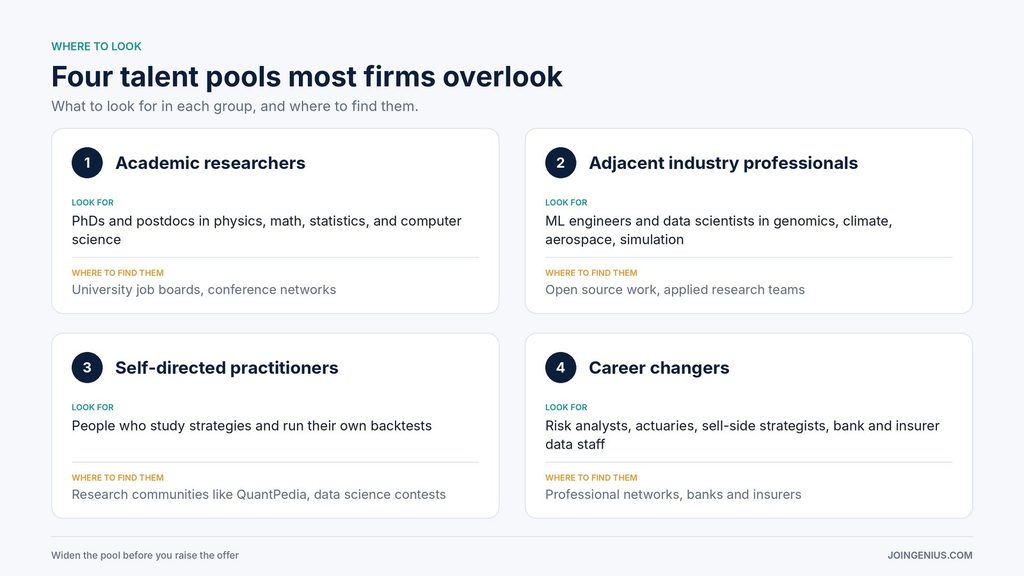
Academic researchers. PhDs and postdocs in physics, mathematics, statistics, and computer science spend years doing this exact kind of work, often with messy data and weak signals. Many are open to applied roles, especially when academic positions are scarce or slow to open. Recent graduates and people finishing postdoctoral terms are the natural place to start.
Adjacent industry professionals. Machine learning engineers, data scientists, and applied researchers in fields such as genomics, climate modeling, aerospace, and engineering simulation already work with noisy, high-dimensional data. They will need to learn market structure, but the modeling instincts are already in place.
Self-directed practitioners. Some of the sharpest candidates never held a formal quant title. They study strategies on their own, run backtests, and join communities built around systematic research.
Resources like QuantPedia, which collects trading strategies drawn from academic research, are the kind of place where these people learn and compare ideas. Watching the communities around them can surface candidates who already think in terms of evidence rather than hunches.
Career changers from adjacent finance roles. Risk analysts, sell-side strategists, actuaries, and data-focused staff at banks and insurers know the domain and are often looking for a research seat. They need less ramp-up on markets and more support on research methodology.
Reaching these groups takes a small change in approach. Post roles in skill-based language instead of “five years at a hedge fund.” Show up on academic job boards and at conference networks, read open source contributions, and look at who performs well in data science competitions. A short, specific message about the research problems your team works on will land better than a generic recruiter note.
Referrals deserve a mention too. Researchers know other researchers, and a good hire from an academic lab or an engineering team often leads to the next one. Ask every candidate, including the ones you reject, who else they respect in their field. Quant talent is a small world, and a thoughtful process travels by word of mouth.
How to Assess Candidates From Outside Finance
Candidates from other fields will not pass a finance trivia screen, and they should not have to. Assess the skill that matters instead. A simple four-step process works well.
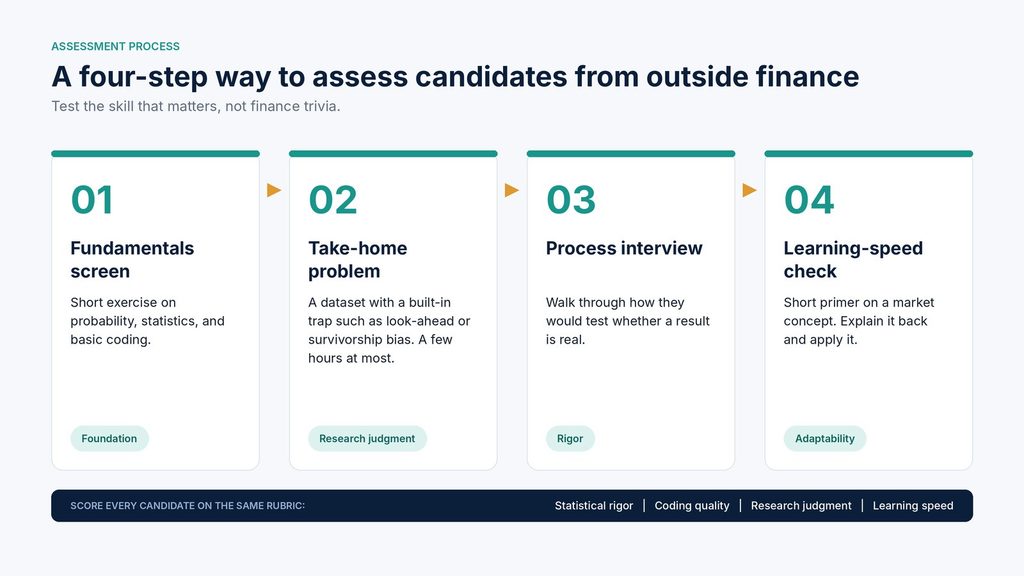
Step 1: Fundamentals screen. Use a short exercise on probability, statistics, and basic coding. The goal is to confirm the foundation, not to trick anyone.
Step 2: Take-home research problem. Give them a dataset with a built-in trap, such as look-ahead bias or survivorship bias, and ask what they would conclude. Keep it to a few hours. If you need more time than that, pay for it.
Step 3: Process interview. Ask them to walk through how they would test whether a result is real. Strong candidates talk about out-of-sample testing, multiple comparisons, and what would change their mind.
Step 4: Learning-speed check. Give a short primer on a market concept and ask them to explain it back and apply it. You are measuring how quickly they absorb a new domain, which is what an outside hire will need to do.
Score every candidate against the same short rubric, covering statistical rigor, coding quality, research judgment, and learning speed. A written rubric keeps the process fair, reduces the pull toward familiar résumés, and gives the hiring team something concrete to compare when opinions differ.
Making the Offer Competitive Without Matching Fund Pay
You will not win a pure cash contest, so do not enter one. Compete on what a smaller team can do better.
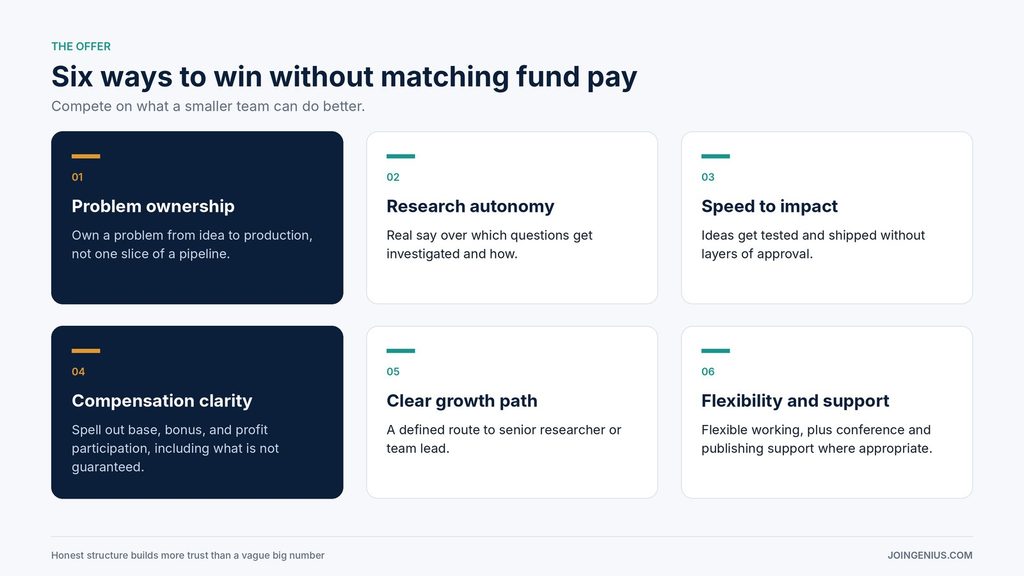
Research autonomy and ownership come first. At a large fund, a researcher may own one narrow slice of a pipeline. At a smaller firm, they can own a problem from idea to production and see the result. Speed to impact matters in the same way, since ideas get tested and shipped without layers of approval.
Compensation clarity is the next lever. Explain exactly how base, bonus, and any profit participation work, and be upfront about what is guaranteed and what is not. Candidates compare offers carefully, and honesty about structure builds trust that vague big numbers do not.
Growth and flexibility finish the case. Offer a clear path to senior research or team lead roles, support for conference attendance or publishing where appropriate, and flexible working arrangements. For many researchers, these carry more weight than a marginal bump in bonus potential.
Finally, think about the first ninety days. A new hire from outside finance needs data access, a mentor, and a realistic first project that can show a result without huge pressure. Strong onboarding is part of the offer. Candidates who see a clear plan for their ramp-up are more likely to say yes, and more likely to still be there a year later.
Build the Bench You Can Actually Hire
Raiding hedge funds is a strategy that depends on out-spending firms that have more money than you. A better strategy is to widen the search, hire for research ability, and sell the things a smaller team does well.
A practical first step is to audit your current job specs. If they require finance experience that the work does not truly need, rewrite them around the skills in this guide and see who applies. The candidates you were missing may have been one job description away.