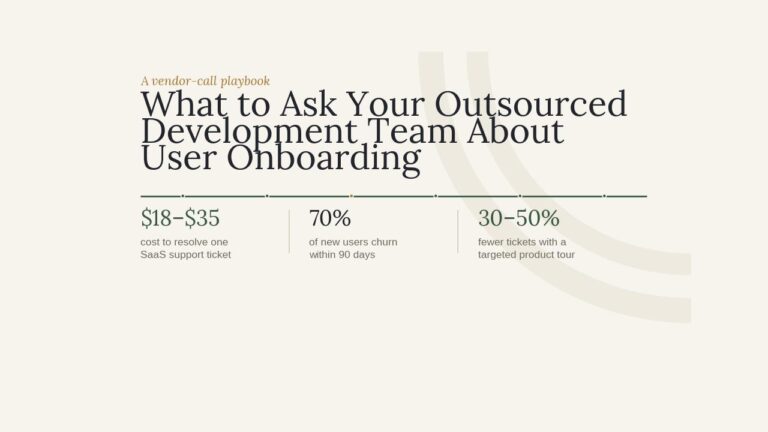
SaaS support tickets cost $18-$35 to resolve, and a big share of that volume traces back to onboarding gaps nobody caught while scoping the outsourcing contract. When an outsourced development team builds your onboarding flow, the questions you ask before the contract starts decide whether that flow prevents tickets or creates them. This gives you 6 questions worth asking in your next vendor call, plus a checklist and 3 metrics that show whether the work actually landed.
What Onboarding Readiness Means For An Outsourced Development Team
Onboarding readiness isn’t a UI polish item. It’s the specific work of getting a new user from signup to their first real win, and it touches product, support, and analytics at the same time.
Most outsourced teams get hired to ship features on a spec, not to own an outcome like activation. That’s a different kind of scope, and it needs a different kind of conversation before anyone signs anything. A team that’s great at shipping a checkout flow on time isn’t automatically good at figuring out why new users abandon a dashboard on day one.
70% of new SaaS users churn within their first 90 days, and most of that loss traces back to a confusing first experience rather than the product itself. A team that treats onboarding as “add a welcome modal” is scoping the wrong problem.
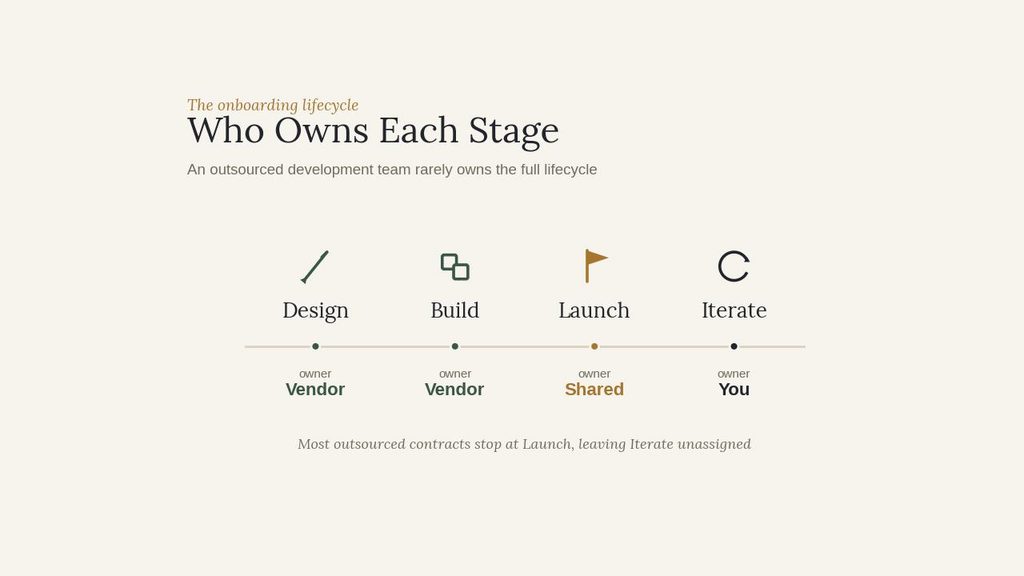
Onboarding ownership splits across design, build, launch, and iterate, and an outsourced development team usually only owns one or two of those stages.
The 6 questions below separate teams that understand this from teams that will hand you a working login screen and call the job finished. Run through them in order, since each one builds on the answer before it.
6 Questions To Ask Your Outsourced Development Team About Onboarding
Ask these before the statement of work gets signed, not after the first sprint review.
Who Owns The First Run Experience After Handoff
Someone has to own what a new user sees in their first 5 minutes, and it’s rarely written down anywhere. Ask the team directly who that person is on their side, and who it becomes on yours once the contract ends.
Vague answers here are the clearest early warning sign. A team that can’t name a single owner for the first-run experience hasn’t scoped onboarding. They’ve scoped a login flow with extra steps, and the difference shows up fast once real users start signing up.
How Will You Document The Onboarding Flow For Future Developers
New developers take 28 days on average to make their first production contribution. Teams with solid documentation cut that to 3-5 days, an 80% drop, just from having answers written down somewhere findable.
📊 By The Numbers
Documentation quality is one of the strongest predictors of software delivery performance, on par with deployment frequency. A team that skips documentation to hit a deadline is borrowing against whoever maintains the flow next.
Ask what format the documentation takes and who’s responsible for keeping it current after launch. “It’s in the code comments” is not a plan, and it usually means the next developer starts from zero.
A Good Product Tour Reduces Support Tickets Before They Happen
Most support tickets from new users are the same 5 or 6 questions asked over and over, the kind a proactive walkthrough answers before anyone opens a ticket. Product tours cut support ticket volume by 30-50% when they’re scoped around actual drop-off points instead of shipped as a generic welcome flow.
One fintech onboarding flow dropped its “how do I connect my bank” tickets by 41% just by swapping a buried help article for a tour that fired on first login. Same content, different delivery, and the support load fell almost in half.
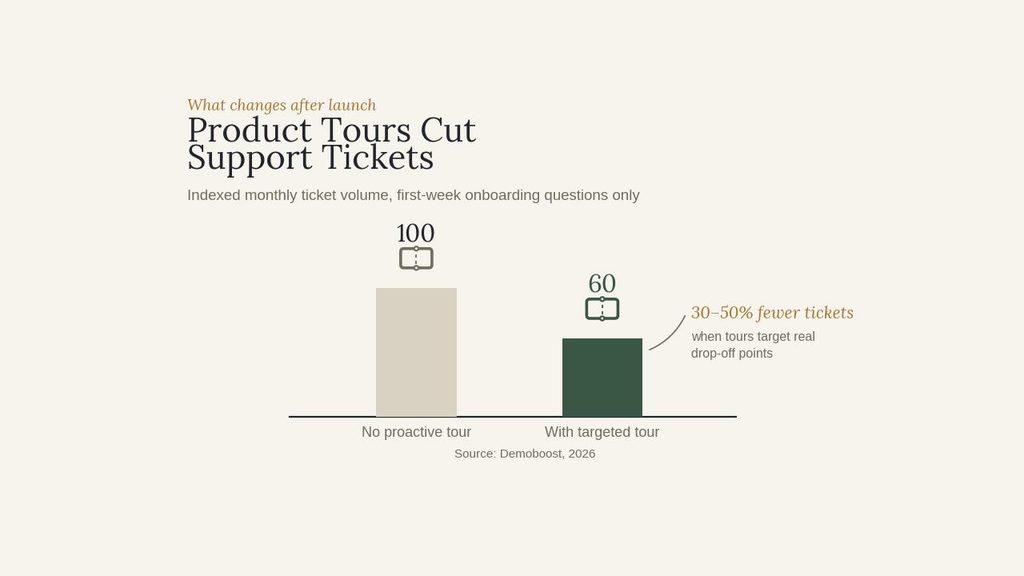
A proactive product tour intercepts the repeat questions before they turn into a ticket at all.
Ask whether your outsourced development team plans to build a walkthrough engine from scratch or reach for an existing product tour library. Intro.js is one option that ships under 10kB with no external dependencies, and it works by tagging data-intro attributes directly onto your existing HTML elements rather than requiring a separate rendering layer.
💡 Pro Tip
Push back on any team that proposes one long tour covering every feature at once. Progressive disclosure, showing one tooltip at a time as users reach each step, consistently beats the “welcome to everything” approach.
What matters more than the tool choice is whether the team wires the tour to your actual drop-off points instead of shipping one generic walkthrough and calling onboarding done.
What Analytics Will You Wire Into The Onboarding Flow
If nobody can see where users stall, nobody can fix it. Ask the team which specific events they’ll track: account creation, first key action, feature discovery, whatever your product’s real activation moment is.
Generic pageview tracking doesn’t count. You need event-level data tied to the exact step where users are dropping off, or the metrics section later in this checklist won’t have anything to measure. This also protects you if the relationship ends, since exported event data travels with you and a dashboard tied to a vendor’s own tooling doesn’t always.
How Often Will You Test The Flow With Real New Users
A flow tested once at launch and never touched again drifts out of sync with the product within a few months. Ask for a testing cadence, not a one-time QA pass before handoff.
The pattern that shows up on almost every vendor call I’ve sat in on is a team that tests thoroughly before launch and then never revisits the flow once it ships. That’s when onboarding quietly breaks, usually right around the time a new feature changes what the first-run experience should actually cover.
Who Fixes Onboarding Bugs After The Outsourced Development Team Leaves
Contracts end, but onboarding bugs don’t. Ask who owns fixes once the engagement wraps, and whether that’s covered under a support window or billed separately.
This question also surfaces whether you’re ready to bring the work in-house. If you’re still deciding which roles to keep outsourced before hiring full-time, onboarding maintenance is a useful test case, since it tends to need faster iteration than a typical outsourced sprint cadence supports.
Red Flags That Show An Outsourced Development Team Isn’t Onboarding Ready
Some answers during a vendor call tell you more than the actual proposal does. Watch for these 5 specifically, since they tend to show up together.
| Red Flag | What It Signals |
| Onboarding described as “just a welcome screen” | Team scoped a UI element, not an outcome |
| No mention of analytics or event tracking | No way to measure drop-off after launch |
| One tour covers every user type | Team isn’t accounting for different roles or goals |
| Documentation plan stops at code comments | Knowledge leaves when the contract ends |
| Support handling never comes up | Nobody owns the bugs that surface after handoff |
⚠️ Common Mistake
Teams often assume a strong technical proposal means a strong onboarding plan. The two aren’t the same skill. A developer who writes clean code can still ship a walkthrough nobody finishes, because writing code and mapping a user’s first session are genuinely different jobs.
A Simple Onboarding Checklist For Your Outsourced Development Team
Run this during the vendor call instead of after the contract is signed. Print it, paste it into your call notes, whatever gets it in front of you live.
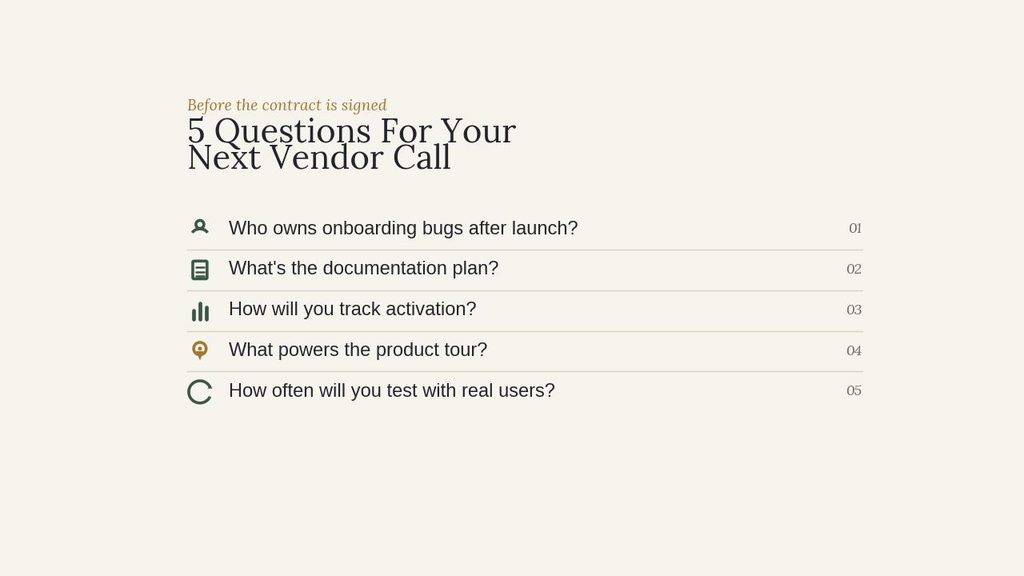
5 questions worth running through live on your next vendor call, before the statement of work is signed.
| Question To Ask | What “Ready” Sounds Like |
| Who owns onboarding bugs after launch? | A named contact and a support window, not “we’ll see” |
| What’s the documentation plan? | A living doc updated as the flow changes |
| How will you track activation? | Specific events tied to your product’s core action |
| What powers the product tour? | A named tool with a reason it fits your stack |
| How often will you test with real users? | A set cadence, not “once at launch” |
📌 Key Takeaway
None of these questions need a technical background to ask. They just need asking before the contract starts instead of after the support tickets start piling up.
3 Metrics That Prove Your Outsourced Development Team Got Onboarding Right
Track these for 60 days after launch, not just in the first week, since early numbers usually look better than they end up being.
Time to first value. Users who hit core product value within 5-15 minutes are 3 times more likely to retain than those who wait 30 minutes or longer. If your dev team can’t tell you this number, the analytics question above wasn’t answered properly.
Onboarding-related ticket volume. Track tickets tagged to the first 14 days after signup specifically, separate from your general support queue. A working onboarding flow should show this number trending down month over month, not flat, and definitely not climbing after a release.
Activation rate. The percentage of new users who complete your product’s defined “aha moment” within the first session. This is the number that ties the other two together, and it’s the one worth reporting back to whoever approved the outsourcing budget in the first place.
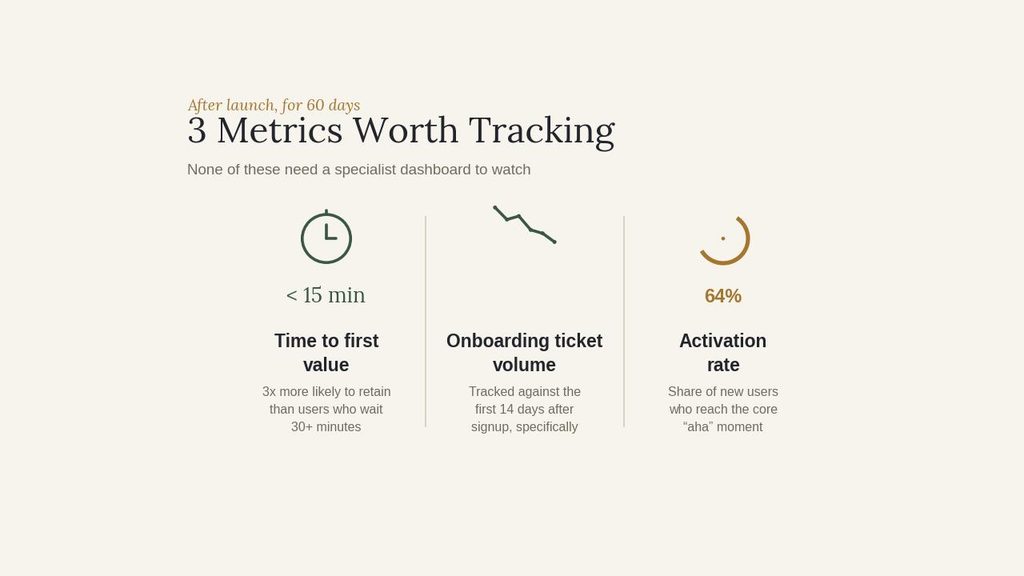
3 metrics worth tracking for 60 days after an outsourced development team ships your onboarding flow.
What Comes Next With Your Outsourced Development Team
Onboarding is the first real test of whether an outsourced development team understood your product, not just your ticket. Run these 6 questions in your next vendor call, use the checklist to keep the conversation concrete, and track the 3 metrics for 60 days after launch. Whichever way you land on outsourcing versus offshoring your next hire, the team that can answer these questions without hesitating is the one worth signing.