
The pattern is familiar. A team posts a polished job description, applications arrive, interviews go well, and an offer is accepted. Then, a few weeks in, the new engineer starts asking questions that the posting never answered. Why is the codebase this old? Why is nobody writing tests? Who actually decides what gets built? A few months later the hire is quietly job hunting, or the team is quietly disappointed.
Most “bad hires” in technical teams are not bad hires at all. They are the predictable result of bad information at the start. When a job description hides what the work is really like, the hiring process selects for people who believed the story, not people who fit the job. If you want to build a productive team, the first thing to fix is the honesty of the posting itself.
How Vague Job Descriptions Quietly Break the Hiring Process
A job description is the first piece of evidence a candidate sees, and every later step builds on it. Interview questions, offer discussions, and onboarding plans all assume that the person on the other side has an accurate picture of the role. When that assumption is wrong, the damage spreads through the whole process.
The costs show up in predictable places. Interview cycles are wasted on candidates who would never have applied with the full picture. Strong candidates drop out late, after they finally learn what the job involves. New hires leave early, and the team has to restart the search while carrying the workload in the meantime.
There is also a quieter cost. Engineers who stay despite a mismatch often disengage. They do the work in front of them without ever raising the problems they can see, because they feel the role was never what it was sold as. That is a hard thing to detect and a harder thing to repair.
What Job Descriptions Usually Leave Out
Most postings describe an ideal version of the team. The details that shape the day-to-day experience tend to be missing.

The state of the codebase is the first gap. Postings mention a modern stack, but rarely say how old the core system is, how much of it is covered by tests, or how much technical debt sits underneath. Engineers care about this a great deal, because it decides whether their week is spent building or untangling.
The real split of work is next. A role described as “building new features” may spend most of its time on maintenance, bug fixes, and support. Neither is a problem on its own, but the mix matters, and candidates deserve to know it.
Team structure is another omission. Who does this person report to? Who makes product decisions? Is there a senior engineer to learn from, or will they be the only one? Candidates read these gaps as signals, and the signals are rarely flattering.
Process details are often left out too. How does the team plan work, ship releases, and review code? A team that runs structured sprints, perhaps with the help of sprint planning software, works very differently from one that reacts to urgent requests all day. Both can be good places to work, but they suit different people.
Finally, there is the on-call and urgency reality. If evenings and weekends are sometimes part of the job, say so. Candidates who learn this after joining feel misled. Candidates who learn it before joining can simply decide.
Why Teams Hide the Reality, and Why It Backfires
Nobody sets out to mislead candidates. The omissions usually come from understandable instincts.
Fear is the most common one. Teams worry that mentioning legacy code, a small team, or messy processes will scare candidates away. The post gets written to attract, not to inform, and difficult facts are left out or softened into phrases like “fast-paced environment” and “wear many hats.”
Another cause is how postings get written. A recruiter or HR partner often drafts the description from a template, and the engineers who know the real work never see it. The result is a document that sounds right but describes a generic role.
The strategy fails because experienced engineers are very good at reading between the lines. A long list of tools with no context, or a “fast-paced” label with no detail, tells a senior candidate that something is being hidden. They either walk away or assume the worst and price the risk into their expectations. The candidates who do not notice are often the ones least equipped to spot problems once they join.
Honest Role Previews Filter for the Right Engineers
The strongest alternative to a vague posting is a realistic preview of the work. Instead of telling candidates what the job is like, let them see it before they commit.
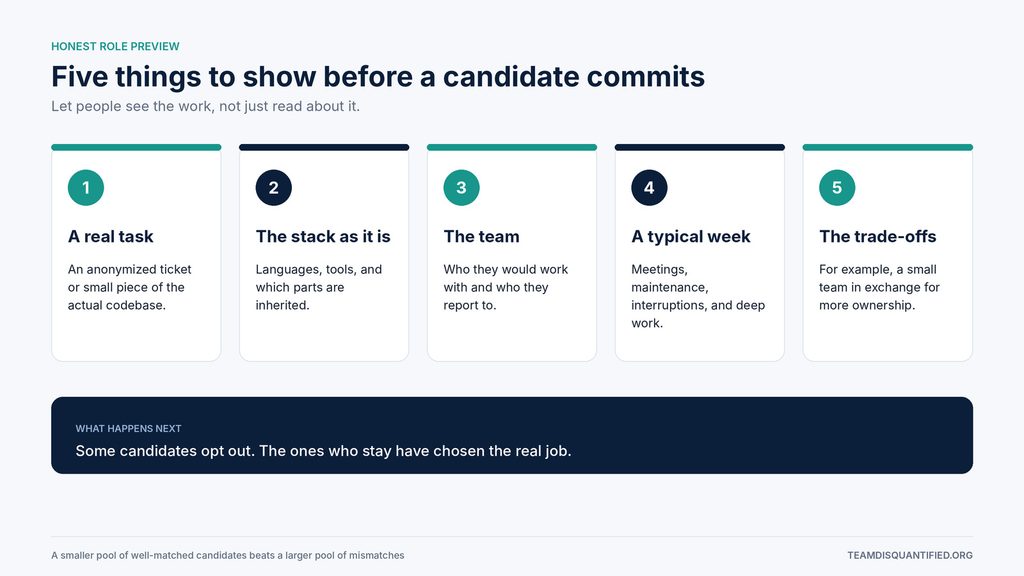
A good preview has five parts. Show a real task, such as an anonymized ticket or a small piece of the actual codebase. Walk through the stack as it truly is, including the awkward parts. Introduce the team the candidate would work with. Describe a typical week, including meetings, maintenance, and interruptions. And name the trade-offs plainly, such as a smaller team in exchange for more ownership.
One practical way to do this is to point candidates to a ANCHOR TEXT so they can see the work for themselves before they apply.
The effect on hiring is easy to predict. Some candidates will decide the role is not for them, and that is a good outcome. The ones who stay in the process have chosen the real job, which makes interviews more focused and offers far more likely to be accepted and to last.
Teams often worry that honesty will shrink the applicant pool. It will, but only by removing the people who would have left or disengaged. The remaining pool is smaller and much more likely to include people who want what the job actually offers.
How to Write a Job Description That Tells the Truth
A truthful description does not need to be negative. It needs to be specific. The goal is to give a capable engineer enough detail to judge fit, and to do it in a way that still sounds like a place worth joining.
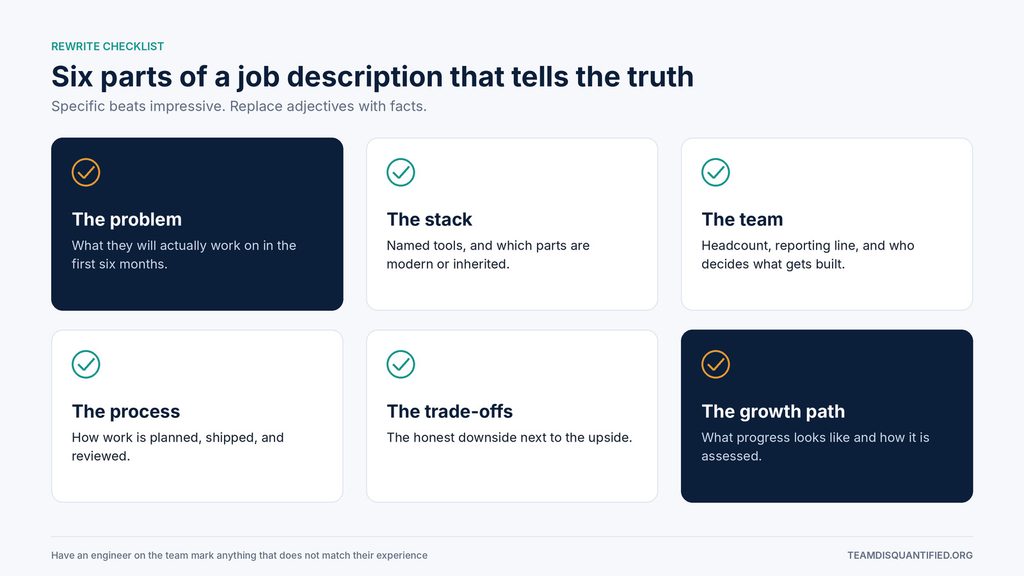
Start with the problem. Describe what the person will actually work on in the first six months, in concrete terms. “Rebuild the billing service so it can handle three times the current load” tells a candidate far more than “work on exciting challenges.”
Describe the stack as it is. Name the languages and tools, and say honestly which parts are modern and which are inherited. Engineers appreciate candor here, and many are drawn to the chance to improve a messy system.
Describe the team and the process. Say how many engineers there are, who the role reports to, how work is planned, and how code gets reviewed. If these practices are still being built, say that. Documenting how work gets done in the first place helps, and a guide to standard operating procedures is a good starting point for teams that have never written theirs down.
State the trade-offs. Every role has them. A small team means broad responsibility. A large system means slow, careful change. Being open about the downside makes the upside more believable.
Finally, describe the growth path. Explain what progress looks like, what the person can learn, and how performance will be assessed. Replace phrases like “fast-paced” with the facts behind them. “We ship every two weeks and handle roughly ten support escalations a month” is more useful than any adjective.
Aligning the Posting With the Interview and Onboarding
An honest posting only works if the rest of the process matches it. If the description promises one thing and the interview tests another, candidates will notice.

Run interviews on the real work. Use problems that resemble what the team actually faces, and let candidates ask about the codebase, the process, and the hard parts of the job. Their questions will tell you as much as their answers.
Make the offer conversation consistent with the posting. If the description mentioned on-call duties, the offer should explain how they work. Surprises at this stage damage trust before the person has even started.
Then check the first week against the promise. A new hire’s first days should look like the role they were told about. Ask them at thirty and ninety days whether the job matches the description, and treat any gap as a correction for the next posting, not as a problem with the person.
Red Flags in Your Own Postings
Review your current descriptions for warning signs. A long list of technologies with no context is one. Phrases such as “fast-paced,” “wear many hats,” and “rockstar” with nothing behind them are others. So is any description that nobody on the engineering team has read. If the people doing the work would not recognize the role in the posting, candidates will not recognize it after they join.
Hire for Fit by Showing the Real Job
Technical hiring fails less often because teams pick the wrong people than because they sell the wrong job. Candidates who know what the work involves can make a real decision, and the ones who say yes are far more likely to stay and do good work.
A practical first step is to take one live posting this week and rewrite it using the six parts above. Ask an engineer on the team to read it and mark anything that does not match their experience. If you are also thinking about who will lead the people you are hiring, this guide on how to build a management team covers the next question to settle.