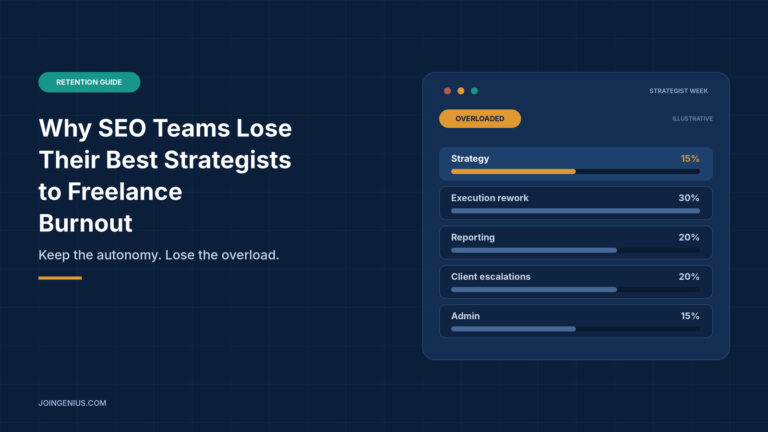
A senior SEO strategist hands in their notice. They are going freelance, with their own clients, their own hours and no more status meetings. Six months later they are working evenings, chasing invoices and handling sales, strategy, reporting and support on their own. Some come back. Many do not, and your team has lost one of its best people to a setup that was not much kinder to them.
That is the pattern behind why SEO teams lose strategists to freelance burnout, and it is worth understanding before it happens to you. Most of these people did not leave because they wanted more work. They left because they wanted more control. This guide covers why strategists leave for freelance work, why freelancing often wears them down, how to offer the upsides inside the team and how outside support can share the load. It ends with a table of warning signs and what to do about each. For the wider picture, these employee retention strategies include advice on distributing workload fairly.
Why Strategists Leave for Freelance Work
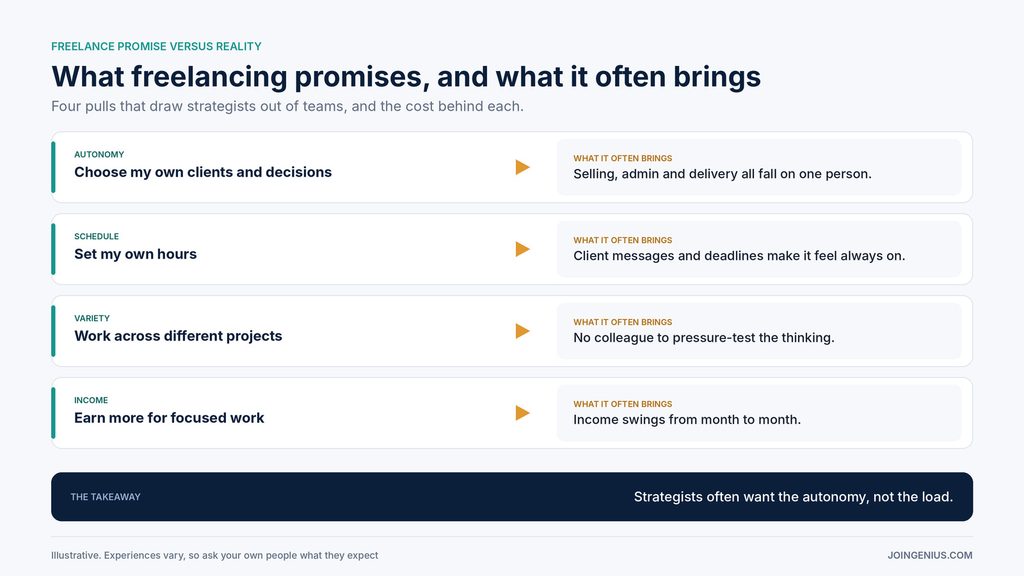
Four pulls tend to show up again and again.
Autonomy is the first. Strategists spend years making judgment calls, and many want to choose their own clients and priorities. Schedule is the second, because freelancing promises control over when and where the work happens. Variety is the third, since a freelancer can work across different industries and problems. Income is the fourth, because focused, billable work can look like it pays more than a salary does.
None of this is disloyalty. Each pull is a signal about something the job is missing, and each one has a fair response.
Why Freelancing Often Wears Them Down
When a strategist goes solo, they become the whole company. One person sells the work, does the strategy, builds the reports, sends the invoices and answers client messages. Income can swing from month to month, which makes it hard to turn work down. And nobody is there to check their thinking, so every call feels like theirs alone.
That is the useful point for a manager. What strategists usually want is the autonomy, not the load. A team that can offer one without the other has something a freelancer cannot easily give themselves: colleagues, steady pay and shared decisions.
What Your Team Is Actually Competing With
Teams rarely compete with freelancing itself. They compete with what their best strategists are putting up with right now. Common examples are strategists who redo execution work because a brief was unclear, reporting that eats their evenings, and being the only person who can make the call on a big client. Each pushes someone toward the exit, and each stays invisible until a resignation lands.
So ask before that happens. A stay interview is built for this. This guide to stay interview questions includes “Is there anything that would make you consider leaving?” Ask it of your strongest strategist this month, then listen without defending.
Pick a quiet moment, not a performance review, and keep it short. Four questions are enough: which part of your week gives you energy, which part drains it, what would you change about how decisions get made here, and what would make you consider leaving. Write down what you hear, choose one change you can make within a month, and tell them what it is. A stay interview only works if something visibly changes afterward. The sample answers in that guide mention work-life balance and uneven task distribution, which are the same pressures that push strategists out of teams.
Bring in Outside Strategy Support So Your Best Strategists Aren’t Carrying Every Decision Alone
When one person is the only decision-maker, every tradeoff lands on them. If internal bandwidth is thin, an experienced outside advisor can share that load. Firestarter SEO describes ongoing SEO advisory as a partner who stays involved, pressure-tests decisions and adjusts priorities as results come in. Its page lists recurring strategy sprints, reporting reviews, iterative keyword and content planning and technical guidance as what you get, and it names prioritization sessions and content brief refinement among typical activities.
The same page compares this with a one-time roadmap, which suits teams that prefer to execute internally. Its watch-out is that strategy can age and execution quality depends on your team. Ongoing advisory has a different watch-out: it requires a monthly commitment and cross-team collaboration. Firestarter says the right choice depends on internal capacity, how fast your market moves and how much risk you can tolerate from set-it-and-forget-it planning.
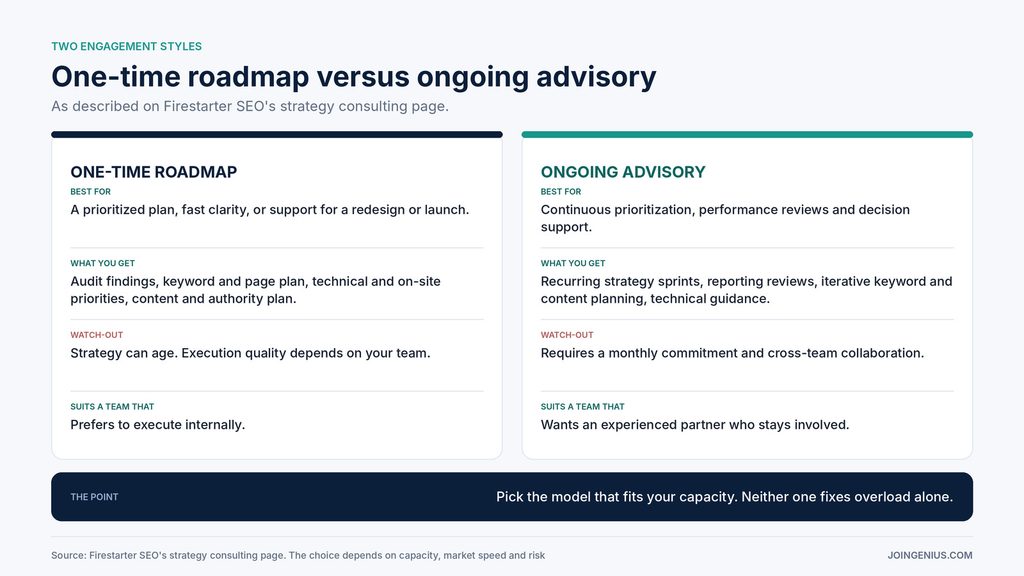
Be realistic about what this does. Outside advice will not fix a team that overloads its people, and it is one lever among several. It works best when it removes the pressure of being the only person who has to be right, alongside the changes below.
Give Strategists the Freelance Upsides Inside the Team
Take each thing that pulls a strategist toward freelancing and offer a version of it at work. The version has to be specific, because a vague promise of “more autonomy” sounds like the one they have heard before.
Offer ownership of a client area, with real authority to set its priorities. Offer core hours with flexible deadlines outside them. Offer rotation across industries or project types each quarter, so the variety is built in. Offer a written path to a lead role, with a pay review tied to it. Workload matters in all of this. This guide to low morale at work lists excessive workload and stress as a core cause of burnout, which is the same problem freelancers run into.
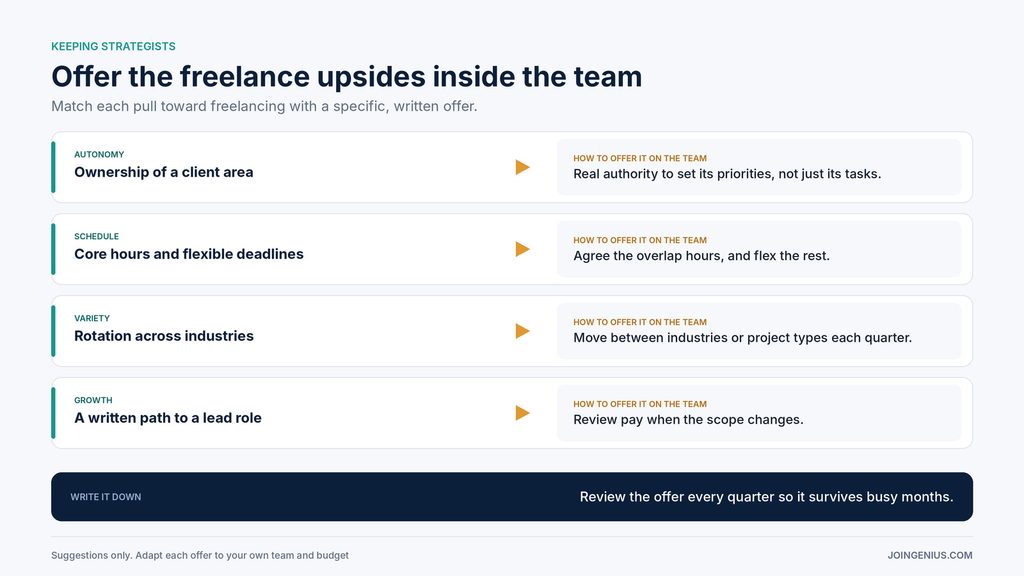
Put the offer in writing and review it every quarter. If it only exists in a conversation, it will not survive the next busy month. Review pay at the same time as scope, too. A strategist who takes ownership of a client area is doing a bigger job, and the pay conversation should happen when the scope changes, not at the exit interview.
Protect Strategy From Execution Overload
Strategists lose time when strategy and execution blur together. Write deliverables so developers, writers and stakeholders can use them without a translation step. Firestarter’s page uses that standard for its own deliverables, and it is a good one for any team.
Give each deliverable one owner and one date. Cap the number of open items per person, so that nobody carries a growing pile. Hold a regular prioritization session, monthly or biweekly, and agree on the top three items. Firestarter’s page puts the principle plainly: “A strategy that cannot be executed is not a strategy.” A strategist who watches their plans stall will start looking for somewhere they ship.
Reporting deserves the same treatment. If a strategist spends evenings assembling the same report every month, automate the data pull and keep their time for the commentary only they can write. Firestarter’s page treats rankings as indicators and leads as outcomes, which is a useful rule for deciding what belongs in a report. Show fewer numbers, and spend the saved time explaining what they mean and what to do next.
Warning Signs You Are About to Lose a Strategist, and What to Do About Each
Some patterns show up before a resignation. The table below pairs each warning sign with what it may mean and a practical next step.
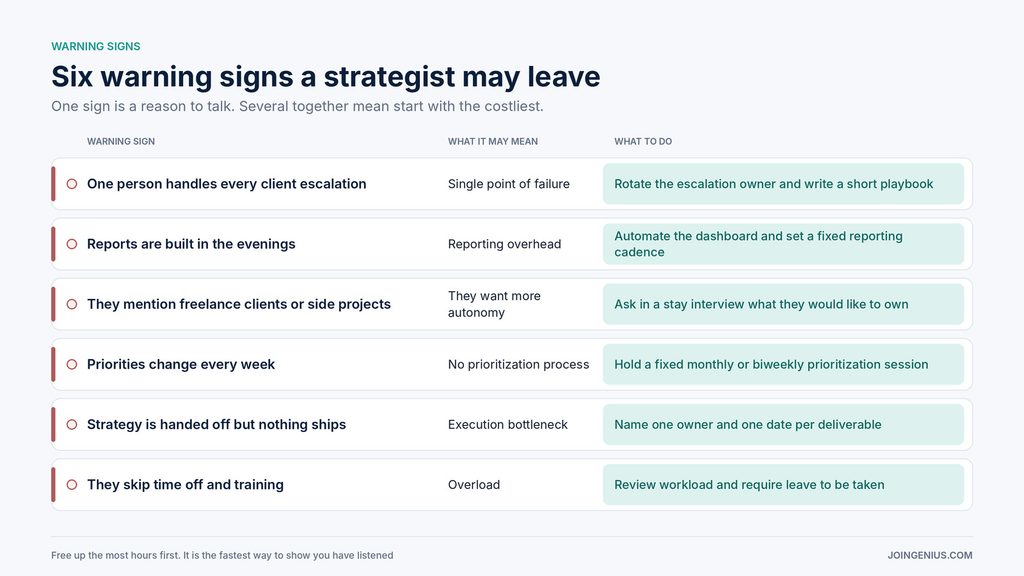
One sign is a reason to start a conversation. If you see several, begin with the row that costs the most hours, because freeing up time is the fastest way to show you have listened.
Take the Next Step
List the decisions that only one person on your team can make. Pick one and share it this month, whether with a peer, a rotating owner or an outside advisor. Then hold a stay interview with your strongest strategist this week.
Strategists who stay are rarely the ones who were never tempted. They are the ones who found, inside the team, most of what they were looking for outside it.