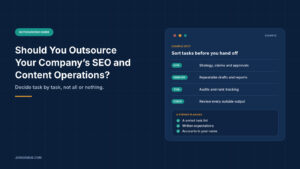
A marketing lead at a small company spends Monday fixing a broken page, Tuesday editing a blog draft, Wednesday replying to reviews on the company’s map listing, and Thursday building the monthly report.
On Friday, the owner asks whether an agency could take all of it. That is an illustration, not a case study, but it is the question many growing teams face: which of these jobs should leave the building, and which should stay.
This guide helps you decide whether to outsource your company’s SEO and content operations. It covers what those operations include, what Google’s own guidance says about hiring outside help, why local businesses and national ecommerce brands need different things, a four-step framework, quality control, and a table of warning signs.
We found no study comparing outsourced and in-house SEO or content results, so the advice rests on guidance from Google and on our reasoning, which we label as such. It does not recommend any agency. Our separate list of SEO outsourcing services covers providers, and this guide is about whether and what to hand off.
What “SEO and Content Operations” Actually Include
The phrase covers several kinds of work. Technical work includes site speed, redirects, error pages, and structured data. Content work includes planning topics, briefing writers, drafting, editing, and publishing. Local work includes managing a business profile, listings and reviews. Reporting covers rankings, traffic and leads. Underneath all of it sit approvals, because someone has to decide what the company will and will not say.
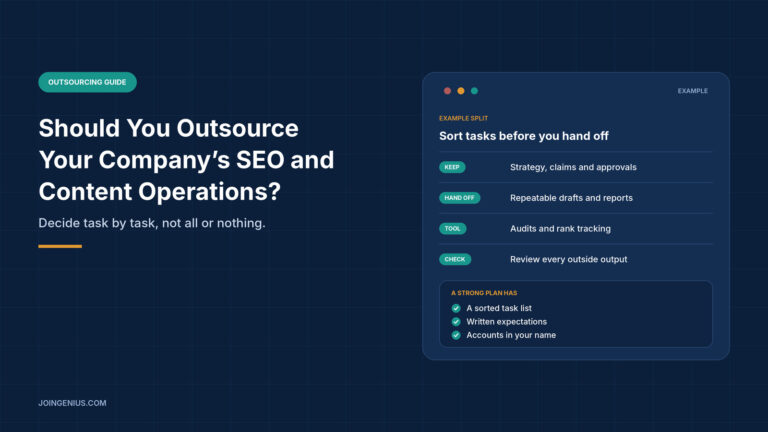
Some of these jobs are repeatable, such as producing a monthly report or drafting a first version of a page. Others depend on knowledge only you have, such as which claims are accurate, which services you want more of, and what your customers actually ask. That difference is the basis for the rest of this guide. It is our reasoning, not a finding, but it explains why the answer is rarely all or nothing.
What the Evidence Says About Hiring Outside Help
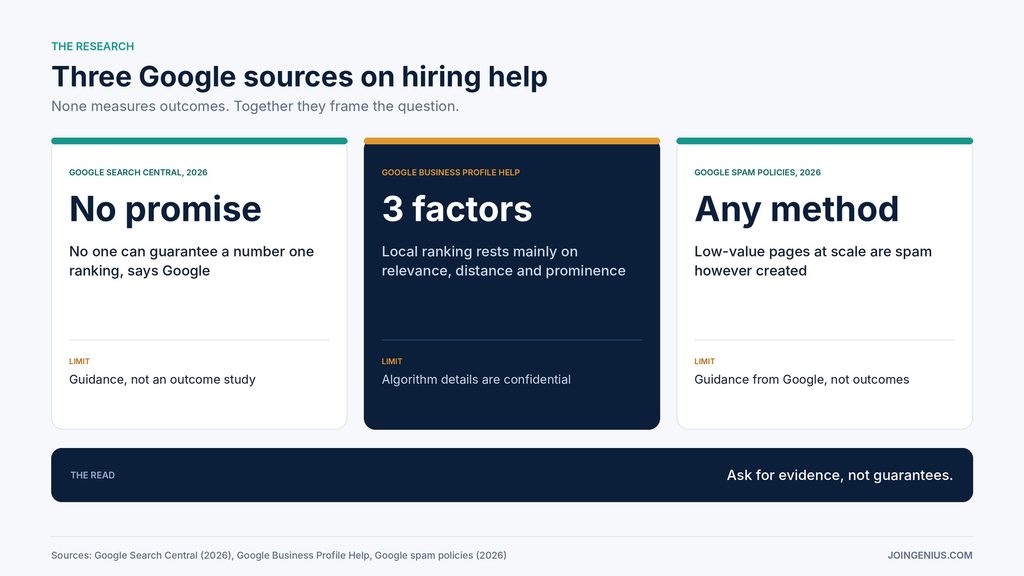
We found three sources that bear on the question. All three are guidance from Google, and none measures outcomes, so they tell you what to ask and what to avoid, but not whether outsourcing pays.
Google’s Search Central page “Do you need an SEO?” was last updated in June 2026. It says hiring help can be worthwhile, but that a small local business can probably do much of the work itself. It suggests asking for examples of past work, asking whether the provider follows Google’s Search Essentials, and asking what results to expect, over what timeframe, and how success is measured.
It also suggests asking about experience in your industry or city, checking references, and asking how changes will be documented. For an audit, it advises granting read-only Search Console access. Its red flags include guarantees of a number one ranking, claims of a special relationship with Google and secretive practices, and it says you are responsible for the actions of any company you hire.
Google’s spam policies, updated in August 2026, define scaled content abuse as generating many pages mainly to manipulate rankings, such as mass-producing unoriginal content that gives users little value. They say it matters not how the content is created, so AI-written, human-written, and mixed content are judged by the same standard.
Google’s guidance on generative AI content, updated in October 2026, adds that AI-assisted content should be manually fact-checked and reviewed before it is published. Both matter to anyone paying a vendor to produce content at volume.
These sources come from the search engine itself and describe what it says it wants. They are not independent outcome studies, and Google keeps its ranking details confidential. We use them for the questions they suggest, not as proof that any model works better than another.
Local Businesses Have Different SEO Priorities Than a National Ecommerce Brand
Local businesses often compete in the map results Google shows for nearby searches, and tools that offer local SEO automation can audit a Google Business Profile, track local pack rankings, and suggest local keywords. That describes the vendor’s own page, and we have not tested the tool. Google also says there is no way to request or pay for a better local ranking, so treat any such tool as an aid for the work, not a way to buy a position.
Google’s help page says local results are mainly based on relevance, distance, and prominence. Relevance is how well a profile matches the search, distance is how far the business is from the searcher, and prominence reflects how well known the business is, including links and reviews. It suggests verifying the business, keeping details such as address, hours, and category accurate, and replying to reviews.
Those tasks depend on facts only the business knows and on being present in the place. Our reasoning is that a local company is likely to keep the profile and reviews in-house and may outsource the writing or the reporting.
A national ecommerce brand has a different mix. Distance matters less, and the work leans toward site structure, category and product pages, technical health, and content at a larger scale. Google’s page on hiring an SEO lists technical advice such as hosting, redirects, and JavaScript among the things an outside provider can do.
Our reasoning is that these tasks are more repeatable and easier to hand to a specialist, though a larger catalog also raises the risk of thin or duplicated pages. The point is that the same service model does not fit both, so decide task by task.
A Four-Step Framework for Deciding
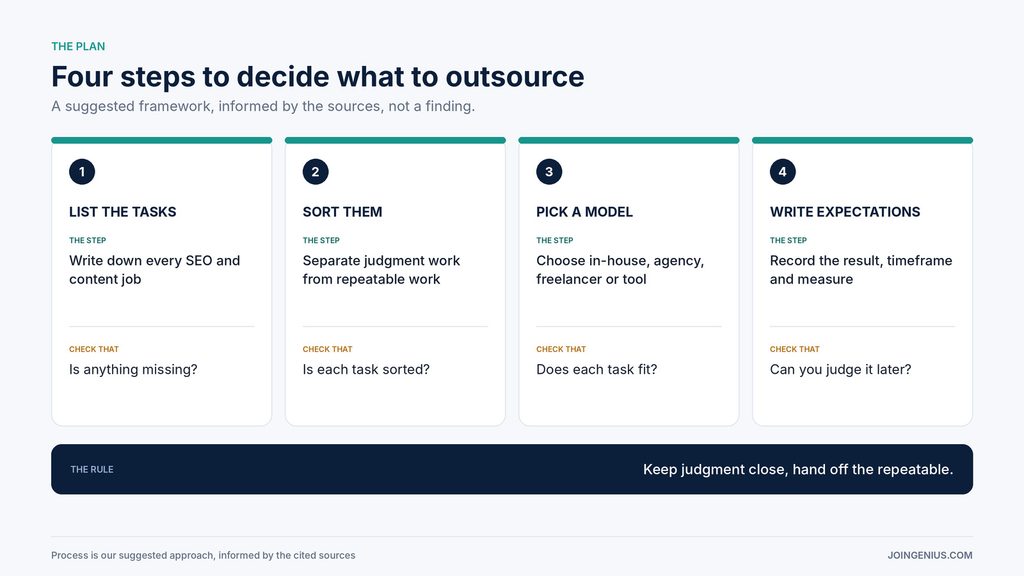
Use this four-step framework before you sign with anyone. It is our suggested process, informed by the sources above.
- List the tasks. Write down every SEO and content job your team does, including the small ones.
- Sort them. Mark each as needing your knowledge or as repeatable work that follows a clear brief.
- Pick a model for each. In-house, agency, freelancer, or tool. Keep judgment-heavy tasks close and consider handing off the repeatable ones.
- Write expectations. For each outsourced task, record what result you expect, over what timeframe, and how it will be measured, following the questions Google suggests asking.
The fourth step is the one teams skip. Without a written expectation, you cannot tell later whether the arrangement worked. A tool can also sit alongside either choice: some teams use software for audits and tracking, keep strategy in-house, and hire a vendor only for drafting. That is our reasoning, not a tested model. Our guide to outsourcing content creation and our guide to outsourced CMOs show two other ways to split marketing work.
Keep Quality Control If You Outsource
Outsourcing the work does not outsource the responsibility. Review and fact-check everything that goes live, including titles and descriptions. Keep your accounts in your own name, and give vendors read-only access where that is enough, as Google suggests for audits.
Ask for a log of changes with the reason for each. Agree in advance who signs off on claims about prices, services, and results, since a vendor cannot know which of those are accurate. Publish fewer, reviewed pages in place of many fast ones, since Google’s spam policy treats mass-produced low-value pages as a problem. If a vendor uses AI to draft, ask how drafts are reviewed.
These are our suggestions, built on Google’s guidance. Our guides to AI search engines and to hiring an SEO content writer are places to start if you want to bring part of the work in-house.
Measure Whether It Works
Track the hours your team saved, the share of drafts accepted without heavy rewrites, and the number of calls, form submissions, or sales that come from search. For a local business, also watch calls and direction requests from the business profile.
Compare these with the expectations you wrote down. Search results can take months to move, and Google’s page does not give a timeframe, so judge over a long enough period and do not read a single month as a verdict. These measures are our suggestions, not findings.
Warning Signs Outsourcing Your SEO and Content Is Not Working, and What to Do About Each
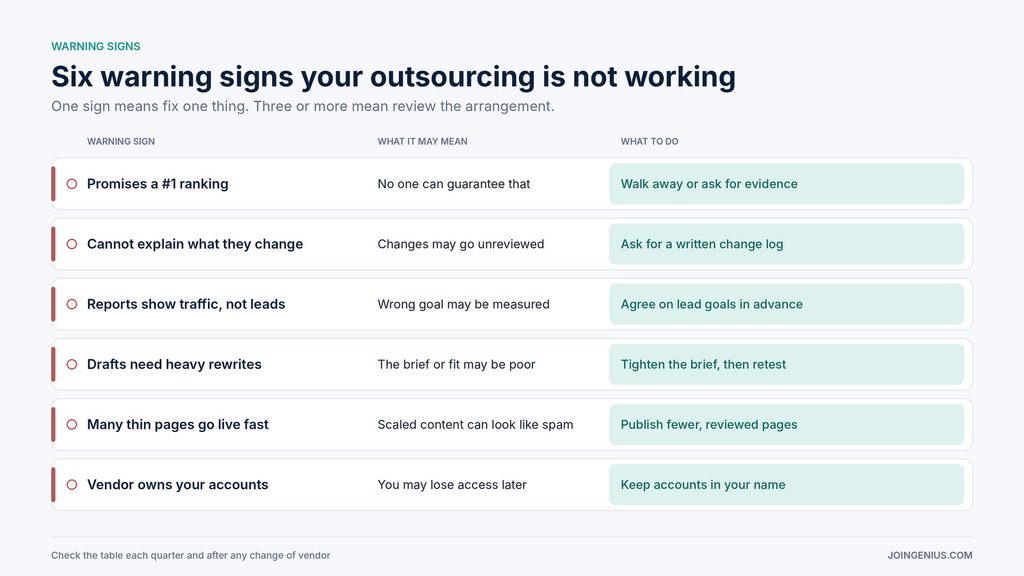
Check this table each quarter. One sign means fix one thing. Three or more mean review the arrangement.
| Warning sign | What it may mean | What to do |
|---|---|---|
| Promises a #1 ranking | No one can guarantee that | Walk away or ask for evidence |
| Cannot explain what they change | Changes may go unreviewed | Ask for a written change log |
| Reports show traffic, not leads | Wrong goal may be measured | Agree on lead goals in advance |
| Drafts need heavy rewrites | The brief or fit may be poor | Tighten the brief, then retest |
| Many thin pages go live fast | Scaled content can look like spam | Publish fewer, reviewed pages |
| Vendor owns your accounts | You may lose access later | Keep accounts in your name |
Outsource the Repeatable Work, Keep the Judgment
Whether to outsource SEO and content operations depends on the task, the company, and the market it serves. A local business may keep its profile and reviews close and hand off drafting, while a national ecommerce brand may hand off technical and catalog work.
We found no study showing that outsourcing beats in-house work or the reverse, and the sources behind our advice are guidance from Google and not outcome research. But each step replaces a guess with something you can check. If you can say what each outsourced task is meant to achieve and how you will know, you are in a better position to decide than a pitch deck could put you.