A manager starts Monday with a clear plan. By mid-afternoon she has reread the same paragraph three times, and the last two hours of work produce less than the first. She blames willpower and pours another coffee. This is an illustration, not a case study, but most people who work long days will recognize it.
This guide explains why focus fades during long workdays and which fixes have research behind them. It covers what focus depends on, what studies show about sleep, breaks and mushroom supplements, a way to test one change at a time, a four-step plan and a table of warning signs. It is written for professionals and for managers who want to understand the problem. For the wider picture of how work affects staff, see our guide to employee health.
What Focus Depends On
Focus depends on more than willpower. It varies with how rested you are, how long you have worked without a pause and what the current task demands. That gives you three levers to examine: sleep, recovery during the day and what you put in your body, such as food, caffeine or supplements.
The order matters. A change to the third lever is hardest to judge when the first two are unsettled, because several things are moving at once and none can be credited with the result. So this guide starts with sleep, moves to breaks and only then looks at an extra such as a supplement.
What Research Says About Sleep
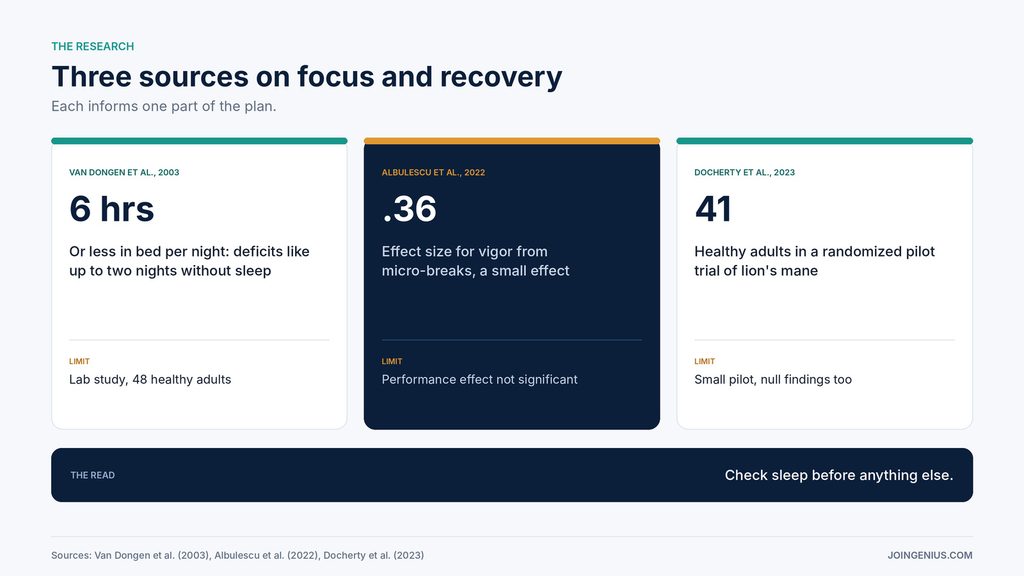
Hans Van Dongen and colleagues tested what happens to thinking when sleep is cut short for days. In a 2003 paper in Sleep, they assigned 48 healthy adults aged 21 to 38 to 4, 6 or 8 hours in bed per night for 14 days in a laboratory. Limiting time in bed to 4 or 6 hours produced significant cumulative, dose-dependent deficits in cognitive performance on all tasks. The authors concluded that chronic restriction to 6 hours or less per night produced deficits comparable to up to two nights of total sleep deprivation.
The finding with the most practical weight is about awareness. Participants were largely unaware of their growing deficits. Their sleepiness ratings rose sharply at first and then barely changed over the following days, while performance kept falling. Someone who feels fine after a week of short nights may still be working below their level. The study was a laboratory experiment with healthy adults on a fixed schedule, so it shows what repeated short sleep can do and not how any one reader’s week will go.
If your focus fades in the afternoon, check your sleep before you try anything else. Record your hours in bed for a week, set a fixed wake time and watch what happens to your afternoons.
What Research Says About Breaks
Patricia Albulescu and colleagues pooled 22 independent samples, with 2,335 participants in total, in a 2022 meta-analysis of micro-breaks in PLOS ONE. Micro-breaks gave a small but significant boost in vigor (d = .36) and a small but significant reduction in fatigue (d = .35). The effect on overall performance was not significant (d = .16). Performance gains appeared only for tasks with lower cognitive demands, and longer breaks produced a bigger boost than shorter ones. The authors suggest that recovering from highly depleting tasks may need breaks longer than 10 minutes.
Treat a break as a tool for energy and not as a guaranteed boost to output. Step away from the screen between demanding tasks, make the break longer after the hardest work and notice whether you feel more alert when you return. The effects are small averages across many studies, so your own notes will tell you more than the average does.
What Research Says About Mushroom Supplements
Lion’s mane, Hericium erinaceus, is a mushroom sold as a supplement, and it is the variety tested in the trial below. Docherty and colleagues ran a randomized, double-blind, placebo-controlled pilot trial, published in Nutrients in 2023, with 41 healthy adults aged 18 to 45. Participants took a single 1.8 g dose and then continued for 28 days. At 60 minutes after the single dose, participants performed quicker on the Stroop task (p = 0.005), a standard test of attention. After 28 days, subjective stress showed a trend toward reduction (p = 0.051) that did not reach statistical significance. The abstract also reports null and limited negative findings without naming the outcomes. The authors describe the study as a pilot with a small sample.
The takeaway is specific. One small trial found quicker performance on one attention task an hour after a dose and a stress trend after four weeks. That gives you something concrete to test on yourself and to measure.
Test One Change at a Time, Including a Mushroom Supplement
The simplest way to learn what helps your focus is to run your own experiment. Pick one change, keep everything else steady and give it four weeks, the length of the longer arm in the lion’s mane trial. Before you start, rate your focus each afternoon on a scale of one to five, and write down the hours you slept and the breaks you took. A week of notes gives you the baseline you will compare against.
Choose the change from the levers above. If your notes show short sleep, fix that first. If you work for hours without stopping, add a break after each demanding task. If sleep and breaks are settled and you want to test something extra, a supplement is one option. Nootropics Depot’s mushroom supplements include lion’s mane, reishi and cordyceps varieties. Lion’s mane is the variety used in the trial above, so it is a natural place to start if you decide to test one.
Whichever change you test, start it on a Monday, record the same rating every afternoon and add nothing else until the four weeks are over. If your rating does not move, you have learned something and can try a different change. If it rises, you have a clearer case that the change was the cause than a good week would give you. If the problem feels larger than focus, our guide to freelance burnout covers the wider picture.
A Four-Step Plan to Protect Your Focus
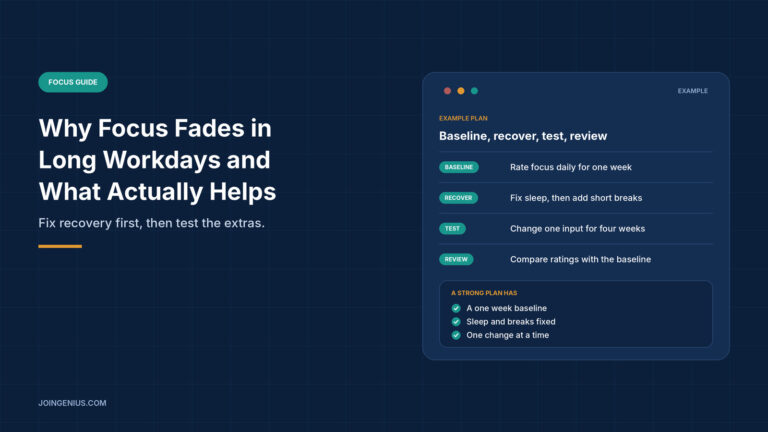
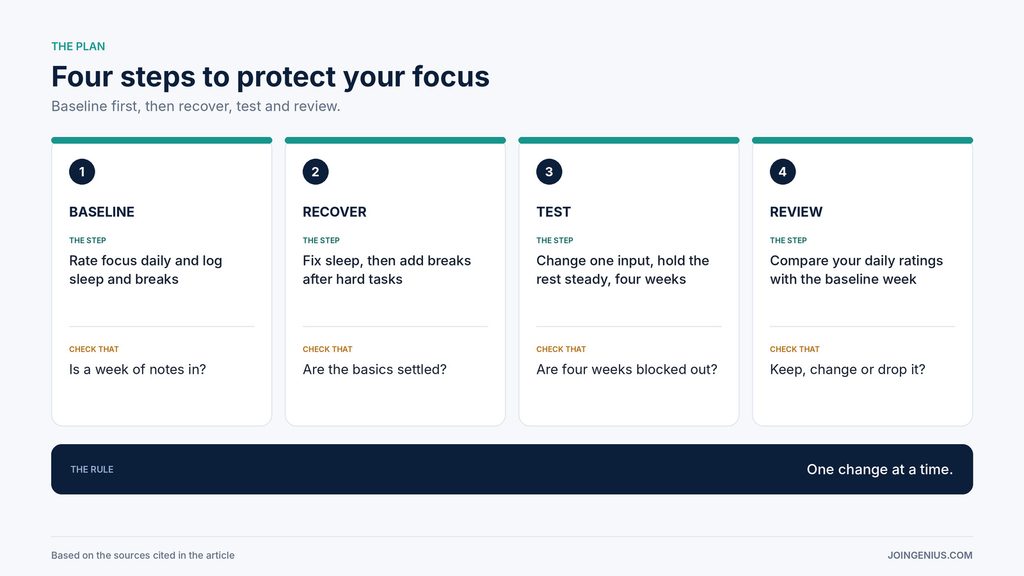
Use this four-step plan for each change you test.
- Baseline. Rate your focus each afternoon for a week, and log hours slept and breaks taken.
- Recover. Fix sleep first, then add a break after each demanding task.
- Test. Change one input for four weeks, such as a supplement, and keep everything else steady.
- Review. Compare your ratings with the baseline, and keep, change or drop the change.
The order protects the result. If you start a supplement in the same week you cut your sleep, the ratings cannot tell you which one moved your focus. If you change one input and nothing else, they can. Managers can apply the same plan to a team by respecting rest and by asking people which of the three levers is the weakest.
Measure Whether It Works
Track your daily focus rating, the hours you slept and the number of breaks you took. At the end of four weeks, compare the average rating with your baseline week and look at the days that stand out. One person’s ratings are noisy, so a small change is a prompt for another four weeks and not a conclusion. For more on planning your day, see our guide to smart scheduling.
Warning Signs Your Focus Is Slipping, and What to Do About Each
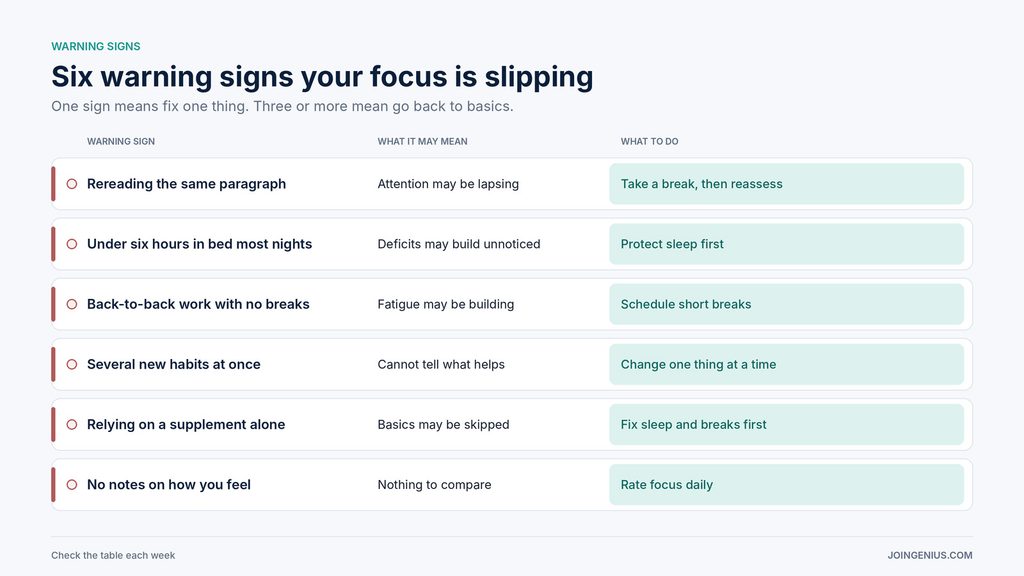
Check this table each week. One sign means fix one thing. Three or more mean go back to sleep and breaks before you try anything else.
Protect Recovery First, Then Test the Extras
Focus fades for reasons you can examine: too little sleep, too few breaks and changes made without a way to judge them. Research shows that short sleep builds deficits people do not notice, that breaks give small gains in vigor and less fatigue, and that lion’s mane produced quicker performance on one attention task in a small pilot trial. Rate your focus for a week, fix sleep and breaks, then change one thing for four weeks and compare. Each step replaces a guess about what helps with a number you recorded. If your afternoon ratings rise, you have found something worth keeping. For managers who want to support this across a team, see our guide to the employee benefits package.