An operations lead puts a routine appointment in her calendar for the afternoon. She blocks the whole afternoon, because the clinic is across town and she has no idea how long the wait will be. Two meetings move, a colleague covers her queue, and a short conversation with a clinician ends up costing the team most of a working day. This is an illustration, not a case study, but anyone who has managed a team will recognize it.
This guide explains where the hours go when employees see a doctor and what an employer can do about it. It covers what research shows about the time a visit takes, what Canadian and employer data show about access and virtual care, policies that give time back, a section on online services for specific needs, a four-step plan and a table of warning signs. For the wider benefits picture, see our guide to the employee benefits package.
Where the Hours Go
An appointment has three parts: getting there, waiting and the visit itself. Most managers see only the last one, because it is the part the employee describes. The first two are easy to overlook and, as the research below shows, they account for most of the time.
Time disappears before and after the conversation, and the schedule around it has to flex. That is why a policy that only says how many hours of leave are allowed misses most of the cost. The question to ask is how long an appointment actually takes your people from the moment they leave their desk to the moment they return.
What Research Says About the Cost of a Visit
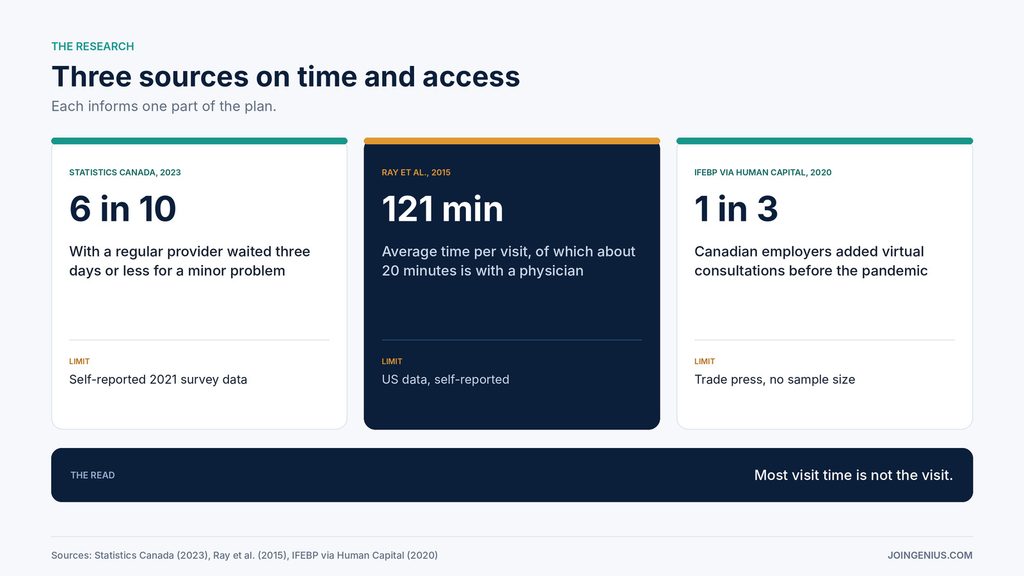
Kristin Ray and colleagues analyzed the American Time Use Survey for 2003 to 2010 in a 2015 paper in the American Journal of Managed Care. Adults who sought ambulatory medical care spent an average of 121 minutes per visit, which included 37 minutes of travel and 84 minutes in the clinic. The clinic figure combines obtaining and waiting for care. Face-to-face physician time, measured in a separate national survey of physician visits, was about 20 minutes. The authors conclude that more than 80% of visit time falls outside face-to-face physician care.
The same analysis puts the opportunity cost of an average visit at $43, which exceeds the average patient’s out-of-pocket payment, and estimates about 1.1 billion hours for employed adults in 2010. The data are American, the time figures are self-reported and the authors note that direct observation studies suggest the physician time may be overestimated by 30% to 40%. Even so, the pattern is clear: the conversation with the clinician is a small share of the hours.
What Research Says About Access and Virtual Care
Statistics Canada’s Health of Canadians report uses the 2021 Canadian Community Health Survey to look at access to primary care. Among people with a regular health care provider, 60.4% of males and 56.5% of females waited three days or less to see them for a minor health problem. In the 2021 Canadian Income Survey, 8.9% of females and 6.9% of males aged 16 and older reported unmet health care needs. These are self-reported answers, so they show how people experience access and not how long any one clinic takes. For more on how work and health connect, see our guide to employee health.
Human Capital magazine reported in 2020 on a survey by the International Foundation of Employee Benefit Plans. One in three Canadian employers added virtual health consultations to their benefits before the pandemic, and another 19% have since added online platforms to support employees seeking medical advice. The article does not state the survey’s sample size. It also cites Dr. Ahmad Firas Khalid of Evidence Aid, who describes telehealth as useful for urgent issues that need quick triage and notes that it cannot replace in-person care for conditions that require a physical examination. According to the article, telehealth can reduce the time employees lose travelling to clinics and taking time off for quick medical advice.
What Employers Can Change
Most of the hours can be recovered with policy and scheduling and no new benefit at all. Allow appointment time without asking people to make it up later, and say so in writing. Let employees book the first or last slot of the day without explaining why. Move recurring meetings that sit on top of common clinic hours, and hold your team’s calendar to the same standard you hold your own.
Then name one person who can answer questions about leave, coverage and what the benefits plan pays for. Employees who do not know the rules may take a full day when an hour would do. Our guides to types of leave and smart scheduling cover the policy and calendar sides in more detail.
Add Online Services for Specific Needs
Some care can start online. Your insurer may offer a virtual primary care line, and online services exist for counselling, prescription renewals and other specific needs. These suit needs where the first steps are a form, a lab test and a follow-up call, since each of those can happen outside working hours or near home. Build a one-page list of the options your employees can use, explain what each one is and say plainly which parts your plan covers.
Keep use voluntary and private. List options and leave decisions about care to employees and their clinicians. Do not ask which service anyone used, and do not tie any option to performance or promotion.
UpGuys’ hormone service is an online option for men in Canada. Patients complete a questionnaire, a licensed practitioner may authorize bloodwork and, if treatment is appropriate, a pharmacist ships the medication. Follow-up bloodwork and practitioner calls happen every three to six months.
Include a line on cost and coverage for each entry. In the UpGuys example, lab work happens at a nearby lab, and coverage for those tests depends on whether the employee’s province treats them as insured or uninsured. Review the list every year, remove anything out of date and tell employees where to find it.
A Four-Step Plan to Give Hours Back
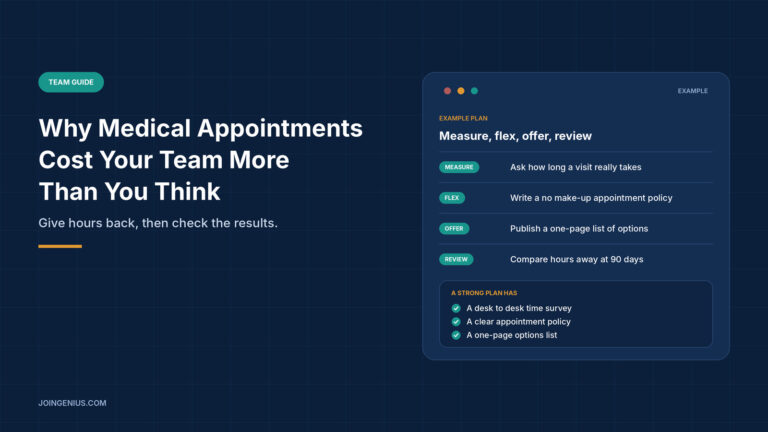
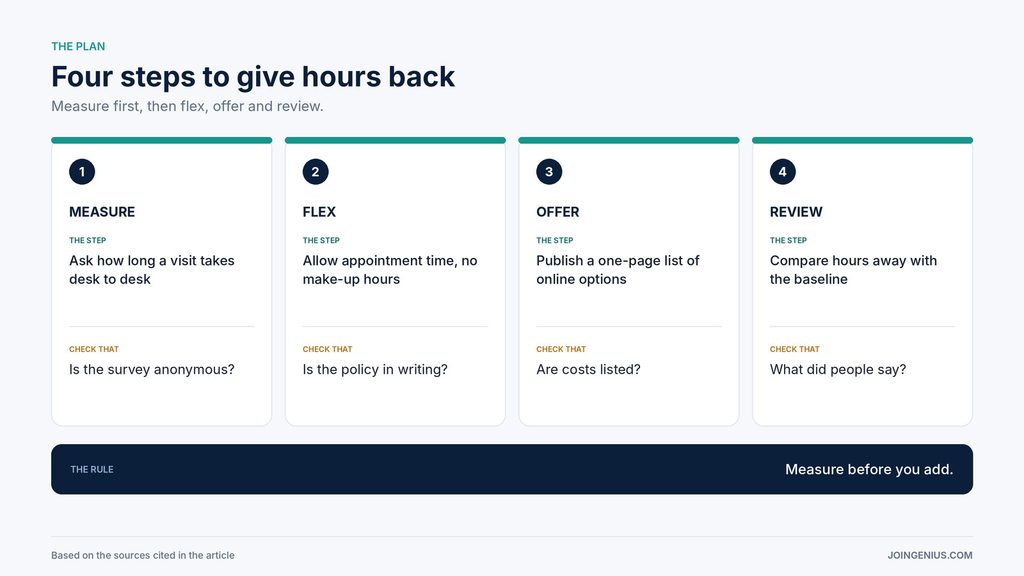
Use this four-step plan for your team.
- Measure. Ask a sample of employees how long a typical appointment takes from desk to desk.
- Flex. Write an appointment policy with no make-up requirement and name a contact for questions.
- Offer. Publish a one-page list of virtual and online options with cost and coverage for each.
- Review. At 90 days, compare hours away, uptake and survey answers with the baseline.
The survey is the step teams skip. Ask three questions: how long did your last appointment take, what made it longer than it needed to be and what would have shortened it. Keep answers anonymous and report back what you heard. Our employee satisfaction survey template shows one way to set one up.
The order matters. Measuring first stops you from adding a benefit nobody needed while the real obstacle, such as a policy that demands make-up hours, stays in place.
Measure Whether It Works
Track the average hours away per appointment, the number of full days taken for short visits, uptake of the options you list and retention, and compare each with the baseline you recorded before the changes. With a small team the numbers are small, so look at trends over a year and ask a few people what they would change. Keep results at team level so no individual’s use of care is visible. Ask the same three survey questions each year so the answers can be compared.
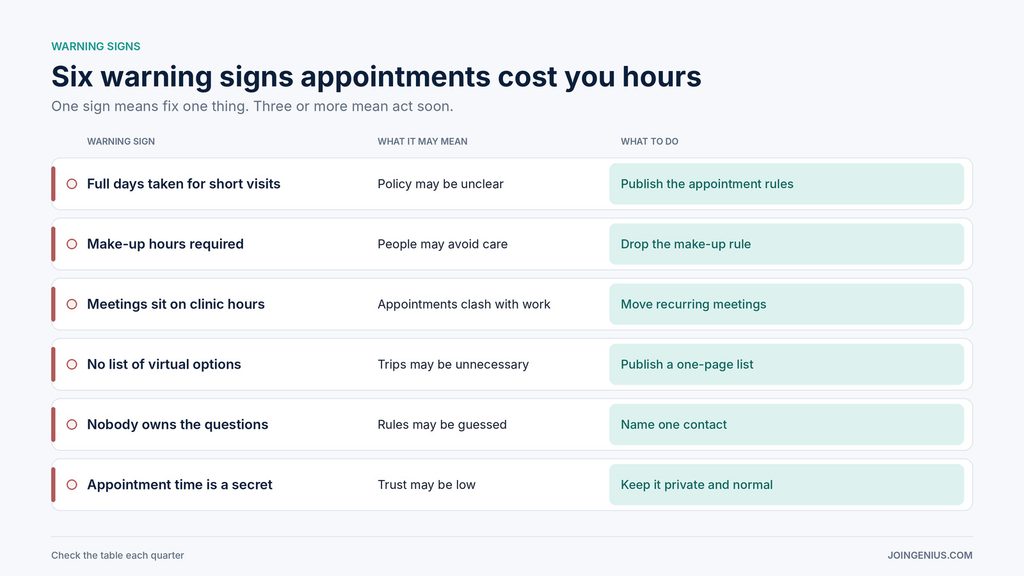
Warning Signs Appointments Are Costing Your Team Hours, and What to Do About Each
Check this table each quarter. One sign means fix one thing. Three or more mean act soon.
Give Time Back, Then Check the Results
Appointments cost more than the visit, and most of the hours sit in travel and waiting. Research on ambulatory care puts total time per visit at 121 minutes against about 20 minutes with a clinician, Canadian survey data shows that access varies, and an employer survey shows virtual care becoming part of benefits. Measure how long appointments take on your team, write a policy that gives the time without conditions, publish a short list of online options and check the result at 90 days. Each step replaces a guess about where the hours go with something you can see. If your team can book care without a scheduling fight, you have given hours back to everyone. For the wider picture, see our guide to employee retention rate.