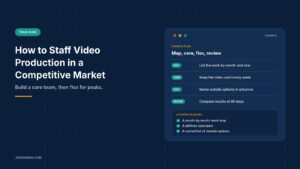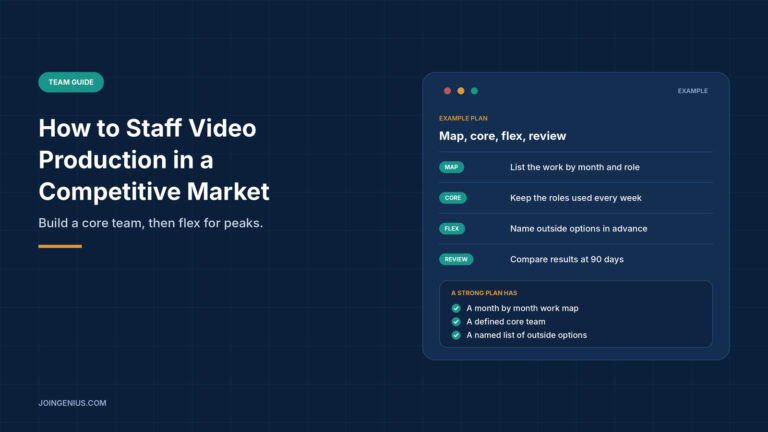
A studio lead has three shoots booked for the same fortnight. Her best editor has just taken another offer, the colorist is already stretched and two clients want rough cuts by Friday. She can hire a full-time replacement, call a freelancer she has used once or hand a project to an outside team, and each choice has a cost she cannot see until a cut is late. This is an illustration, not a case study, but anyone who runs video work will recognize it.
This guide explains how to staff video production when many employers compete for the same people. It covers why the work is hard to staff, what research shows, how to split work between a core team and flexible capacity, a section on outside capacity for busy weeks, a four-step plan and a table of warning signs. If you are filling a single editing role, see our guide to hiring freelance video editors.
Why Video Production Is Hard to Staff
Video work arrives in bursts. A product launch, an event season or a client campaign can fill the calendar for a month and leave a gap after it. A single project also needs several skills: planning, camera work, editing, motion graphics, color and sound. Few people are strong at all of them, so one person often becomes the one every project depends on.
In a market where many employers look for the same people, a gap in one role can stall a whole project. The question is which work to keep close, which to flex and how quickly you can add capacity when the calendar fills.
What Research Says About Project-Based Creative Work
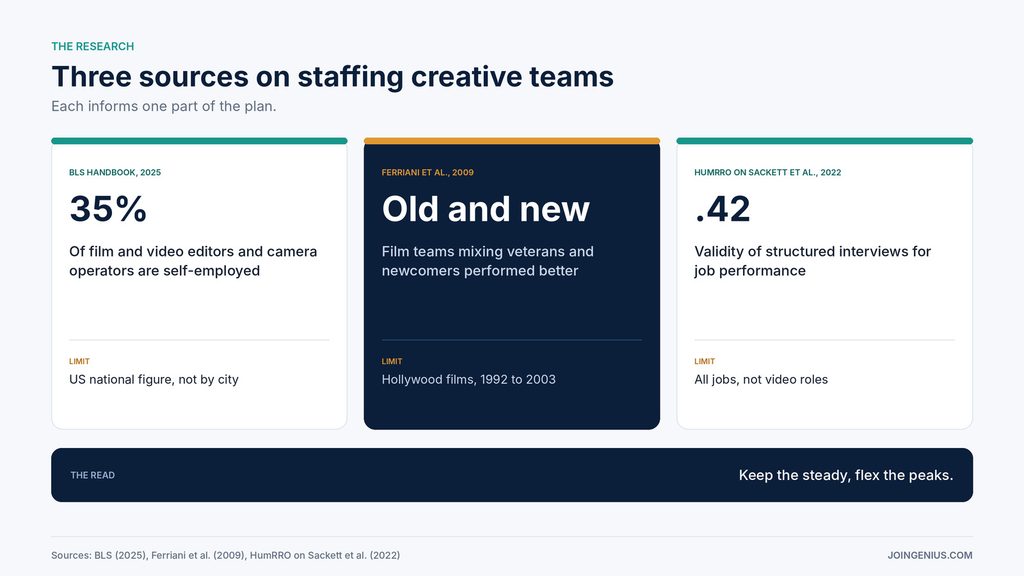
The US Bureau of Labor Statistics Occupational Outlook Handbook covers film and video editors and camera operators together. It reports 72,000 jobs in 2025 and projected growth of 3% from 2025 to 2035. Of camera operators and of film and video editors, 35% are self-employed. The handbook adds that motion picture workers often have busy schedules during filming, then a period of job searching after a film is complete. These are national figures and do not describe any one city. The practical reading is that a full-time offer competes with working for yourself, and that skilled people are often between projects.
A Finnish Institute of Occupational Health project on film and TV production professionals describes long working days, unusual hours and fixed-term, short employment as typical, and operators who report that many professionals switch to other work because they find the job stressful. The project page reports no results yet, so it describes conditions and does not give a measured turnover rate.
A 2020 WorkInCulture report for Ontario Creates, written by Lisa Fiorilli, interviewed owners and senior managers at 10 Ontario companies in book publishing and interactive digital media. Compensation, career growth and cultural fit came up as reasons people leave. The sample is small, it reflects the employer view and it does not cover video. For a studio, pay, growth and fit are the first three things to check when someone leaves.
What Research Says About Team Mix and Assessment
Simone Ferriani, Gino Cattani and Charles Baden-Fuller studied the Hollywood film industry from 1992 to 2003 in a 2009 paper in Research Policy. They found diminishing returns to the network centrality of project-entrepreneurs, and performance benefits from teams that combine old-timers and newcomers. The study covers one industry, film. The practical reading is to keep some continuity on each project and add one new person.
Paul Sackett, Charlene Zhang, Christopher Berry and Filip Lievens revisited the validity of hiring methods in a 2022 Journal of Applied Psychology paper. A HumRRO summary reports validity of .42 for structured interviews, .40 for job knowledge tests and .33 for work sample tests. The authors report that earlier estimates were inflated by range restriction corrections, and that validity varies across settings. The figures describe general job performance across many roles, not video production specifically.
They support asking every candidate the same structured questions and giving every candidate a comparable piece of real work. For an editor, that can be a short sequence cut from supplied footage to a written brief. A showreel shows finished work, and a supplied-footage test shows how someone decides with the same material as everyone else. Our guide to talent assessment covers more ways to judge candidates.
Build a Core Team and a Flex Bench
Start by listing the last twelve months of work by month and role, and mark each role as steady or peak. Roles used on nearly every project, such as a producer and a lead editor, belong in the core team. Roles used in bursts, such as motion graphics, color, sound and extra shooters, can flex.
For the core team, check the three things the Ontario report lists. Review pay against what similar studios offer and say when the next review is. Write a career path for each core role. Ask each person what they would keep and what they would hand off, and act on one answer within a month. Our guide to the talent management framework is a starting point for the core team.
For the flex bench, build a named list before you need it. Aim for two people for each specialist role, and give each of them one small paid project so you know how they work. On each project, pair an experienced person with a newer one, in line with the team-mix finding above.
Add Outside Capacity for Peak Weeks
Some weeks the core team and the bench are still not enough. A launch or a trade show can need extra shooters, a second edit team or a full production run at once. Outside capacity comes in several forms: freelancers you manage directly, a staffing agency that supplies crew and a production company or creative agency that delivers finished video.
DD.NYC’s video production services cover corporate, event and promotional video and post-production, including editing, color grading, motion graphics and sound design. The agency is based in Manhattan and produces video across the U.S.
Whichever form you use, send each provider the same short brief: the audience, the length, the formats, the delivery date and the number of revision rounds. Agree in writing who keeps the raw footage and project files, how files are handed over and how feedback is collected. Compare providers on the same brief, since quotes built on different scopes cannot be compared.
Decide in advance what triggers outside help, for example two projects overlapping or the edit queue passing a set length, so the call is made before a deadline is at risk. For a wider look at working with outside teams, see our guide to global outsourcing.
A Four-Step Plan to Staff Video Production
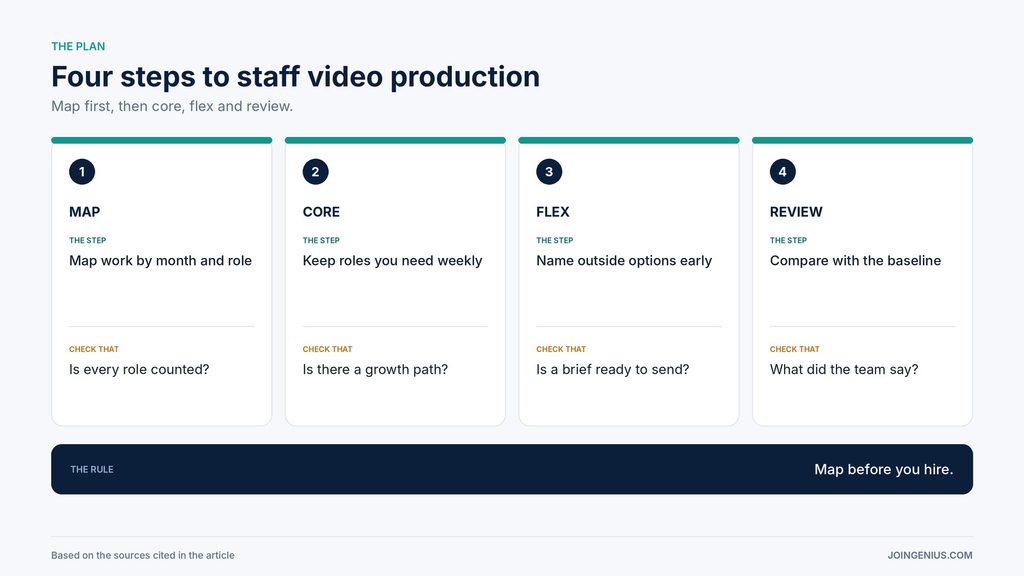
Use this four-step plan for your team.
- Map. List the last twelve months of work by month and role, and mark each role as steady or peak.
- Core. Keep the steady roles in the team and write a career path for each one.
- Flex. Name outside options for each peak role and send each one a trial brief.
- Review. At 90 days, compare turnaround, overtime and exits with the baseline.
The map is the step teams skip. Count the overlapping projects each month, the overtime hours and the one person every project waited for.
The order matters. Mapping first stops you from hiring full time for a one-month peak while the steady gap stays open.
Measure Whether It Works
Track the time from footage to first cut, overtime hours per project, voluntary exits, the share of projects delivered on the agreed date and the share of peak weeks covered by a named outside option. Compare each figure with the baseline you recorded before the changes. With a small team the numbers are small, so look at trends over a year and ask each person the same three questions every quarter: what slowed you down, what would you hand off and what would make you stay.
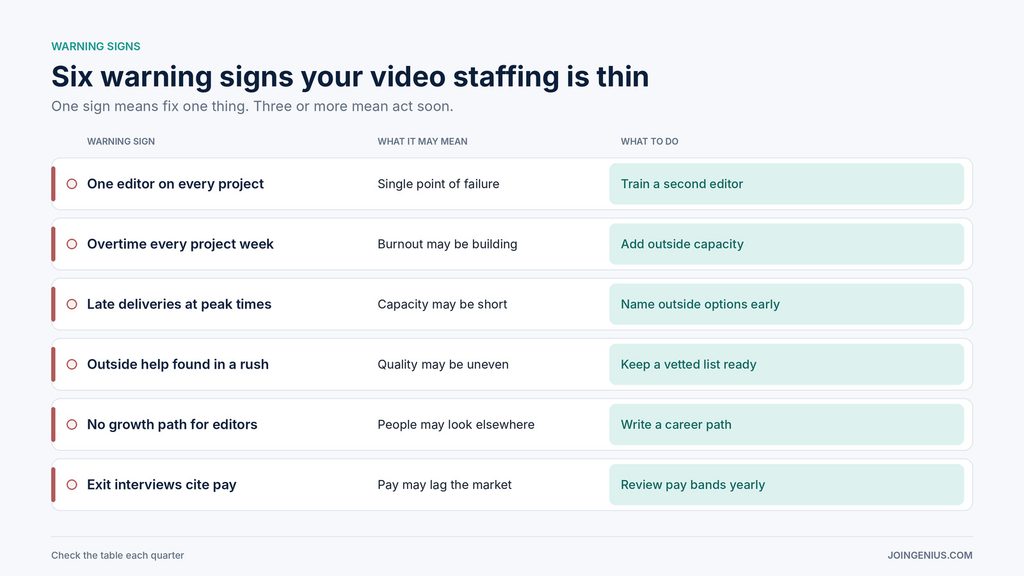
Warning Signs Your Video Staffing Is Too Thin, and What to Do About Each
Check this table each quarter. One sign means fix one thing. Three or more mean act soon.
Hire for Fit, Then Flex for Peaks
Video production is staffed in bursts, and a competitive market makes every gap expensive. Federal data shows a large self-employed share and project-based work, a study of creative employers points to pay, growth and fit as reasons people leave, and film research favors teams that mix experienced and new people. Map the work, keep the steady roles in a core team, name outside options before you need them and check the result at 90 days. Each step replaces a guess about capacity with something you can see. If you can cover a busy fortnight without losing your best editor, the plan is working. For the wider picture, see our guide to employee retention rate.