Contingent workforce managers inherit three problems the full-time hiring team never has to think about. Which worker is a contractor and which is an employee under the current rule in each country. Which agency of record owns the compliance for the engagement. And whether the manager is personally liable when the audit arrives. Hiring compliantly is the entire job.
That is why most contingent workforce programs still spend half their week on paperwork and the other half apologizing for it. Regulations change every quarter. Vendors change every year. Platforms do not talk to each other. Our write-up on hiring remote employees in other countries covers the baseline. This piece covers the compliant version.
Why Compliance Is The Hardest Part Of A CWM Program
Compliance is the hardest part of a CWM program for a simple reason. The spend is large, and the rules that govern it are not written in one place.
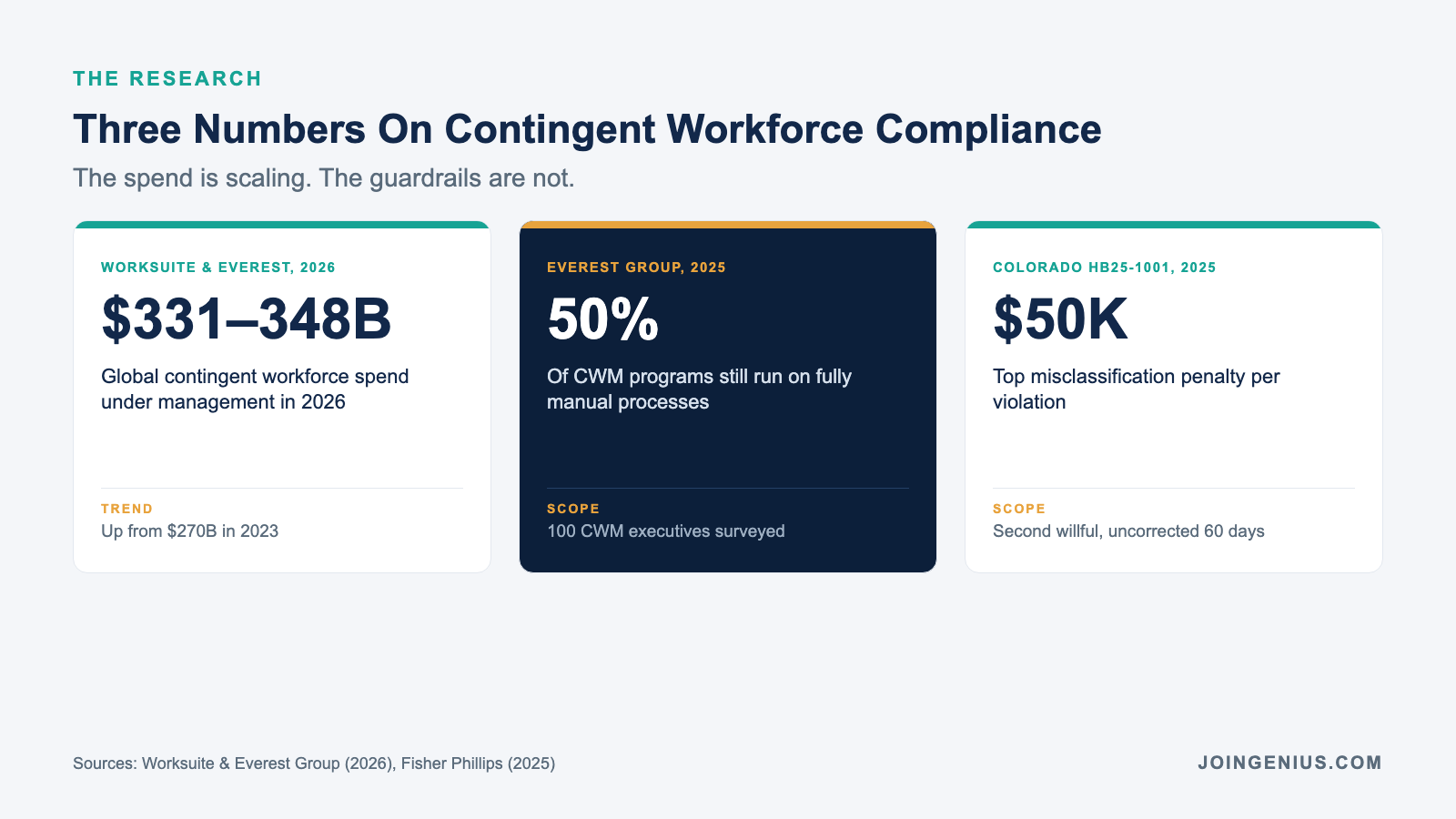
Worksuite’s new report with Everest Group, Compliant Workforce by Design (October 2026), estimates global contingent workforce spend under management at $331 to $348 billion in 2026, up from $270 billion in 2023. The same report finds 50% of CWM programs still run on fully manual or minimally automated processes. The spend is big. The infrastructure is not.
The role is also comparatively new. Contingent workforce management grew up in the last decade. The compliance rules that govern it were written across forty years and multiple agencies, so there is no single playbook a new contingent workforce manager can inherit.
The complexity is also geographic. A single engagement can cross three jurisdictions by the time the invoice goes out. The worker is in Portugal. The client is in the US. The vendor of record is in the UK. Each has its own rule on what makes the worker a contractor, and the three rules do not line up.
Our overview of global outsourcing in 2025 and beyond covers how organizations are thinking about this layer. The CWM slice is the one with the largest compliance tail.
Three forces compound. The spend is growing. The regulatory map is widening. The tooling is still catching up. Any one of these would be manageable. The three together are the job.
Where The Compliance Gaps Open Up In Hiring
The compliance gaps open at specific moments in the hiring workflow. Four moments in particular are where most programs lose the thread.
The first moment is classification at intake. A hiring manager scopes a “short contractor engagement” that is actually a full-time role with a fixed 40-hour week and a managed workflow. By the time the engagement reaches the CWM team, the misclassification is already locked into the statement of work.
The second moment is the handoff to the agency of record or employer of record. The intake form says the worker is a contractor. The AOR says they qualify as an employee under the local rule. Nobody owns the decision, so the engagement goes live under the wrong structure.
The third moment is renewal. A contractor who was correctly classified at month one has a growing scope at month twelve. The role now looks like a full-time job. The paperwork still says contractor. Renewal is where most audit findings start.
The fourth moment is offboarding. An engagement that ends without a clean paper trail of hours and deliverables creates an audit gap three years out. Teams that run tight intake and loose offboarding fail the audit at the same rate as teams that run loose intake.
Four moments, four handoffs. None of them is complicated on its own. All four at scale, across jurisdictions, is where the breakage happens.
The Legal Exposure In 2026
The downside risk changed in 2025 and 2026. New state and EU rules raised the ceiling on misclassification penalties, and the enforcement calendar is tighter than it used to be.
In the US, Colorado’s HB25-1001, effective August 6, 2025, raised the top misclassification penalty to $50,000 for a second or subsequent willful violation that remains uncorrected after 60 days. First-tier penalties start at $5,000. The law also expanded personal liability to owners holding at least 25% of an employer.
In the EU, the Platform Work Directive requires Member States to transpose by 2 December 2026, with a rebuttable presumption of employment and joint liability across the contracting chain. Any CWM program with workers in the EU has about five weeks to get the paper trail right.
Our breakdown of payroll outsourcing covers how most programs route the mechanics of this. Payroll gets the attention. Classification does not, which is why the fines are at classification.
The headline cost of a single misclassification is now meaningfully larger than the headline cost of a single hire. That math changes the compliance budget whether the contingent workforce manager wants it to or not.
The old frame of compliance as cost-of-business no longer holds. In both the US and the EU, the penalty scale moved into the range where a single uncorrected finding can erase a year of program savings. Programs that treated compliance as a review-at-year-end item are the ones most exposed.
What To Fix In The Hiring Process
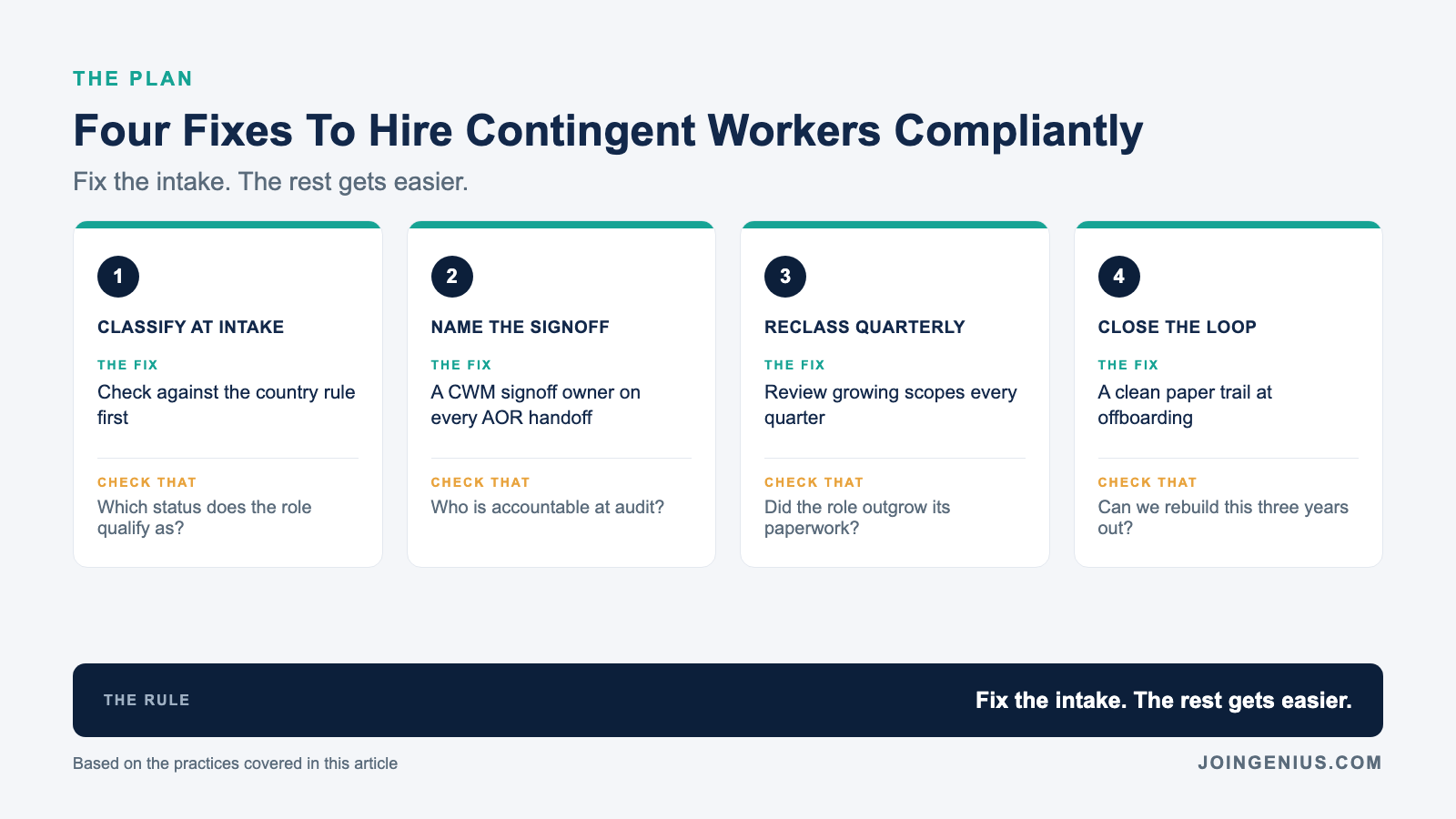
Fixing hiring compliance starts at the intake form, not at the audit. Four fixes close most of the common gaps.
The first is a classification check that runs before the role is scoped. Instead of asking “do we need a contractor or an employee?”, the intake asks “under the current rule in the worker’s country, which does this role qualify as?” The question is harder. The answer is enforceable.
The second is a single system of record for the engagement. Fragmented tooling is a top-three CWM challenge for 31% of programs in the Everest Group survey. A single platform that holds the intake decision and the paper trail turns an audit from a scramble into a database query.
The third is clear ownership of the AOR/EOR decision. Someone with authority on the CWM team signs off on the classification before the engagement goes live. The hiring manager does not get to overrule the signoff. The signoff owner is the one accountable at audit.
The fourth is a quarterly reclassification review. Our breakdown of HR outsourcing services covers how teams structure the mechanics. Reclassification is a change-of-scope exercise, not an annual audit. If the role grew by 20% in Q2, the classification should be revisited in Q3.
The order matters too. Intake is the cheapest fix and the one that moves the most. A clean intake prevents four downstream problems. The AOR/EOR signoff is the one most often skipped. Renewal and offboarding share most of the same checklist.
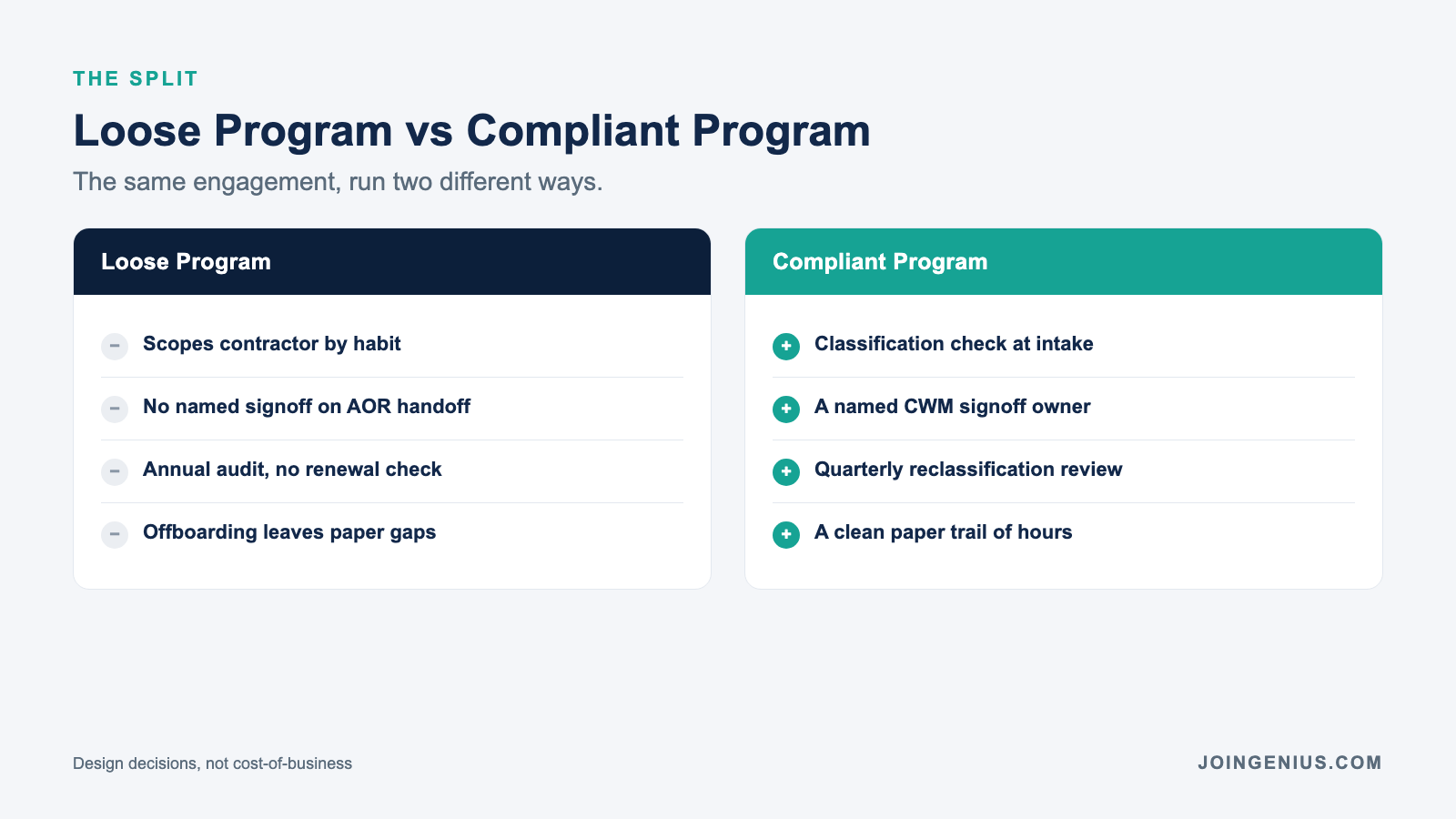
The four fixes work best as a system. Here is the fix list in one view.
| Hiring Moment | The Fix |
|---|---|
| Intake | Classification check against the worker’s country rule |
| AOR/EOR handoff | A named signoff owner on the CWM team |
| Renewal | Quarterly reclassification review on growing scopes |
| Offboarding | A clean paper trail of hours and deliverables |
How To Build The Program So Compliance Scales
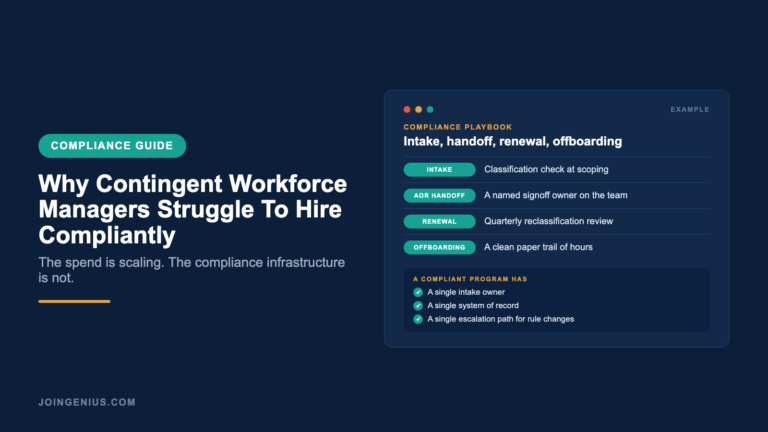
A CWM program that scales compliance has three structural pieces. A single intake owner. A single system of record. A single escalation path when the rule changes mid-engagement.
The intake owner is the person who writes the first version of the classification. On most programs this is a hiring manager with no classification training. On compliant programs this is a CWM team member with a one-page checklist against the current country rule. The checklist is the whole asset.
The system of record keeps the paper trail together. The alternative is six tools, each with partial data, which is the state the Everest Group report flagged as the top-three challenge for 31% of CWM programs. A single CWM platform consolidates the intake and the vendor-of-record decision into one record.
The escalation path matters because the rules move. Colorado passed HB25-1001 in May 2025 and it took effect in August. Programs with a named compliance owner adjusted inside a quarter. Programs without one are still catching up. Compliance slip is slower than regulatory change, and the gap is the exposure.
Retention of CWM talent matters too. The role is high-stress and the pool is small. Our list of talent acquisition and retention strategies is a starting point. A CWM team that loses its lead in Q3 inherits every late reclassification in Q4.
The budget math on all of this is simpler than it looks. A single platform plus a named compliance owner costs less than one $50,000 Colorado penalty. The investment case writes itself after the first audit.
Conclusion
Contingent workforce managers struggle to hire compliantly because the spend is scaling faster than the compliance infrastructure, and the regulatory map keeps widening. The fix is a tighter intake and a single system of record, with a named owner for the classification call. Compliance is now the first page of the engagement, not the end-of-year review.
If adding compliance or operations talent without the overhead of local hiring is on the table, Genius is the easiest route. We vet the top 1% of applicants across the Philippines and LATAM and place them full-time at roughly 80% less than an equivalent local hire.
No monthly agency fees. Every hire ships with a six-month replacement guarantee if the fit is wrong. The paperwork gets more complicated every year. The hire does not have to.