The loan officer who closed conforming paper for ten years is the wrong hire for a 2026 non-QM desk, and most managers do not find out until the file hits underwriting. This piece covers how to hire loan officers who close non-traditional mortgages, screened for the three skills the average conforming LO never had to build.
The 2026 numbers explain the hiring gap. Bank of America Securities projects non-QM originations to hit $175 billion this year, up from $108 billion in 2025. That is a 62 percent jump in a single year on a book that most desks are not staffed to underwrite or close.
The borrower side explains why the jump is real. The BLS Current Population Survey counts 9.156 million unincorporated self-employed workers in 2025, before adding the incorporated self-employed who push the total near 16 million. That is the borrower pool funding the $175 billion book. Conforming loan officers rarely touch it.
The hiring gap compounds every quarter the non-QM book grows. A desk that staffs for $108 billion in 2025 and tries to run $175 billion in 2026 on the same headcount ends up with LOs carrying 40 percent more files each. Without the right skill mix, that volume lands as missed closings, not as revenue.
What Non-QM Volume Actually Looks Like
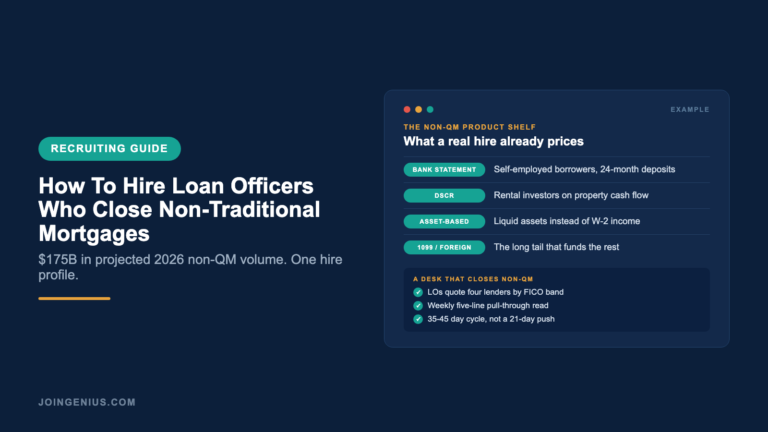
Non-QM is not one product. It is a product shelf. Bank statement programs for self-employed borrowers. DSCR loans for rental investors who qualify on property cash flow instead of personal income. Asset-based programs for retirees and high-net-worth borrowers who show liquid assets instead of W-2 income. Plus a long tail of 1099 and foreign national files on top.
Lenders like Griffin Funding have built entire pipelines around bank statement and DSCR loans with asset-based programs on top. That is the volume a strong hire should already know how to price and close before the first week.
The practical implication for a loan-officer hiring manager is that the candidate pool must be filtered for lenders running that specific product shelf. The general LO market is not the pool. A candidate from a conforming-only shop will need six months of ramp that most desks cannot afford to carry.
Pricing a non-QM file is a different skill from pricing conforming. Rate sheets are longer. LLPAs are more aggressive. The overlays between investors can vary by two full points on the same borrower profile. A loan officer who has only priced agency paper will quote the wrong rate and lose the deal before the hard pull hits the credit bureau.
The margin on a funded non-QM file is also a different animal. Basis points per file run roughly two to three times what a conforming desk sees. The trade is that pull-through is lower and cycle time is longer.
A hire who does not already live inside that math will burn pipeline chasing the wrong file types for the first six months. The LO comp structure on a non-QM desk reflects this. Base is usually lower and bps per file is higher, which means a candidate who wants a flat salary is probably the wrong hire for the seat.
Why The Average Loan Officer Can Not Close These Files
The average loan officer has not seen a bank statement file at volume. The BLS Occupational Outlook Handbook counts 283,000 US loan officer jobs in 2025, with a median wage of $76,690 and only 1 percent projected growth through 2035. Most of that book is conforming.
Conforming LO volume is built on automated underwriting. Pull a credit score. Run DU or LP. If the AUS approves, the file closes with light manual review. Non-QM has no DU. Every file is a manual exercise in documenting income and assets against a non-agency guideline that changes quarterly, with reserve posture as the additional check.
The result is a slower file at higher margin. A clean non-QM file takes 35 to 45 days from application to clear-to-close. A loan officer accustomed to a 21-day conforming cycle will push the file too hard and lose the realtor relationship by week three. The hiring screen has to catch that mismatch before it hits the pipeline.
The borrower conversation is different too. A self-employed business owner being asked for 24 months of statements is not reading them the same way a W-2 borrower reads a paystub request. A conforming LO who has never had that conversation will sound audit-adversarial and lose trust by the second call.
What To Hire For
The three screens that catch a real non-QM LO can be run in 45 minutes. The first is a pricing screen. Hand the candidate a mock file for a self-employed borrower at 680 FICO and 20 percent down, with 24 months of bank statements showing $18,000 in average monthly deposits.
Ask which four lenders they would quote and why. A real non-QM LO names four and pairs each to a different product variant, then explains which one usually wins at that FICO band. A conforming LO names one lender and freezes on the deposit math a minute into the conversation.
The second screen is the realtor-call screen. Give them the same file and ask them to leave a two-minute voicemail for the listing agent who sent the referral. A real non-QM LO frames the timeline up front and sets expectations on documentation. A conforming LO promises a conforming close date and buries the realtor at week four.
The third screen is the exception screen. Give them a file that will not fit the first-tier investor and ask what happens next. A real non-QM LO can name two second-tier options in under 30 seconds. A conforming LO asks if the borrower can increase the down payment.
The interview loop should spend most of its time on these three screens, not on resume credentials. A candidate who passes the pricing screen and the realtor-call screen and then clears the exception screen is a hire. Everything else is a reference check at that point.
A Weekly Pipeline Read For A Non-QM Desk
The dashboard that keeps a non-QM desk honest has five lines. First, application-to-locked ratio by product variant, broken out so the DSCR book is not hiding behind the bank statement book. Second, average days from application to clear-to-close by lender.
Third, pull-through percentage on locked files. Fourth, the fallout bucket by reason code, so the desk manager sees whether files are dying at income documentation or at appraisal. Fifth, average revenue per funded file, since a non-QM file at higher margin can carry a slower cycle without hurting the desk.
These five lines fit on one page. A non-QM desk manager who cannot produce this weekly is a manager running on hope. The weekly cadence matters as much as the five lines. A monthly version of the same report is a postmortem. A weekly version is a steering wheel.
Teams that run this report weekly find a two-week pullforward on every underwriting correction they make. The LO who was not pricing DSCR right in week two gets caught in week three instead of month three, and the desk recovers the next 40 files instead of eating them.
The other reason the weekly cadence matters is that non-QM investor appetite shifts inside of a quarter. An investor that was buying 680 FICO bank statement paper in January may cap at 700 by March.
A manager who only reads monthly numbers finds out at the lock desk. A weekly reader finds out from the pull-through line and reshuffles the investor shortlist in two days, before any more files hit the wrong window.
Hire Loan Officers Who Can Close The Pipeline
The structural pull on non-QM is not reversing. The self-employed worker pool is expanding every year. Non-agency origination is projected to climb 62 percent year over year into 2026. And conforming LOs are not retooling fast enough to close the gap at scale.
The desks that keep hitting their fundings are the ones that stop looking in the conforming LO pool and start sourcing from desks that actually run bank statement volume. And retaining that loan officer past the twelve-month mark is what compounds a pipeline that can absorb the next $67 billion in projected non-QM growth.
The first hire sets the pricing playbook. The second confirms it. By the third hire, the desk is quoting non-QM files from the same investor shortlist every week. The pull-through number then tells the manager which LO is actually closing, not just which one is taking the most applications.
Three real non-QM LOs on a desk will out-fund five conforming LOs retrained mid-career every time. The fastest desks in 2026 have figured out that sourcing from inside the non-QM world is the only move that compounds.
Retraining is a 12-month bet with a 50 percent success rate. Hiring from inside the book is a 90-day ramp with a 90 percent success rate. The math favors the second move on every desk I have seen run both.