The question that keeps coming up in 2026 is whether a lean team can ship a content site on Notion and still rank in Google. This piece covers Notion website SEO performance across the Core Web Vitals that drive Google’s page experience signal. It also covers the single hire that keeps a Notion site competitive against a tuned WordPress build.
Google still owns 91.05 percent of global search as of October 2026 per StatCounter. That one share number means the only SEO rules worth caring about are Google’s. And Google’s technical rules have moved toward performance in a way that quietly favors static CDN-served sites over heavy CMSes.
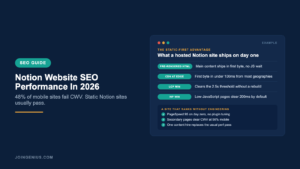
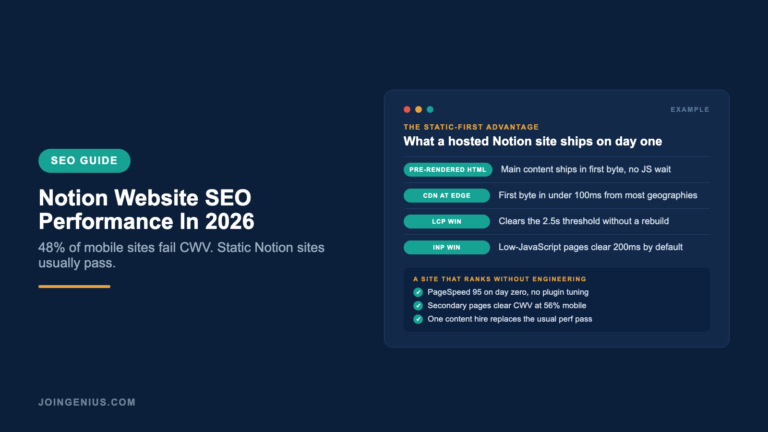
The HTTP Archive Web Almanac 2025 reports that only 48 percent of mobile origins pass all three Core Web Vitals. A Notion site served through a modern builder that pre-renders HTML at the edge will usually pass on day one. Most WordPress and Webflow builds will not pass without a performance rebuild.
Why Notion SEO Got Easier In 2026
Three years ago the honest answer on Notion as a website platform was that it was fine for docs and portfolios and unfit for a serious content site. Google rewarded visible interactive polish and heavy design. A plain Notion page looked and ranked like an afterthought.
That stopped being true when Core Web Vitals became a ranking input and INP replaced FID in March 2024. The rules shifted from does-it-look-ambitious to does-it-load-and-respond-fast. A pre-rendered Notion site loads fast by default because there is almost no client-side code to run.
The 2025 CrUX numbers make the gap concrete. LCP sits at 62 percent good across the mobile web. Only 25 percent is in the needs-improvement band and 13 percent in the poor band. LCP is the single metric most sites lose on. It is also the metric a static CDN site is almost designed to win.
The LCP Problem That Static Notion Sites Already Solve
Largest Contentful Paint is Google’s measure of how fast the main content of a page renders. The threshold for good is 2.5 seconds at the 75th percentile of real user visits. Most WordPress sites miss that threshold on mobile because the theme loads a large hero image behind a fonts-loading block.
A Notion page rendered through a builder that caches HTML at the CDN edge serves the first byte in under 100ms from most geographies. The main content block ships in the initial HTML payload and does not wait for JavaScript to run. That architecture is the LCP win for free.
The Web Almanac also reports that secondary pages outperform home pages on CWV. Mobile secondary pages pass at 56 percent against 45 percent for home pages. The gap is bigger on desktop at 61 percent against 47 percent. A Notion-based blog is a stack of secondary pages by design, which is the easier side of the benchmark to clear.
INP And The Low-JavaScript Advantage
INP (Interaction to Next Paint) became a Core Web Vital on March 12, 2024. The threshold for good is under 200ms at the 75th percentile. INP measures how fast the page responds to a tap or a click. It punishes JavaScript-heavy pages that block the main thread for hundreds of milliseconds.
The 2025 numbers across the mobile web show 77 percent of origins passing INP. That sounds high until you look at the WordPress and ecommerce cohorts specifically where interactive scripts are the norm. A Notion-rendered page typically ships with almost no client-side interactivity. That is the structural reason INP passes without any engineering work.
The INP win matters more than the raw number suggests. Google’s page experience signal is binary at the ranking level. But the sites that pass CWV consistently get more impressions and clicks on the same keyword than the sites that miss. That is the compounding advantage a lean Notion stack gets against a plugin-loaded CMS.
What Super.so Actually Solves For On-Page SEO
The gap between a Notion page shared on notion.site and a Notion page published as a real website is roughly the gap a hosting builder closes. A platform like Super.so turns a Notion workspace into a CDN-hosted site with a custom domain and SSL and SEO settings baked in from the Personal tier up.
The direct SEO wins are the ones Notion itself cannot deliver. A real custom domain instead of a subdomain-of-a-subdomain. Automatic SSL. Social sharing card auto-generation. Page redirects on every tier that supports them. These are the table stakes a Notion page cannot satisfy on its own.
The architecture win is the one most teams undervalue. A hosted Notion site with HTML pre-rendered at the edge and a CDN in front of it gets the LCP win and the INP win without the team ever running a Lighthouse audit.
That is why a four-person startup can ship a 40-page docs site on Notion in a weekend and still score 95 on PageSpeed. The usual performance pass the hire in week one would otherwise be building is already shipped on day zero.
The gap the builder does not close is schema markup and sitemap control. If the content strategy depends on rich snippets or on a very deliberate internal link hierarchy a dedicated CMS still has more surface area for optimization. A Notion site should be picked for speed and not for schema depth.
Where A Notion Site Hits Its Ceiling
The honest limits of a Notion site matter as much as the wins. Standard builder plans publish on a subdomain of the hosted domain rather than a sub-path like /docs or /blog on a primary site. Sub-path hosting is gated to the higher Custom tier which starts above where most small teams expect.
The sub-path versus subdomain decision matters because domain authority concentrates on the root domain in Google’s crawl. A blog at example.com/blog consolidates authority with the product pages. A blog at blog.example.com splits it. Teams with real content ambition should budget for the higher tier if authority consolidation matters.
The other ceiling is editorial muscle. Notion is a great writing tool and a limited editorial CMS. There are no workflow states for drafts or scheduled posts on standard tiers. There are no granular publishing permissions below the Teams plan. A content team of three can live with that. A content team of twelve usually cannot.
The Content Hire That Makes Notion SEO Work
The platform is never the ceiling on organic growth. The ceiling is whether the team has one person who owns the keyword map and the publishing cadence. On a Notion stack that role is lighter on technical SEO and heavier on content velocity because the technical SEO is already handled by the builder.
The BLS Occupational Outlook Handbook for 2025 counts roughly 220,100 web developers and digital designers in the US. The median pay is $99,520 and the projected growth through 2035 is 5 percent. The content operator sits adjacent to that pool and usually costs less to hire than a developer with the same SEO judgment.
The sourcing pass for the role should filter for one specific trajectory. Someone who ran content on a lean static-site stack at a previous startup is a yes. Someone who ran content on an enterprise WordPress install with fifteen plugins is probably a no because the muscle memory is the wrong shape for a Notion workflow.
The interview loop that catches a real one is short. Show them the current top-twenty-ranking pages in the target category and ask what they would publish in the first 30 days. A real hire names three page templates with specific keyword targets inside three minutes. A fake hire asks for more data before answering.
The Weekly SEO Read For A Notion Site
Once the Notion site is shipping content five lines on one page keep it honest week over week. First is page count published that week against the editorial plan. Second is impressions in Google Search Console segmented by new versus existing pages.
Third is average position for the top ten target keywords tracked explicitly. Fourth is Core Web Vitals pass rate from the CrUX field data on the site’s own origin. Fifth is referral traffic from the content pieces that cite external authority since those are the pages that compound.
The cadence matters more than the lines themselves. A Notion site that only checks Search Console once a month is a Notion site that discovers a crawl issue three weeks after it started dropping rankings. A Monday read catches it inside seven days. That gap is usually the difference between a flat quarter and a compounding one.
The hire who sets up this read in week one is the hire who keeps the compounding alive. Retaining that operator past the twelve-month mark matters because organic traffic is a compounding asset that can take two quarters to show its full return.
The Build Decision Comes Before The SEO Decision
Notion as a website stack is now a defensible choice for a specific profile of team. The team fits a particular shape: small and writer-led and content-first, shipping to a market where the keyword universe is manageable. For that team the build decision is lower-stakes than it was in 2023 because the CWV defaults do most of the heavy lifting.
The teams it is still wrong for are the ones with a serious ecommerce surface or a schema-heavy content model or a brand studio that wants pixel-exact design control on every page. Those teams should buy Webflow or hire a Next.js build. Notion is not a universal answer and should not be sold as one.
The founders I have watched succeed with Notion as a site stack all did the same three things. They picked a hosted builder on day one instead of DIY-ing the publishing pipeline. They hired a content operator before they hired a second engineer. And they put the five-line weekly SEO read in every Monday review from week two.
The founders who stalled on Notion stalled for the same three reasons. They tried to replicate a Webflow design system inside a Notion page. They hired a technical SEO before they hired a content operator. And they treated the first ranking win as proof that the process was finished instead of as the start of the compounding curve.