
The average sales win rate is 21%. That means roughly 4 out of 5 pitches fail.
But here’s what’s interesting. It’s rarely the product that kills the deal. It’s the pitch. Buyers tune out within seconds when they hear “Let me tell you about our company” or a 12-minute feature dump nobody asked for.
59% of buyers say they’re frustrated by generic pitches that don’t address their specific situation. And with B2B buying committees now averaging 6-10 people, your pitch has to survive being retold by someone who heard it once.
This guide gives you a repeatable 5-part framework for writing a sales pitch that grabs attention, builds trust, and actually moves deals forward. Whether you’re writing a cold email pitch, preparing a sales presentation, or crafting a 60-second elevator pitch for a networking event.
The Only Sales Pitch Framework You Need (5 Parts, 2 Minutes Or Less)
Great pitches aren’t great because the seller was charming. They’re great because the structure did the heavy lifting. The best reps follow the same bones every time, then customize the details for each prospect.
That customization only works if the language itself is genuinely original. A free plagiarism checker like TextToHuman’s plagiarism tool that scans copy against billions of online sources and publications catches any inadvertent overlap with scripts that have already been overused in your prospects’ inboxes.
Here’s the framework. It works for email, phone, in-person presentations, and even LinkedIn messages. The only thing that changes is length.
Part 1: Open With A Hook That Earns The Next 30 Seconds
You have about 10 seconds before a prospect decides whether to keep listening or start thinking about lunch. That’s not an exaggeration. It’s how human attention works.
Your hook needs to do one thing: make them think “wait, that’s relevant to me.”
The best hooks fall into 3 categories:
- A specific problem they recognize. “Most [their role] at [their company size] lose 8-12 hours a week on [problem]. That’s 500+ hours a year.”
- A surprising data point. “Companies in [their industry] that do X see 40% higher retention. Most don’t.”
- A relevant observation. “I noticed your team just launched [product/feature]. Companies at that stage usually hit [specific challenge] within 3-6 months.”
Notice what’s missing? Your company name. Your product. Your origin story. Nobody cares about those in the first 10 seconds.
💡 Quick Tip
Test your opening by asking: “Would this make ME stop scrolling or look up from my phone?” If the answer is no, rewrite it. The hook should create a small tension or curiosity gap that only the rest of your pitch can close.
This same principle applies to how companies attract top employees. You lead with what matters to them, not what matters to you.
Part 2: Name Their Pain (Make It Specific, Not Generic)
After the hook, you need to articulate the buyer’s pain points better than they can themselves. This is where most pitches fall apart. They stay vague.
“Many companies struggle with efficiency” is not a pain statement. “Your SDR team is probably spending 3 hours a day on data entry instead of selling” is.
The more specific you get, the more credible you sound. And credibility is the currency of sales.
Here’s how to get specific:
- Research their company before you pitch. Check their careers page (are they hiring for roles your product replaces?), their latest earnings call, their LinkedIn activity, their Glassdoor reviews.
- Reference their industry. “In SaaS, the average sales cycle just stretched to 84 days. That’s 20% longer than 2 years ago.”
- Name the cost of inaction. Don’t just describe the problem. Quantify what it costs them every month they don’t fix it. A great example for this is Rentredi. They quantify the hours landlords waste on manual rent collection and maintenance tracking, making the cost of not switching painfully obvious.
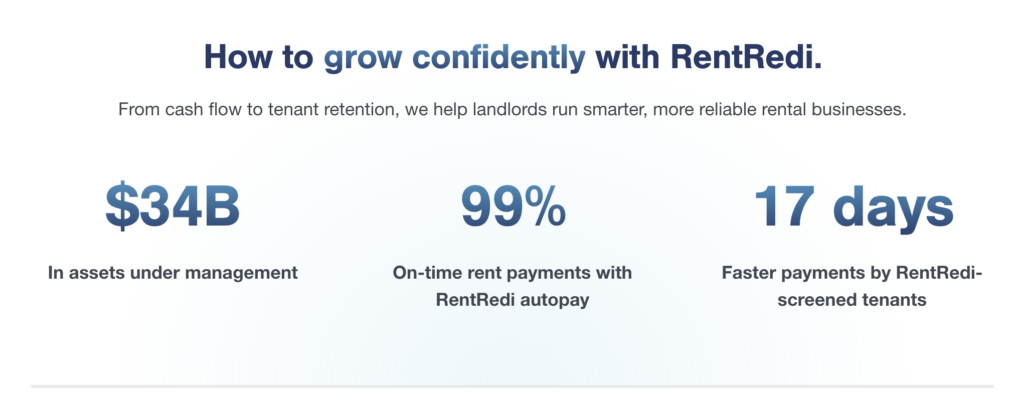
This is prospect research turned into pitch fuel. The same homework that drives a strong talent acquisition process drives a strong sales pitch. Know who you’re talking to before you open your mouth.
⚠️ Common Mistake
Don’t tell prospects what their problems are. Ask questions that lead them to say it themselves. “What’s the biggest bottleneck in your current workflow?” gets you the same information. And now THEY said it, which means they own it. A pain point the buyer articulates is 10x more powerful than one you assert.
Part 3: Present Your Solution As The Bridge (Not the Hero)
Your product isn’t the hero of this story. Your buyer is. Your product is the bridge that gets them from where they are (frustrated, inefficient, losing money) to where they want to be (growing, efficient, ahead of competitors).
This is where your unique selling proposition lives. But keep it tight. 2-3 specific capabilities that directly solve the pain you just described.
The formula:
“[Your product] does [specific thing] so that [their team/role] can [desired outcome] without [current friction].”
Example: “Our platform automates your SDR outreach sequences so your reps spend their time on qualified conversations instead of copy-pasting templates into Gmail.”
That’s it. One sentence. Not 15 features. Not a product demo. Just a clear line from their problem to your solution.
Teams building a talent acquisition strategy know this well. You don’t sell candidates on every perk. You sell them on the 1-2 things that matter most to them.
Part 4: Back It Up With Proof That Lands
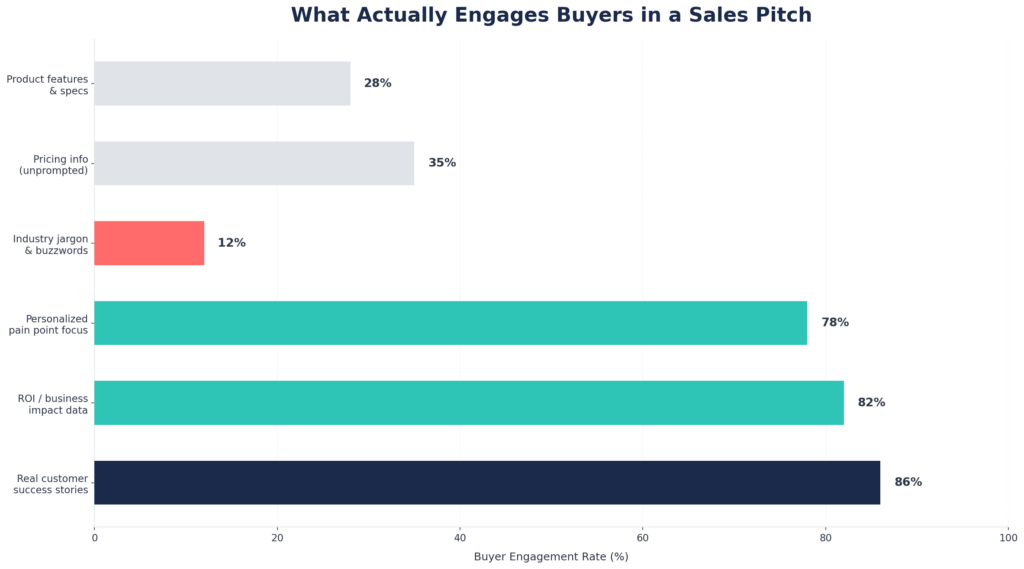
Claims without evidence are just opinions. And prospects hear opinions from 10 vendors a month. What separates a forgettable pitch from one that moves to the next meeting is social proof.
The 3 strongest types of proof:
Customer success stories that mirror their situation. “We worked with [similar company in their industry] that had the same challenge. In 90 days, they cut their [metric] by 35%.” The closer the case study matches their world, the harder it hits.
Hosting customer stories as on-demand webinars through platforms like WebinarGeek lets prospects hear directly from your clients instead of reading a polished PDF. That authenticity makes your proof section hit harder.
Specific numbers, not vague improvements. “40% faster onboarding” beats “significantly faster onboarding.” “Saved $180K annually” beats “major cost savings.” Every number you include adds a layer of credibility.
Third-party validation. Industry awards, analyst mentions, press coverage, or even a quote from a respected customer. These signal that your claims have been verified by someone who doesn’t work for you.
📊 By the Numbers
Personalized email pitches generate a 32.7% higher response rate than generic ones (Seismic, 2025). And sales presentations kept under 10 slides see 32% completion rates compared to 22% for longer decks (Storydoc, 2025). Less is more when every word earns its place.
Part 5: Close With An Ask That’s Easy To Say Yes To
The biggest mistake in closing a deal (or at least moving it forward) is making the ask too big. “Want to sign a 12-month contract?” after a first conversation is absurd. But so is ending with “Let me know if you have any questions” because that’s not a call to action. That’s a dead end.
Your ask should be:
- Specific: “Can we do a 15-minute demo on Thursday at 2 PM?”
- Low-friction: Make the next step small. A short call, a demo, a trial. Not a commitment.
- Time-bound: “This week” or “Thursday” beats “sometime soon.”
📌 Key Takeaway
Never end a pitch without a scheduled next step. The moment a prospect says “let me think about it” without a follow-up date, your deal starts dying. Even if they need time, lock in a specific day to reconnect.
Adapt Your Pitch To 4 Different Channels
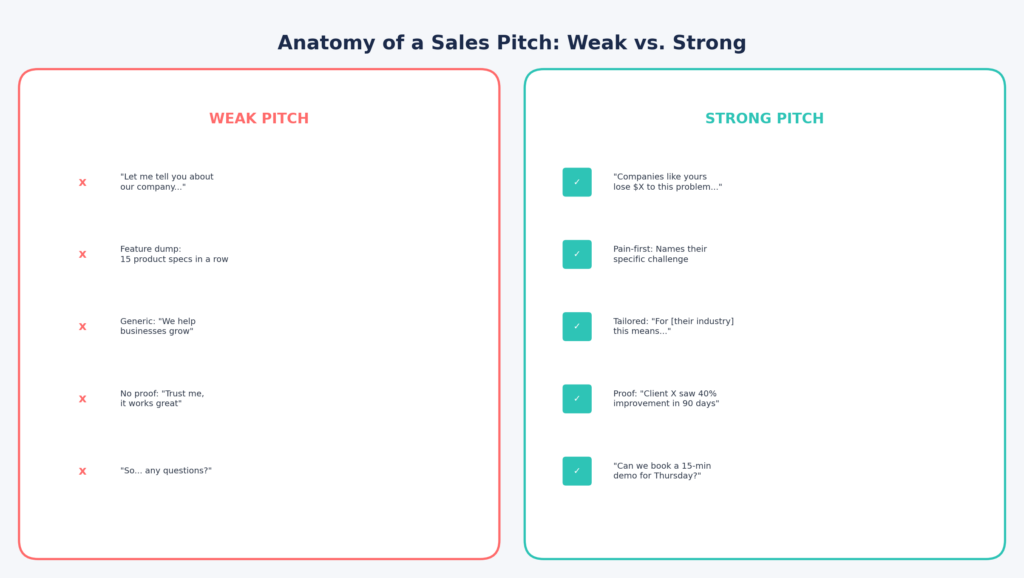
A great sales pitch framework is channel-agnostic. But the execution changes depending on whether you’re writing, calling, presenting, or messaging. Here’s how to adjust.
Write A Cold Email Pitch That Gets Replies
Keep it to 3 short paragraphs max. Your cold email pitch should follow this exact structure:
Paragraph 1: Personalized hook. Reference something specific about their company, role, or industry. No “I hope this email finds you well.”
Paragraph 2: 2-3 sentences connecting their pain to your solution. Include 1 proof point.
Paragraph 3: A single clear ask. “Would a 15-minute call on [day] work to see if this is relevant for your team?” Make sure the link in your email signature leads to a landing page that reinforces your pitch, not a generic homepage.
That’s it. 80-120 words total.
The closer a pitch gets to a booked meeting, the more friction matters at the CTA. Embedding an automated calendar link directly in the email removes one more reason to defer and can meaningfully improve the rate at which interested responses convert to actual meetings.
Nail The Phone Pitch In Under 90 Seconds
On the phone, you don’t have the luxury of someone re-reading your message. You get one shot and they’re deciding within 10 seconds whether to stay or find an excuse to hang up.
Lead with your hook. Then immediately ask a question. “Does that resonate, or is your team dealing with a different challenge right now?”
Questions do 2 things: they give you information, and they signal that this is a conversation, not a sales script being read at them.
💡 Quick Tip
Record yourself delivering your pitch. Listen back. If it sounds like you’re reading, it sounds like a pitch. If it sounds like you’re talking to a friend about a problem you noticed, it sounds like a conversation. Buyers respond to conversations.
Build a Presentation That Holds the Room
For a full sales presentation or pitch deck, follow this slide structure:
| Slide | Purpose | Time |
| 1. Their Problem | Hook with a problem they recognize | 30 sec |
| 2. Cost of Inaction | Quantify what the problem costs them | 30 sec |
| 3. Your Solution | Bridge from pain to value proposition | 45 sec |
| 4. How It Works | Simple visual, not a feature list | 45 sec |
| 5. Proof / Case Study | Customer success story with numbers | 60 sec |
| 6. Next Steps | Clear, specific ask | 30 sec |
6 slides. Under 5 minutes. Anything beyond that and you’re losing people.
The data backs this up. Presentations under 10 slides see completion rates nearly 50% higher than longer ones.
Pitch Through LinkedIn (Without Being Annoying)
LinkedIn pitches should be 3-4 sentences max. Lead with a mutual connection or specific observation. Never open with “I’d love to connect and tell you about what we do.”
Instead: “Saw your post about [topic]. We ran into the same challenge at [company] and found that [specific approach] cut [metric] by [number]. Happy to share what worked if it’s useful.”
That reads like a person being helpful, not a pitch. And it works because you’re offering value before asking for anything.
5 Sales Pitch Mistakes That Kill Deals Before They Start
Even solid pitchers make these errors. Fixing them doesn’t require new skills. Just awareness.
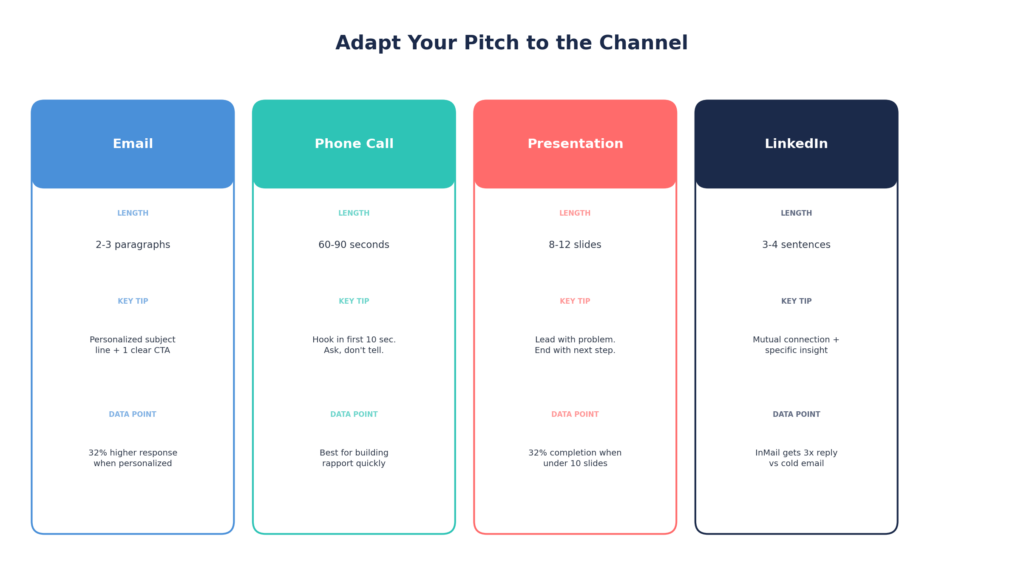
Starting with your company history. Nobody wakes up wanting to hear about your founding story or your 47 office locations. Lead with their problem. If they want your background, they’ll ask.
Feature dumping. Listing every capability your product has is not a pitch. It’s a product spec sheet. Pick the 2-3 features that solve their specific pain and go deep on those. The rest is noise.
Being vague about outcomes. “We help companies grow” could mean anything. “We helped a 50-person sales team book 40% more qualified demos in 6 weeks” means something. Specifics build trust. Generalities build skepticism.
Your pitch assets should match that specificity. If your case studies live on a poorly designed webpage, the presentation undermines the message.
Skipping the follow up. Most deals don’t close on the first touch. 80% of sales require 5+ follow-up contacts, yet 44% of reps give up after 1. Your follow up is part of your pitch strategy, not separate from it.
Pitching the wrong person. 81% of revenue leaders say deals are more complex than ever (Gong, 2025). That means you’re not pitching one decision-maker. You’re pitching a committee. Adapt your message for each stakeholder. The VP of Sales cares about quota attainment. The CFO cares about cost savings. The end user cares about ease of use.
Teams doing talent acquisition and retention face the exact same challenge. You don’t sell the same story to a hiring manager and a C-suite sponsor.
⚠️ Common Mistake
84% of sales reps missed quota last year (Vena Solutions, 2025). The top reason wasn’t a bad product or bad market. It was inconsistent execution. The fix is a repeatable sales strategy that your whole team follows, not just your top 2 closers.
How To Practice And Sharpen Your Pitch Over Time
Writing a strong pitch is step 1. Delivering it consistently is where the real wins come from.
Record and Review Every Pitch
Record your calls and presentations. Listen back for filler words, pace, and whether you actually followed the framework. Most reps think they’re customer-focused. The recordings usually tell a different story.
Track What Works With a Simple Scorecard
After every pitch, note 3 things:
- Did the prospect engage or go silent at the pain point?
- Did the proof element get a reaction?
- Did you get a next step scheduled?
Over 20-30 pitches, patterns emerge. You’ll see which hooks land, which proof points resonate, and where you consistently lose attention. This is how talent acquisition analytics works too. You measure, you learn, you adjust.
Role-Play Objection Handling Weekly
Objection handling isn’t something you “figure out in the moment.” It’s a skill you rehearse. The most common objections are predictable: price, timing, competitor preference, internal politics.
| Objection | Reframe |
| “It’s too expensive” | “What’s the cost of NOT solving this for another 6 months?” |
| “We’re happy with our current vendor” | “Totally fair. What would need to change for you to consider alternatives?” |
| “Now isn’t the right time” | “Understood. When does [relevant planning cycle] start? Let’s reconnect then.” |
| “I need to talk to my team” | “Makes sense. Who on your team would find a quick demo most useful?” |
Every objection is a buying signal in disguise. It means they’re engaged enough to push back instead of just ghosting you.
🎯 Pro Insight
The best closers don’t overcome objections. They prevent them. If your pitch addresses the top 3 objections proactively (cost, timing, competitive comparison), you reduce friction before it even starts. Bake the answers into your proof section.
Good delegation examples show the same pattern. Anticipate the resistance, address it upfront, and the conversation moves faster.

Build A Pitch That Wins More Than 1 In 5
Most sales pitches fail because they’re about the seller, not the buyer. Flip that, and you’re already ahead of 80% of the competition.
Start with their pain. Present your solution as the bridge. Back it up with proof. Ask for a small, specific next step. Then follow up like a professional, not a robot.
The framework in this guide works across email, phone, presentations, and LinkedIn. Use it as your sales script skeleton, then customize the meat for every prospect.
Pick 1 thing from this guide and apply it to your next pitch. Track whether it moves the needle. Then add the next piece. That’s how good pitchers become great ones.