
You spent $50,000 on marketing last month. A customer saw your Facebook ad, read 3 blog posts, opened 2 emails, then clicked a Google ad and bought.
Which channel gets credit for the sale?
If you said “Google Ads” because it was the last click, you just ignored 80% of the customer journey. And you’re about to make the same mistake with next month’s budget.
That’s the attribution problem. 38% of marketers say it’s their number 1 analytics challenge. And companies without proper marketing attribution models misallocate up to 30% of their marketing budget.
This guide breaks down every attribution model, shows you which one fits your business, and gives you a step-by-step plan to stop guessing where your money goes.
What Marketing Attribution Actually Means (And Why Most Teams Get It Wrong)
Marketing attribution is the process of assigning credit to each touchpoint a customer interacts with before they convert. It connects the dots across your entire customer journey so you know which channels, campaigns, and content actually drive revenue.
Here’s why that matters. Every ad platform claims credit for every conversion it touches. Facebook says the sale came from Facebook. Google says it came from Google. Your email platform takes credit too. Without attribution, every platform is telling you it deserves 100% of the budget.
This is the core problem Lean Labs, an outsourced growth team for B2B SaaS companies, was built to solve. Their work across 500+ brands consistently points to the same root issue: marketing spend gets misallocated, not because teams lack budget, but because they can’t accurately trace which activities drove revenue.
The result? You’re looking at overlapping, inflated numbers that tell you nothing useful about where to spend your next dollar. Proper marketing analytics follows the same principle you’d apply to hiring. You need data that tells the truth, not data that makes one department look good.
📌 Key Takeaway
Marketing attribution isn’t about giving credit. It’s about making smarter budget allocation decisions. Companies that master it see 15 to 30% higher marketing ROI and reduce wasted ad spend by 27%.
Attribution models fall into 2 main categories. Single-touch models give all credit to 1 interaction. Multi-touch models spread credit across the full conversion path. Each has a time and place.

Single-Touch Attribution: Simple, Fast, & Dangerously Misleading
Single-touch models are the starting point for most teams because they’re easy to set up and easy to understand. But “easy” doesn’t mean “accurate.” 22% of organizations still rely exclusively on last-click attribution. That’s a problem.
First-Touch Attribution: Who Found You First
First-touch attribution gives 100% of the credit to the very first interaction. If someone discovered your brand through a LinkedIn post, that post gets all the credit for the eventual sale. Even if they interacted with 10 more touchpoints before buying.
This model is useful for 1 thing. Understanding which channels drive brand awareness and fill the top of your funnel. If your goal is attracting new prospects, first-touch data shows you where they’re discovering your brand.
But it completely ignores everything that happened after that first click. The nurture emails, retargeting ads, and demo calls that actually closed the deal get zero credit.
Last-Click Attribution: The Default That Distorts Reality
Last-click attribution gives 100% of the credit to the final touchpoint before conversion. This is the default in most analytics platforms because it’s straightforward. Someone clicked a Google ad and bought? Google gets the credit.
The problem is obvious. 55% of paid social conversions require 3 or more touchpoints to close. Last-click ignores all of them except the last one. It overvalues bottom-of-funnel channels and undervalues everything that built the relationship.
⚠️ Common Mistake
Using last-click attribution to make budget decisions means you’ll keep funding the channels that close deals while starving the channels that create demand. Over time, your pipeline dries up because nobody’s discovering your brand anymore.
If your talent acquisition strategy only measured the final interview before a hire, you’d cut all the sourcing and screening steps that made that hire possible. Same logic applies here.
Multi-Touch Attribution Models: Seeing The Full Picture
Multi-touch attribution spreads credit across multiple touchpoints in the conversion path. 74% of high-growth companies use multi-touch attribution. And companies that switch from single-touch to multi-touch see an average 22% increase in budget efficiency.

Here’s how the 4 main multi-touch models work.
Linear Attribution: Equal Credit For Everyone
Linear attribution splits credit evenly across every touchpoint. 5 touchpoints? Each gets 20%. It’s fair, and it’s simple. But it treats a random display ad impression the same as a high-intent demo request. That lack of nuance is its biggest weakness.
Best for teams just starting with multi-touch who want a baseline view of their channel attribution without making assumptions about which touchpoints matter most.
Time-Decay Model: Recent Interactions Matter More
The time-decay model gives increasing credit to touchpoints closer to the conversion. The email sent 2 days before purchase gets more credit than the blog post from 3 weeks ago.
This model makes intuitive sense for businesses with longer sales processes. Research shows that for complex B2B sales cycles, interactions in the final 30 days before purchase have up to 3x the impact of earlier touchpoints.
💡 Quick Tip
Time-decay works best when your sales cycle runs 30 days or longer. If customers convert in under a week, the decay curve doesn’t have enough range to provide meaningful differentiation between touchpoints.
Position-Based Attribution: The U-Shaped Approach
Position-based attribution (also called U-shaped) gives 40% credit to the first touch, 40% to the last touch, and spreads the remaining 20% across everything in between. This is the most popular model among B2B SaaS companies for good reason.
It respects the channels that create awareness AND the channels that close deals. The middle touchpoints still get credit, just less of it. This mirrors how most customer journeys actually work. The first and last interactions tend to carry the most weight.
A W-shaped variation adds a third major credit point at the lead creation stage (when someone converts from anonymous visitor to known contact). It splits credit roughly 30/30/30 with 10% for everything else.
Data-Driven Attribution: Let The Machine Decide
Data-driven attribution uses machine learning to analyze thousands of conversion paths and determine which touchpoints actually drove the outcome. It compares converting journeys against non-converting journeys to find the patterns that matter.
This is the most accurate model available. AI-powered attribution adoption has grown 44% year-over-year and is expected to exceed 60% by 2027. Google Analytics 4 now uses data-driven attribution as its default model.
The catch? You need high data volume. If you’re running fewer than 300 conversions per month, the algorithms don’t have enough signal to be reliable. Start with a rules-based model and graduate to data-driven as your data matures.

How To Pick The Right Model For Your Business
There’s no universal “best” attribution model. The right choice depends on 3 factors. Your sales cycle length, your channel complexity, and your data volume.
Here’s a quick comparison.
| Model | Best For | Sales Cycle | Data Needed | Accuracy |
| First-Touch | Brand awareness tracking | Any | Low | Low |
| Last-Click | Simple, direct-response | Short (under 7 days) | Low | Low |
| Linear | Balanced channel view | Medium (7 to 30 days) | Medium | Medium |
| Time-Decay | Long nurture sequences | Long (30+ days) | Medium | Medium-High |
| Position-Based (U-Shaped) | B2B with clear funnel stages | Medium to Long | Medium | High |
| Data-Driven | Maximum accuracy at scale | Any | High (300+ monthly conversions) | Highest |
Start simple and evolve. Most teams get the best results by starting with position-based attribution and moving to data-driven once they have enough conversion data. Trying to implement data-driven attribution on day 1 with limited data is like trying to build an enterprise-level team before you’ve defined the roles.
🎯 Pro Insight
Don’t pick just 1 model. The smartest marketing teams compare results across 2 to 3 models simultaneously. If a channel looks strong in every model, that’s high confidence. If it only looks good in 1 model, dig deeper before scaling spend.
Setting Up Attribution Tracking That Actually Works
Choosing a model is step 1. Making it work is step 2. Here’s how to set up cross-channel tracking without losing your mind.
Start With Clean UTM Parameters
Every link you share needs consistent UTM tags. Source, medium, campaign, and content. Without standardized UTMs, your attribution data is garbage in, garbage out. 63% of teams now use UTM standardization practices. The other 37% are flying blind.
Create a naming convention document and share it with everyone who creates links. Include your ad team, email team, social team, and anyone running campaigns.
Connect Your CRM To Your Analytics
Attribution data that lives only in Google Analytics tells half the story. You need to connect it to your CRM to see which touchpoints drive actual revenue. Not just clicks and conversions, but dollars.
Implement Server-Side Tracking
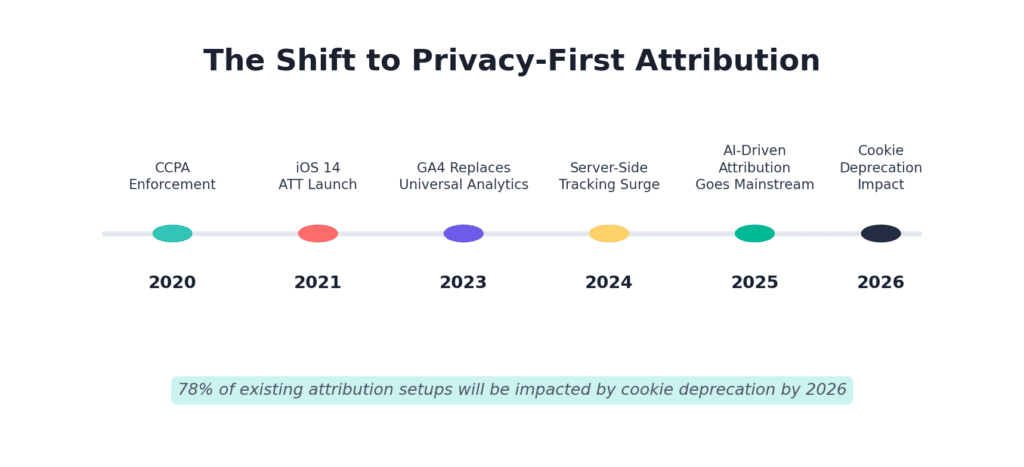
iOS 14 tracking limitations reduced observable conversions by 18 to 32%. Cookie deprecation will impact 78% of existing attribution setups by 2026. The fix is server-side tracking, which sends data directly from your server to ad platforms instead of relying on browser cookies.
Server-side tracking improves data accuracy by 13 to 27%. Only 1 in 5 advertisers have fully implemented it. That’s a competitive advantage waiting to be claimed.
📊 By the Numbers
Companies using attribution effectively see 15 to 30% higher marketing ROI, reduce wasted ad spend by 27%, and achieve 1.7x faster revenue growth. The gap between teams with good attribution and teams without it is getting wider every year.

Privacy Changes Are Rewriting The Attribution Playbook
The era of tracking every user across every device is over. Privacy regulations, browser restrictions, and cookie deprecation are forcing marketers to rethink marketing measurement from the ground up.
First-Party Data Is Your New Foundation
With third-party cookies disappearing, your own first-party data becomes the most valuable asset in your marketing measurement stack. Email addresses, account logins, purchase history, and on-site behavior give you direct signals that no browser update can take away.
Zero-party data (information customers voluntarily share, like preferences and survey responses) increases attribution accuracy by 16%. Building mechanisms to collect this data, like preference centers and value-exchange forms, should be a priority for every marketing team in 2026.
Media Mix Modeling Is Making A Comeback
Marketing mix modeling (MMM) analyzes aggregate spending and outcome data without tracking individual users. It answers the question: “If we increase spend on Channel X by $10,000, how much additional revenue should we expect?”
MMM works for channels that resist user-level tracking. TV, radio, billboards, and even some digital channels where privacy blocks traditional conversion tracking.
The smartest teams are combining MMM with multi-touch attribution to get both the bird’s-eye view and the granular touchpoint analysis. This dual approach is particularly valuable for companies managing global operations where privacy regulations vary by region and a single tracking approach can’t cover everything.
Incrementality Testing Validates Your Attribution
Attribution tells you what happened. Incrementality testing tells you what would have happened without your marketing. It isolates the true causal impact of each channel by running controlled experiments.
The gold standard is geo-based lift testing. You turn off spend in one region and keep it running in another, then compare results. It’s disruptive and sometimes expensive, but it gives you ground truth that no model can argue with.
💡 Quick Tip
Run incrementality tests quarterly on your top 2 to 3 channels. Even a single test per quarter gives you a reality check on whether your attribution model is actually pointing you in the right direction.
5 Common Attribution Mistakes (And How To Avoid Them)
Even teams with solid models in place make avoidable errors. Here are the 5 biggest ones.
- Over-relying on a single model. No single model provides complete accuracy. Last-click undervalues upper-funnel work. First-touch ignores conversion drivers. Compare at least 2 models before making campaign performance decisions.
- Ignoring offline touchpoints. Phone calls, events, and in-store visits still drive conversions. If your attribution stack only tracks digital, you’re missing critical pieces of the conversion path. 90% of enterprise ad platforms are expected to integrate offline conversions natively by 2027.
- Setting and forgetting. Attribution requires ongoing calibration. Customer behavior changes, new channels emerge, and market conditions shift. Review your model quarterly at minimum.
- Chasing perfect data instead of useful data. You’ll never track 100% of interactions. Focus on capturing the touchpoints that drive the most marketing spend optimization decisions. 80% accuracy on your top channels beats 0% accuracy while you wait for a perfect system.
- Not connecting attribution to revenue. Clicks and conversions are intermediate metrics. If your attribution data doesn’t connect to actual revenue and business outcomes, it’s just an expensive reporting exercise.
Here’s a quick audit checklist to see where your attribution stands.
| Area | Questions to Ask | Red Flag |
| Data Quality | Are UTMs standardized across all campaigns? | Multiple naming conventions per channel |
| Model Selection | Are you using more than 1 attribution model? | Only last-click with no comparison |
| Tech Stack | Does attribution connect to your CRM revenue data? | Attribution lives only in Google Analytics |
| Privacy | Have you implemented server-side tracking? | Still relying 100% on client-side cookies |
| Process | When did you last review your model? | “We set it up 2 years ago” |
⚠️ Common Mistake
47% of businesses upgraded attribution software in the past 12 months, but only 29% have a dedicated attribution specialist. Buying the tool without having someone own the process means expensive software collecting dust.
Building Your Attribution Strategy: Where To Start This Week
You don’t need to overhaul everything at once. Here’s a 4-week plan to get meaningful attribution running.
Week 1: Audit your current tracking. Check UTM consistency, verify your analytics tags fire correctly, and document every channel you’re actively spending on. This is the foundation. For solopreneurs and freelance consultants running lean, your financial platform doubles as your data source. Tools like Xolo track invoicing and revenue across clients and geographies, which gives you a clean baseline for connecting marketing spend to actual income.
Week 2: Pick your attribution model. If you’re under 300 monthly conversions, start with position-based (U-shaped). If you’re over that threshold, test data-driven attribution in GA4 alongside position-based.
Week 3: Connect attribution to revenue. Map your analytics data to your CRM pipeline stages so you can see which touchpoints drive actual dollars. Not just leads or clicks.
This is where your talent sourcing tools and marketing tools need to work together to give you a full picture.
Week 4: Run your first budget reallocation. Take the insights from your attribution data and shift 10 to 15% of spend away from overvalued channels toward undervalued ones. Measure results over 60 days.
The key is progress, not perfection. Every team that switches from gut-feel budgeting to attribution-informed decisions sees better results. The 22% improvement in budget efficiency that comes from multi-touch attribution doesn’t require a perfect setup. It just requires a better one than what you have now.
Attribution isn’t a one-time project. It’s an ongoing practice of getting slightly more right about where your money goes. Start with what you can control, measure what matters, and improve from there. The teams that treat marketing measurement as a competitive advantage are already pulling ahead. The gap will only get wider in 2026.