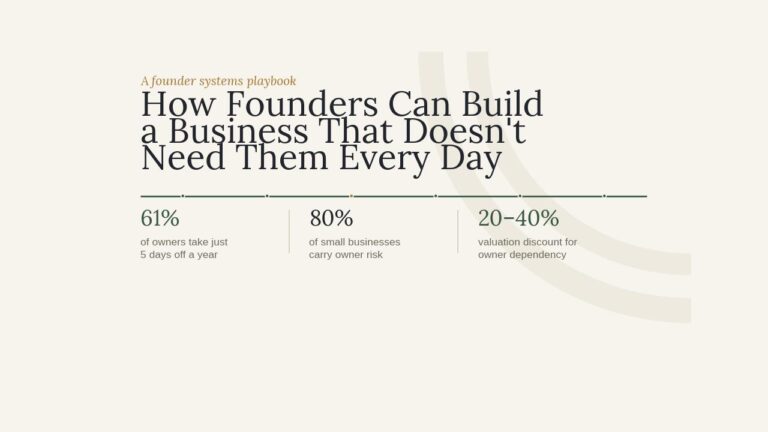
61% of small business owners take just 5 days off a year, and 12% take none at all, not because the work never stops but because nothing runs without them checking in. That gap is a systems problem, not a discipline problem, and it shows up the moment a founder tries to step back from the habits that prevent founder burnout and finds the business simply stalls. This post lays out 6 systems that fix that, a checklist to run before you try stepping back, and 3 metrics that prove it actually worked.
What It Actually Means to Build a Business That Doesn’t Need the Founder
A business that doesn’t need the founder still needs the founder’s judgment. It just doesn’t need their hands on every task, every decision, every day.
That distinction matters because most founders hear “step back” and picture disappearing entirely. Stepping back and checking out are different things, and confusing them is why so many systems projects stall halfway.
80% of small businesses carry heavy owner dependency, and buyers price that risk directly into what they’ll pay. Owner-dependent businesses sell at a 20-40% valuation discount compared to ones with documented processes and a real management layer.
Whether you plan to sell in 5 years or never, the same systems that raise a sale price are the ones that get you an actual weekend off. That’s the real prize here, not the eventual exit.
And the two goals rarely conflict. A buyer’s due diligence checklist and a founder’s honest wishlist for their own week both land on the same short list: written processes, a second person who knows the clients, and decisions that don’t wait on one inbox.
6 Systems That Build a Business That Doesn’t Need the Founder
Build these roughly in order. Each one makes the next easier, and skipping ahead to authority or metrics before the documentation exists is why most systems projects stall halfway through.
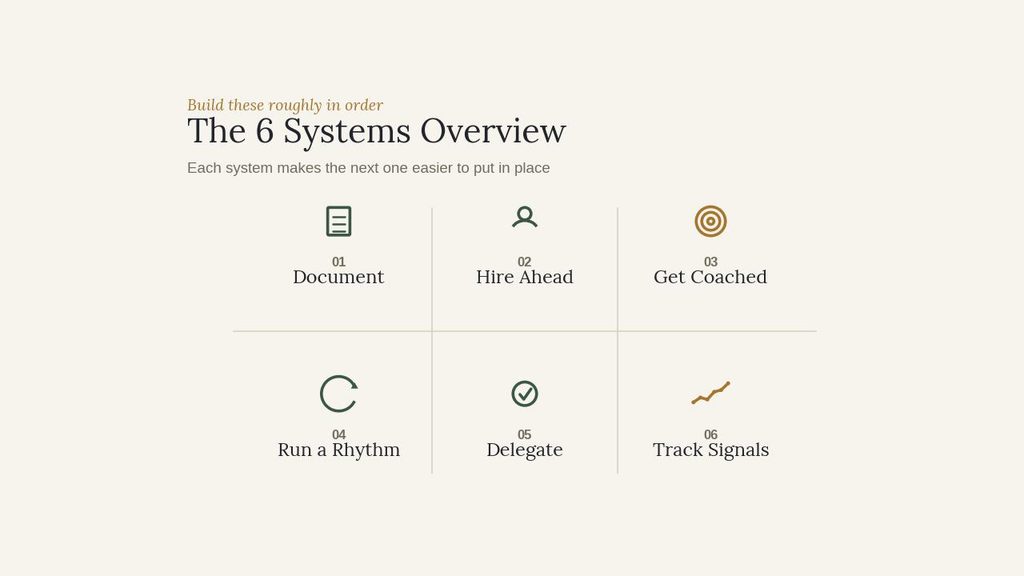
Document, hire ahead, get coached, run a rhythm, delegate, and track signals, roughly in that order.
Document the Decisions Only You Currently Make
Founders spend 68% of their time on operational work instead of strategic growth, and most of that time goes toward decisions nobody else is allowed to make. Not because the founder hoards control on purpose. Because the decision only ever existed in their head.
Start a running list this week. Every time you make a call someone else could have made if they’d known what you know, write down the decision and the reasoning behind it. After a month, that list is your first real operations manual.
Don’t wait for a slow week to start this, because a slow week never actually arrives. Keep the list open in a tab and add to it the moment a decision happens, while the reasoning is still fresh enough to explain in 2 sentences.
Hire Before You’re Desperate, Not After
Desperate hiring produces the same bad pattern every time: whoever’s available gets the job, not whoever fits it. By the time a founder admits they need help, they’re too underwater to interview properly.
The uncomfortable fix is hiring 1 quarter before you think you need to, while you still have the bandwidth to onboard someone right. Most hiring problems are actually leadership problems that show up as bad hires, and a rushed hire almost always traces back to a founder who waited too long to start looking.
⚠️ Common Mistake
Founders often hire a generalist to “help with everything” instead of a specialist for the one bottleneck that’s actually costing them time. A vague job description produces a vague hire, and a vague hire becomes one more thing the founder has to manage closely.
A Structured Framework Beats Generic Advice From a Podcast
Podcasts and YouTube hand founders scattered tactics, not a sequence. A structured program forces the order, diagnose first, plan second, execute third, instead of grabbing whichever framework trended this week.
Founders who go through structured mentoring survive past year 5 at roughly double the rate of founders who don’t, 70% vs 35%. That gap comes from sequence, not information, since most founders already know they should delegate, document, and hire ahead of need.
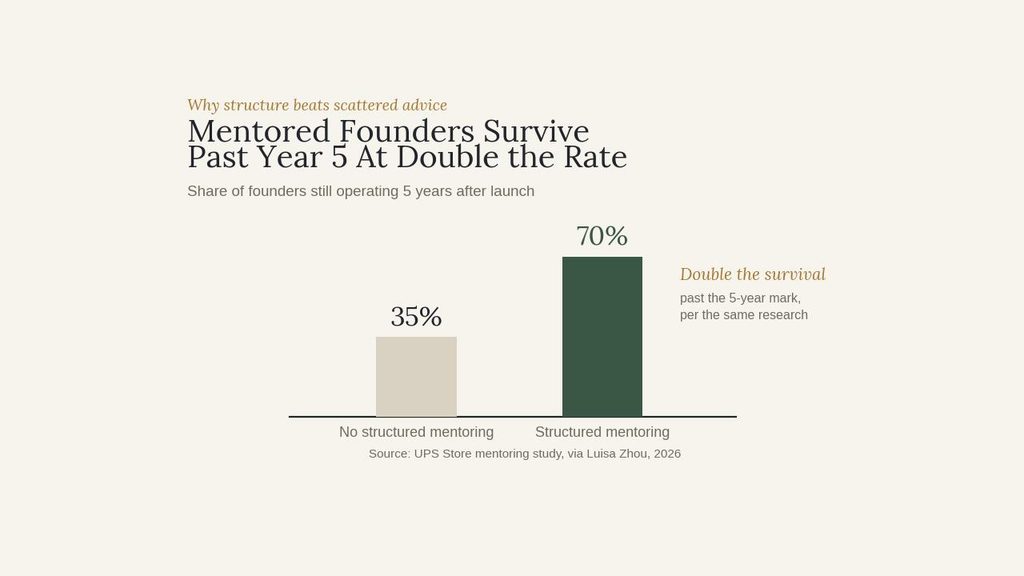
Founders who go through structured mentoring survive past the 5-year mark at roughly double the rate.
A startup coaching program like Small Business Coach packages that sequence into a single engagement, a business assessment, a written plan, systems setup, instead of a hundred scattered podcast episodes. Small Business Coach runs its jump-start package on exactly that order over 3 months: business planning first, marketing strategy next, then systems setup so daily operations stop running through the founder’s inbox.
The group format runs a few hundred dollars a month rather than the low thousands a one-on-one engagement costs, which matters for a founder who hasn’t validated the spend yet. Either format still forces the same sequence, and the sequence is the part generic advice can’t give you.
💡 Pro Tip
Before hiring any coach or consultant, write down the 3 decisions you keep deferring. If a program can’t name how it addresses those 3 things in the first session, it’s generic advice wearing a structured price tag.
Build a Weekly Rhythm That Doesn’t Require You to Run It
A business without a meeting rhythm runs on whichever fire is loudest that day. EOS, the operating system behind Gino Wickman’s book Traction, runs a 90-minute weekly leadership meeting that hundreds of thousands of companies now use to review numbers, check priorities, and solve issues before they compound.
The founder doesn’t have to personally run this meeting forever. Someone else can hold the agenda once the rhythm exists, which is the entire point.
Start smaller if 90 minutes feels like too much to hand over immediately. A 30-minute weekly check on 3 numbers still beats no rhythm at all, and it’s easier to hand to someone else on week 1.
📌 Key Takeaway
The specific framework matters less than the discipline of a fixed weekly slot, same day, same time, where the business reviews itself instead of waiting for the founder to notice something’s wrong.
Give Someone Else Real Authority, Not Just Tasks
Delegating tasks without delegating authority just moves the bottleneck sideways. The employee still has to check with the founder before anything real gets decided.
Roughly a third of small and mid-sized businesses actively practice formal delegation, meaning most founders are delegating tasks while quietly keeping every decision. Real delegation means naming a dollar threshold or a decision category and actually letting someone act inside it without asking first.
Pick one category this month. Refunds under a set amount, or scheduling changes that don’t touch pricing, work well as a first test since the downside of a wrong call stays small while the team builds confidence.
Track Leading Indicators, Not Just Revenue
Revenue tells you what already happened. It never tells you what’s about to happen next, which is the entire problem with using it as your only dashboard.
Pick 2 or 3 leading indicators specific to your business, like proposals sent, response time on support tickets, or the percentage of decisions made without the founder’s input this week. That last one is the number that actually measures the goal of this whole article.
Review these on the same weekly cadence from the system above, not as a separate exercise. A leading indicator nobody looks at regularly isn’t a metric. It’s a spreadsheet column.
Signs Your Business Still Needs the Founder Every Day
Watch for these 5 patterns. They tend to cluster together.
| Red Flag | What It Signals |
| Team members wait for approval on routine calls | No documented decision rights |
| Founder is the only one who talks to key clients | Relationship risk concentrated in one person |
| No meeting happens if the founder is out sick | Rhythm depends on a person, not a system |
| New hires shadow the founder to learn the job | Nothing is written down anywhere |
| Founder checks messages daily on vacation | The business hasn’t been tested without them |
A Simple Systems Checklist for a Business That Doesn’t Need the Founder
Run through this before you try taking real time off.
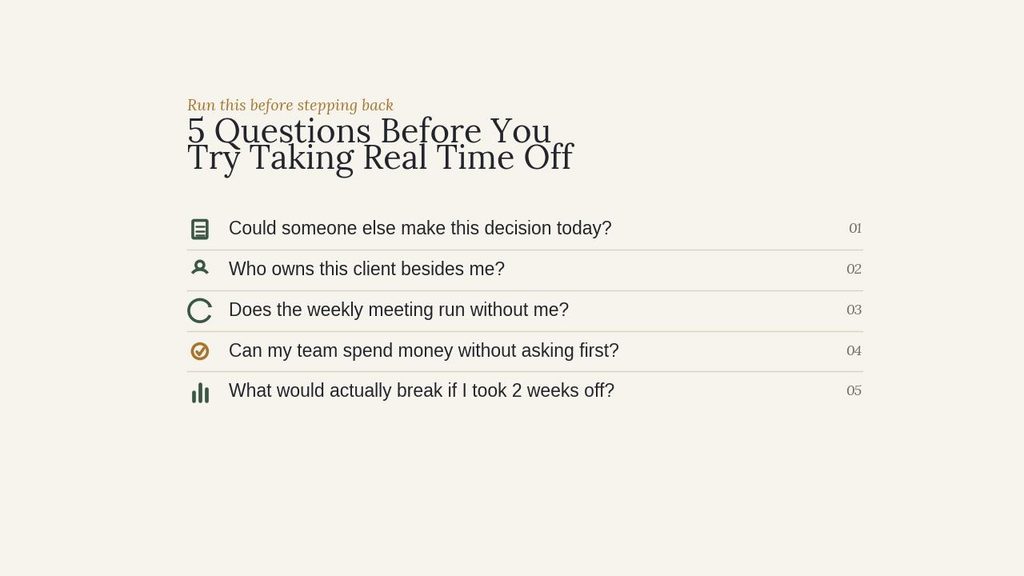
5 questions worth running through honestly before you try taking real time off.
| Question to Ask Yourself | What “Ready” Looks Like |
| Could someone else make this decision today? | A documented rule, not just your gut |
| Who owns this client relationship besides me? | A named second point of contact |
| Does the weekly meeting run without me? | Someone else holds the agenda |
| Can my team spend money without asking first? | A clear, communicated dollar threshold |
| What would break if I took 2 weeks off? | A short list, not a long one |
3 Metrics That Prove Your Business Doesn’t Need the Founder Anymore
Track these over a full quarter, not just one good week.
Days off without checking in. Start with 1 full day, phone off. Most founders can’t get through the morning the first time they try. That’s diagnostic information, not failure, and it tells you exactly which system from above is still missing.
Decision latency. How long does a routine decision sit waiting for the founder’s input? If the answer is measured in days instead of hours, authority hasn’t actually transferred yet, no matter what the org chart says.
Revenue per founder hour. Track total revenue against hours the founder personally worked. A business that doesn’t need the founder shows this number climbing even as founder hours drop, which is the clearest financial proof the systems are working.
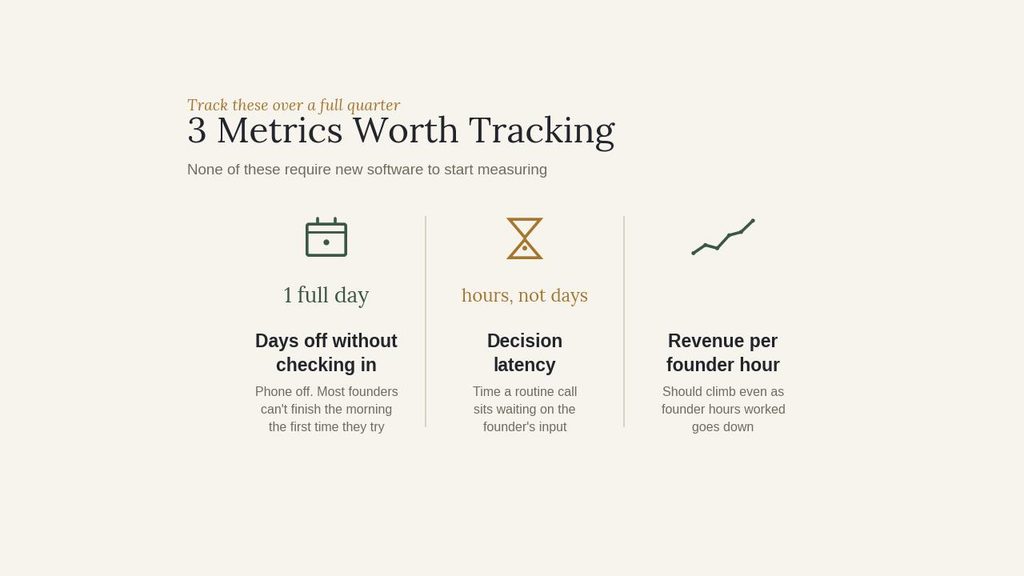
3 metrics worth tracking over a full quarter, none of which need new software to start measuring.
What Comes Next for a Business That Doesn’t Need the Founder
None of these 6 systems are complicated on their own. What’s hard is doing them in order instead of jumping to whichever one feels most urgent this week. Build the documentation first, and organizational values that outlast any single founder become the thing that actually holds the business together once you’re not the one holding it.