The quote is in, the sample looks fine and the launch date is getting closer. Approving the design feels like progress, so many founders do it quickly. That is the moment to slow down. Approval is the last point where a change is cheap. Once tooling is cut and materials are ordered, every fix costs money and weeks.
The good news is that a handful of well-chosen questions catches most problems early. You do not need an engineering degree to ask them. You need to know what to ask, who should answer and what a good answer sounds like. If you are still deciding between a local partner and an overseas one, this comparison of outsourcing vs. offshoring lays out the trade-offs.
This guide covers the questions to ask about capability, materials, the prototype file, the design package, minimums, quality checks and problem handling. It ends with a short list of warning signs and what to do about each.
Why the Questions Come Before the Approval
A design approval is a promise. You are telling the manufacturer that this file, at this revision, is what you want built. If the file is wrong, unclear or incomplete, the factory will usually build exactly what it says.
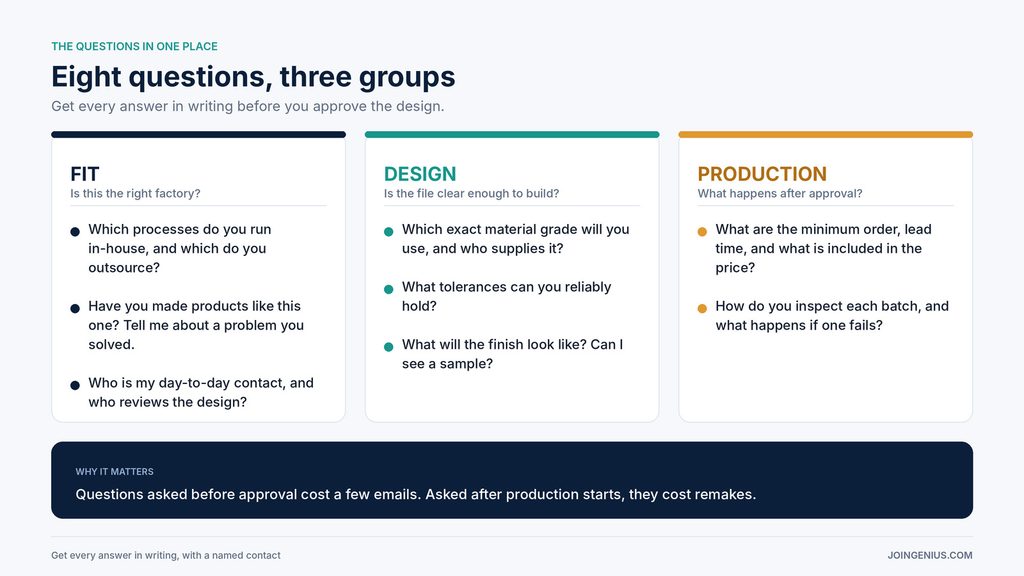
That is why the order matters. Questions asked before approval cost a few emails. The same questions asked after production starts cost remakes, delays and awkward conversations about who is at fault. Treat the approval as a gate that opens only when the answers are in writing.
The questions in this guide fall into three groups: fit, design and production. Here is the short version, and the sections below explain each one.
Ask About Capability and Fit
Start by finding out whether this manufacturer is the right one for your product. A factory that makes excellent metal brackets may be a poor choice for a molded plastic case.
Start with fit. Which processes do you run in-house, and which do you outsource? Have you made products like this one, and can you describe how? Who will be my day-to-day contact, and who reviews the design? Outsourced steps are worth knowing about, because they add handoffs and delays you may not see until something goes wrong.
Ask for examples of similar work, and ask how they handled a problem on one of those jobs. A confident manufacturer will have a specific story. A vague answer suggests either limited experience or a reluctance to share it.
Ask About Materials, Tolerances and Finishes
Many disputes come down to three words on a drawing: material, tolerance and finish. Each one needs a clear answer.
For materials, ask exactly which grade will be used, who supplies it and what happens if it is unavailable. Substitutions can change strength, weight, color and cost, so ask the manufacturer to tell you before they make one.
For tolerances, ask what the process can reliably hold and whether any dimension on your design is tighter than necessary. Tighter tolerances usually cost more. If a dimension does not affect fit or function, it can often be relaxed.
For finishes, ask for a physical sample or a clear reference. “Matte black” means different things to different suppliers, so agree on what it looks like before production.
Reviewing a Prototype File Before You Approve a Production Run
Many founders approve a design from a quick render or a few screenshots. A better habit is to open the actual file and look at it yourself, from every angle, before you sign off.
A 3D visualization tool such as F3D makes that easy to do. Its site describes it as a fast, minimalist 3D viewer for the desktop, free and open source and cross-platform. Its gallery shows many kinds of models, including a CAD part in STEP format, and its homepage says it can be used to view and inspect engineering models.
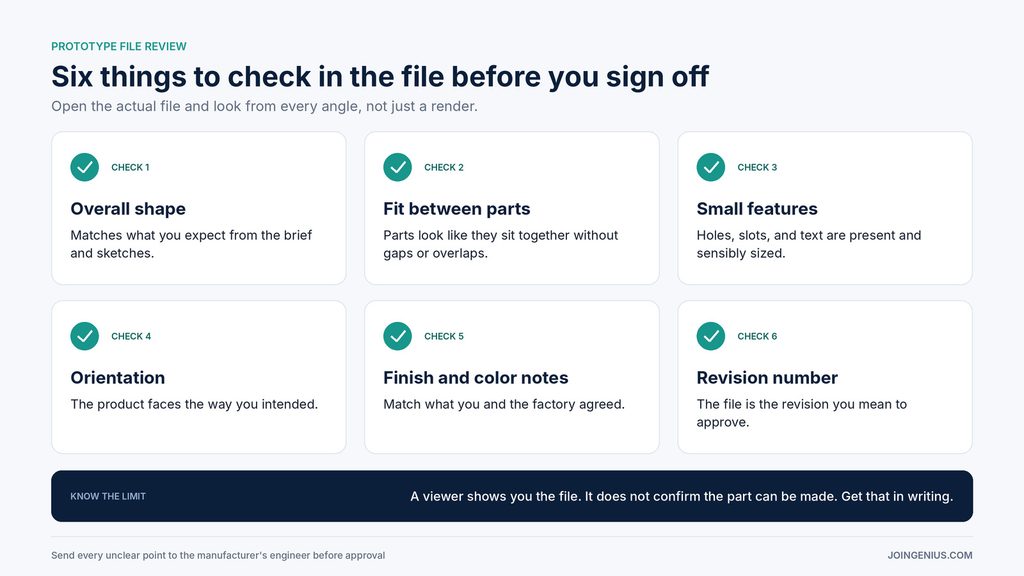
Use the view to check six things. Does the overall shape match what you expect? Do the parts look like they fit together? Are small features, such as holes, slots and text, present and sized sensibly? Is the product oriented the way you intended? Do the finish and color notes match what you agreed? And does the file carry the revision number you meant to approve?
Write down anything that looks unclear, and send those questions to the manufacturer’s engineer before you approve.
Keep the tool’s limits in mind. F3D’s pages describe it as a viewer, and they do not mention tolerance checks or manufacturability analysis. Its homepage does not list which file formats it supports, so check that your file opens before you rely on it. Use it to look closely, then ask the manufacturer to confirm in writing that the design can be made as shown.
Send a Complete Design Package
An incomplete package forces a factory to guess, and guesses become defects. Before you approve anything, make sure the manufacturer has everything they need in one place.
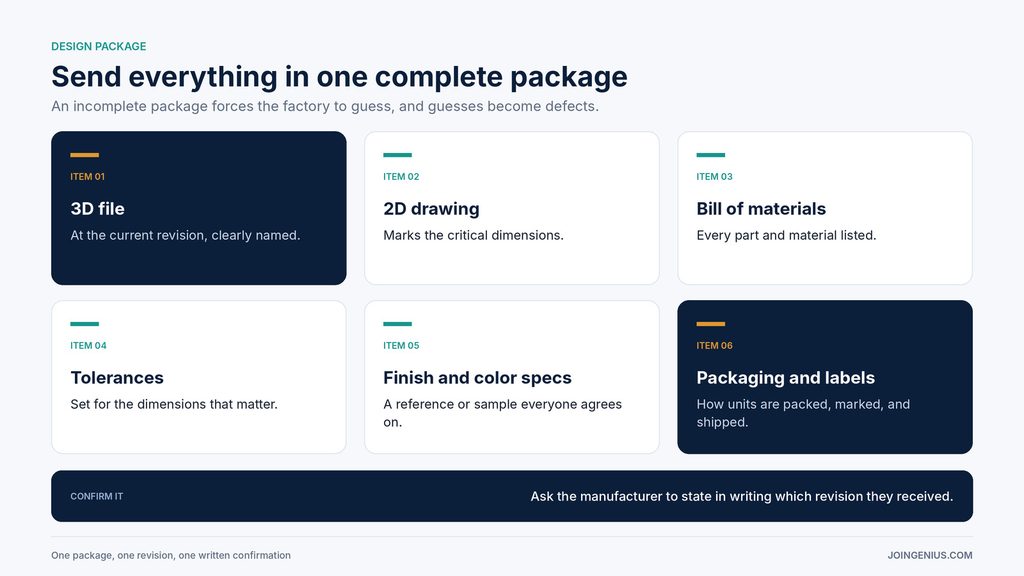
A solid package includes six items. First, the 3D file at the current revision. Second, a 2D drawing that marks the critical dimensions. Third, a bill of materials that lists every part and material. Fourth, tolerances for the dimensions that matter. Fifth, finish and color specifications. Sixth, packaging and labeling notes.
Ask the manufacturer to confirm in writing which version they received. Small sellers who make custom items already know the value of a clear approval step, and this guide to fulfilling 3D-printed custom orders shows how simple checks before production prevent expensive surprises. The same habits apply when a factory builds your parts.
Ask About Minimums, Lead Times and Pricing Terms
Price is more than the number on the quote. Ask what the minimum order is and what happens if you want to order less the first time. Ask how long production takes after approval, and which steps could add time.
Ask what is included in the price. Tooling, samples, packaging, testing and shipping are often quoted separately, and a low unit price can hide large extra costs. Ask how the price changes if you order more, and how long the quote is valid.
Finally, ask about payment terms. A deposit is normal. Find out what it covers, when the balance is due and what happens if you reject a batch.
Ask About Samples and Quality Checks
A sample proves that the factory can make the product once. A quality process proves that it can make the product every time.
Ask what sample you will get before full production, and whether it will be made with the final materials and process. Ask what inspections happen during and after production, who performs them and what you will receive as proof. Agree in advance on what counts as a defect and how many defective units are acceptable, since “good quality” is not a measurable standard.
If the budget allows, consider an independent inspection before the goods ship. The cost is small compared with the cost of finding a problem after the shipment arrives.
Ask What Happens When Something Goes Wrong
No supplier is perfect, so ask about the problem plan before you need it. Who pays for remakes if the fault is the factory’s? What if the fault is a mistake in your file? How quickly will they respond to a defect report? What evidence do they need?
Get the answers in writing, along with a named contact. A manufacturer that has a clear answer to these questions has probably dealt with problems before and handled them well.
Warning Signs in a Manufacturer’s Answers, and What to Do About Each
Some answers should slow you down. The table below pairs each warning sign with what it may mean and a practical next step.
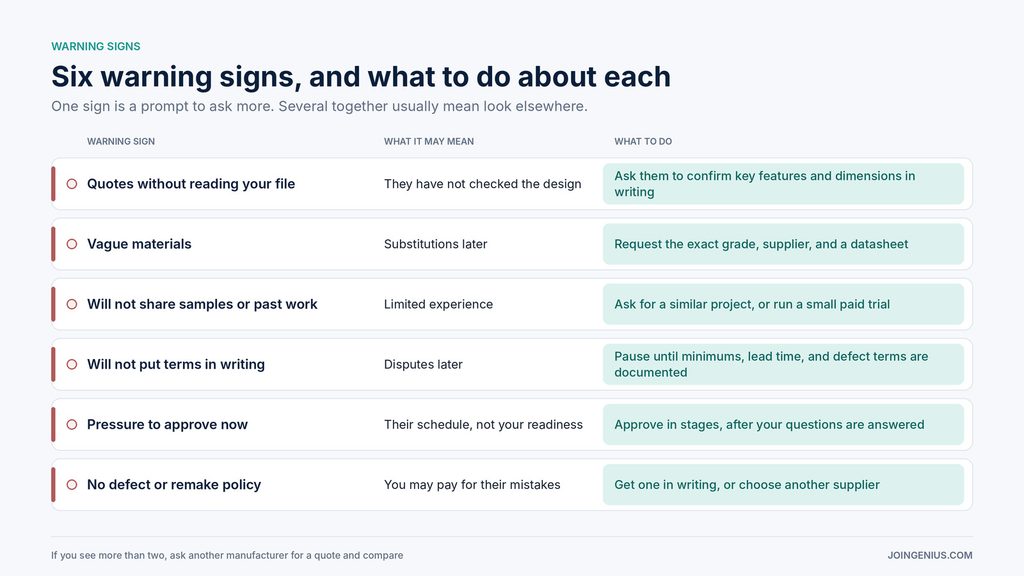
One warning sign does not always mean a bad partner. Several together usually do. If you see more than two, consider asking another manufacturer for a quote and comparing the answers.
Approve in Stages
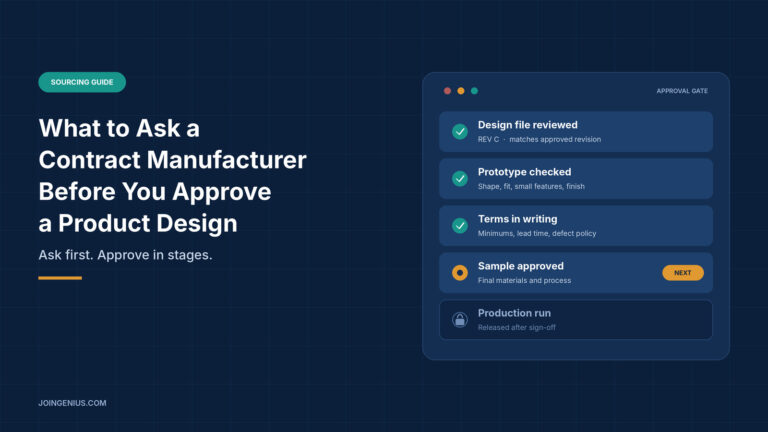
A product design does not have to be approved in one leap. Ask your questions, review the file yourself, send a complete package, agree on terms, approve a sample and only then release the production run. Each step is a chance to catch a problem while it is still cheap.
A practical first step is to turn this article’s questions into a one-page checklist and send it to your shortlisted manufacturers. Compare the answers side by side. Once the product is lined up for production, the next job is making sure your store can sell it, and this guide to the ecommerce tool stack covers what to put in place.