
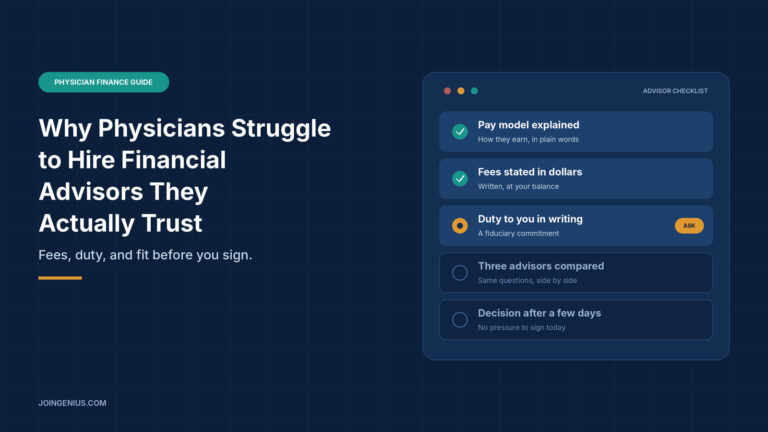
A physician finishes training with a high income, a pile of obligations and almost no time. Within months, advisors start to appear: a colleague’s recommendation, a cold call, a seminar invitation. Each one sounds confident. Few explain, in plain language, how they are paid or what they owe you.
That is why so many physicians struggle to hire a financial advisor they actually trust. The problem is rarely a shortage of options. It is the lack of a clear way to tell good advice from a good sales pitch. The habit that helps most is the one you would use anywhere else: check claims before you accept them. This guide to vetting candidates before you trust them frames verification as a way to test what someone tells you, not as an accusation, and that mindset fits here.
This guide covers why trust is hard to build, how to read an advisor’s pay, what a fiduciary duty means, how to use a vetted list, how to compare advisors side by side and what to do when something feels off. It ends with a table of warning signs.
Why Physicians Find Advisors Hard to Trust
Four things work against physicians when they look for financial help.
Time is the first. Long hours mean decisions get handed off quickly, often to whoever is easiest to reach. Income is the second. A high and steady income attracts honest advisors and aggressive salespeople alike. Training is the third. Medical education often includes little about personal finance, so it is hard to judge advice from the inside. Titles are the fourth. Words like “advisor,” “planner” and “consultant” are used loosely, and none of them tells you how the person is paid.
Add a colleague’s story about a bad experience, and the whole field can start to feel unsafe. Many physicians end up relying on a recommendation from a peer or on whoever called first. Trust built on comfort alone is fragile. Trust built on checks holds up.
Start With How the Advisor Gets Paid
The most useful single question is how the advisor is paid, because pay shapes incentives. There are four common models, and each one creates a different pull.
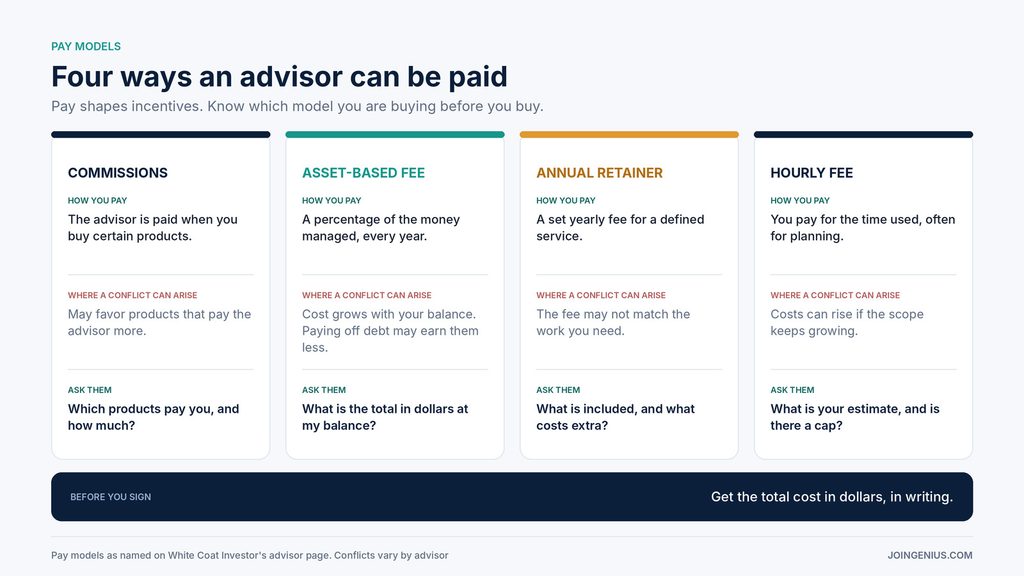
With commissions, the advisor earns money when you buy certain products, which can favor products that pay more. With a percentage of assets, you pay a share of the money managed each year, so the cost grows with your balance, and the advisor may have less reason to suggest paying down debt. With an annual retainer, you pay a set fee for a defined service, so the question is what is included. With hourly fees, you pay for time used, which suits specific planning questions, so ask for an estimate and a cap.
None of these is automatically right or wrong. The White Coat Investor page covered below says it generally prefers flat annual fees for investment management and hourly fees for planning, and that percentage fees can be cost-effective at lower asset levels. Whatever the model, ask for the total in dollars at your current balance, and review it every year.
Confirm the Duty Before the Pitch
A fiduciary is expected to put your interests ahead of their own. Not every advisor is held to that standard. Some are held to a looser one that only requires a recommendation to be suitable.
Ask directly: “Will you act as a fiduciary at all times, and will you put that in writing?” A clear yes in writing is a good sign. Hesitation, or a long answer that never quite says yes, tells you something too.
Keep in mind that a written duty is not a guarantee. It gives you something to hold the advisor to, but it does not replace checking their fees, their record and your own comfort with them. You can also look up an advisor’s registration and any disciplinary history through regulator databases, such as the SEC’s adviser search and FINRA’s BrokerCheck, before you meet.
A Vetted List Is a Starting Point, Not a Verdict
A list of vetted firms can shorten the search. White Coat Investor publishes one of the best-known lists of financial advisors for doctors, and it is open about how it works: every listed firm is a paid advertiser that passed a vetting process, the first ten are premium listings, and placement does not imply endorsement. Read it the way you would read any shortlist. It is a place to find names, not proof that any one advisor is right for you. The page also explains the four ways advisors get paid, which gives you a ready set of questions to ask each firm you contact.
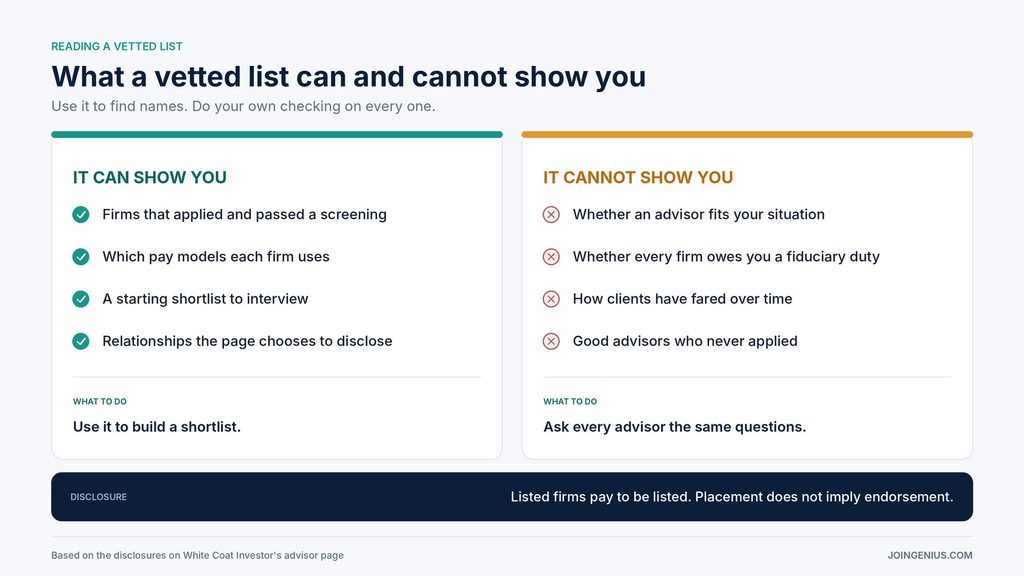
The page also discloses that White Coat Planning, one of the listed firms, was founded by White Coat Investor, which is useful to know when you weigh any recommendation.
A list can show you which firms applied and were screened, and which pay models they use. It cannot show you whether an advisor suits your situation. The page does not say that every listed advisor is a fiduciary, and it gives no performance data, so those are questions for you to ask. It also only includes firms that chose to apply, so a good advisor who has never advertised will not appear. None of that is a reason to skip the list. It is a reason to ask the same questions of every name, on the list or off it.
Compare Several Advisors Before You Choose
Interview at least three advisors, and ask each of them the same questions so the answers can be compared. The scorecard below turns the key questions into something you can print and fill in during each call.
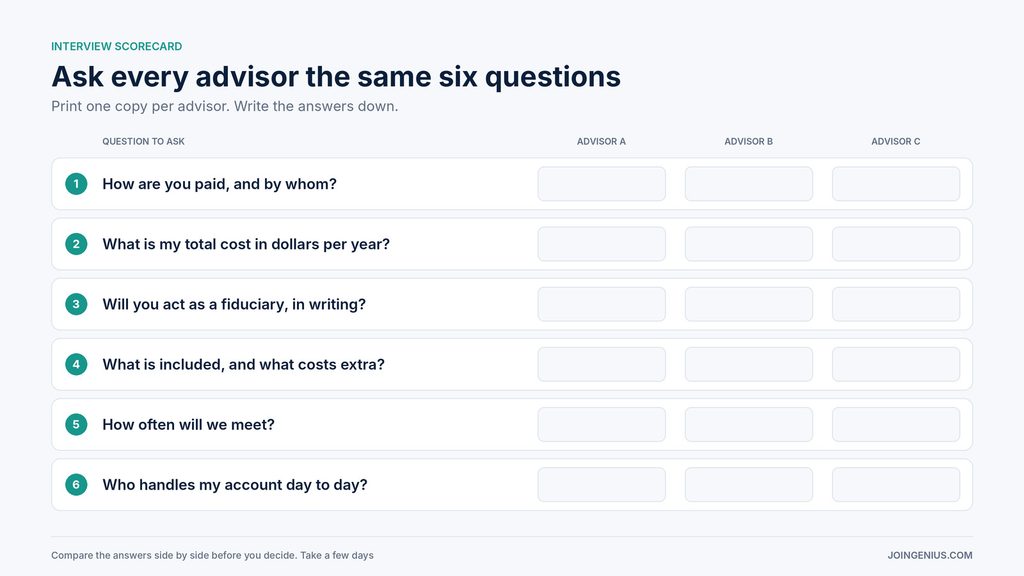
Ask for the fee schedule in writing, along with a description of what is included, and ask how often you will meet and who handles your account day to day. Then take a few days. A good advisor will not mind. The process is similar to choosing a finance provider for any business, which means clarifying what you need, comparing several options and checking client feedback before you commit.
Check Fit, Not Just Credentials
Credentials and a clean record are the minimum. Fit decides whether you will actually follow the advice.
Notice whether the advisor explains things without jargon, whether they ask about your goals or steer you to a standard plan, and whether they tell you when you do not need their services. Ask how they handle disagreement, and ask what they would do in a situation you are facing. A sample plan or a worked example shows more than a sales presentation does. Small tests like these build trust faster than reassurance does.
Warning Signs When Hiring an Advisor, and What to Do About Each
Some behaviors should slow you down. The table below pairs each warning sign with what it may mean and a practical next step.
| Warning sign | What it may mean | What to do |
|---|---|---|
| Will not state fees in dollars | Hidden cost | Ask for a written fee schedule at your balance |
| Vague about how they are paid | Possible conflicts | Ask who pays them, and for what |
| Pushes a product in the first meeting | Sales focus | Ask why, and who gains from it |
| Pressure to sign today | Their timeline, not yours | Take the paperwork home and compare |
| Promises returns | Unrealistic claims | Ask about process, not outcomes |
| Will not put duty to you in writing | No clear commitment | Ask again in writing, or choose another advisor |
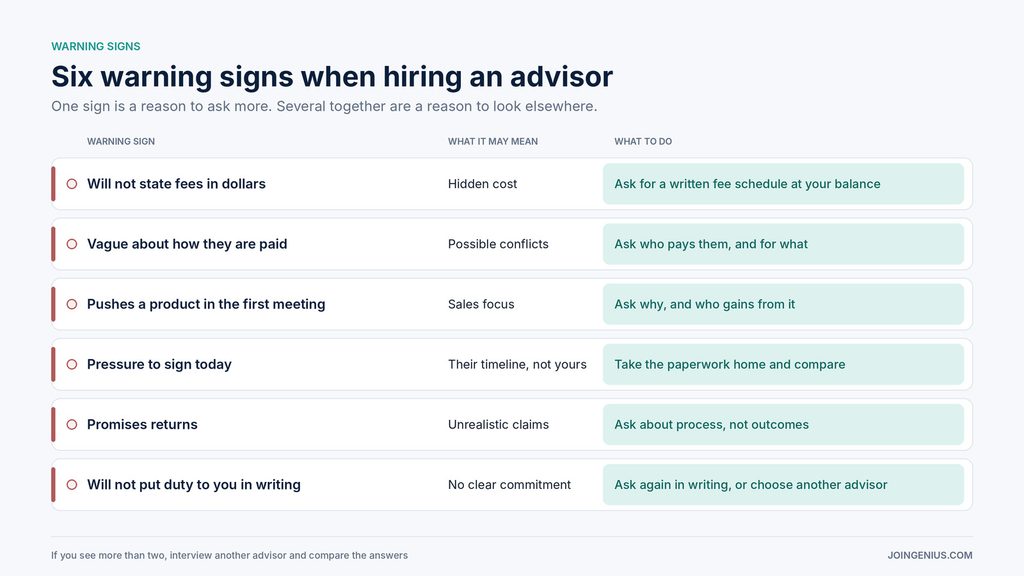
One warning sign is a reason to ask more questions. Several together are a reason to look elsewhere.
Take the Next Step
You do not need to decide this week. Write down your questions, gather three names from any source, including the list above, and send the questions in advance so the answers come back in writing. Fill in the scorecard after each conversation, and decide only once you can compare them side by side.
For the conversation itself, the working-style questions in these culture fit interview questions can be adapted for an advisor interview. Advisors who earn your trust are usually the ones who welcome the scrutiny.