
You are hiring a founder-type leader, and the résumé lists a handful of ventures. One was acquired, one wound down, and one is described as “a side project that grew.” The references are warm and the interviews went well. But almost everything you know about those ventures comes from the candidate. That is a lot of trust to place in a single source, especially for a role with real authority and a public reputation that will become your company’s.
Résumés and references tell the story the candidate wants told. Public records can confirm that story or complicate it. Domain registration data is one of the more practical sources, because almost every venture leaves a trace online. This guide explains what those records can and cannot tell you, how to prepare before you search, how to read the results, and how to turn what you find into fair interview questions. If you are weighing whether a founder should join as a full-time leader or as a part-time adviser, this comparison of a business coach and a fractional executive is a useful place to start before you get to verification.
Why Founder and Executive Hires Need Extra Verification
Founders and senior executives carry more risk than most hires. They hold authority over budgets, people, and decisions. They often have access to sensitive data. And their public reputation becomes closely tied to the company’s, so a surprise from their past can quickly become a problem for the business.
Their histories are also harder to verify. A person who has spent fifteen years at large employers leaves a clear trail of titles, dates, and references. A person who has started several companies may have a trail that is fragmented, informal, or simply undocumented. Some ventures were never incorporated. Some were closed quietly. Some ended on good terms and some did not.
Standard checks were not built for this. They confirm identity, employment, and education, but they say little about a founder’s earlier ventures. That is where public domain records can help, as one more way to test the story you have been told.
What Public Domain Records Can and Cannot Tell You
Before you rely on any source, be clear about what it can actually show.
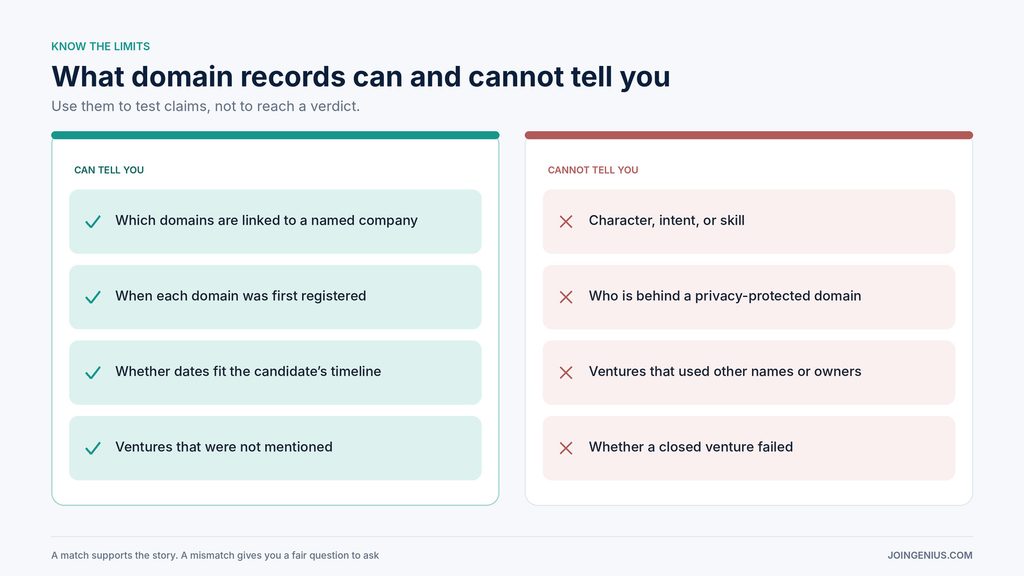
Domain records can show which domains are linked to a named company or registrant, when each domain was first registered, and whether those dates fit the candidate’s account. They can help you spot ventures the candidate did not mention and confirm ones they did. They can also show whether a business they describe as long-running was actually online for as long as claimed.
They cannot tell you about character, intent, or skill. A closed venture is not a failed venture, and an old domain is not proof of a successful one. Records also have gaps. Many registrations use privacy services that redact names and contact details, so you may see a domain but not who is behind it. A search may also miss ventures that used other names or other registrants.
Treat domain data as a way to test claims, not as a verdict. A match supports the candidate’s story. A mismatch simply gives you a fair question to ask.
What to Verify Before You Start Searching
Preparation matters more than the search itself, because it keeps the review focused, lawful, and fair.
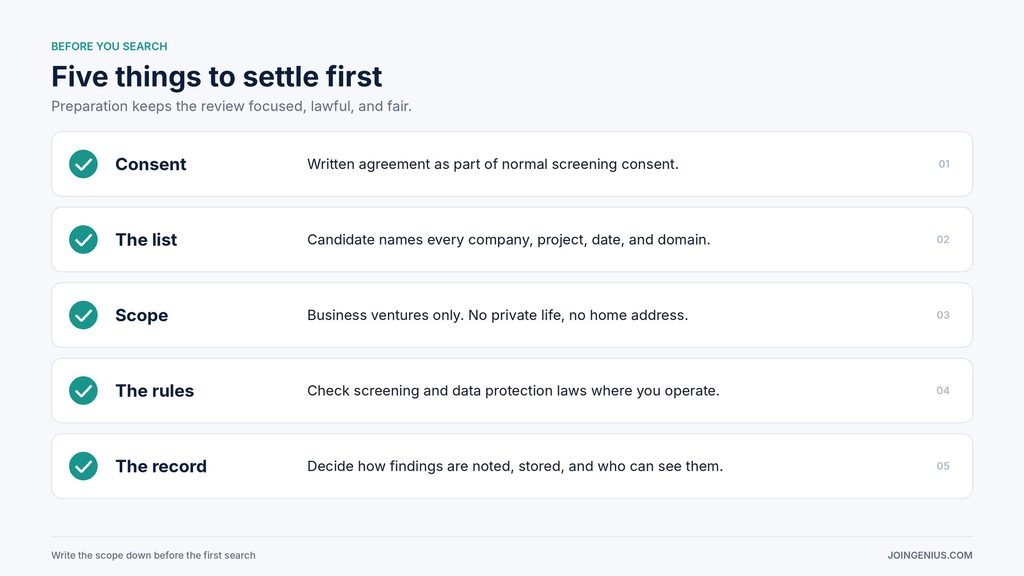
Start with consent. Tell the candidate that you will review public records connected to the ventures they list, and get their agreement in writing as part of your normal screening consent. Candidates who are open about their history usually have no problem with this, and the request signals that your process is careful.
Next, ask for the list. Have the candidate name every company and project they have led, with the approximate dates and the domains they used. This keeps your review anchored to the history they have chosen to share, and it gives you a clear baseline to compare against.
Separate the business from the person. Your goal is to understand the candidate’s professional ventures, not their private life. Decide in advance that you will look only at records connected to the companies and projects on their list, and write that scope down.
Then check your obligations. Screening and data protection rules differ by country and region, and some restrict how information can be gathered and used. If you are unsure, ask your legal or HR adviser before you begin.
Finally, decide how you will record and store what you find. Keep notes factual and brief, store them securely, and limit who can see them.
Reverse Lookups Show What Else a Candidate Has Registered
Once the groundwork is in place, a reverse lookup is the most direct way to compare the candidate’s list with the public record.
A reverse WHOIS search starts from a registrant name, email or company and lists the domains linked to it, so you can compare a candidate’s claimed ventures with what is actually registered.
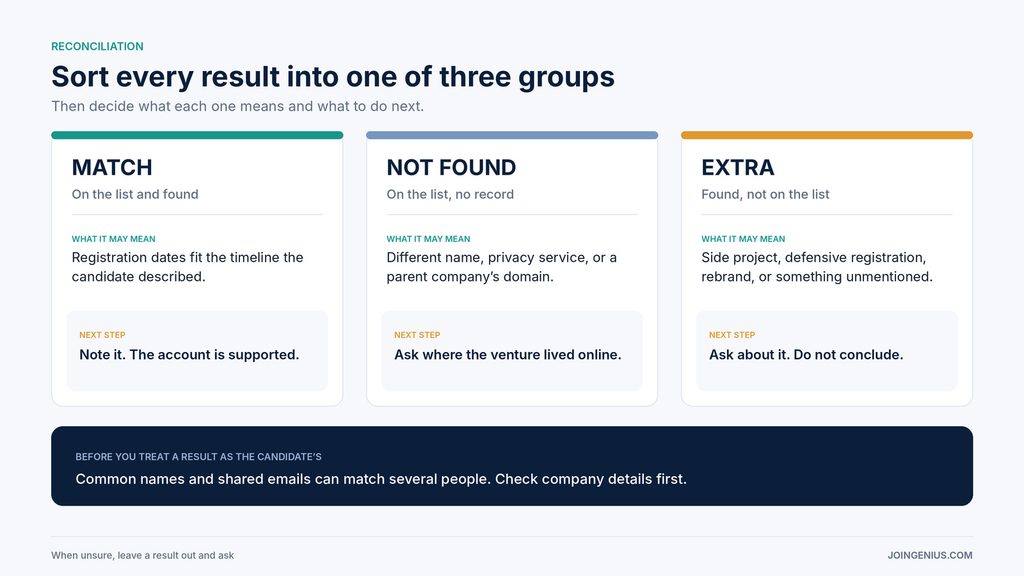
Run the search using the company names and business details the candidate gave you, not their personal details. Then compare what comes back with what they told you. Sort the results into three groups: matches, items on the list that you could not find, and items you found that were not on the list.
Matches are reassuring. If a venture appears with registration dates that fit the timeline the candidate described, that supports their account.
Items you could not find are not a red flag by themselves. The venture may have used a different name, the registration may be hidden behind a privacy service, or the business may have operated under a parent company’s domain. Ask the candidate where it lived online.
Extra items need a conversation, not a conclusion. A domain tied to the candidate’s company that does not appear on their list might be a side project, a defensive registration, or a rebrand. It might also be something they would rather not discuss. You will not know until you ask.
Be careful with common names and shared details. A name or email that matches several people can produce results that have nothing to do with your candidate. Verify each result against the company details the candidate gave you before you treat it as theirs. If you are unsure whether a result belongs to the candidate, leave it out and ask.
This kind of verification fits naturally into a broader decision about whether to promote from within or hire from outside. This comparison of internal vs external recruitment explains why external executive hires call for more verification, since you have less direct knowledge of their record.
Turning Findings Into Fair Interview Questions
The value of any finding comes from what you do with it. The goal is not to catch the candidate out. It is to understand their history well enough to make a good decision.
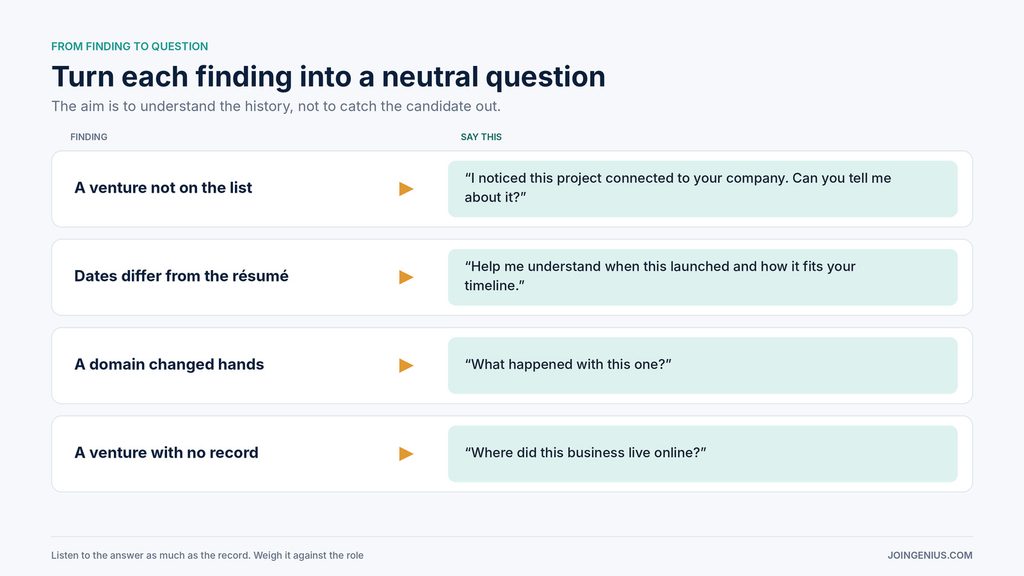
Turn each finding into a neutral, open question. If you found a venture that was not on the list, ask, “I noticed this project connected to your company, can you tell me about it?” If dates differ from the timeline, ask, “Help me understand when this launched and how it relates to the dates on your résumé.” If a domain changed hands, ask, “What happened with this one?”
Listen to the answer as much as to the record. A clear, consistent account that explains the gap is a good sign, even if the details are unflattering. Honest candidates often volunteer difficult history when asked directly. Vague, shifting, or defensive answers are worth noting, especially if they differ from what references say.
Weigh what you learn against the role. A closed venture that taught the candidate hard lessons may be a point in their favor. A pattern of undisclosed ventures that ended in disputes may matter more for a role with financial authority. The same finding can carry very different weight depending on what you are hiring for.
If the role involves public communication, consider how a candidate’s history would look if it became news. This guide to hiring communications leaders covers why trust and candor matter so much for leaders who represent the company, which applies to any executive hire.
Legal and Ethical Limits
A domain check has to be done carefully. Follow the screening, employment, and data protection laws that apply to you and the candidate, and use records only for the stated purpose. Store results securely and delete them when they are no longer needed.
Keep the scope to business matters. Do not use domain data to find someone’s home address or to look into family, health, or personal matters. Never make a decision on a single signal, and always give the candidate a chance to explain. Apply the same process to every candidate for the same type of role, so that the review is consistent and fair.
Test the Story, Not the Person
A domain check is a way to test a candidate’s account of their ventures. It is not a way to build a file on a person. Used with consent, kept to business records, and followed by open questions, it gives you a clearer picture of the leader you are about to hire and gives the candidate a fair chance to explain.
A practical first step is to add a consent line and one verification step to your executive hiring checklist: ask for the list of ventures and domains, review those records, and bring any questions to the interview. If you are building a longer-term plan for senior hiring, this guide to building a hiring pipeline shows how to bring verification into the process early instead of leaving it for the end.