Founder burnout hit 54% of founders in the past year. A lot of that burnout traces back to one bad hire, or one hire made too late.
Here’s the pattern. A founder feels stuck, hires the wrong kind of help, waits 3 months to see results, gets none, then finally hires the right kind of help and wonders why they didn’t start there.
The business coach vs fractional executive question comes up constantly because both promise the same outcome: a founder who isn’t drowning. But they solve completely different problems on the road to scaling your business. A coach works on how you think. A fractional executive works inside your business, running a function you don’t have time to run yourself.
This guide breaks down exactly what each one does, what signs point to each, and how much you should expect to pay. If you’ve been wrestling with the leadership decisions that come with scaling a startup, this is the framework to use before you sign anything.
What’s the Difference Between a Business Coach and a Fractional Executive
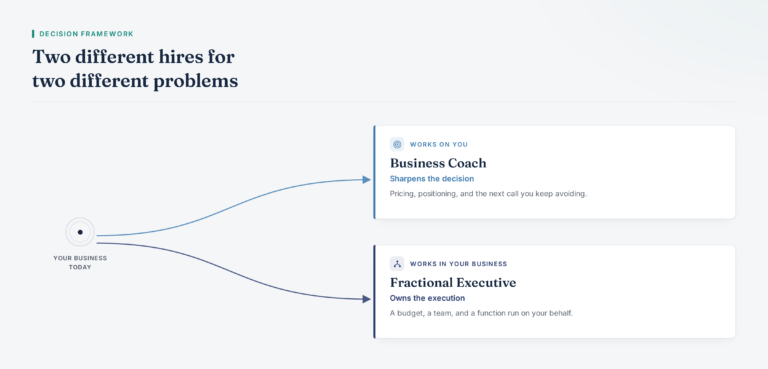
A business coach works on you. A fractional executive works in your business. That’s the whole distinction, and almost every wrong hire happens because someone missed it.
A coach doesn’t touch your calendar, your team, or your budget. Their structure is built around one-to-one coaching sessions rather than team meetings, and they push on how you’re thinking about pricing, positioning, hiring, and the next big decision. The output is a sharper founder, not a finished deliverable. Some people call this executive coaching. The label matters less than what actually happens in the room.
A fractional executive is the opposite. They step into a real leadership seat, usually 10 to 25 hours a week, and own a specific function. They run meetings, manage vendors, hire people, and report on results the same way a full-time hire would, just on a part-time clock.
📖 What Is a Fractional Executive?
A fractional executive is a senior leader, often a CMO, CTO, or CEO, who works part-time executive leadership across one or more companies instead of full-time at one. They carry real authority and real accountability inside the org chart. They’re not a consultant who hands you a slide deck and leaves.
The confusion usually starts because both options get pitched the same way: “senior help, without the full-time cost.” But one changes how you decide. The other changes what actually gets built. Confusing the two is how founders end up paying for 6 months of coaching when what they needed was someone to run their marketing calendar, or paying for a fractional CMO when what they actually needed was to stop second-guessing every pricing decision.
What a Fractional Executive Actually Does for Your Business
A fractional executive owns outcomes, not advice. That’s the one-line test. If the person you’re evaluating is accountable for a number, a deliverable, or a team, you’re looking at a fractional executive. If they’re only accountable for showing up to a call, you’re not.
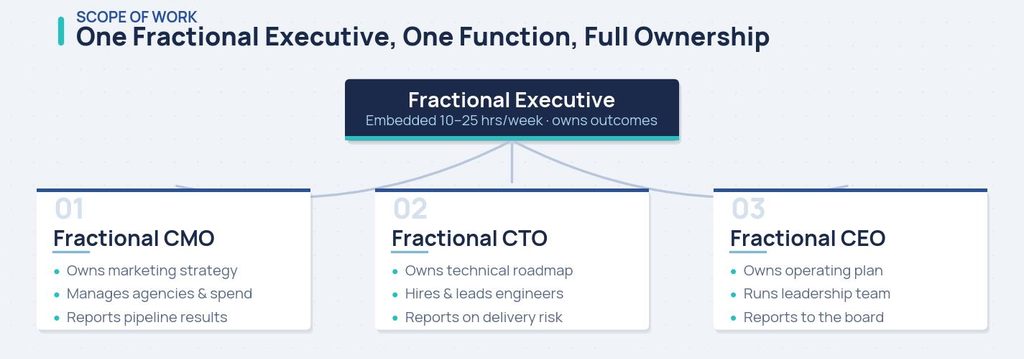
Across all 3 common roles, a fractional executive typically:
- Owns a defined budget or function, not just an opinion on it
- Manages a team, agency, or set of vendors directly
- Works a fixed 10 to 25 hours a week on a retainer
- Reports on outcomes the way a full-time hire would
Most fractional roles fall into 3 buckets, and each one solves a different gap.
What a Fractional CMO Owns Day to Day
A fractional CMO owns your marketing strategy, manages the agencies or contractors doing the work, and reports on pipeline the way a full-time hire would. They typically run 10 to 20 hours a week and are the right call when you have execution resources (an agency, a small internal team) but no one steering the ship.
What a Fractional CTO Owns Day to Day
A fractional CTO owns the technical roadmap, hires and manages engineers, and makes the architecture calls a non-technical founder can’t make safely alone. This role earns its cost back fastest when you’re scaling a product and every wrong technical decision compounds into 6 figures of rework later.
What a Fractional CEO Owns Day to Day
A fractional CEO runs the operating plan, leads the rest of the leadership team, and represents the company to the board or investors. This is the highest-stakes fractional hire, and it’s usually reserved for founders stepping back from day-to-day operations or companies navigating a leadership gap.
Every fractional executive role shares one trait: real leadership accountability, embedded in the org chart and measured on results. If a candidate can’t tell you what they’ll be responsible for delivering in 90 days, they’re not operating as a fractional executive. They’re consulting.
What a Business Coach Actually Does Differently Than a Fractional CMO
A business coach never touches your ad account. That’s the fastest way to spot the difference. A fractional CMO logs into your campaigns, adjusts spend, and reports on cost per lead. A coach sits on the other side of the table and asks why you’re targeting that customer at all.
Here’s the part that trips founders up.
The work looks similar on a calendar (both involve regular calls) but the content of those calls is almost entirely different. A fractional CMO’s agenda is your business: the campaign, the funnel, the hire you need to make next month. A coach’s agenda is you: the decision you’re avoiding, the price you’re scared to raise, the meeting you keep dodging.
A business coach spends the engagement working through one-to-one business coaching sessions built around your pricing, positioning, and the decision sitting in front of you, not your ad accounts or your hiring pipeline. The sessions are less about a marketing plan and more about why you haven’t raised your prices in 2 years, or why you keep taking on clients you privately don’t want.
Take pricing as an example. A fractional CMO will test your pricing page and report which price point converts best. A coach will ask why you set that price in the first place, and won’t let you dodge the answer. Coaching sharpens executive decision making. It doesn’t execute what you decide, and that’s the execution gap a fractional CMO closes and a coach never touches.
That distinction matters because founders often hire a fractional CMO expecting them to fix a confidence problem, or hire a coach expecting them to fix a broken funnel. Neither works.
A fractional CMO can build you a flawless campaign, and it still won’t move the needle if you undercut your own pricing on every sales call. A coach can sharpen your thinking for months, and your funnel still won’t convert if nobody is running it.
📌 Key Takeaway
If the problem is what you decide, hire a business coach. If the problem is what gets executed once you’ve decided, hire a fractional executive. Most founders eventually need both, just not always at the same time.
Signs You Need a Business Coach vs a Fractional Executive
Neither option is right by default when it comes to small business leadership. The signs are specific, and they usually show up in how you talk about the problem, not just what the problem is.
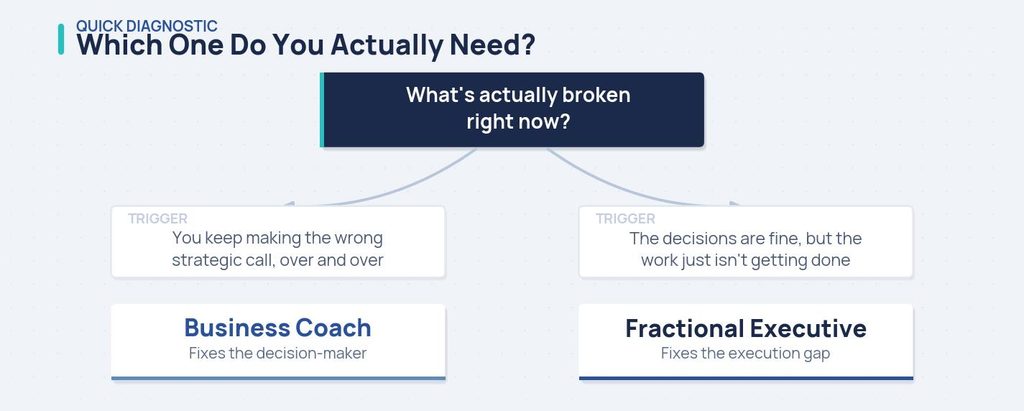
You Need a Business Coach If
- You’ve made the same strategic mistake 3 times in a row
- You know what to do and still can’t make yourself do it
- Pricing conversations make you want to discount before anyone objects
- You’re avoiding a hard conversation with a co-founder, employee, or client
- Your team executes fine, but you keep changing direction on them
- You’ve hit a revenue ceiling you can’t explain
You Need a Fractional Executive If
You already know what needs to happen inside your organization, you just don’t have anyone senior enough to build a leadership team around it.
- Marketing efforts are scattered across freelancers with no one steering strategy
- Your product roadmap changes based on whoever complained loudest last week
- You’re the only person who understands your own tech stack
- You’re too busy running the business to run the department that needs leadership
- A board member or investor keeps asking who owns a specific function
- You’ve outgrown “we’ll figure it out as we go” for a core part of the business
💡 Quick Tip
Read back your own complaints from the last team meeting or board update. If the complaints are about decisions, you need a coach. If they’re about deadlines and deliverables, you need a fractional executive.
Can You Use Both at the Same Time
Yes, and it’s actually the most common setup once a company passes $2 million in revenue. The 2 roles don’t compete for the same hours or the same agenda, so layering coaching with fractional leadership tends to work cleanly.
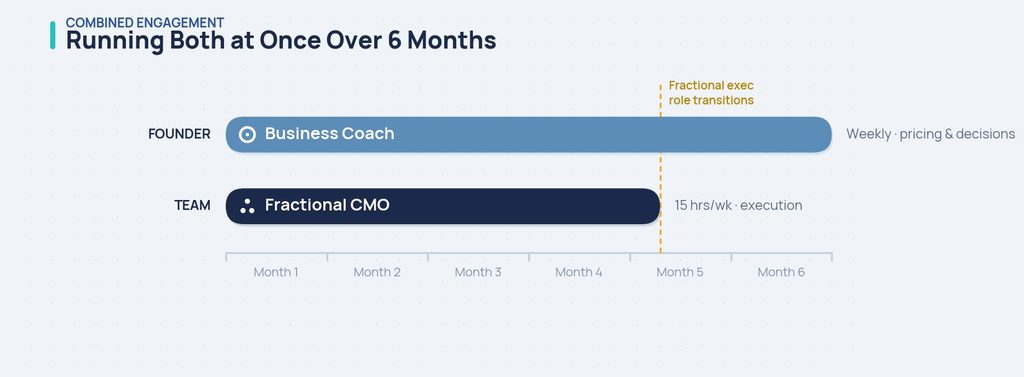
A typical combined engagement looks like a coach meeting with the founder weekly to work through pricing, positioning, and whatever decision is stuck, while a fractional CMO or CTO runs 15 to 20 hours a week executing the plan that decision produces. The founder gets clearer. The function gets built. Neither one is waiting on the other to finish their job first.
The order matters more than people expect. Bringing in a fractional executive before you’ve fixed your own decision-making just gives you a well-run function inside a company whose direction changes every quarter. That’s how a good hire burns out in 4 months. Delegating well starts with knowing which decisions are actually yours to make, and a coach is often what gets a founder there.
🎯 Pro Insight
The founders who get the most out of combining both usually start the coaching relationship first, even by just 4-6 weeks. That head start means the fractional executive walks into a company with a clearer mandate, instead of a founder who’s still changing their mind about what the function should even do.
Cost Comparison: Business Coach vs Fractional Executive
Business coaching services run $500-$3,000 a month for most small business owners. Fractional executives cost considerably more, starting around $5,000 a month for a fractional CMO or CTO and reaching $22,000 a month for a fractional CEO.
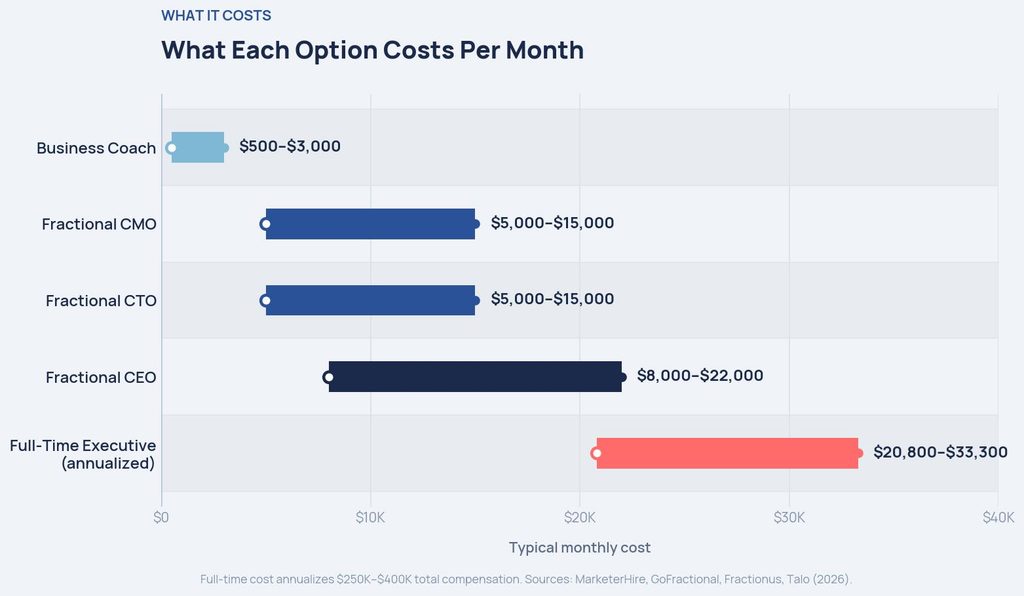
That gap makes sense once you compare it to what you’d pay for the same role full-time. A full-time CMO, CTO, or CEO runs $250,000 to $400,000 a year in total compensation.
Even the priciest fractional executive still saves 50-70 percent over a full-time hire. That’s the same math behind outsourced executive talent in general: you’re buying the outcome, not the headcount, which is how you scale your business without a 6-figure commitment on day one.
| Role | Typical Monthly Cost | Engagement Model | Best For |
| Business Coach | $500 to $3,000 | Weekly 1:1 sessions | Founders stuck on decisions |
| Fractional CMO | $5,000 to $15,000 | 10 to 20 hrs/week | Scattered marketing execution |
| Fractional CTO | $5,000 to $15,000 | 10 to 20 hrs/week | Unmanaged technical roadmap |
| Fractional CEO | $8,000 to $22,000 | 2 to 3 days/week | Leadership gap at the top |
Budgeting for either one is really a business growth strategy decision, not just a cost decision. A simple way to size it: budget coaching at roughly 2% to 3% of annual revenue, and size a fractional executive retainer against what a bad hire would cost you instead, since a mis-hire at the executive level often runs 2-3 times the annual salary once severance, lost time, and re-hiring are factored in.
| Your Situation | Best Fit |
| Repeating the same bad call | Business Coach |
| No one owns marketing | Fractional CMO |
| Tech decisions feel unsafe | Fractional CTO |
| Missing leadership at the top | Fractional CEO |
| Both decision and execution are stuck | Coach + Fractional Executive |
4 Common Mistakes When Choosing Between a Coach and a Fractional Executive
Most of these mistakes come down to matching the hire to the title instead of the actual problem.
- Hiring a fractional executive to fix a founder problem. A brilliant fractional CMO can’t out-execute a founder who overrides every campaign decision at the last minute. The function looks broken. The founder is the actual bottleneck.
- Expecting a coach to produce deliverables. Coaching sharpens decisions. It doesn’t execute them. If nobody on your team can turn a clear decision into finished work, coaching alone won’t close that gap.
- Matching the label instead of the work. A “business coach” who spends every session reviewing your marketing calendar is functioning as a marketing consultant, whatever their title says. And a “fractional CMO” who spends every call asking about your confidence is coaching you, whatever their invoice says.
- Switching too fast. Both coaching and fractional leadership take 60 to 90 days before results show up in any meaningful way. Founders who bail after one disappointing month usually just repeat the same wrong-hire cycle with a different provider, at a different price, 6 months later.
⚠️ Common Mistake
Judging either engagement inside the first 30 days. That window is almost always spent on diagnosis, not results. Give both models a full quarter before deciding whether the hire was right.
The fix for all 4 mistakes is the same one this guide has been pointing to from the start: name the actual problem, in one sentence, before you name a hire.
Bottom Line
The test hasn’t changed since the beginning of this guide. If you’re stuck on a decision, hire a business coach. If you’re stuck on execution, hire a fractional executive. If you’re stuck on both, most founders find it works best to start the coaching relationship a few weeks ahead of the fractional hire, so the executive walks into a clearer mandate.
More than half of founders are burned out right now, and a lot of that comes down to trying to be the coach, the CMO, the CTO, and the CEO all at once. You don’t have to be all four. You just have to know which one you’re missing.
Whichever direction you choose, treat the first 90 days as a real evaluation window, not a formality. The right hire, in the right role, is the difference between outsourcing that actually moves your business forward and another line item that quietly disappears from the budget next quarter.