
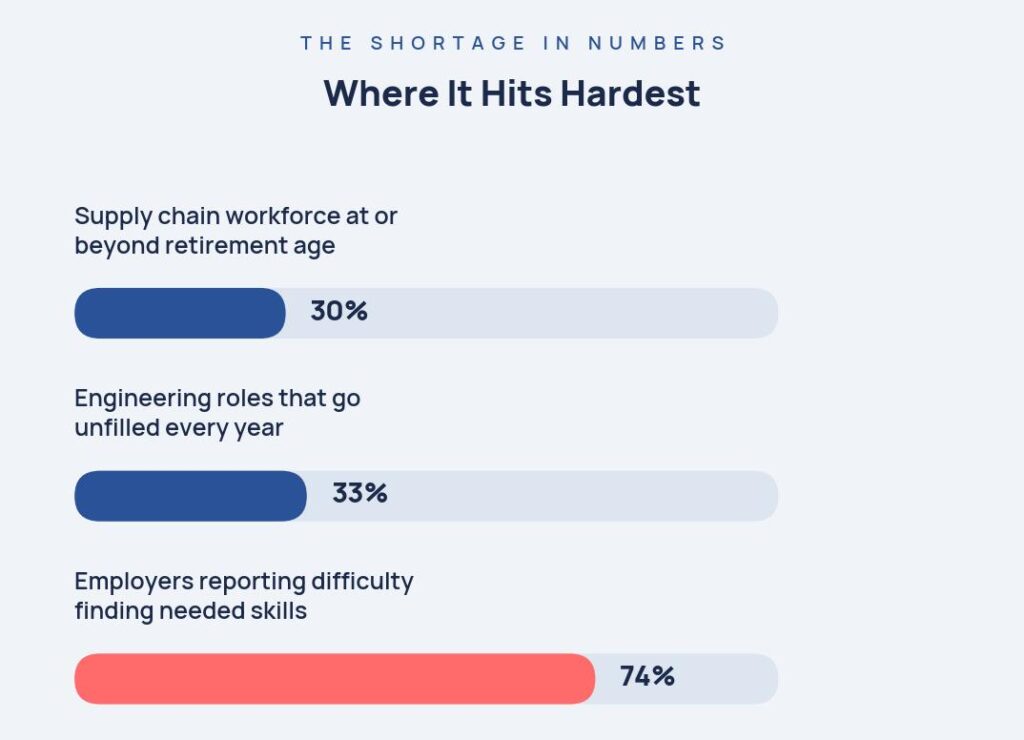
1 in 3 engineering roles goes unfilled every year, and IT searches now stretch past 60 days before an offer gets signed. Supply chain isn’t any better. Nearly 8 in 10 supply chain organizations report significant workforce shortages right now.
That’s the reality behind every open req in engineering, IT, or supply chain today. Waiting until a role opens to start looking for candidates means you’re already behind. A technical talent pipeline flips that. Instead of scrambling every time someone quits, you build a steady, warm supply of vetted candidates before you need them.
This guide walks through how to map your technical hiring needs, source passive candidates across all 3 functions, work with specialized staffing partners the right way, and keep your pipeline warm long after the initial search ends.
Why Engineering, IT, and Supply Chain Can’t Rely on Reactive Hiring Anymore
These 3 functions look different on paper. But they’re all fighting the same structural problem: too few qualified people, chasing too many open roles, for too long.
Engineering Is Losing a Generation of Institutional Knowledge
Engineering’s shortage isn’t really about a lack of interest in the field. It’s a retirement problem. 186,500 engineering openings are projected every year through 2034, and 1 in 3 of those roles stays unfilled.
Civil infrastructure, aerospace, and defense are hit hardest. Retiring engineers are taking decades of institutional knowledge with them, and university graduates aren’t trained on the specialized systems those roles require.
IT Hiring Has Split Into 2 Very Different Markets
Junior and generalist developer roles are actually easier to fill than they were 2 years ago. Senior, production-ready engineers are the opposite story entirely.
The market has polarized. Companies are competing hard for a shrinking pool of engineers who can operate complex systems in production, while junior postings sit with hundreds of applicants. If your technical talent acquisition strategy still treats “developer” as one category, you’re sourcing for the wrong market.
That polarization shows up fastest in AI-adjacent roles. Machine learning engineer postings are now getting filled with a median posting duration of just 16 days, not because the search is easy, but because companies are throwing compensation and speed at a razor-thin pool instead of hiring strategically.
Supply Chain Is Aging Out Faster Than It’s Being Replaced
Supply chain has its own version of the engineering retirement problem. Between 25% and 33% of the current supply chain workforce is at or beyond retirement age, and most companies don’t have a pipeline sized to backfill that wave.
📊 By the Numbers
76% of supply chain organizations report significant workforce shortages right now. That’s not a future risk. It’s the current state of the field.
Map Your Technical Talent Needs Before You Source Anyone
Sourcing without a clear target wastes everyone’s time. Before you post a single job or call a single recruiter, get specific about what you actually need.
Build Role Scorecards for Your Hardest-to-Fill Positions
Separate must-have skills from nice-to-have skills for every hard-to-fill role. Bloated job descriptions scare off qualified candidates who assume they don’t meet 100% of the list.
This is also where skills-based hiring pays off. Skills-based hiring can expand your candidate pool by as much as 15.9x compared to filtering by degree or years of experience alone.
A solid talent acquisition strategy starts with this kind of role-level clarity, not with a job board post.
Forecast Hiring Needs 6-12 Months Out
Workforce planning only works if you do it before the pressure hits. 73% of workers say they’d rather stay in their current role than risk a move, which means passive candidates are harder to reach and take longer to convert.
If you wait until a role is vacant to start building your talent acquisition process, you’re negotiating from a position of urgency instead of strength.
Build this forecast with your hiring managers, not just HR. They see skill gaps on their teams months before a role technically opens, and that early signal is exactly what a workforce plan needs.
Build Sourcing Channels That Reach Passive Technical Talent
Job boards catch active candidates. Everyone else, the engineers and supply chain leaders who aren’t actively looking but would move for the right opportunity, needs a different approach.
Tap Developer, Engineering, and Supply Chain Communities
GitHub, technical Slack and Discord communities, and professional associations like ACEC and ASCM put you in front of people who never touch a job board. These candidates respond to genuine engagement, not a recruiter cold-pitching a req.
The right combination of talent sourcing tools makes it possible to track these relationships at scale instead of losing them in a spreadsheet.
Sponsor a niche meetup or contribute to an open technical challenge instead of just posting in the group. Passive candidates notice genuine participation long before they’ll respond to a direct message from someone they’ve never seen show up.
Turn Employees Into a Referral Engine
Referrals consistently outperform every other channel. Referral hires outperform non-referral hires by 26% on first-year performance scores, and they typically cost less than half of what an agency placement runs.
💡 Quick Tip
The average referral bonus sits around $2,500. Agency fees average closer to $5,000 per placement. A well-run referral program isn’t just faster. It’s cheaper too.
Partner With Universities for Early Pipeline
University and bootcamp partnerships build a pipeline of candidates before they even enter the open market. This matters most for supply chain and engineering roles, where the talent gap is widest at the entry level.
Companies that genuinely want to attract the right employees treat these partnerships as a long-term investment, not a one-time career fair booth.
Working With Niche Staffing Partners
Sometimes the fastest way to fill a hard technical role isn’t sourcing it yourself. It’s partnering with someone who already has.
When a Specialized Staffing Partner Beats a General Recruiter
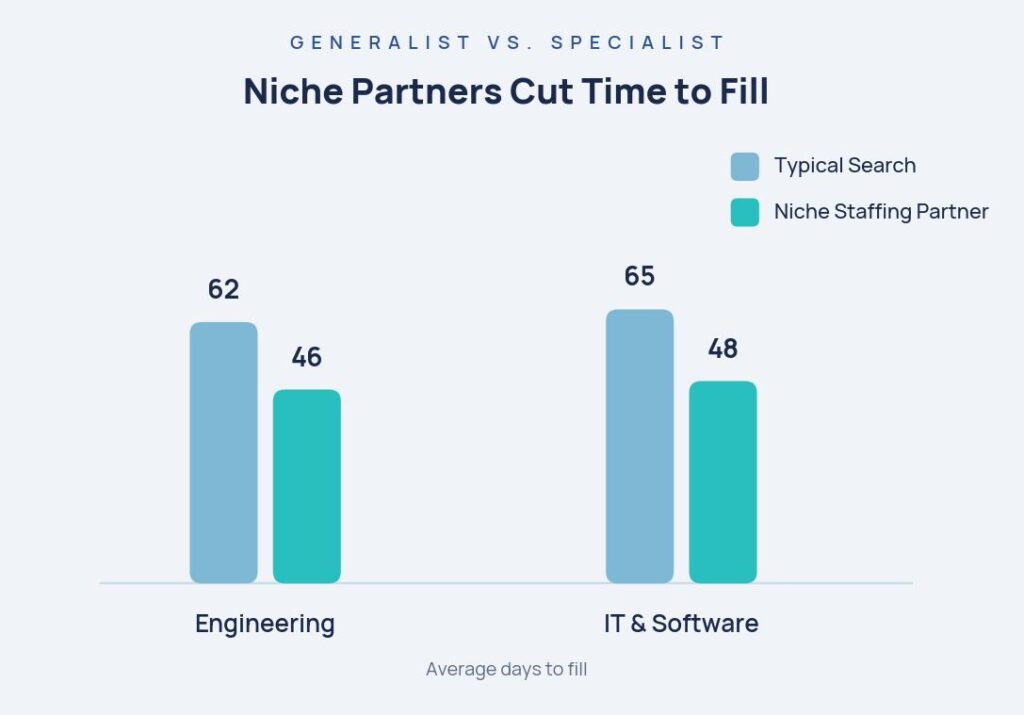
A generalist agency working your niche search alongside 20 others delivers a different outcome than a firm that lives in that niche every day. For narrow, high-stakes technical roles, that difference shows up directly in your time to fill.
Niche specialists regularly secure fill-rate improvements of 25%-30% because they have relationships with passive candidates that generalists simply can’t reach. That’s the value technical staffing specialists like Apollo Technical bring to engineering and IT searches specifically. They’ve already built the relationships you’d otherwise spend months developing from scratch.
What to Vet Before You Sign With a Niche Firm
Ask for their placement history in your exact sub-specialty, not just “engineering” broadly. A firm that places embedded systems engineers isn’t necessarily the right partner for a supply chain automation search.
Also ask how long candidates in their active pipeline have been vetted. A stale pipeline defeats the purpose of paying for speed.
Ask about fee structure too. Contingency, retained, and contract-to-hire markups all shift your real cost per hire, and a transparent partner will walk you through the math before you sign anything.
Use Contract-to-Hire to De-Risk Specialized Roles
Contract-to-hire has become the default model for senior technical roles, and for good reason. It’s now overtaking direct hire as the standard approach for senior IT positions, letting both sides confirm fit before making a permanent commitment.
This works especially well for engineering, IT, and supply chain roles, where technical skill and team fit both matter and neither is obvious from an interview alone.
Keep the Pipeline Warm With Structured Nurture
A pipeline you build once and never touch again isn’t a pipeline. It’s a stale list.
Build a Talent CRM Instead of a Resume Graveyard
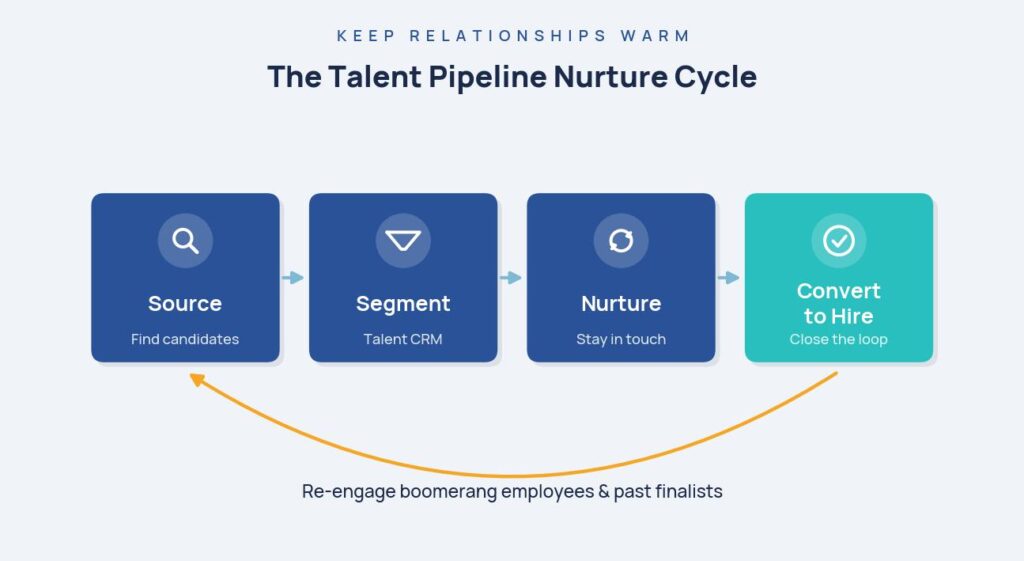
Most companies collect resumes and never revisit them. A talent CRM turns that dead weight into an active, searchable pipeline.
📖 What Is a Talent CRM?
A talent CRM tracks and nurtures candidate relationships before someone is ready to apply. It segments people by role, seniority, and how engaged they currently are, instead of dumping everyone into the same folder.
Start small. A niche passive pipeline of 50 to 150 pre-qualified candidates, tracked consistently, beats a bloated database nobody maintains. This kind of structured talent acquisition management is what separates companies that fill roles fast from companies that start every search from zero. It also feeds directly into talent acquisition and retention, since the same warm relationships that speed up hiring also tend to make people stay longer.
Re-Engage Boomerang Employees and Past Finalists
Former employees and runner-up candidates are some of the fastest hires you’ll ever make. Boomerang rehires ramp 40%-60% faster than new external hires and post 20% higher 12-month retention rates.
Keep a simple system for checking in with people who almost got the offer, or who left on good terms. A short note every few months keeps you top of mind without being intrusive.
Track the Metrics That Prove Your Pipeline Is Working
A pipeline that isn’t measured is just a hope. These are the numbers that tell you whether yours is actually working.
Time-to-Fill and Time-to-Hire by Function
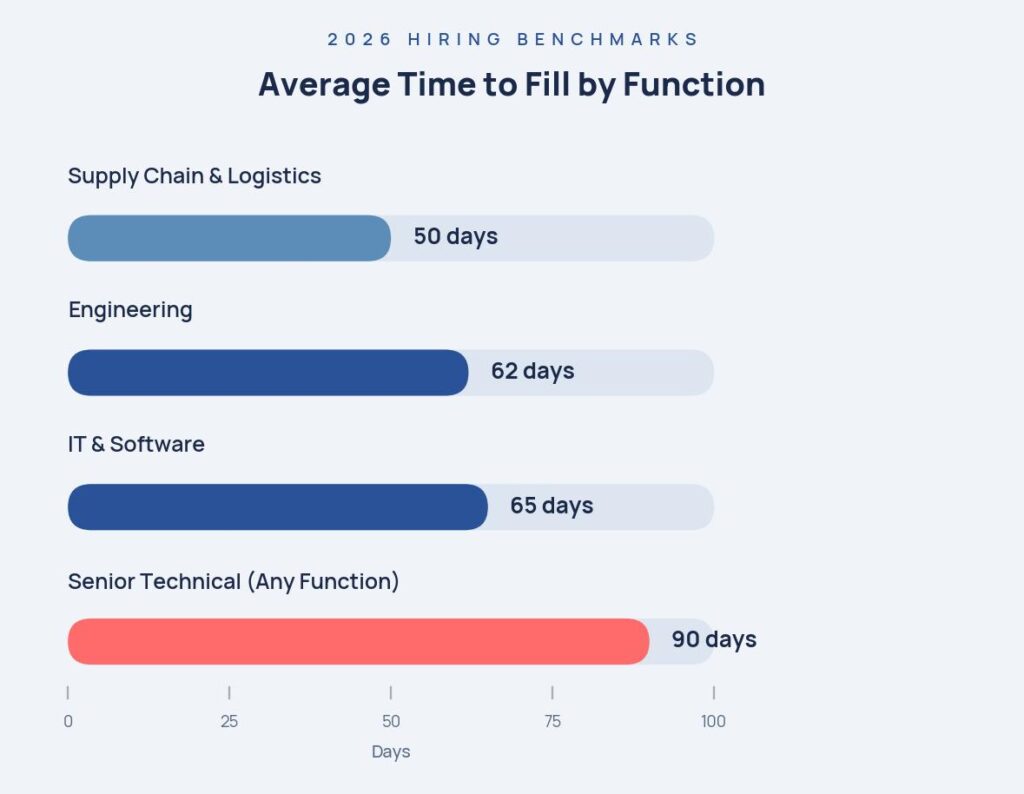
Engineering, IT, and supply chain don’t move at the same speed, and your benchmarks shouldn’t pretend they do.
| Function | Avg. Time to Fill | Key Driver |
| Supply chain and logistics | 45 to 55 days | Aging workforce, automation skill gaps |
| Engineering | 62 days | Retirement wave, narrow specialization |
| IT and software | 63 to 68 days | Senior/AI-ML scarcity, 5 to 8 interview rounds |
| Senior technical (any function) | 90+ days (40% of searches) | Compounded scarcity and stakeholder delays |
Every unfilled technical position costs an average of $4,129 over a 42-day vacancy. That number climbs fast once you factor in lost productivity and team strain.
Quality of Hire Is the Metric Most Teams Skip
Speed matters, but only if you’re also hiring the right people. Quality of hire is ranked the most valuable recruiting metric by talent leaders, yet only 33% of companies actually track it. Track your own numbers against broader hiring statistics to see where your process is losing time.
You don’t need a complex model to start measuring this. Score each new technical hire at 90 days on 3 things: manager satisfaction, ramp-up speed, and whether they’re still there. That alone gives you a usable quality of hire signal within a single hiring cycle.
🎯 Pro Insight
Review your pipeline’s health quarterly, not just when a req opens. Teams that treat pipeline-building as an ongoing discipline consistently outpace teams that only think about sourcing once someone quits.
Final Thoughts
A technical talent pipeline isn’t a one-time project. It’s role scorecards, active sourcing across communities and referrals, the right staffing partners for your hardest searches, and a system for keeping warm relationships alive long after the initial outreach.
The companies that consistently fill engineering, IT, and supply chain roles fast aren’t doing anything mysterious. They started building before they needed to.
Pick one piece from this guide, whether that’s a referral program, a talent CRM, or a conversation with a specialized staffing partner, and start there. The rest compounds from that first step.