A mid-level engineer finishes a weekend project for a friend’s small business and bills it at an hourly rate that looks far higher than their salary divided by hours worked. The number sticks. A few weeks later, the engineer is looking at freelance job boards, and the manager hears about it in an exit interview. That is an illustration, not a case study, but it describes how freelance often arrives: as a comparison that leaves out most of the costs.
This guide explains how to retain mid-level engineers when they discover freelance. It covers why freelance looks attractive, what freelancing involves, how salary compares with the full package, how to handle side work and a table of warning signs. We found no study showing how to keep mid-level engineers who are weighing freelance work, so the advice rests on compensation data, a self-selected moonlighting survey, a freelancing guide and our reasoning. It is general information, not legal or tax advice, and rules differ by country.
Why Freelance Looks So Good at First
An hourly rate is easy to compare with a salary, and the comparison flatters freelance. That is our reasoning, but it explains the pull. A rate quoted for billed hours leaves out the unbilled time needed to find clients, write proposals, send invoices and handle taxes. Mid-level engineers may feel the pull most, which is also our reasoning: they have enough skill to deliver a project alone, but their pay has not yet reached senior levels, so the gap between the two numbers looks widest to them.
The best data we found on developers who do outside work is thin. Cutshort, a tech hiring platform, surveyed 3,085 tech professionals in India in 2023. It reports that 22.91% had moonlighted or were moonlighting, and that 73.69% of those spent under 10 hours a week on it. Learning and applying new skills was the most common reason, and extra income was also cited. The sample was self-selected, the platform sells hiring services and the article does not explain how respondents were recruited, so it cannot tell you how many of your engineers are tempted.
It also complicates the premise. The article says moonlighting was least common among respondents with three to seven years of experience, the mid-level group, though it gives no percentage for that bracket. We found no data showing that mid-level engineers are more drawn to freelance than other levels. Treat the premise as a risk to manage, not a trend.
Show Them What Freelancing Involves Before They Price It Against Your Salary
Start with the work that is not coding. Oflox’s guide on how to freelance as a web developer lists the steps: building skills and a portfolio, choosing a niche, branding, setting prices, handling legal and finance matters such as registering the business and opening a separate bank account, finding clients, marketing, writing contracts and managing time. Much of that is not billable work, in our view. The guide also says freelancing “requires patience and persistence,” that building a client base “takes time” and that platforms have their own “terms, fees, and competition levels.”
Use the guide for that checklist only. It was published in August 2023 and last modified in November 2025, it gives no rates or income figures, cites no sources, and does not cover moving from a job to freelancing. We would not repeat its platform list without checking that each platform is still active.
Then put the salary in context. The US Bureau of Labor Statistics reported that private industry employer compensation costs averaged $46.89 per hour worked in June 2026, and that benefits made up 30.0% of that, with wages and salaries the other 70.0%. For management, professional and related occupations, benefits were 31.5%, including 7.4% for insurance and 9.3% for paid leave. These are US averages across occupations, not engineers, and they measure what employers spend, not what an individual could buy. They show that a salary is only part of what a job provides, and a freelancer has to replace the rest.
Tax is a second difference. NerdWallet’s guide to US self-employment tax says the rate is 15.3% on net earnings, made up of 12.4% for Social Security and 2.9% for Medicare, and that the self-employed pay both halves, which employees and employers normally split. It is US federal tax only, and your engineers may be elsewhere, but the point travels: employment can carry costs that an hourly rate does not show.
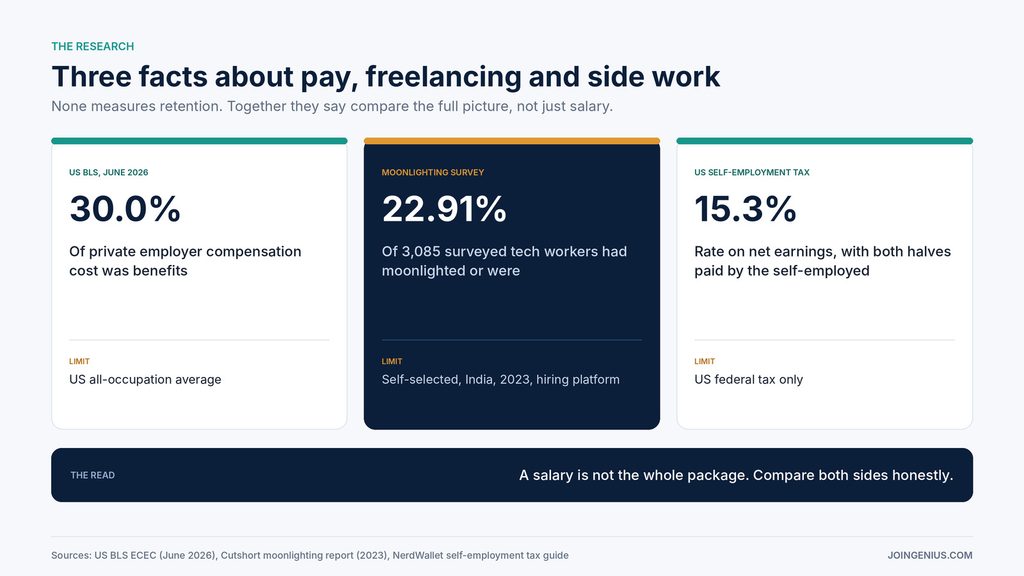
Sit down with the engineer and do the arithmetic with real figures. Take the salary and add the value of benefits. Then ask what rate, and how many billed hours a year, would replace it after unbilled time, tax, insurance and unpaid leave. Add one more question: what happens in a month when no client work arrives? A salary arrives on schedule, and freelance income may not. This is our suggestion, not a tested method. It is meant to inform, not to talk anyone out of a choice, and an engineer who works through it honestly may still decide to freelance. That is a fair outcome.
What Keeps Mid-Level Engineers Anyway
Pay is rarely the whole story. The Work Institute’s 2020 Retention Report, based on exit interviews with more than 233,000 employees from 2010 through 2019, lists career development as the top reason for leaving at 19.6%, with compensation at about 9%, and says pay is a cause sometimes but not always. It covers all industries and mostly 2019 data, so it is not about engineers or freelance, but it suggests that growth matters at least as much as money.
Policy clarity is a second lever. In the Cutshort survey, about 27% of respondents were unsure of their company’s policy on outside work, and about 33% said their company had no clear policy. The article describes employer responses ranging from dismissing staff who moonlighted at one large company to asking for disclosure at another. We found no evidence on which approach retains more people. Our reasoning is that an engineer who knows the rules can ask a question before breaking one. Write a short policy covering disclosure, conflicts with clients, use of company tools and ownership of work, and check it against local law and each contract. Some places limit outside work through employment contracts and others do not, so take advice before you promise anything in writing.
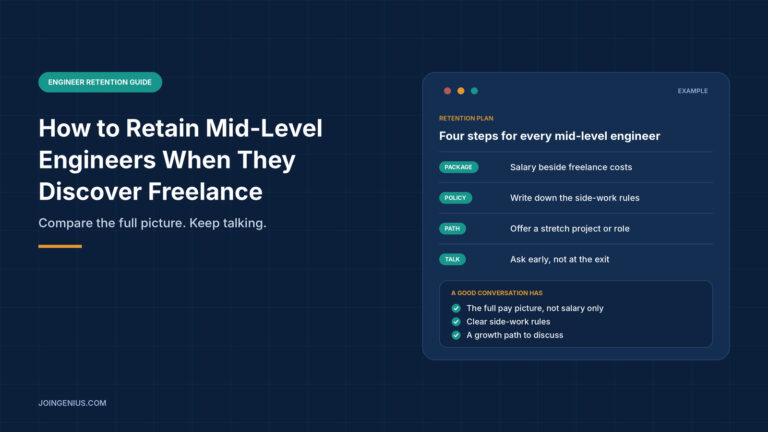
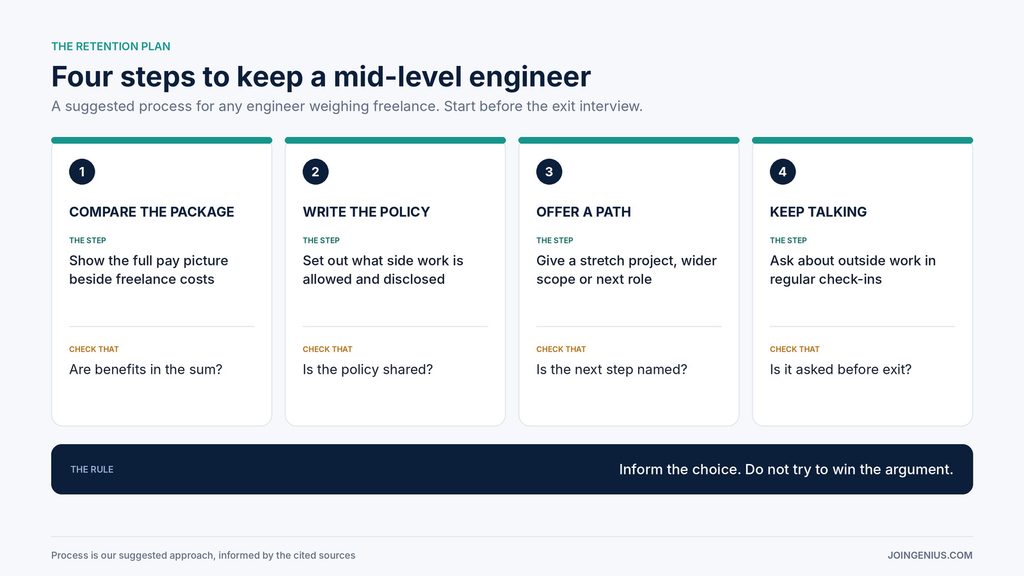
Use this four-step plan with each mid-level engineer. It is our suggested process, informed by the sources above.
- Compare the package. Show the full compensation picture next to the freelance costs.
- Write the policy. Set out what side work is allowed and what must be disclosed.
- Offer a path. Give them a stretch project, a wider scope or a clear next role.
- Keep talking. Ask about outside work in regular check-ins, not in the exit interview.
Step three matters most for mid-level engineers, in our view, because their next level is where the pay gap shows. A visible route to senior scope gives them something to weigh against a freelance rate.
Measure Whether It Works
Track how many mid-level engineers leave and how many of them cite freelance, the share with a written side-work policy and how many have had a career conversation in the past year. A single resignation proves little, so look for a pattern over several quarters. In check-ins, ask engineers what they would miss about employment, as well as what attracts them to freelance, because the answers show which parts of the package matter to them. Our data on freelance statistics and the number of freelancers gives context on how common the move is.
The same pull affects other roles. Our piece on why SEO teams lose strategists to freelance burnout and our guide to retaining senior designers who want to write code cover related cases, and the guide to employee retention strategies covers the wider picture.
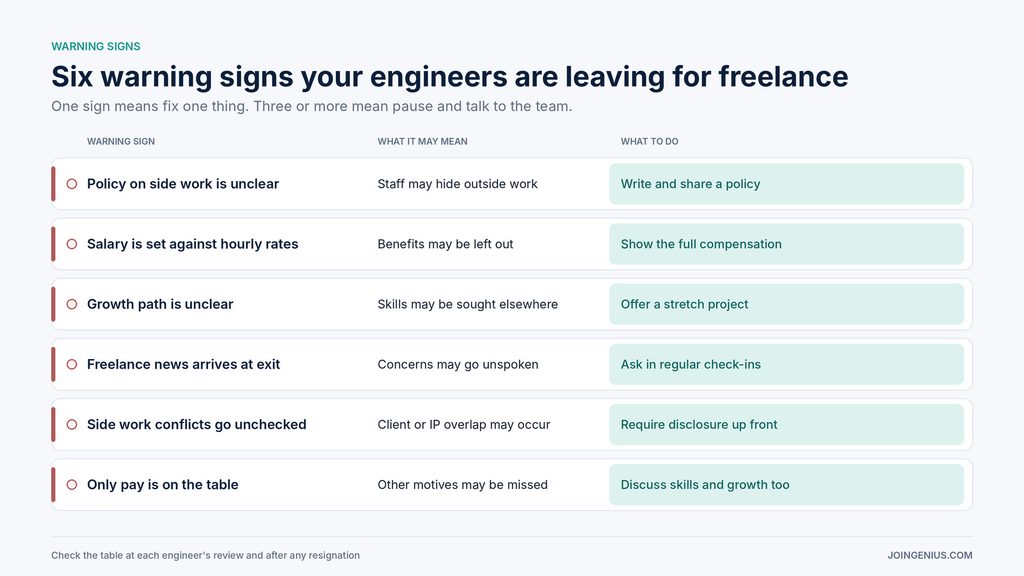
Warning Signs Your Mid-Level Engineers Are Leaving for Freelance, and What to Do About Each
Check this table at each engineer’s review and again after any resignation. One sign means fix one thing. Three or more mean pause and talk to the team.
Compare the Whole Package, Then Keep the Conversation Open
Mid-level engineers who discover freelance are weighing a rate against a salary, and the two are not the same kind of number. Show them what freelancing involves, set the benefits and costs side by side, write down the rules for side work and give them a path worth staying for. We found no study proving these steps retain people, but they replace a one-line comparison with an honest one. If the engineer still chooses freelance, you will at least have had the conversation before the exit interview.