A senior designer starts building prototypes in code instead of Figma. A few weeks later they ask for access to the repository, or whether they could pick up a small front-end ticket. Some managers hear that as a request to leave design. Others hear nothing at all, and the designer quietly starts looking for a company where the interest is welcome.
Neither reaction helps. A designer who wants to code is usually asking for a bigger role, not a different job, and the people who leave over it are often the ones you most want to keep. This guide covers why senior designers start coding, how to spot it early, how to offer a real path, how to protect learning time, how to fix the handoff and how to handle title and pay. It ends with a table of warning signs and what to do about each. For the wider picture, these employee retention strategies are a useful companion, especially the advice on creating career growth opportunities.
Why Senior Designers Start to Code
Coding rarely means a designer is unhappy with design. It usually comes from one of four things.
Speed is the first. Building in code lets them test an idea in hours without waiting for an engineering slot. Fidelity is the second. They have watched careful work lose detail on the way to production and want to protect it. Curiosity is the third. After years of designing interfaces, they want to understand how those interfaces are built. The market is the fourth. Hybrid skills are in demand, and they know it.
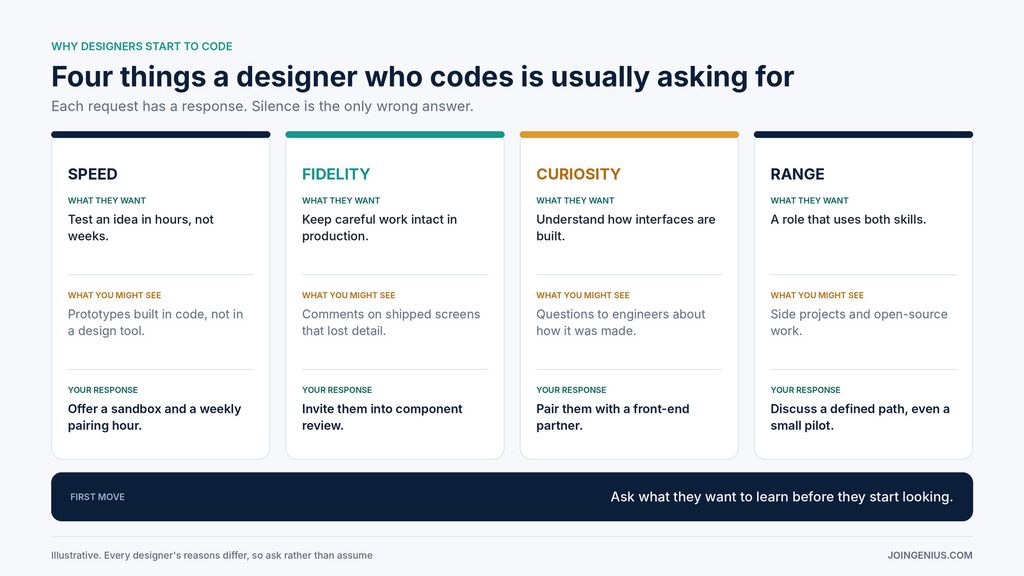
None of these is a complaint about your company. Each one is something a good manager can respond to, which is why the response matters more than the request.
Spot the Signals Early
Most designers will not announce it. Watch for prototypes built in code instead of a design tool, questions to engineers about how something was built, and requests to sit in on code review or join a front-end ticket. Side projects, personal component libraries and open-source work are also common. So is a sudden interest in design tokens and the components behind a design system.
Then ask directly, in a one-on-one: “Is there anything on the engineering side you would like to learn?” Ask before they start looking. People who feel their interest is welcome tend to mention it. People who feel it is unwelcome hide it, and that is the point at which you lose them. The pattern is the same one behind most voluntary exits. This guide to talent acquisition and retention strategies notes that when employees see a clear route to advancement, they are less likely to look elsewhere.
Give Designers a Real Path Into Code Before They Leave to Find One
Many senior designers who start to code are not asking for a different job. They are asking for a role that uses both skills, and in most companies that role does not exist yet. Design engineering is one name for it. UI Things describes it as a hybrid discipline in which one person designs and implements UI without a traditional handoff, and its guide names designers who want to code as one of its three audiences. The path it lays out for them begins with HTML and CSS and then moves to JavaScript and React. The aim, in its words, is not to replace engineers but to prototype interactions in code.
That framing matters for retention. If your company has no equivalent role, a designer with this interest has to find one somewhere else. A defined path, even a small pilot, gives them a reason to grow here.
How do you know whether your team needs the role? The guide cites Paraform’s four signs that a team is ready for a design engineer: steady UI work, accumulating design debt, a product scaling past MVP, and handoff friction that slows delivery. If two or more describe your team, the need already exists, and a designer who codes may be the person to meet it.
Not every company will want to build this role, and that is a legitimate decision. If yours does not, say so plainly and early, and talk about what you can offer instead. A clear no keeps trust. A long silence does not.
Build a Learning Path With Protected Time
Interest without time becomes an after-hours hobby, and then a reason to leave. Turn the path into stages, and decide what the company provides at each one.
Stage one is HTML and CSS: the cascade, the box model, Flexbox and Grid, which is where the guide says to start. The company provides a few protected hours each week and a pairing partner on the front-end team. Stage two is JavaScript and React, which the guide calls the default choice for most design engineering roles. The company provides access to the component library, a safe place to test changes and review on every change. Stage three is shipping one small thing, such as a single component or interaction that goes through the same review as any other code. The company provides an engineer who owns the merge, and recognition when it ships.
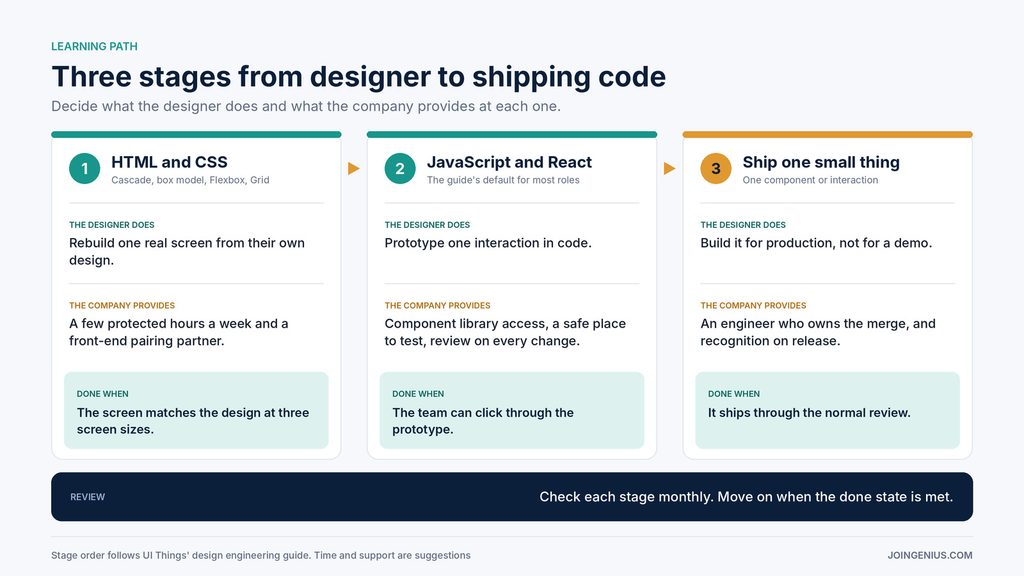
Give each stage a clear done state so progress is visible, and review it once a month. The guide describes prototyping interactions in code as faster and more accurate than rebuilding them from Figma, so the payoff reaches the team early, not only the designer.
Fix the Handoff and Define the Role
Learning to code does not solve role confusion. A designer who codes can easily end up doing two jobs at once. Define the role before that happens.
The guide quotes Vercel’s description of how its design engineers work. They do not receive a completed handoff. Instead, a designer sketches the start and iterates with a design engineer in Figma or code to produce the final design. That account dates from March 2024, so treat it as one example and not a rule.

Write down what the designer owns, such as design intent, prototypes and front-end components in the design system. Write down what engineering still owns, such as review, security, performance and production releases. Agree how code gets approved, and what share of the designer’s time goes to each kind of work. Review that split every quarter. The common mistake is adding the second job on top of a full design load, which turns a growth opportunity into overwork.
Title, Pay and Career Ladder
Learning with no recognition looks like free labor to the person doing it. Show the next level: a title, review criteria and pay that reflect hybrid work. Put in writing what it would take to move up, because vague promises are the ones people have heard before.
For a rough reference point, UI Things cites Built In data showing an average US base salary of $148,301 for design engineers, alongside a listed range of $83K to $233K. That is US data and a wide range, so check your own market before you use it. Recognition also does not have to mean pay alone. These employee incentive program ideas include low-cost ways to show people that their extra effort is noticed.
Warning Signs You Are About to Lose a Designer Who Codes, and What to Do About Each
Some patterns show up before a resignation. The table below pairs each warning sign with what it may mean and a practical next step.

One sign is a prompt to have a conversation. If you see several, start with the first row, because a small pilot produces the evidence you need for everything else on the list.
Take the Next Step
In your next one-on-one, ask the designer what they would like to build. Agree on one small pilot with a clear deliverable, a named engineer partner and protected hours. Set a check-in at 90 days, and decide together whether the work becomes a role.
If it works, write it down so the next designer does not have to ask. Teams that give people a visible path to grow are far more likely to keep the people who are already ahead of the job description.