A creator hires a freelance video editor from a polished showreel. The first cut arrives late, ignores the brief and uses a style that does not match the channel. The showreel was real, and it said little about how this editor would work with this creator. That is an illustration, not a case study, but it describes why hiring from a showreel alone is risky.
This guide explains how to hire freelance video editors with less guesswork. It covers what you are hiring, why showreels and star ratings mislead, how to run a practice edit, how to put ownership in writing, how to measure the hire and a table of warning signs. We found no study showing what predicts a good freelance video editor, or which hiring method works best for editors. The advice rests on a marketplace experiment, selection research, a US government guide to copyright and our reasoning. It is general information, not legal advice, and rules differ by country.
What You Are Actually Hiring
Video editing covers several jobs. Some editors cut footage and pace a story, some add captions and sound design, and some also make thumbnails or short clips for social platforms. We found no standard definition, so treat this split as ours. Decide which jobs you need before you post a role, because an editor who is strong at one may be weak at another. Short-form and long-form work may also call for different habits, such as faster pacing for short clips, which is our reasoning and not a finding.
Write the brief before you look at candidates. Include the goal of the video, the audience, the style, two or three reference videos you like, the deadline and the files you will supply. A brief also gives you something to score an edit against later. Our guide to hiring content creators covers the wider profile, and our piece on outsourcing content creation covers how to split work between your own team and outside people.
Why Showreels and Star Ratings Mislead
A showreel shows an editor’s best finished work. It does not show the brief they were given, how much the client changed, how long the job took or who else touched the project. Reviews help, but new editors often have few, and a star rating does not say whether the job resembled yours. A five-star editor who cut gaming clips may never have worked from a written brief or a client’s brand rules.
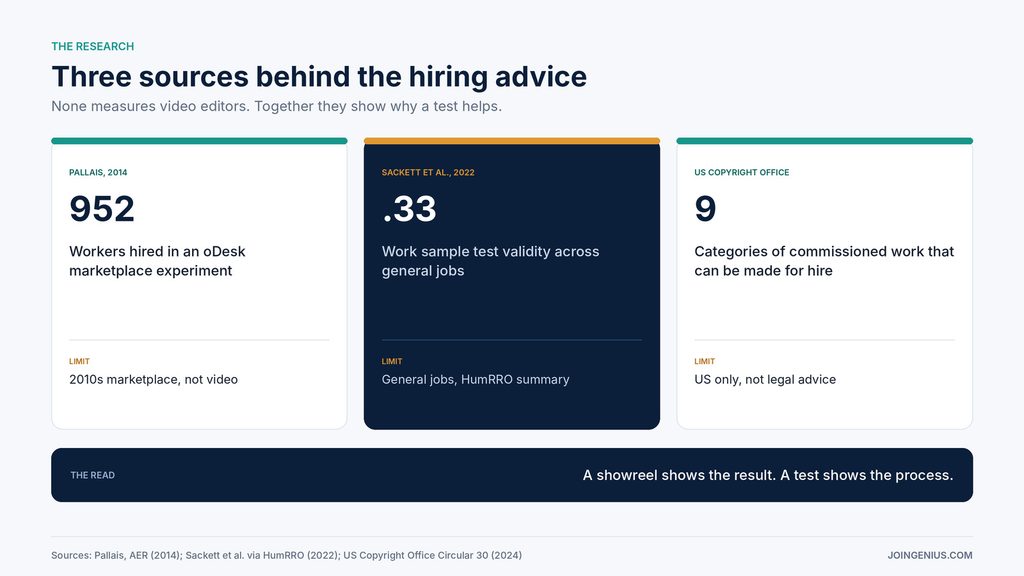
Research on online labour markets suggests why employers struggle with this. Amanda Pallais hired 952 workers on the oDesk marketplace and gave each either a detailed or a coarse public evaluation, in a paper published in the American Economic Review in 2014. Hiring inexperienced workers and giving detailed evaluations both substantially improved the workers’ later employment outcomes. The paper’s point is that employers have little information about new workers, so a first hire and a detailed review give the market something it lacked.
The paper has limits. It is from an early-2010s marketplace, the summary we read does not say what task the workers did or how large the effects were, and it is not about video editing. It suggests that a track record is hard to read for newcomers. Our reasoning is that direct evidence of work on your own footage is worth more than a profile, which is why a test is useful.
Test Editors With a Practice Edit, Not Just a Showreel
A practice edit shows what a showreel hides: how the editor handles your footage and your brief. ContentCreator.com’s careers page lists two full-time remote Expert Video Editor roles and says all candidates must complete a practice edit to apply. That is one company’s practice for its own full-time hires. The page lists no pay, says nothing about freelance work and gives no results, and we did not read the linked instructions. Treat it as an example of the method, not proof that it works.
Selection research supports the general idea, with a limit. A HumRRO summary of Sackett, Zhang, Berry and Lievens (2022) reports revised validity estimates in which structured interviews were highest at .42 and work sample tests were .33. The authors argue that earlier estimates were inflated by range restriction corrections, and the summary notes that structured interview validity varies considerably. These figures concern job performance in general, not editors. They support a modest point: asking every candidate to do the same task and scoring it the same way beats improvising. Our interview guide covers how to structure the conversation.
To run the test, give every editor the same short set of raw footage, the same written brief and the same time limit, such as a one-minute cut. Pay for their time, since unpaid tests ask people to work for nothing and may put off experienced editors. That is our view, not a finding. Write the scoring rubric before you watch any cuts, with criteria such as matching the brief, pacing, audio, captions and clean file delivery. Then ask each editor to explain two choices they made. A strong edit follows the brief and the explanation shows why. A weak one looks polished but ignores what you asked for.
Put Ownership in Writing Before the First Edit
A freelancer is not an employee, so who owns the finished video depends on what you agree. In the US, the Copyright Office’s Circular 30, revised in August 2024, says a commissioned work counts as a work made for hire only if it falls within one of nine categories, which include part of a motion picture or other audiovisual work, and there is a written agreement, signed by both parties, saying so. Without both, the video is not a work made for hire. The circular also says that whether someone counts as an employee is judged under general agency law, which is a separate test from the commissioned-work rule.
This is a US overview and not legal advice, and the Copyright Office does not give legal advice. Other countries differ. Put the terms in a signed written agreement that covers ownership, the handover of raw footage, the number of revision rounds, credit and confidentiality, and ask a lawyer where you operate to check it.
A Four-Step Plan to Hire an Editor
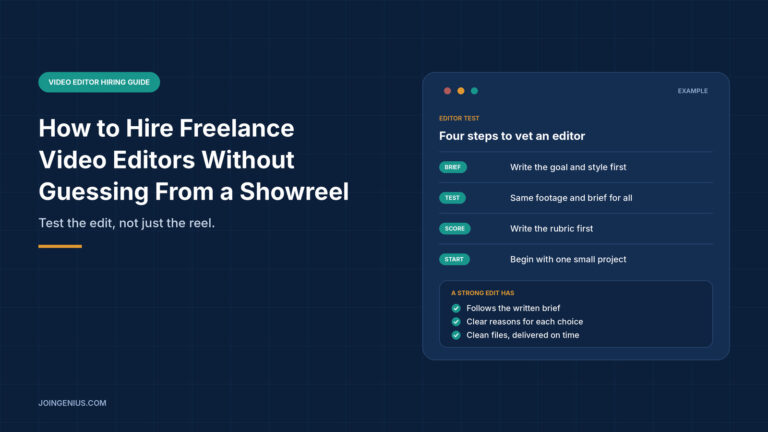
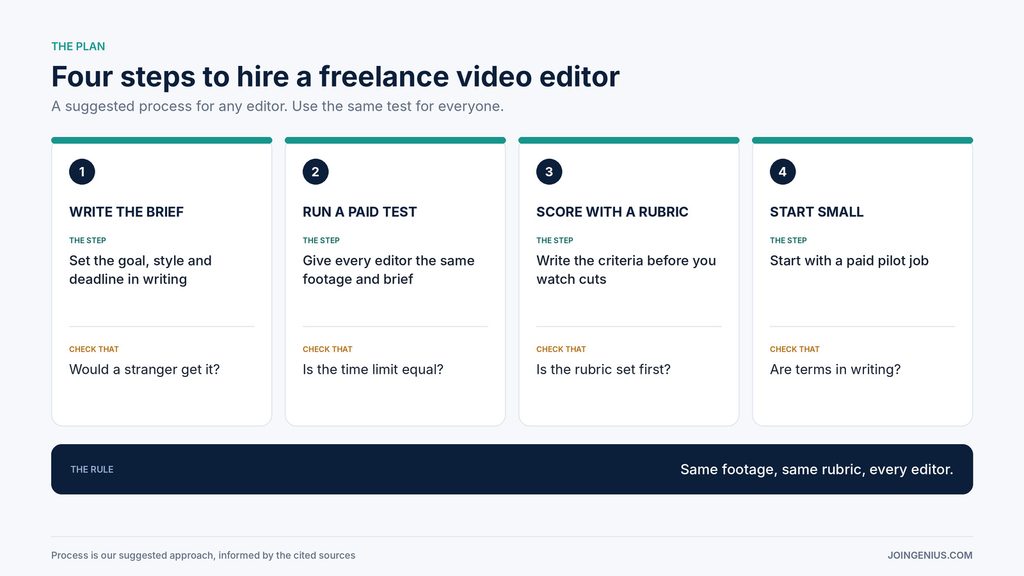
Use this four-step plan for every freelance video editor. It is our suggested process, informed by the sources above.
- Write the brief. Set the goal, style and deadline in writing before you contact anyone.
- Run a paid test. Give every editor the same footage and brief and pay for their time.
- Score with a rubric. Write the criteria before you watch the cuts.
- Start small. Begin with one short paid project, with terms in writing, before any longer commitment.
The last step matters because a test shows how someone handles one task, and a small real project shows how they handle feedback, deadlines and file handover. If the first project goes well, you can widen the scope.
Measure Whether the Hire Works
Track turnaround against the agreed date, the number of revision rounds, how closely each edit matches the brief on your rubric, how often you have to redo work and how easy the file handover is. Judge the editor over several projects, since one job proves little. Be careful about judging an editor on views alone, because many factors beyond the edit affect how a video performs. That is our reasoning, not a finding.
For context on the market, our data on freelance statistics and creator economy statistics shows how common freelance work is. If you also need someone to find topics, see our guide to hiring YouTube researchers, and for short clips see the guide to hiring a social media content creator.
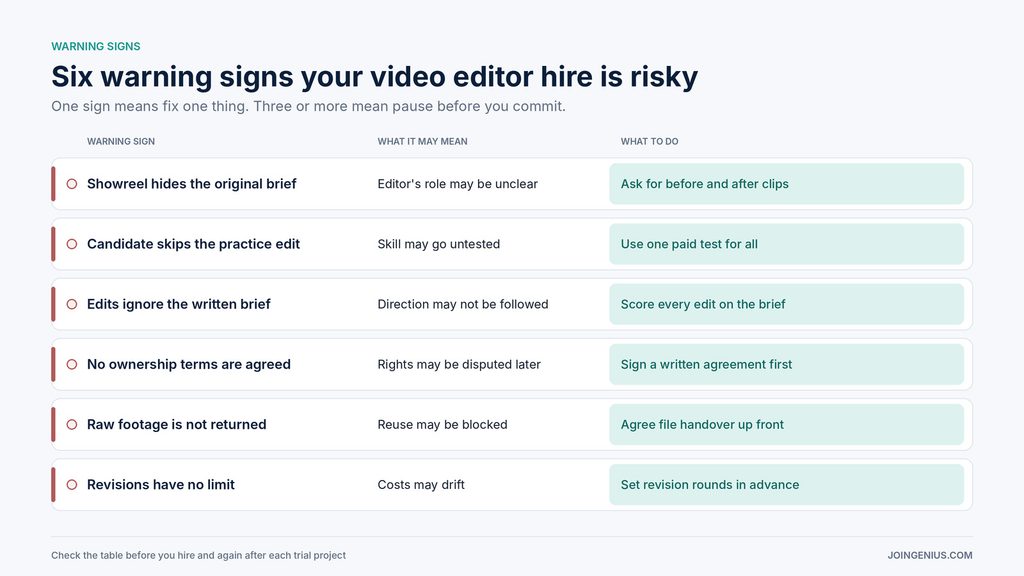
Warning Signs Your Video Editor Hire Is Risky, and What to Do About Each
Check this table before you hire and again after each trial project. One sign means fix one thing. Three or more mean pause before you commit.
Test the Edit, Then Put the Terms in Writing
A good freelance video editor is one who follows your brief, delivers on time and leaves you with files and rights you can use. Write the brief first, give every candidate the same paid practice edit, score the results against a rubric written in advance and sign an agreement before work begins. We found no study proving that this method picks better editors, but each step replaces a guess with evidence. If the first small project goes well, you have a better reason to keep the editor than any showreel.