A channel hires a researcher whose portfolio is full of topic lists with big view counts attached. Three months in, the pitches keep arriving, but each one copies something that worked for another channel. Nobody can say which viewer a topic is for or why that person would click. That is an illustration, not a case study, but it describes a real hiring risk: a researcher who can find videos that did well is not necessarily one who understands the people watching them.
This guide explains how to hire YouTube researchers who understand your audience. It covers what the role involves, what the evidence says about audience data and success, a test that shows how a candidate reasons, how to check that they can read viewers, how to measure the hire and a table of warning signs. We found no study showing what makes a YouTube researcher effective or how best to hire one, so the advice rests on YouTube’s own documentation, research on hiring methods and our reasoning. It is general information, and what works varies by channel.
What a YouTube Researcher Does, and What Understanding the Audience Means
A YouTube researcher usually works before production: finding topics, testing angles for titles and thumbnails and gathering what viewers ask for. Duties vary by channel and we found no standard definition, so treat this one as ours.
We would split “understands the audience” into three skills. The first is reading audience data, such as who the viewers are and how they behave. The second is reading viewer language, meaning what people ask for and complain about. The third is explaining why a video performed as it did. We found no study showing that any of these predicts success in the role. They come from how YouTube describes its own reports and from our reasoning, so use them as a way to structure your questions, not as a validated checklist.
What the Evidence Says About Audience Data and Success
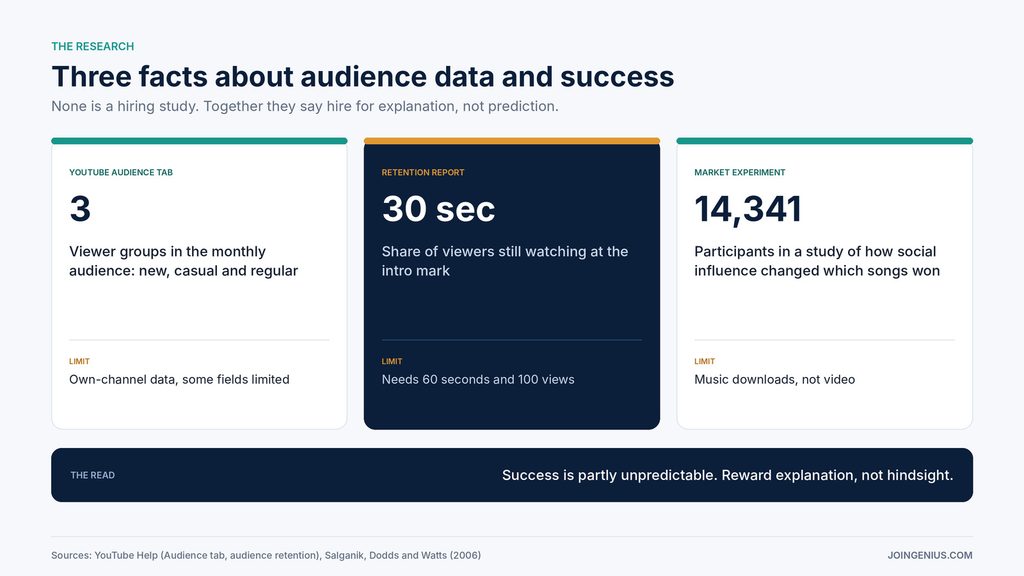
YouTube’s Help pages show what audience data a channel can see. The Audience tab says “Your monthly audience is split into three groups based on watch behavior: new, casual, and regular viewers,” calculated over the previous 28 days. It also shows when viewers are on YouTube, age and gender, and what else they watch. The page warns that “Some data, such as geography, traffic sources, or gender, may be limited in YouTube Analytics.” A candidate who has only seen public view counts has not seen any of this.
The audience retention report adds a view of behaviour inside a video. YouTube says it “explains how well different moments of your video held viewers’ attention,” and that it is only available at the video level. Its intro key moment measures the share of viewers still watching after 30 seconds. Key moments appear only when the video is at least 60 seconds long and has at least 100 views. So a researcher needs access to a real channel’s analytics to show this skill, and a portfolio built from other people’s public videos cannot show it.
The second piece of evidence is a caution about explaining success. Matthew Salganik, Peter Dodds and Duncan Watts ran an experiment in which 14,341 participants downloaded songs by unknown bands, either independently or after seeing what others downloaded. In the social conditions, outcomes were more unequal and more unpredictable. The authors found that quality was positively related to success, but that “songs of any given quality can experience a wide range of outcomes,” and they concluded that the characteristics of success “will seem predictable in retrospect.” It was a music experiment with 48 songs, and the authors say real-world social influence is far stronger, so it does not measure YouTube. It does say that an explanation given after the fact can sound better than it is.
For hiring, the point is simple. Look for a researcher who can explain a result from evidence and say what they would test, not one who claims to predict hits.
Test Candidates on Why a Video Won, Not Just Whether It Did
A work task shows reasoning that a portfolio hides. Give every candidate the same five videos that beat their channels’ usual performance and ask four questions. Who is the viewer? What need did the video meet? What about the packaging mattered, and how do you know? What would you test before copying it?
You can find such videos with an outlier tool. OutlierKit’s outlier finder lists videos that beat their channel’s typical performance, and its page says “A 10x outlier score means 10 times the channel average.” The page says outliers “reveal which topics and formats resonate with audiences,” which is the vendor’s claim, and it also says “no tool can guarantee viral success.” We found no independent evaluation of its accuracy. Its page describes the baseline as an average in one place and as a distribution measure in another, so check how any tool defines an outlier before you rely on the list. Used this way, the tool only builds the test set. The candidate does the reasoning.
Score the answers against a rubric you write before you read them. The reason is research on selection methods. A HumRRO summary of Sackett, Zhang, Berry and Lievens (2022) reports revised validity estimates in which structured interviews were highest at .42, and work sample tests came in at .33. The authors argue that earlier estimates were inflated by range restriction corrections. The summary notes that structured interview validity varies considerably, and these figures concern job performance in general, not YouTube research. It supports a modest conclusion: asking every candidate the same questions and scoring them the same way beats improvising. Our interview guide covers how to structure the conversation.
A strong answer names a specific viewer, uses evidence from the video or the channel, and states what it does not know. A weak answer tells a neat story that fits the result and offers no test.
Check How They Read Viewers, Not Just Views
Add a second exercise with data the candidate rarely sees. Share a retention graph from your own channel, with permission to discuss it, and ask what they notice in the first 30 seconds, where viewers drop off and what a spike might mean. YouTube’s page says dips can show where viewers skipped or stopped, and spikes can show rewatched or shared moments, or unclear content that viewers had to replay. A good candidate offers more than one explanation and says what else they would look at.
Then ask for three questions or complaints the audience has raised in the comments, and what the candidate would do with each. Comments come from a small group who chose to write, which is our reasoning, so a strong candidate treats them as clues to check against retention and audience data, not as a vote. The same candidate should say when a signal is too thin to act on.
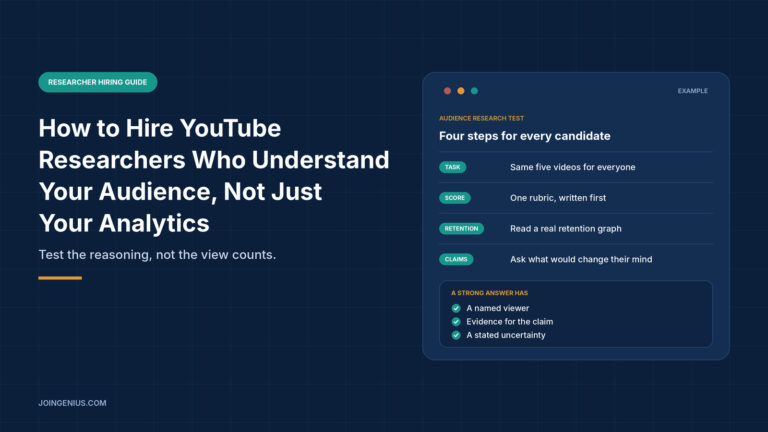
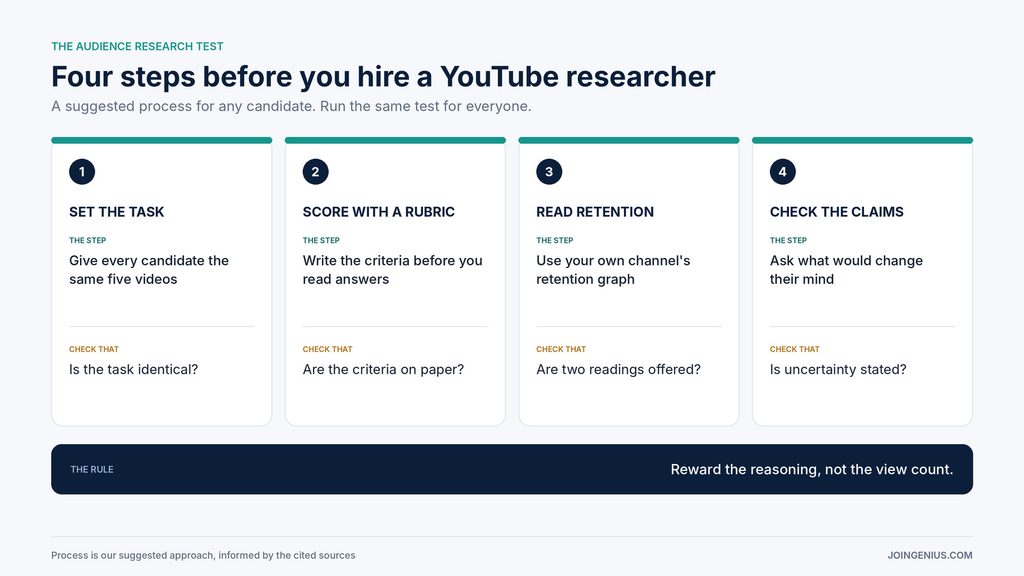
Use this four-step audience research test for every candidate.
- Set the task. Give everyone the same five videos and the same questions.
- Score with a rubric. Write the criteria before you read any answers.
- Read retention. Share a real retention graph and ask what they would check.
- Check the claims. Ask what evidence would change the candidate’s mind.
Measure Whether the Hire Works
Track the share of pitches that reach production, how produced videos perform against your channel’s median, how often the researcher states what they are unsure about and how long a pitch takes. A handful of videos proves little, because success varies widely even for good ideas, so judge the researcher over a longer run and by the quality of their reasoning as well as the results.
If you are also deciding who should sit alongside the role, our guide to hiring growth marketers who understand creator marketing covers a neighbouring profile, and the list of platforms to hire content creators shows where to look. The piece on retaining content creators when platform algorithms shift explains why the research function needs patience.
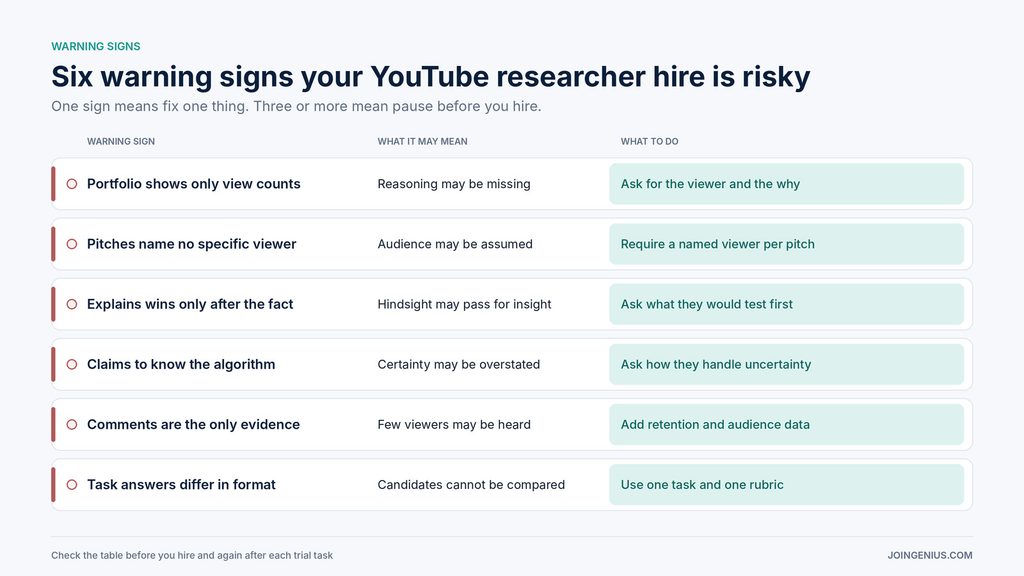
Warning Signs Your YouTube Researcher Hire Is Risky, and What to Do About Each
Check this table before you hire and again after each trial task. One sign means fix one thing. Three or more mean pause before you commit.
Hire for Explanation, Then Test It
A YouTube researcher who understands your audience can name a viewer, use evidence and say what they do not know. Give every candidate the same videos, score the answers against a rubric written in advance and ask to see how they read a real retention graph. Treat outlier lists as a way to build the test, not as proof of skill. If the candidate can explain a result and propose a test, you have a better reason to hire them than any portfolio of view counts.