A recruiting agency has an intake routine its best recruiter has refined over years: the same eight questions, the same scoring notes and the same summary for the client. A client asks whether they could have that routine without paying for the recruiter’s hours. The agency wonders whether the routine could become a product. That is an illustration, not a case study, but it describes why agencies look at packaging their workflows into AI products.
This guide explains how recruiting teams can package a workflow into an AI agent that clients use themselves. It covers which workflow to choose, where a no-code platform such as Pickaxe fits, what you take on when you sell it, how to scope the product, how to measure it and a table of warning signs. We found no study showing that agencies or recruiters can sell AI products profitably, so nothing here promises revenue. The advice rests on regulator findings, legal summaries and our reasoning. It is general information, not legal advice, and rules differ by country.
Why Agencies Look at Packaging Workflows
A recruiting agency sells time: a recruiter’s hours, turned into shortlists. A packaged workflow could sell the result of one repeatable step without selling the hours. That is our reasoning, not a finding. We found no data on how many agencies have tried it or what they earned, and the vendor material we read gives none either.
What we can say is which steps are commonly described as candidates for automation. Pickaxe’s own recruiting guide lists sourcing, resume screening, candidate outreach and interview scheduling.
Pick One Workflow Worth Packaging
A workflow suits packaging when it is repeatable, bounded, produces output a person can check and leaves the hiring decision with a human. Two of the agents in Pickaxe’s guide fit that test: a candidate intake agent that collects work history and availability, and a client job brief agent that asks a hiring manager structured questions and writes up the answers.
We would start with agents that gather and summarise before agents that score or reject. That is our reasoning: a tool that decides who moves forward is the one that can filter people out unfairly.
The same guide lists what AI does poorly: culture-fit assessment, ambiguous client requirements, candidate counselling, sensitive situations and executive search. When a vendor’s own guide names these limits, they are a sensible start for your “not for sale” list. Our overview of AI recruiting tools shows what already exists, so you can check whether the step you want to package is already sold.
Build the Agent, Then Offer It Through a Branded Portal
According to Pickaxe’s materials, teams can use Pickaxe to build custom recruiting assistants and offer them through branded portals. Its homepage calls the product “Shopify for agent-powered businesses” and says users can “Build agents for anything, sell them to anyone.” It says agents can be sold “through branded portals with billing, access control, and usage tracking built in.” The recruiting guide describes three agents an agency could build, covering intake, client job briefs and compliance screening, and mentions a “white-labeled portal” branded to the agency. It says agents can be deployed through chat, WhatsApp or an API.
All of that is Pickaxe describing Pickaxe. We found no independent evaluation of how well its agents perform on recruiting tasks, or of how agencies fare when they sell through it. The homepage shows no pricing, customer counts or sourced figures. The guide does not explain how to package, price or sell an agent to a client, and several of its headline numbers are unsourced, so we do not repeat them. A platform can handle the build and the billing. It does not decide which workflow is safe to sell.
What You Take On When You Sell It
Once a client runs your agent on real candidates, you are no longer only a user of a tool. The evidence below comes from regulators, courts and researchers, and none of it concerns Pickaxe.
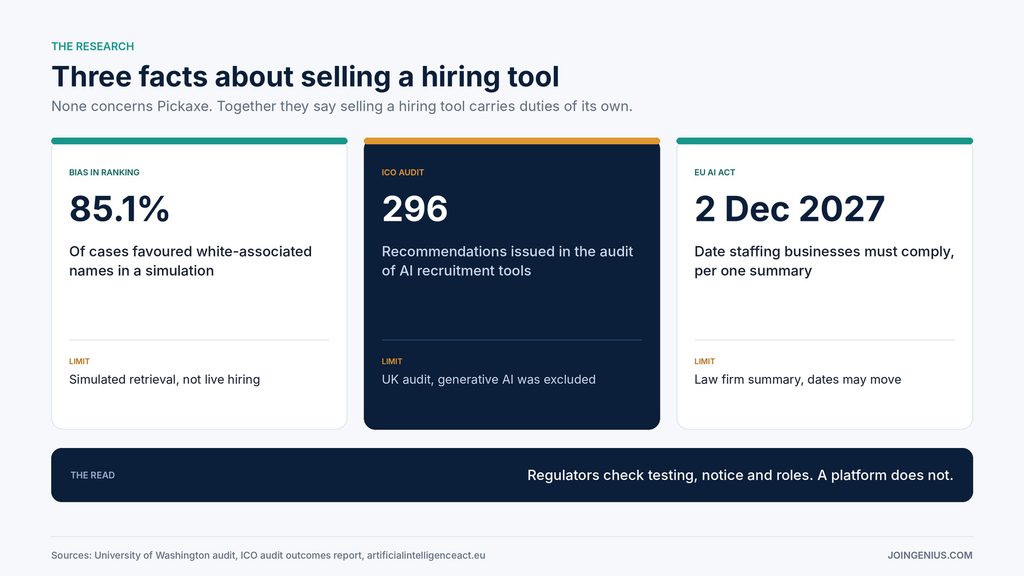
Kyra Wilson and Aylin Caliskan of the University of Washington audited embedding models in a simulated retrieval setting, using over 500 publicly available resumes and 500 job descriptions across nine occupations. They report that the models favoured white-associated names in 85.1% of cases and female-associated names in 11.1%. It was a simulation, not a live hiring process, but it shows how a ranking can carry bias.
The UK Information Commissioner’s Office published an audit report on AI recruitment tools in November 2024, covering audits from August 2023 to May 2024. It issued 296 recommendations, and 97% were accepted and actioned. It found that some providers did no accuracy testing, that several estimated gender and ethnicity from names, which it said is too inaccurate for reliable bias monitoring, and that some contracts put all compliance on recruiters. It also found that several providers wrongly called themselves processors. The report excluded generative AI tools, so it shows what regulators check, not how agents built on language models perform.
New York City’s Local Law 144 covers employers and employment agencies that use automated employment decision tools. A Perkins Coie summary from 2023 says it requires an independent bias audit, at least 10 days’ notice to candidates and a published summary of the results. That summary is secondary and the rules may have changed, so confirm the current text.
On the EU AI Act, a guest article on artificialintelligenceact.eu, published in March 2026 by the law firm Nazareth & Partners, says AI used in employment decisions is high-risk and gives 2 December 2027 as the compliance date for staffing businesses. It says deployers stay responsible even if the vendor says otherwise. It does not say whether an agency that builds or rebrands its own agent becomes a provider, and it notes an update in light of the Digital Omnibus, so dates may move.
In Mobley v. Workday, a US federal court ruled in July 2024 that a claim could proceed against an HR software vendor on the theory that it acted as the employer’s agent, because its tools were alleged to perform a hiring function. It was a pleading-stage ruling on allegations, and we have not confirmed the case’s current status. Workday is not a staffing agency, so applying it to an agency’s agent is our reasoning.
None of this shows that your agent breaks a rule. Together it says that selling a hiring tool carries duties that do not disappear because a platform handled the build.
Scope the Product So Clients Know What It Does
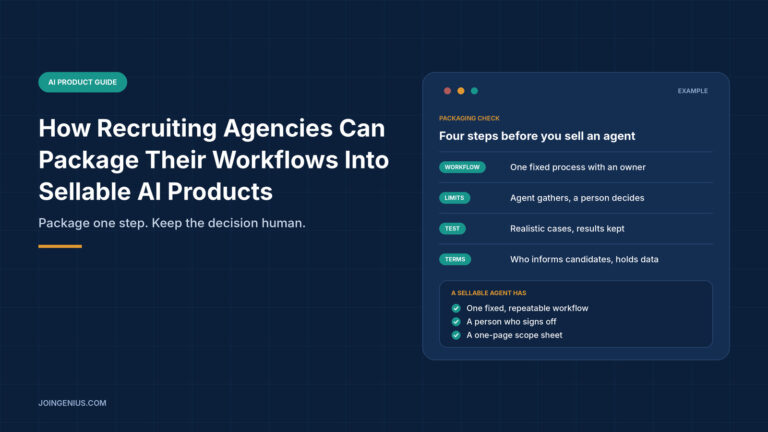
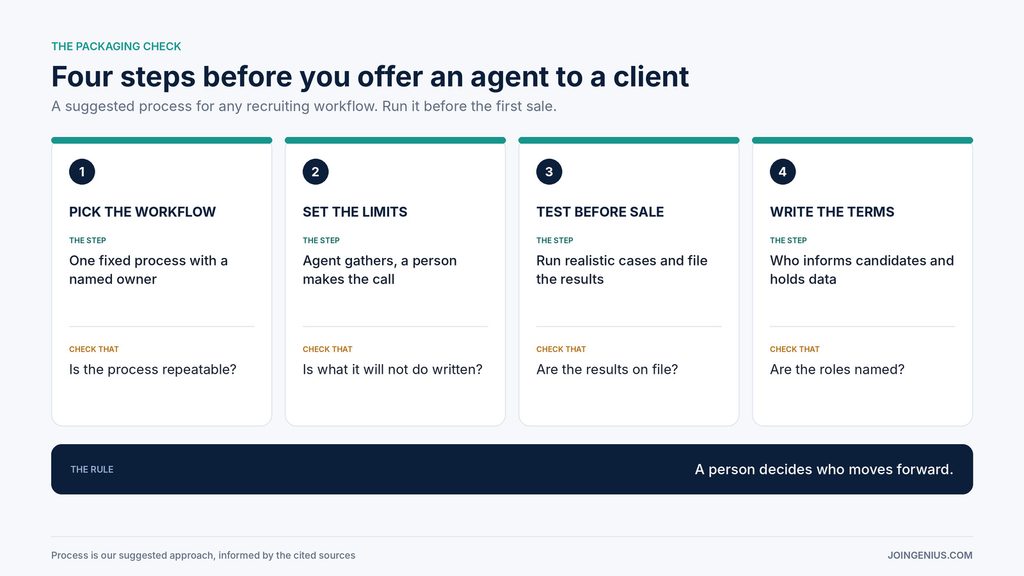
Use this four-step check before you offer an agent to a client.
- Pick the workflow. Choose one fixed process with a named owner on the client’s side.
- Set the limits. Let the agent gather and summarise, and have a person decide who moves forward. Write down what it will not do.
- Test before you sell. Run it on realistic cases and keep the results. The ICO criticised one provider for relying on its tool being “at least better than random,” and found that inferring protected traits from names is unreliable, so ask a specialist how to test by group lawfully.
- Write the terms. Say who tells candidates an agent is used, who holds the data and for how long, and who handles complaints. Do not assume you are a processor, since the ICO found providers who did.
Put the result on one page for clients: what the agent does, what it does not do, who reviews its output and where candidate data goes. The ICO found that contracts were often unclear about who must inform candidates, and a one-page sheet makes that question hard to skip.
Measure Whether It Works
Track the recruiter time the workflow takes from the client’s own records, not from vendor figures, along with how often a person overrides the agent’s output, how many candidates complain and what you earn against build, platform and support costs. One or two pilot clients prove little, so treat the first results as a test.
Our data on how many companies use AI in hiring gives context for demand, and the guide to auditing your recruiting pipeline for demographic blind spots explains how to look for uneven outcomes. For the commercial side, see our piece on pricing strategy models and the explainer on the SaaS business model.
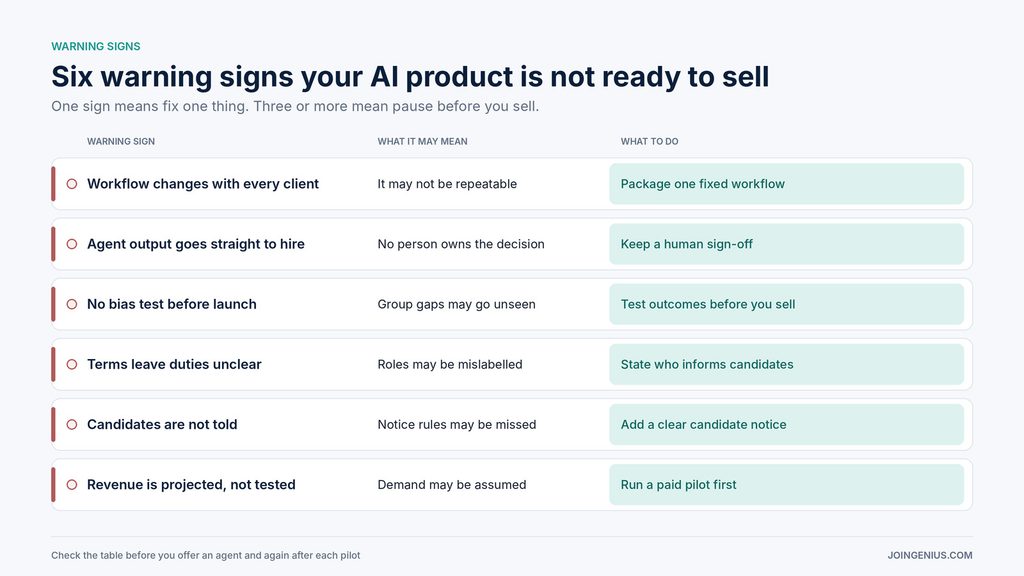
Warning Signs Your Recruiting AI Product Is Not Ready to Sell, and What to Do About Each
Check this table before you offer an agent to a client and again after each pilot. One sign means fix one thing. Three or more mean pause before you sell.
Package the Repeatable Step, Keep the Decision Human
A recruiting workflow is worth packaging when it is repeatable, bounded and checkable, and when a person still makes the hiring decision. Start with intake or job briefs, scope the product on one page, test it before sale and write down who tells candidates. A platform can host and bill the agent, but the duties that come with selling it stay with you. If a paid pilot shows that a client will use the agent and the results hold up, you have a better reason to expand than any vendor claim.