A founder wants a byline in an industry publication. The draft goes to a junior content marketer, comes back sounding like a press release and gets rewritten twice by the founder. Meanwhile a former business reporter who could have found a sharp argument in a 30-minute interview never sees the role, because it was posted as a content job. That is an illustration, not a case study, but it shows why the choice of writer matters.
This guide explains why thought leadership ghostwriting tends to draw experienced writers and how to hire one. It covers who the work draws, why senior writers may choose it, why it needs senior judgment, how to test candidates and a table of warning signs. We found no study that explains why senior writers choose thought leadership ghostwriting, or that shows it attracts them more than other writing work. “Senior” is our label, not a standard one. The advice rests on work design research, a thought leadership survey, an independent work report, one agency’s description of its writers and our reasoning.
What Thought Leadership Ghostwriting Involves
Thought leadership ghostwriting means writing under an executive’s name, in their voice, about their views. That definition is ours. Gotham Ghostwriters, an agency, lists white papers, thought leadership blogs, CEO presentations, reports and company newsletters as the materials it produces.
The writing is only part of the job. The writer usually has to interview someone busy, find the one argument worth making, match another person’s voice and take feedback from whoever has the final say. Those are different skills from producing volume, and a writer strong at drafting may still struggle with the interview. That is our reasoning. Our guide to hiring a ghostwriter covers where to find candidates, and our piece on outsourcing content creation covers splitting work with outside writers.
Who This Work Draws
Gotham’s thought leadership page says its network includes business journalists, communication executives and speechwriters, alongside digital content strategists. That is one agency’s description, and we treat it as a claim. The page names no writers or seniority levels, and “elite” and “unmatched” are the agency’s own words. Its pages give different writer counts, so we skip them. Gotham’s writers page adds that admission is by invitation only and based on “considerable experience creating smart content or compelling stories,” with no application steps or pay terms.
Even as a claim, the list is useful. Every group on it works by interviewing, building an argument and writing for someone else’s name. Our reasoning is that these are the habits the job rewards, so a former reporter may fit better than a generalist. We found no study that compares them.
Why Senior Writers May Be Drawn to It
We found no study of what attracts senior writers to this work, so this section is mostly our reasoning.
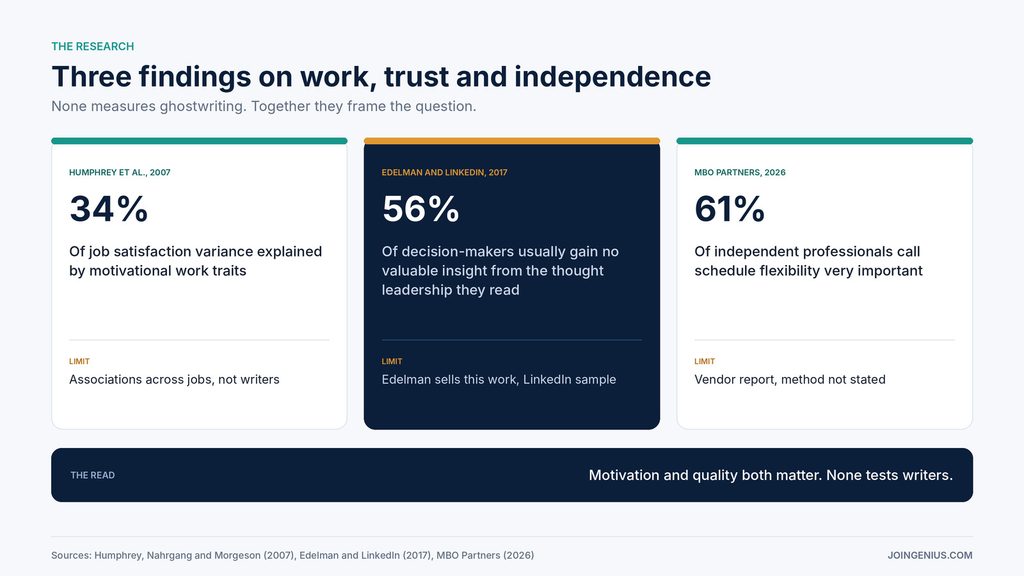
A 2007 meta-analysis in the Journal of Applied Psychology by Stephen Humphrey, Jennifer Nahrgang and Frederick Morgeson summarized 259 studies and 219,625 participants. It found that motivational work characteristics explained 34% of the variance in job satisfaction, 25% in subjective performance and 24% in organizational commitment, and only 2% in turnover perceptions. The abstract we read reports these traits as a group, without individual ones such as autonomy. The figures are associations across many jobs, not about ghostwriting.
Our reasoning is that the work can offer features of this kind: a clear end product, real judgment calls and room to decide how it gets done. That is an inference, not a finding, and not every engagement works this way.
Independence may be part of it too. MBO Partners, a workforce services firm, reports in its 2026 State of Independence research that 61% of independent professionals say schedule flexibility is very important and 78% plan to stay independent or build larger businesses. It calls independent professionals “more established, more sophisticated and more selective.” The page gives no sample size or method for the first report and does not define “independent.” The company sells services to employers, and the data covers independent workers, not writers, so read it as a rough signal.
Why the Work Needs Senior Judgment
The case for hiring experience is clearer on the buyer side. In 2017, Edelman and LinkedIn surveyed 1,300 business decision-makers and C-suite executives. Fifty-six percent of decision-makers said they usually do not gain valuable insights from the thought leadership they consume. Forty-five percent of decision-makers and 53% of C-level executives said poor-quality thought leadership had cost a company their respect.
The limits matter. Edelman sells communications services, the sample came through LinkedIn, the answers are self-reported and the study is about nine years old. It gives no question wording or margin of error. Our reasoning is that if readers discount thought leadership this readily, a piece with no real argument carries a cost, and a writer who can find the argument is worth more. We do not know whether more experienced writers produce better pieces, so that is an assumption to test.
Test Candidates With a Paid Draft From a Real Interview
A paid draft shows what a portfolio hides: how a writer turns a conversation into an argument in someone else’s voice. Most thought leadership work is unsigned or confidential, so a portfolio may not show who wrote what. Gotham’s own credentials page says confidentiality stops it naming clients, a common reason samples are hard to verify.
Selection research supports a shared, realistic task, with a limit. A HumRRO summary of Sackett, Zhang, Berry and Lievens (2022) reports revised validity estimates in which structured interviews were highest at .42 and work sample tests were .33. The authors argue that earlier estimates were inflated by range restriction corrections, and they note that structured interview validity varies considerably. These figures concern job performance in general, not ghostwriters. They support a modest point: the same realistic task, scored the same way, beats improvising. Our interview guide covers how to structure the conversation.
To run the test, record a 20-minute interview with one executive, with their permission, or use a public interview with a leader in your field. Give every candidate the same transcript, the same brief and a time limit such as three hours, and ask for an 800-word draft in the executive’s voice. Pay for the time, since unpaid tests ask people to work for nothing and may put off experienced writers. That is our view, not a finding. Write the rubric before you read any drafts, with criteria such as voice, a clear argument, claims that can be checked and response to one round of feedback.
What an Experienced Writer Will Look for in the Offer
Senior writers can usually choose their work, so the offer matters. These points are our suggestions, not findings. Give access to the executive, since a draft built only from a brief tends to read thin. Name one approver and a deadline. Set the number of revision rounds. Agree credit, confidentiality and ownership in writing and ask a lawyer to check it.
Our guide to PR strategy covers how placed articles fit a wider plan, and our piece on retaining senior designers covers what keeps another kind of senior specialist engaged. Our freelance statistics show how common independent work is.
A Four-Step Plan to Hire a Ghostwriter
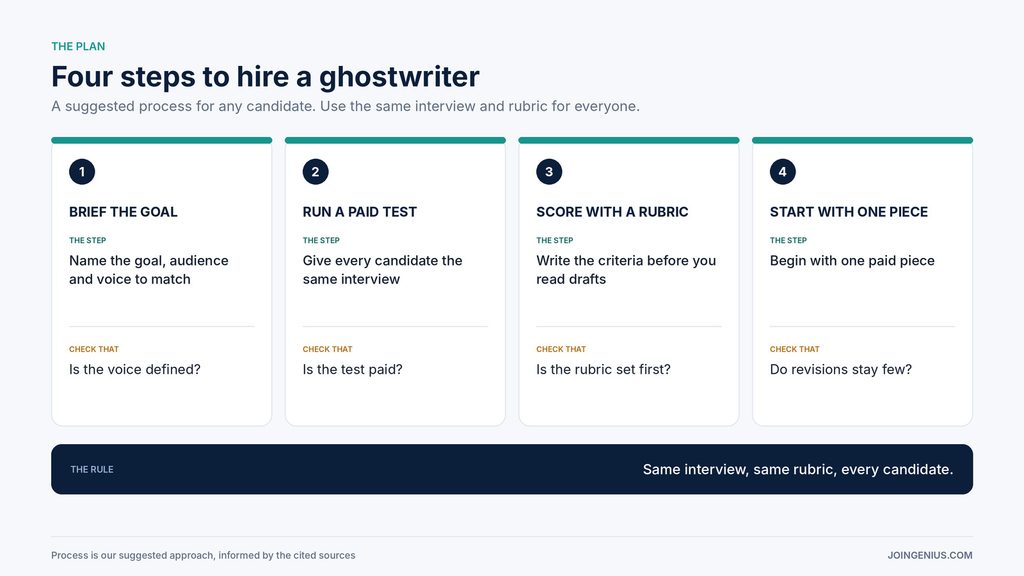
Use this four-step plan for every ghostwriter. It is our suggested process, informed by the sources above.
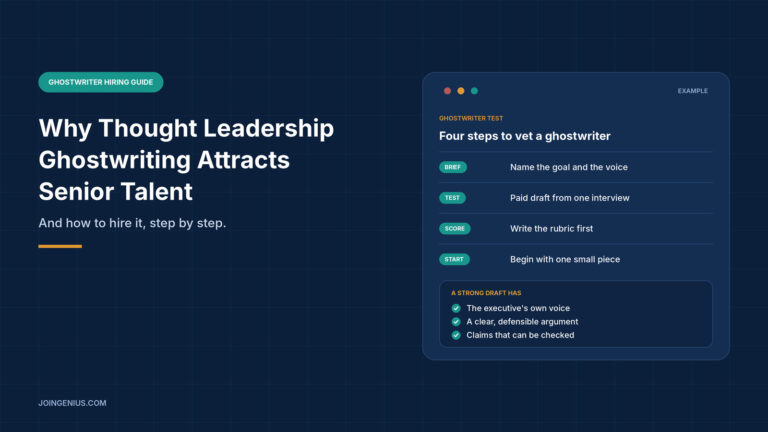
- Brief the goal. Name the executive’s goal, the audience and the voice to match.
- Run a paid test. Give every candidate the same interview and brief and pay for their time.
- Score with a rubric. Write the criteria before you read any drafts.
- Start with one piece. Begin with one small paid piece before a longer commitment.
The last step matters because a test shows how someone handles one draft, and a first real piece shows how they handle the executive’s schedule and feedback.
Measure Whether the Hire Works
Track the factual corrections each draft needs, the revision rounds the executive asks for, the executive’s time each piece takes and whether the executive says it sounds like them. Judge the writer over several pieces, since one draft proves little, and be careful about judging on views alone, because many factors beyond the writing affect reach. Ask a few readers whether they learned something. These measures are our suggestions, not findings.
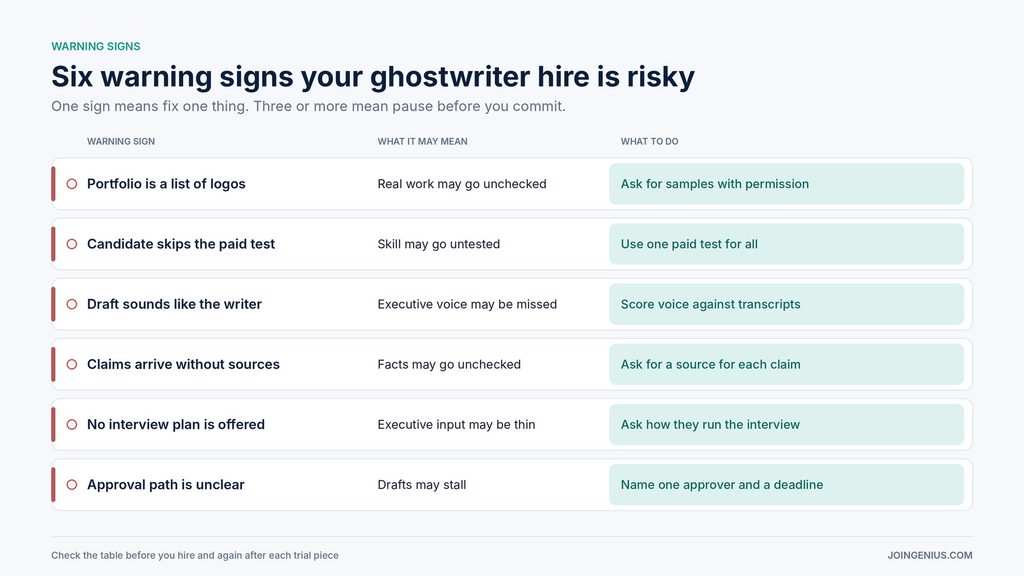
Warning Signs Your Ghostwriter Hire Is Risky, and What to Do About Each
Check this table before you hire and after each trial piece. One sign means fix one thing. Three or more mean pause before you commit.
Hire for Judgment, Then Test for It
A good thought leadership ghostwriter finds the argument, writes in the executive’s voice and leaves you with claims you can stand behind. Brief the goal first, give every candidate the same paid draft from the same interview, score the results against a rubric written in advance and start with one small piece. We found no study proving that this method picks better writers, but each step replaces a guess with evidence. If the first piece needs few corrections and the executive recognizes their own voice, you have a better reason to keep the writer than any logo on a portfolio.