A hiring manager compares two candidates for a senior backend role. Both pass the coding exercise. One has spent four years triaging issues, reviewing other people’s pull requests and explaining, politely, why a change will not be merged. In the team’s first month a design disagreement drags on, and that candidate is the one who can say no clearly and keep the other person on side. That is an illustration, not a case study, but it shows the skills that maintainer work may build.
This guide explains why open-source maintainers can make better technical hires and how to check whether a given maintainer does. It covers what maintainers do, what research says, why the skills may transfer and where they may not, a test you can run, a four-step plan and a table of warning signs. We found no study showing that maintainers outperform other technical hires, so the title says “can,” and the case rests on related research and our reasoning.
What Maintainers Actually Do
In our usage, a maintainer is someone who looks after a public software project: reading issues, reviewing contributions, deciding what gets merged, answering users and keeping releases moving. The word covers a lot of ground, from a solo author of a small library to one member of a large team, so judge the individual and not the label.
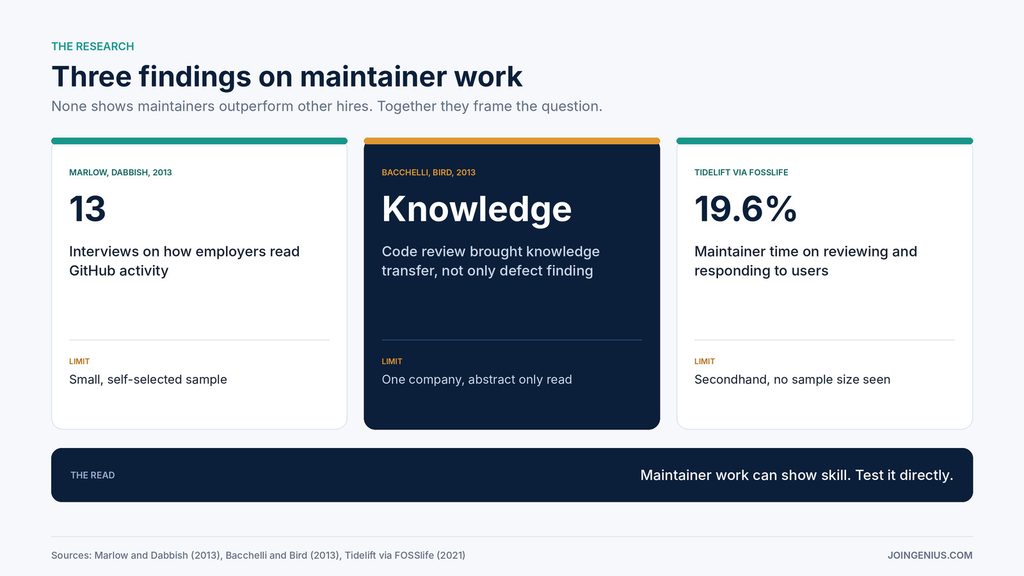
Maintenance time is often spent on people as much as code. A FOSSlife article summarizing a Tidelift survey says maintainers reported spending 19.6% of their time on reviewing contributions and issues and responding to users. We have not seen the survey itself or its sample size, and the figure is self-reported. It still suggests that review and communication are a large share of the work.
What the Research Says
We found three sources that bear on the question, none of which compares maintainers with other hires.
Jennifer Marlow and Laura Dabbish interviewed seven employers and six job seekers about GitHub profiles for a 2013 CSCW paper. Employers said activity traces gave more reliable insight into skill and character than résumés, and they treated popularity measures such as forks and watchers as easy to game. Employers also favored cues that were quick to verify, and they rarely examined interaction and collaboration history because it took more effort. The sample was small and self-selected, and the authors did not test whether these impressions predicted job performance. Our reasoning is that the slow-to-read parts, such as how someone replies to a newcomer, may be the most revealing.
Alberto Bacchelli and Christian Bird studied code review at Microsoft for ICSE 2013. Their abstract says finding defects remains the main motivation, yet reviews are less about defects than expected and also bring knowledge transfer, team awareness and alternative solutions, with understanding the change as the key aspect. We read the abstract, not the full paper, and the setting was one company.
Our reasoning is that a maintainer who reviews code every week practices exactly this kind of understanding. That is an inference, not a finding.
Why the Skills May Transfer, and Where They May Not
Five skills seem likely to carry over, in our reasoning:
- Reading other people’s code. Maintainers do it daily, often without the author present.
- Prioritizing. Issue queues never empty, so someone has to decide what waits.
- Saying no well. Declining a change while keeping the contributor engaged is a team skill.
- Writing for strangers. Clear replies and documentation reach people who share no context.
- Staying courteous under pressure. Public threads can turn tense, and a maintainer has had practice keeping a reply calm.
The limits are real. Maintainers choose their projects, so they may differ from other engineers in ways that have nothing to do with maintenance. Volunteer pace is not deadline pace, and a solo maintainer may never have shared ownership of a codebase. Some maintainers work in narrow stacks, and some maintain little. Treat maintainer experience as a reason to look closer, not as a result.
Our guide to how open-source projects become talent pipelines covers sourcing and approaching contributors respectfully, so we do not repeat it here. Contributors are volunteers, so use only public information and make it easy for them to say no.
Check the Maintainer Skills a Contributing Guide Leaves Out
A public contributing guide shows how outsiders are expected to work. The Oh My Posh contributing guide starts with local setup: forking the repository, running tests and the linter, building the program to check changes in a shell and opening a pull request. That page does not describe code review or what maintainers expect, so a hiring team still has to ask about those parts. We cite it as an example of a public guide, not as a recommendation.
Here is a way to ask. Write an invented issue thread for a fictional project, with three comments from users and one pull request that mostly works but has a problem. Ask the candidate to triage the issue, reply to the contributor and decide whether to merge, request changes or decline, explaining why. Use invented material, not a real project or real people. Give the candidate 45 minutes or so, and tell them in advance that you want reasons, not only a decision. Include one detail that makes the easy answer wrong, such as a change that fixes the reported bug but breaks an older use of the same feature.
Score the answer on five things: whether they understood the change, whether the decision has a reason, whether the reply is clear and courteous, whether they said what they would not do and whether they asked a useful question. A strong candidate declines or redirects without making the contributor feel dismissed. A weak candidate merges to avoid friction or rejects without explanation. Pay for the time on any take-home, since unpaid tests ask people to work for nothing and may put off experienced candidates. That is our view, not a finding.
Structure the Scoring
Selection research supports a shared, scored task, with a limit. A HumRRO summary of Sackett, Zhang, Berry and Lievens (2022) reports revised validity estimates in which structured interviews were highest at .42 and work sample tests were .33. The authors argue that earlier estimates were inflated by range restriction corrections, and they note that structured interview validity varies considerably. These figures concern job performance in general, not maintainers. They support a modest point: the same realistic task, scored the same way, beats improvising. Our interview guide covers how to structure the conversation, and our HR scorecard guide can help you set up the scoring sheet.
Write anchors before you read any answers. For the problem pull request, a weak answer merges it, an acceptable one requests changes and a strong one requests changes, explains the reason and says what would make it mergeable. Have two people score independently and compare before they discuss. These anchors are our suggestions.
A Four-Step Plan to Check a Maintainer
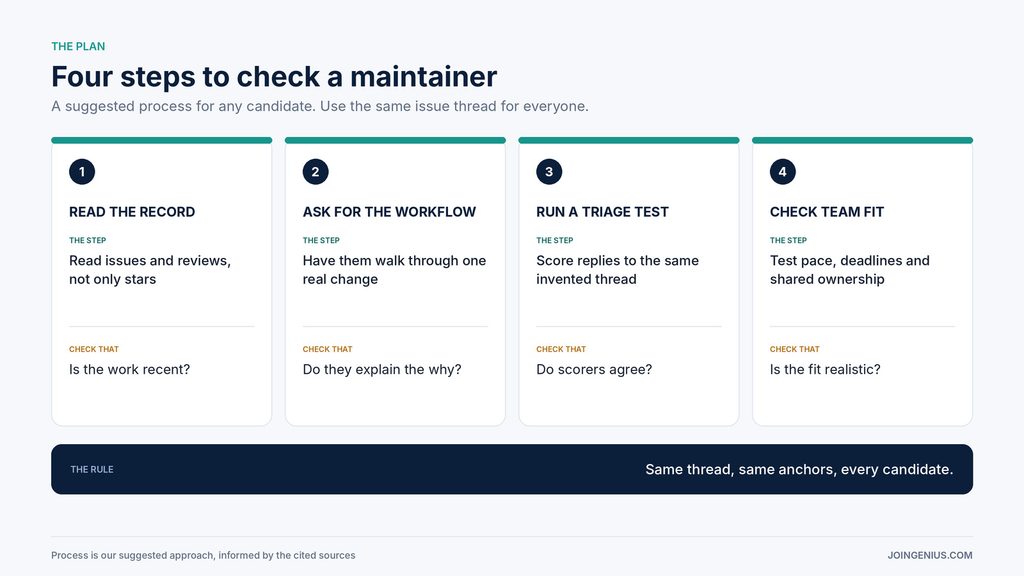
Use this four-step plan for each candidate. It is our suggested process, informed by the sources above.
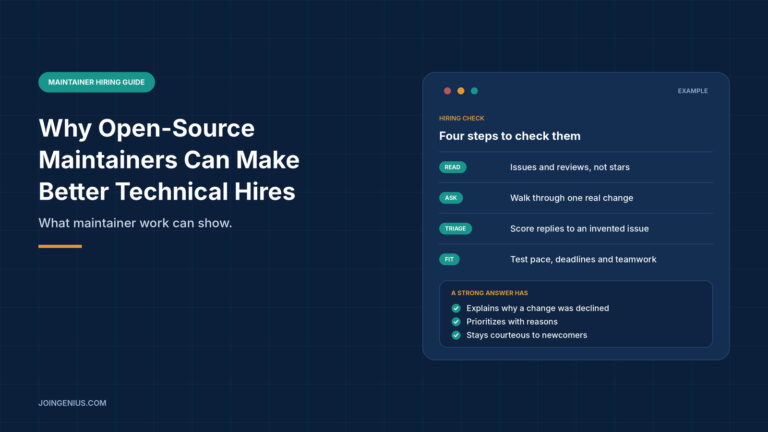
- Read the record. Look at issues, reviews and replies, not only stars.
- Ask for the workflow. Have them walk through one real change from start to finish.
- Run a triage test. Score replies to the same invented issue thread.
- Check team fit. Test pace, deadlines and shared ownership.
The last step matters because the first three show maintenance skill, and only the fourth shows whether it works on a team with deadlines. Our guide to technical hiring fails covers other ways technical hires go wrong.
Measure Whether the Hire Works
Look at how quickly the hire’s reviews help others, whether teammates find their feedback clear, how they handle a disagreement and how they onboard a newcomer over the first ninety days. Compare with how you judge any other engineer, and ask the people they work with, not only the manager. One hire is a small sample, so be careful about drawing a general rule from it. These measures are our suggestions, not findings.
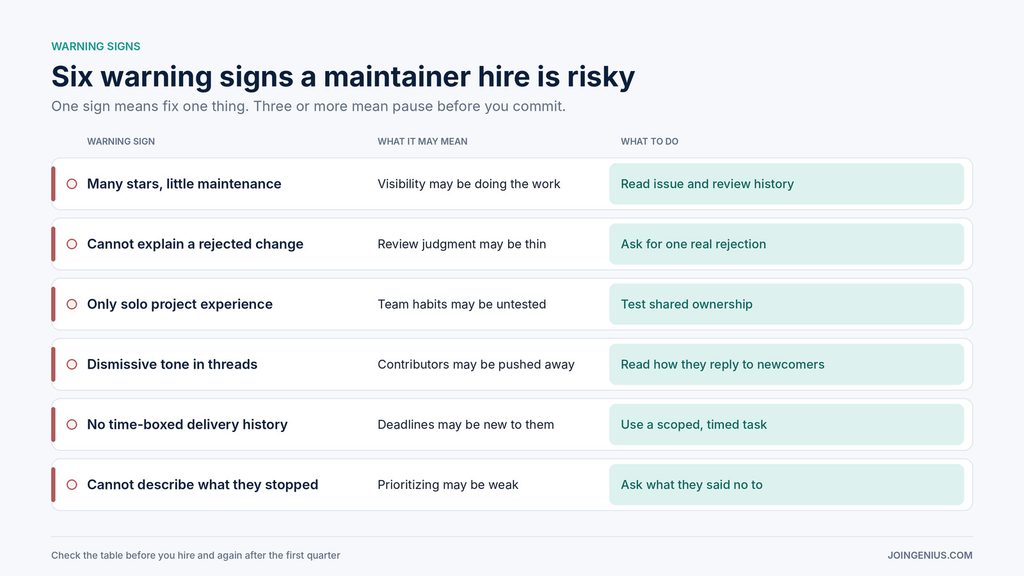
Warning Signs a Maintainer Hire Is Risky, and What to Do About Each
Check this table before you hire and again after the first quarter. One sign means fix one thing. Three or more mean pause before you commit.
Look for Maintenance Work, Then Test for It
A maintainer can be a strong technical hire because the work builds judgment about other people’s code and other people’s feelings. Read the maintenance record, ask for one real change from start to finish, score replies to an invented issue thread against anchors written in advance and check fit with your team’s pace. We found no study proving that maintainers outperform other hires, but each step replaces an assumption with something you can check. If the candidate can explain a no and keep the contributor, you have a better reason to hire them than a star count could give you.