
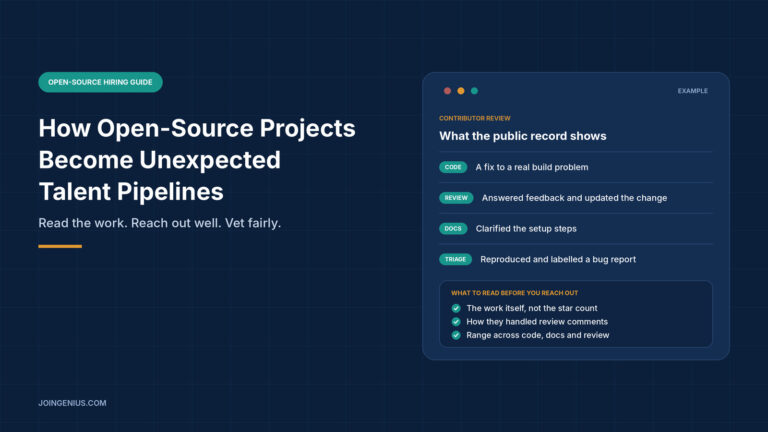
Most hiring plans start with job boards, recruiters and referrals. Some of the best evidence of what a developer can do sits somewhere else entirely: in public issue trackers, pull requests and code reviews on open-source projects. A developer who fixes a bug in a project you already depend on has shown you real work, in the open, without sending a CV.
This guide explains how open-source projects become unexpected talent pipelines. It covers why the talent is easy to overlook, what contributions do and don’t signal, what maintaining other people’s code can show, how to approach contributors respectfully, how to vet what you find and how to build the pipeline over time. It ends with a table of warning signs. We found no study that measures open-source projects as hiring pipelines directly, so treat this as practical reasoning built on related research. It is general information, and every project and community is different.
Why Open-Source Talent Is Easy to Overlook
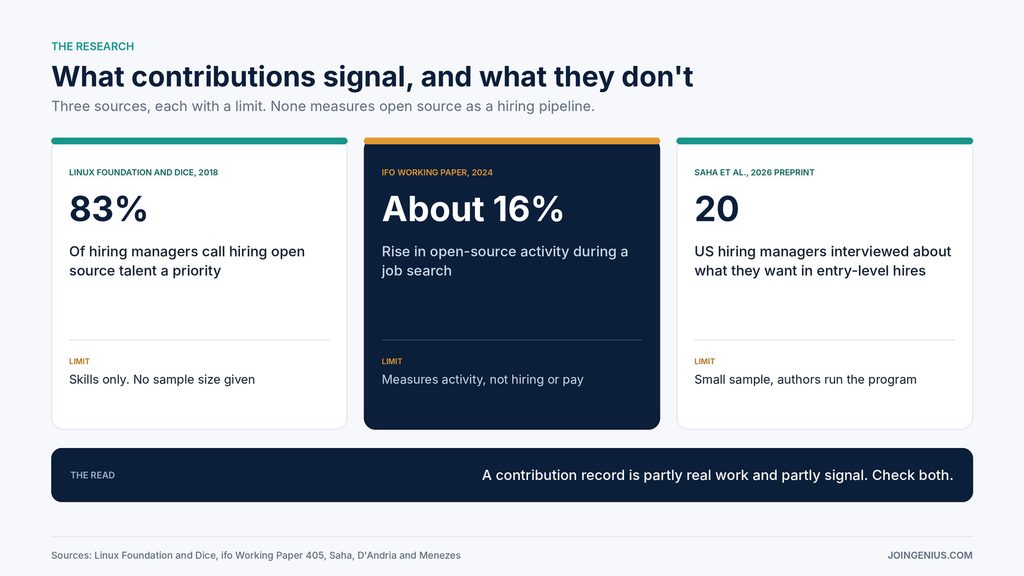
Employers say they want open-source skills. The Linux Foundation’s 2018 Open Source Jobs Report, developed with Dice, says hiring open source talent was a priority for 83% of hiring managers, up from 76% in 2017. The page gives no sample size, and the report is about open-source skills rather than contributors, so it shows demand and not how hiring managers find people. It is also several years old.
What most hiring processes miss is that the work itself is public. Philip Walton, an engineer at Google, argued in 2014 that companies should look for proven developers instead of waiting for résumés, and that open source is a good place to look. He suggested targeting contributors to the technologies a company already uses, because they are far more numerous than library creators and have shown they can read and improve other people’s code. His article rests on experience, not data, so treat it as an argument to test. If you are building a developer pipeline from scratch, the guide to a technical talent pipeline covers the wider picture.
What Contributions Signal, and What They Don’t
Two pieces of research help here, and both come with limits.
The first is an ifo Institute working paper by Lena Abou El-Komboz and Moritz Goldbeck, published in 2024. It looked at about 22,900 GitHub developers and found that open-source activity rose by about 16% during the job search for developers who moved for a job.
The rise was concentrated in projects that raise the visibility of a developer’s existing work and in languages valued by employers. The authors conclude that these contributions are “targeted less to community needs and more to their signal value”. The paper measures activity during job searches, not hiring outcomes or pay. A contribution record is therefore partly real work and partly advertising, and you should read it that way.
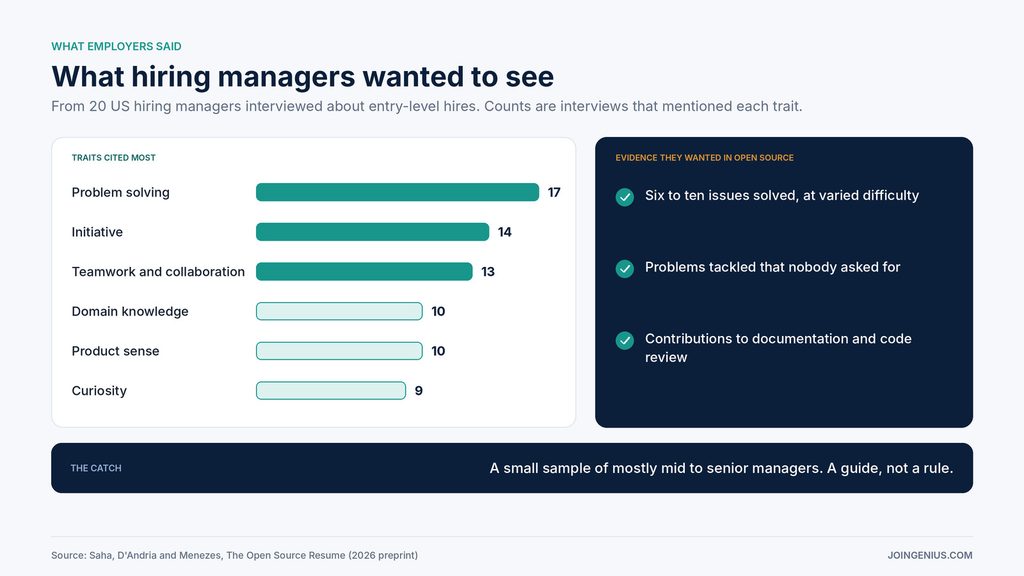
The second is a preprint by Utsab Saha, Jeffrey D’Andria and Tyler Menezes, also listed in the SIGCSE 2026 technical papers. The authors interviewed 20 US hiring managers about entry-level hires. The traits they cited most were problem solving (17 interviews), initiative (14) and teamwork (13).
They wanted to see those traits shown through solving six to ten issues of varied difficulty, tackling problems nobody asked for and contributing to documentation and code review. The sample is small, the survey part measured student motivation rather than hiring, and the authors run the program they studied. Their own conclusion is that open-source work may help students get hired, but only with sustained engagement in several areas.
Forks and Maintainers: How Open-Source Work Makes Developer Talent Visible
Not every useful contribution is a new feature. Some of the most revealing work is keeping an existing project alive.
Dev-C++, a free and open-source C and C++ IDE for Windows, shows what that can look like. Its website explains that forks maintained by other developers carry the project forward, and it lists Orwell Dev-C++ and wxDev-C++ among them. The site says the software is licensed under GPL v2 and has been around since 1998. The page does not name the fork maintainers, describe what each fork changes or say anything about hiring, so what follows is our reasoning rather than anything the page claims.
Taking over or extending someone else’s code usually means reading an old codebase, getting a build working again, handling compatibility problems and deciding what to change and what to leave alone. Those are skills many teams need and few CVs show. A maintainer has also dealt with users, which says something about communication. Walton’s point about contributors carries over: the people who improve and maintain code written by others are more numerous, and often easier to reach, than its original authors. Look at the maintenance record, not only the most starred project.
How to Source From Open-Source Projects Respectfully
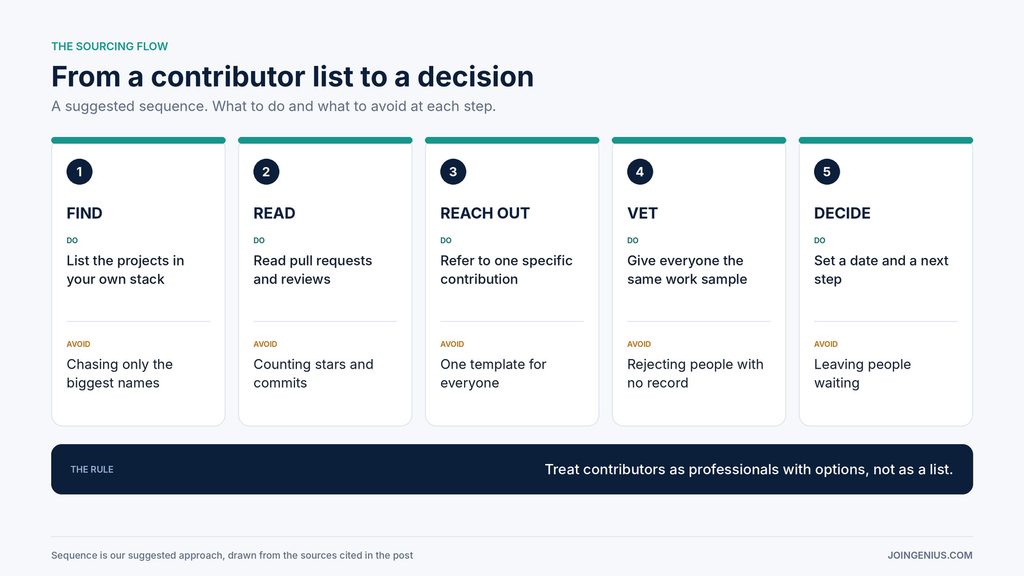
Start with your own stack. List the open-source libraries, tools and frameworks your product depends on, then read the contributor lists for the ones that matter most. Match the skill you need to the project. Walton’s example is that a contributor to a project focused on browser compatibility suits a team facing cross-browser problems.
Contributors are volunteers, not an inbox. Contact them as you would any busy professional. Refer to a specific contribution you read and say why it caught your eye, describe the role and make it easy for them to say no. A template sent to everyone on a contributor list will read as spam, and it may damage your reputation in a community you want to keep working with. The guide to talent sourcing tools can help you organise outreach without turning it into mass mailing. Collect only the details you need to reach out, and check the platform rules and privacy requirements that apply to you.
How to Vet What You Find
A contribution list is a starting point, not a verdict. Stars and commit counts show visibility, and the ifo paper suggests visibility is partly what some developers are aiming for. Read the work itself: the pull requests, the discussion around them and how the person responded to review comments. Look for the traits the hiring managers in the Saha study described, and for sustained work across more than one area, such as code, documentation and review.
Then test what you saw with a short work sample based on a real issue rather than abstract puzzles, and give every candidate the same exercise, whether they came from open source or not. That matters for fairness. Walton warns that not everyone has the time to contribute, and that candidates with several jobs or other obligations should not be penalised for lacking open-source work. A structured interview guide keeps the conversation consistent, and awareness of interviewer bias helps panels avoid favouring profiles that simply look impressive.
Building the Pipeline Over Time
A pipeline is a relationship, not a list. Let your own engineers spend some working time contributing to the projects you depend on, so the people who maintain them can see what your team is like. Contributors who already know your engineers are the easiest to bring in, and a clear employee referral program gives that a route. Keep the stages of your hiring pipeline visible so everyone knows what happens after a first conversation: a chat, a work sample and a decision date.
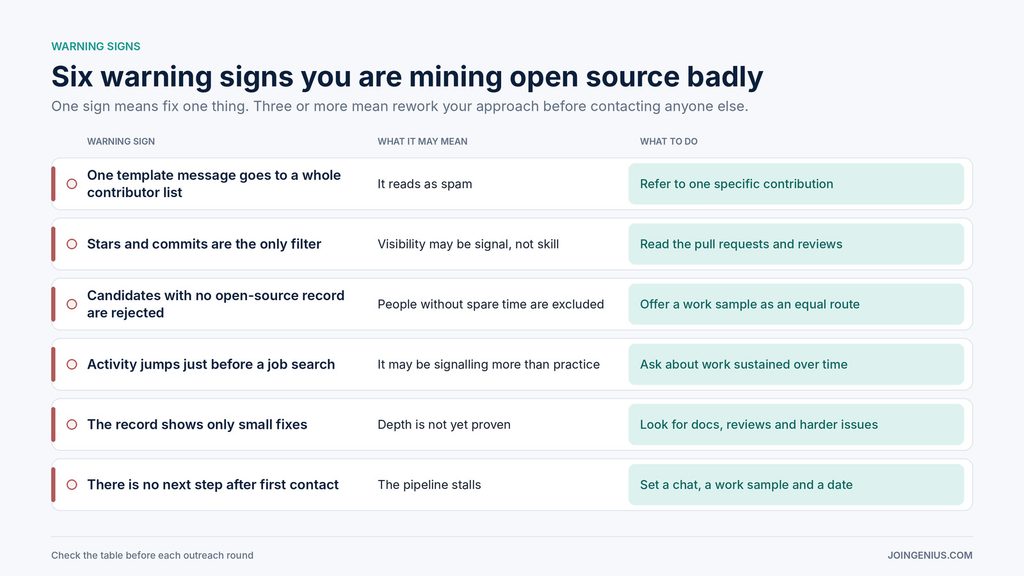
Warning Signs You Are Mining Open Source the Wrong Way, and What to Do About Each
Check this table before each outreach round. One sign means fix one thing. Three or more mean pause and rework your approach before you contact anyone else.
Read the Work, Then Build the Relationship
Open source gives you something most hiring channels cannot: work you can read before you ever speak to the person. Use it to find people, check it for depth rather than visibility, and treat contributors as professionals with options. If the outreach is specific, the vetting is fair and the next step is clear, the pipeline will build itself over time.