You need to staff emerging roles that did not exist eighteen months ago, and no five-year veterans sit in a conventional talent pool. The WEF Future of Jobs Report 2025 says 39 percent of core skills will change by 2030, and 59 percent of workers will need training over that window.
For most of these jobs the standard credential filter stops working. The hiring team is left squinting at adjacent experience and hoping it predicts the next role, when the title itself is still being invented inside the company that posted it.
What follows is a working playbook for staffing those roles today. It leans on signals that predict performance before a title exists. It also uses internal talent as the first candidate pool and treats the first 90 days as a live trial rather than a gamble.
Why Emerging Roles Break The Standard Hiring Playbook
Most recruiting workflows filter on titles and tenure in that title. The resume parser then scores whichever tools the candidate listed. That works for a backend engineer or a controller.
It fails for an AI product strategist, a prompt operations lead or a trust and safety analyst on a new policy surface. The title did not exist two years ago, so nobody has three years in it.
The result is a shortlist of people who claim adjacent experience without a way to compare them. Hiring managers default to the loudest resume or the biggest brand on the CV, both of which are weak predictors when the actual job is new.
There is a second trap. Teams write the job description against the role they imagine, not the role as it exists in the first 90 days. The spec asks for a senior person with five years of Copilot experience when the tool shipped in late 2023.
The pipeline dries up on day one because the posted bar cannot be met by anyone. Recruiters then widen the net to candidates who adjust their resume to fit the ask, which produces an even weaker shortlist.
Emerging roles need a different approach. You hire for the shape of the problem on day one, not for a title that proves someone solved it before.
What An Emerging Role Actually Needs On Day One
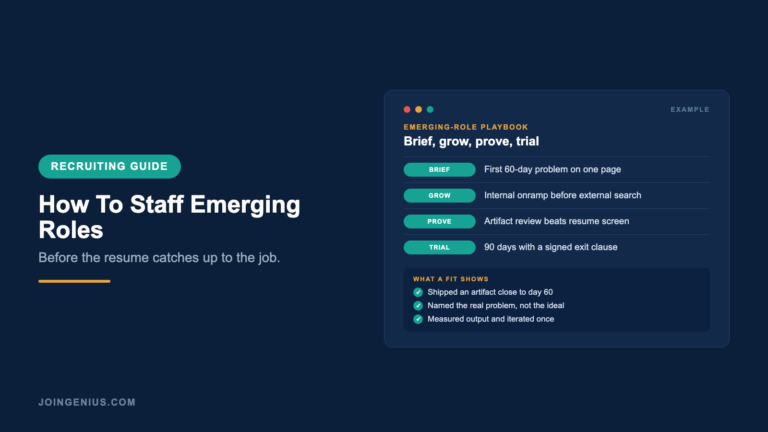
Before you source anyone, write a one-page brief that answers three things. What is the first problem this person solves in their first 60 days. What is the smallest piece of evidence a candidate could show to prove they can solve it. What does the team already have in place that the new person builds on.
That brief is not the job description. It is a scoping document for the hiring manager and the recruiter. Without it, the recruiting process falls back to credential matching because the team has nothing concrete to screen against.
Pair the brief with a shortlist of adjacent roles that produce the right skills. For a prompt operations lead, that might be a technical writer with scripting experience or a QA lead at a model company. For an AI-first customer research role, it might be a user researcher who already runs model evaluations on the side of their main project.
Those adjacent roles are where you source from. The point of the brief is to make the adjacency defensible before the first outreach so recruiters are not guessing.
Grow Internal People Into The Role
Most emerging roles are easier to grow than to buy. People already in the company know the product and the customers. They also know the internal tooling, which means they only need the new skill rather than the whole context.
A 2025 LinkedIn Economic Graph report found that internal mobility raises retention by up to 72 percent in APAC, so moving existing people into new roles pays twice.
Start with a quiet internal post that names the problem, not the title. Describe the first 60 days of work and the signals you are looking for. People who recognize themselves in that description will raise their hand, even if the job title on their LinkedIn profile sounds unrelated.
Give them a one-month onramp that pairs them with a working artifact from the role. For a trust and safety analyst role, that could be a sample of real policy decisions. For a Copilot deployment lead, it could be an internal pilot with a measurable rollout goal.
As more teams lean on Copilot and AI agents to learn on the job, the quality of what those tools draw from matters, which is why some companies feed them verified business knowledge from sources like getAbstract instead of whatever the open web turns up. That is a direct lever on the quality of internal upskilling.
The internal candidate who passes the onramp is now a stronger hire than most external ones. They have shown you the work, not a resume.
A Portfolio-First Signal Set For Candidates Without The Title
External candidates for emerging roles rarely have the right title, but they usually have artifacts. The screening job is to find and read those artifacts rather than skim resumes. Ask for one piece of work the candidate shipped that is closest to the first 60 days of your role, plus a short note on what they would do differently now.
The artifact is the signal. Look for three things in it. Did the candidate name the real problem, not a cleaned up version. Did they ship something that others could use or build on. Did they measure the outcome and change their approach when the first version missed.
Those three signals predict performance in a role nobody has done before, because they capture judgment under ambiguity. According to McKinsey’s State of AI in 2025, 88 percent of organizations now use AI in at least one business function, yet only a third are scaling it. The gap is judgment rather than access. That is what the artifact exposes.
Treat the resume as a prompt for which artifact to ask for, not as the decision document. The resume gets a candidate into the artifact review. The artifact gets them to a trial, which is where the rest of your interview process actually earns its weight.
A 90-Day Trial That Replaces The Reference Check
Reference checks for emerging roles return weak signal because the references cannot evaluate work they have not seen. Replace most of the reference step with a 90-day trial plan that both sides sign off on before the start date.
The plan has three parts. A 30-day deliverable the hiring manager can read and critique. A 60-day decision the new hire owns end to end. A 90-day review that compares the output to the brief written at the start of the process.
Make the trial contractual on the employer side, not just the employee side. If the 90-day review fails against the brief, the hire exits with a defined severance and the role is reopened. If it passes, the person moves into the role with full tenure accrual from day one.
This matters more for emerging roles than for staffed ones. The manager is also learning what the role should look like. The brief is therefore a shared document rather than an employee contract.
The 90-day plan forces both sides to agree on what success means before anyone wastes six months. It also protects the hire from a shifting target when leadership rewrites the role mid-stream, which is common when the role is new.
Keep the sourcing pipeline warm during the trial. Emerging roles have a higher trial-failure rate than mature ones, and the cost of a cold pipeline on month four is the one that kills the hiring plan.
Staff Emerging Roles Before The Resume Catches Up
Emerging roles stay empty when teams wait for the perfect candidate to appear with the title spelled out on their resume. The resume will not catch up for another two years, by which point the role itself has shifted.
The teams that are staffing these roles today use briefs and internal onramps up front. They then test candidate artifacts and run 90-day trials that are contractual on both sides.
If you want help building that pipeline without expanding headcount in your talent team, Genius sources from the top 1 percent of candidates in the Philippines and Latin America. The cost sits around 80 percent below a local hire for comparable work, with no monthly platform fees and a six-month replacement guarantee if the hire does not land.
That model fits emerging roles because the pricing lets you run two 90-day trials in parallel for the price of one local attempt. If the first trial fails against the brief, the second is already producing work, and the role is staffed on month four instead of month ten.
The playbook is simple. Write the brief first. Open an internal onramp before the external search. Review artifacts over resumes. End with a 90-day trial that both sides agree to in writing.
Teams that run this process now will have the hire shipping work by the time the market produces a candidate with the title spelled out. The role will already be a known quantity on the inside, with a brief that has been pressure-tested against real output rather than wishlist criteria.