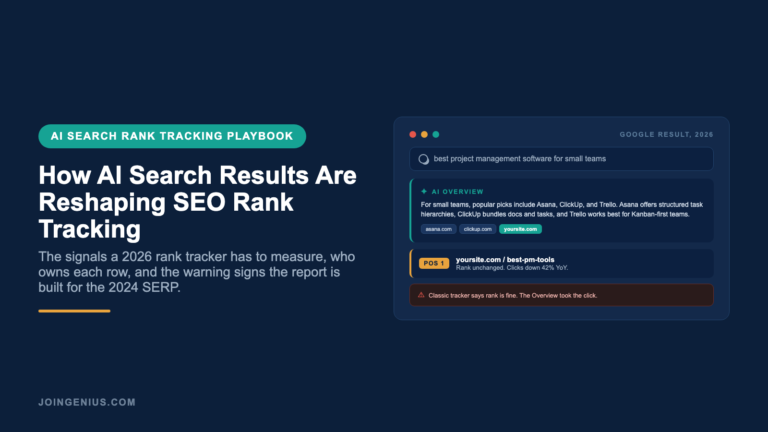
AI search results are rewriting what SEO rank tracking is supposed to measure. A keyword might still rank first for your page, but a synthesized Google AI Overview appears above it and takes the click before it ever reaches your blue link. If your reports still open with position alone, they are telling half the story.
Below we cover what AI Overviews actually changed about the result page, why classic rank tracking falls behind, what a modern tracker has to instrument, a reference for the signals that count, and the warning signs your setup is slipping. Start with the pattern in AI Overview visibility and the Google algorithm.
What AI Overviews Changed About The Google Result Page
AI Overviews are no longer a feature on the margin. By late 2025 they appear on nearly half of tracked Google searches. That matters for rank tracking because the Overview changes what a given keyword returns to the user, and position alone no longer tells the whole story.
The Classic SERP Was A List Of Ten Blue Links
For two decades the Google result page was a vertical list of ten blue links. SEO rank tracking matched that: a keyword got a position number from 1 to 10, and that number moved up or down. The job of the rank tracker was to say where your page appeared in the list.
The AI Overview Compresses The Top Of The Page
The top of the page is now a synthesized answer with inline citations, followed by the organic list. A user can read a paragraph and leave without scrolling past it. Position 1 still exists, but it is below the Overview, and the citations inside the Overview matter as much as the rank below.
Coverage Grew Fast In 2025
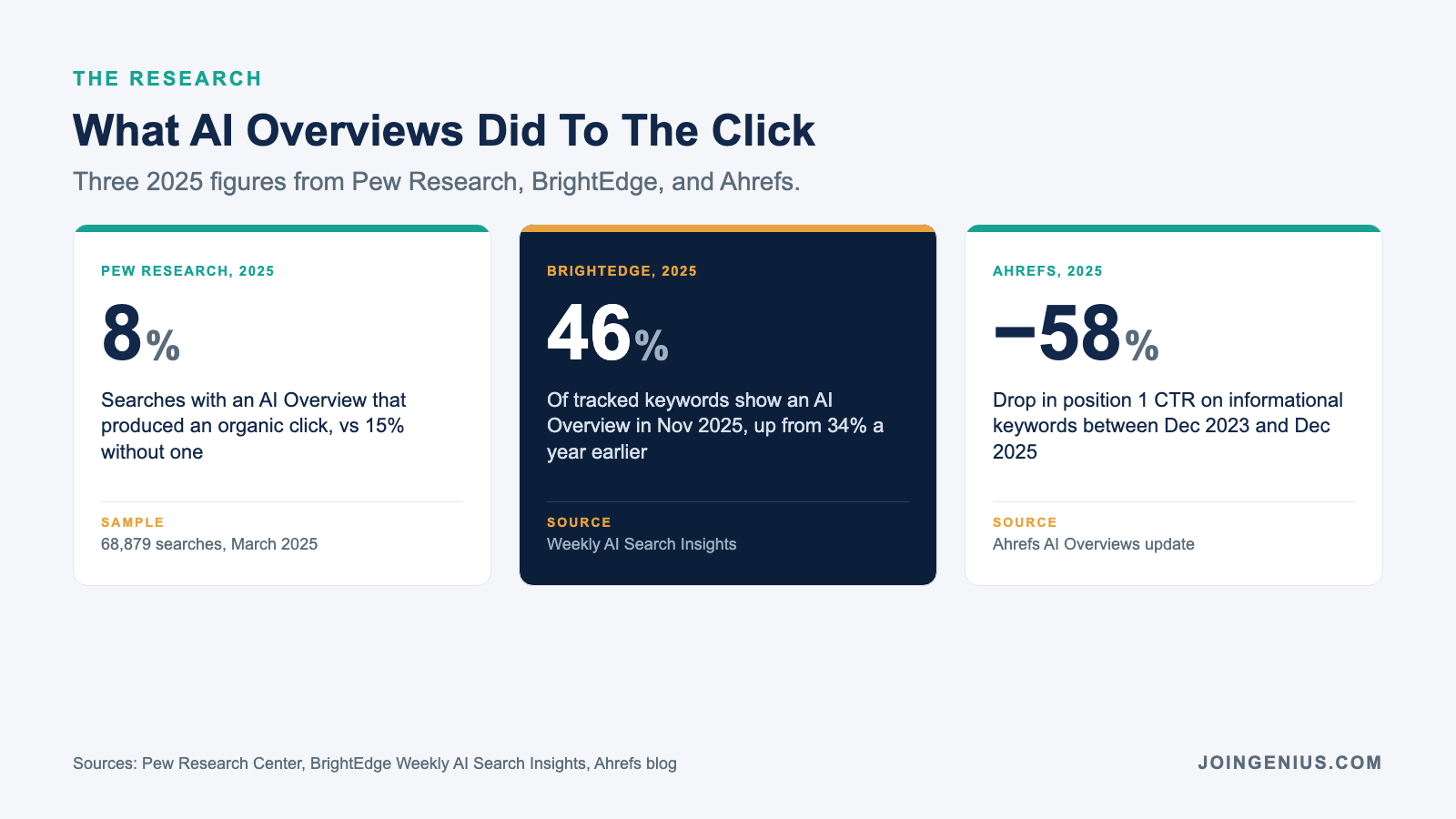
BrightEdge’s Black Friday 2024 vs 2025 analysis found that 46 percent of tracked keywords show an AI Overview in November 2025, up from 34 percent a year earlier. In “best product” queries, the share jumped from 5 percent to 83 percent inside a single year.
The coverage is uneven by vertical. Grocery and food queries jumped from 5 percent to 49 percent Overview coverage year over year, while technical reference queries grew more slowly. Rank tracking weights have to follow the vertical, not an average.
Why Classic Rank Tracking Falls Behind
A rank tracker that only reports position for the ten blue links can misread a high-value page as a failing one. The number did not move, but the behavior around it did. Three 2025 data points make the gap clear.
Position Alone Hides Whether The Overview Took The Click
Pew Research’s July 2025 study of 68,879 searches found that only 8 percent of searches with an AI Overview produced an organic click, compared with 15 percent of searches without one. A rank at position 1 can halve its traffic when an Overview appears above it, without the rank itself changing.
The Pew sample used behavioral data, not self-report. The 7 point gap is a direct read of the zero-click effect, not an estimate.
Click-Through At Position 1 Is Not What It Was
Ahrefs’ December 2025 update measured position 1 click-through on informational keywords falling from 0.076 in December 2023 to 0.039 in December 2025, a 58 percent drop. The ranking did not move. The reward for it did, and classic rank tracking shows only one of those two lines.
The Ahrefs sample tracks the same keywords over time. The position 1 keywords did not change, only the result page around them.
Classic Reporting Hides The Overview Entirely
If the dashboard shows rank 1 and traffic down 40 percent for the same page in the same month, the chart is not wrong. It is incomplete. A modern read of AI search engines puts both lines on the same report, because both are now part of the same keyword.
The Rank Tracker Now Has To Watch The AI Overview, Not Just Position 1
A rank tracker’s job is no longer where your page appears in the list. It is where your page appears across every slot a Google result page can now contain: the blue links, the AI Overview citations, the People Also Ask panel, and the featured snippet.
Classic trackers were built for a result page that had one feature pack per query at most, and every pack was below the blue links. The 2026 result page has the Overview first, so the tracker has to see it first too.
What A Modern Tracker Instruments
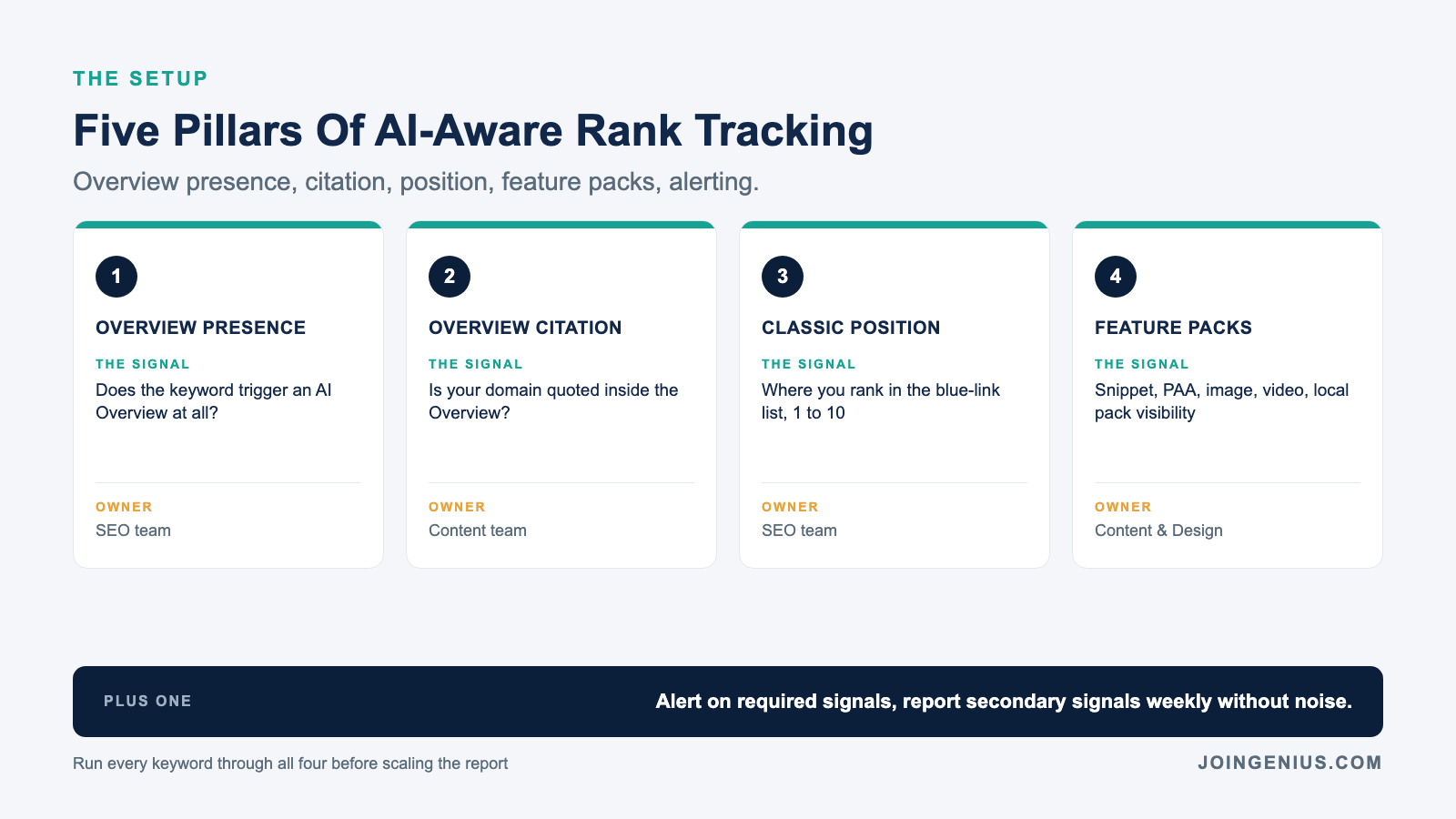
A modern rank tracker measures four things per keyword: whether the keyword triggers an AI Overview, whether your domain is cited inside that Overview, which section of the Overview quotes you, and where your page ranks in the classic blue-link list. Four signals, one keyword, one row in the report.
Each of those four signals triggers a different workflow. Overview presence tells SEO the query has entered a new mode. Citation inside the Overview tells content whether the structured markup works. Position stays on the team’s dashboard, but one row across.
Where Advanced Web Ranking Fits
A rank tracker like Advanced Web Ranking that instruments AI Overview presence alongside classic SERP position tells you whether your page actually feeds the synthesized answer. The reporting stays in one place, and the AI Overview column goes next to the position column, where the SEO team already looks.
How To Act On Dual Signals
The action is different depending on which signal moved. A page that ranks 1 but is not cited in the Overview needs structured content changes, not more links. A page cited in the Overview but ranking 6 in the list needs on-page work. Classic reporting cannot tell those two cases apart.
The split is the practical argument for instrumenting both signals together. When content and SEO read the same row, each team’s next move is obvious. A one-tool-per-signal setup forces weekly meetings a better tracker replaces.
A Reference For What To Track Now
The move is from a single position number to a small set of signals, each with a clear owner and a clear response. Below is what to put on the weekly report, and who owns the fix when a signal shifts.
What A 2026 Rank Tracking Report Should Contain
Each row below pairs a signal with the team that moves it. The AI Overview row is new. The position row is not. The point of the reference is that both belong on the same report, not on separate ones.
The table is not meant to be comprehensive. It is the minimum set a rank tracking report should include in 2026, and most of it is one column added per row, not a new tool.
| Signal | What It Measures | Who Owns It |
|---|---|---|
| AI Overview presence | Does the keyword trigger an Overview at all | SEO |
| AI Overview citation | Is your domain cited inside the Overview | Content |
| Position in classic SERP | Blue-link rank 1 to 10 | SEO |
| Featured snippet | Zero-click box above the organic list | Content |
| People Also Ask | Related question and answer panel | Content |
| Image pack | Visual results block for the query | Design |
| Video pack | Video carousel block for the query | Content |
| Local pack | Map and local business set | Local SEO |
| Click-through rate | Clicks divided by impressions per keyword | SEO |
| Branded mentions | Domain named inside the Overview text | Brand |
Required Signals vs Secondary Ones
The three required signals are AI Overview presence, Overview citation, and classic position. Report them on the same row. The rest are secondary: track them weekly, alert only when the required three move in opposite directions.
Alerting discipline matters as much as signal choice. Alert on required signals only. Report secondary signals weekly without alerts, so the team can read trends without noise when a feature pack reorders on one keyword.
Signs Your Rank Tracking Is Behind
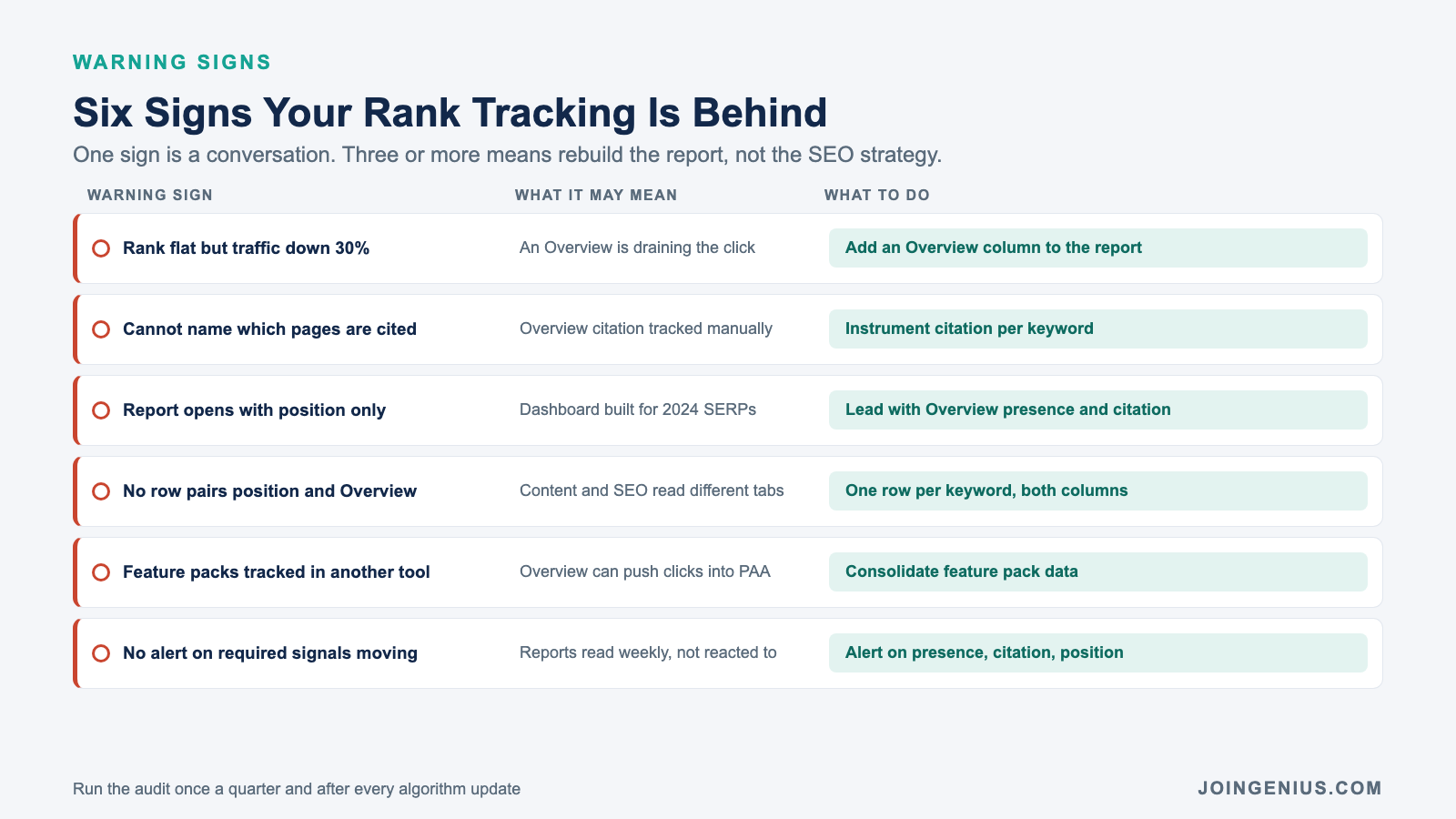
Three quick checks say whether your tracking is built for the 2024 SERP or the 2026 one. Run them against last month’s report, not this quarter’s roadmap. If any answers yes, the fix is a column on the tracker, not a new SEO strategy.
Traffic Dropped But Your Ranks Look Fine
If organic traffic to a page dropped 30 percent in the last two quarters while the tracked rank for its main keyword did not move, the AI Overview is almost certainly the cause. The tracker needs an Overview column before the next report cycle, not next quarter.
That gap between flat rank and falling traffic is the clearest proof an Overview is draining the click. The tracker has to say it directly, not leave the team to piece it together from Analytics and Search Console tabs.
You Cannot Tell Which Pages Feed An Overview
Ask the SEO team which of your top 20 pages are currently cited inside an AI Overview. If the answer is “we check manually,” the tracker is behind. Overview citation is a per-keyword data point, and manual checks do not scale past a dozen queries.
Your Reporting Still Opens With Position
A 2026 SEO dashboard should open with AI Overview presence and your page’s citation status. Position belongs on the report, but not at the top of it. If a technical SEO expert still gets handed a position-only brief, the brief is the problem, not the SEO.
Conclusion
AI search results made the rank tracker’s job bigger, not smaller. Position still matters, but it is one column on a wider report that now includes Overview presence, citation, and the other slots a Google page can contain. Start with one keyword, expand from there. More Genius playbooks at joingenius.com.