Supply chain engineering recruiters who close run a different process at every stage of the funnel, and the shortage of senior candidates in the talent pool makes that process matter more every quarter. The BLS Occupational Outlook Handbook projects logistician roles to grow 18 percent from 2025 to 2035, which is far faster than the 3 percent average across occupations.
A Gartner survey released in late 2025 found 54 percent of supply chain executives say leadership turnover disrupted their function’s performance over the past three years. Senior engineering talent is the exact segment hit hardest by that churn.
Non-closers chase inbound and rely on job boards. Closers run a tighter funnel with a different first call. They also work a different sourcing surface and a different offer-week plan. Here is what the top of the pack does differently in 2026.
Why Most Supply Chain Engineering Searches Stall At The Shortlist
Most searches for a supply chain engineer go the same way. The recruiter posts the role, screens inbound, and sends a slate of five resumes to the hiring manager. Two decline, two ghost, one gets to a loop and then disappears when the offer lands. The role sits open at week nine.
The common failure point is not sourcing. It is that the recruiter never pressure-tested the brief against the market before outreach began. The hiring manager wanted a candidate with ERP implementation experience inside a Tier 1 automaker.
The spec also demanded five years in a specific city at a comp band set two quarters ago. That candidate exists for about eleven people in the country, and six of them are already working at a direct competitor on a long-vesting equity package.
A closer catches this before the first outreach. The signal is a short kickoff where the recruiter maps the hiring manager’s wish list against external benchmarks and comes back with a trimmed must-have list before any outreach begins.
What Closers Know Before The First Call
A closer walks into the kickoff with external data, not just the hiring manager’s gut. Published engineering benchmarks like Apollo Technical’s benchmarks give the recruiter a defensible comp range by city and a current read on time-to-hire for supply chain and operations engineering, so the first ask of the hiring manager is a reality check rather than a wish.
SmartRecruiters put median time to hire in manufacturing at 55 days in its 2025 benchmark report. That is the slowest of any industry it tracked. A closer uses that number to push back during the kickoff.
If the hiring manager wants a start date in six weeks, something in the process has to compress. The recruiter is the one who names the step that gets cut from the loop, not the hiring manager hoping for a lucky draw.
Closers also prep three concrete pull signals for the role. Not vague ones like “team culture” or “growth,” but specific items a candidate would notice. The nearshoring project the engineer would own. The specific ERP migration slot. The reporting line into the VP of operations rather than a plant manager.
Those three signals are tested against the first ten candidates. If none react to them, the signals are wrong rather than the sourcing being wrong. A closer revises the brief instead of widening the net.
Closers also run a weekly scan of competitor hiring moves before the search opens. A new plant announcement at a Tier 1 supplier means a wave of hiring is coming in that region. The local labor pool will tighten in the next 90 days, and that signal tells the recruiter which candidates to call first.
The First-Call Playbook: Signals Over Credentials
Non-closers run the first call as a credential screen. Closers run it as a two-way diagnosis. The goal is to find a pull reason the candidate names out loud, not to recite the job description back at them.
The call opens with a one-line role framing and a single question. What does the candidate’s current week actually look like, not what their title says. That answer tells the recruiter which of the three pull signals from the kickoff will land for this specific person. The rest of the call is spent pressure-testing that signal.
A closer ends the call with three clean outputs. The candidate named a pull signal out loud. The candidate raised a specific concern about their current role. The candidate made a soft commitment to the next step.
If any of those three is missing, the candidate moves to a slower nurture track rather than a loop slot. Loop slots are expensive, and spending one on an uncertain candidate is how the recruiting process loses two weeks it does not have.
Where Closers Actually Find Supply Chain Engineers
Inbound and LinkedIn are table stakes. Closers also work surfaces that non-closers forget about. ASCM and APICS member directories list professionals by certification level, which is a strong proxy for depth in supply chain operations. Technical conference attendee lists for events like CSCMP EDGE and ProMat produce a different pool than a boolean search.
Second, closers work backwards from recent hires at target competitors. A hiring manager at a Tier 1 supplier recently joined a competitor to run a specific plant. The engineers who worked under them in the previous role are now candidates for your opening, and they are rarely on the inbound list.
Third, closers partner with manufacturing-adjacent educators. Programs at Georgia Tech and MIT run supply chain certificate tracks for mid-career engineers, and Michigan State and Penn State run parallel executive programs. The alumni of those programs are the exact profile most searches ask for, and the program directors maintain a current list.
Fourth, closers maintain a quiet relationship with two or three specialist search firms that live in the industry. Not as a backfill when the search stalls, but as a parallel channel from day one. The best firms have a bench of passive candidates nobody else can reach, and sharing the brief early is faster than reinventing it in month three.
None of these surfaces are hidden. They are just outside the default sourcing stack most recruiters run on autopilot. A closer treats sourcing as a weekly design exercise rather than a search string.
The Offer Week Is Where Deals Die Or Close
Most engineering offers lose the deal in the final week, not during the interview loop. Supply chain roles are especially exposed because candidates often have counteroffers from their current employer who does not want to run the search themselves.
A closer runs offer week as a scheduled process with specific touchpoints. Day one is a live offer walkthrough on video, not a PDF emailed over. The recruiter reads the offer line by line and names the parts the candidate is likely to push back on before the candidate raises them.
Day two is a peer call booked inside the window. The candidate talks to a future peer or direct report who is already in the role, not a hiring manager repeating the pitch.
Day three is a counteroffer prep call. The recruiter walks through what a counter from the current employer will probably look like, then rehearses what the candidate’s answer should sound like when it lands.
Day four is the decision. Keeping the window to 48 to 72 hours is the single biggest predictor of close rate. Longer windows give the current employer time to assemble a retention package, and most retention packages win against an unstructured close process.
Closers also keep the interview loop warm with a backup candidate during offer week. If the primary falls through, the backup is at loop stage within a week rather than at a cold intro six weeks out.
Hire Supply Chain Engineering Recruiters Who Close
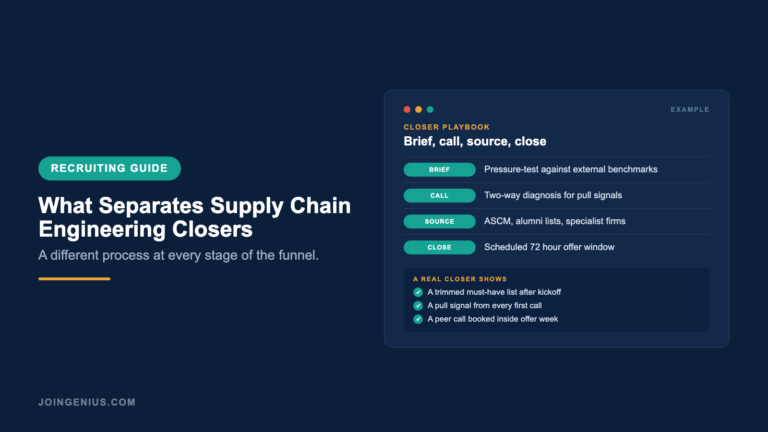
Closers in supply chain engineering do four things non-closers skip. They pressure-test the brief against external benchmarks before outreach begins. They run the first call as a two-way diagnosis for pull signals. They source from certification directories and alumni lists, not just inbound. They run offer week as a scheduled 72-hour process.
If you want help staffing those recruiter seats or the engineering roles themselves, Genius sources from the top 1 percent of candidates in the Philippines and Latin America. The cost sits around 80 percent below a local hire for comparable work. There are no monthly platform fees, and a six-month replacement guarantee covers you if the hire does not land.
That model fits supply chain engineering recruiting because the funnel runs long and the comp band is tight. Running a closer-trained recruiter at 20 percent of local cost means you can staff two seats for the price of one and keep both the inbound queue and the sourced pipeline warm at the same time.
The gap between a closer and a non-closer in this space is a process gap, not a talent gap. The teams filling supply chain engineering roles in 2026 are the ones that pressure-test the brief, surface pull signals on the first call, and run offer week as a scheduled 72-hour process rather than a hopeful wait.