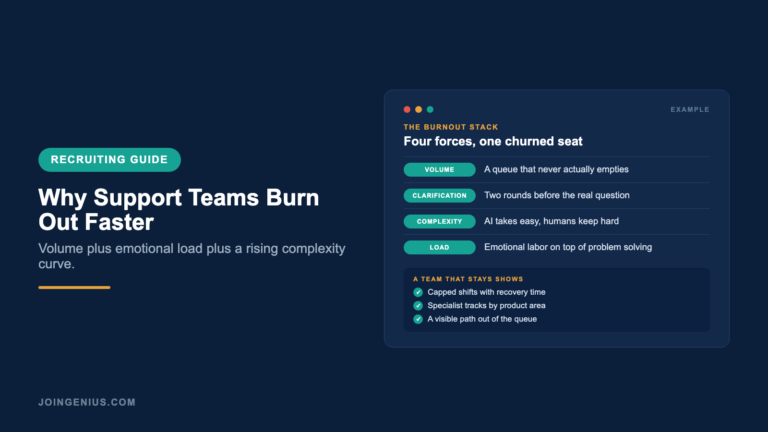
Support team burnout is not just a workload story, and the talent pool most companies underestimate is the one that keeps leaving. The BLS Occupational Outlook Handbook lists 2.67 million customer service representatives in 2025 and projects a 5 percent decline over the next decade.
Yet the same report projects roughly 289 thousand openings every year of that decade. All of them come from replacement rather than growth. That is the shape of a role churning through its people on a routine basis.
What follows is a working explanation of why support burns out faster than other functions. The short version is that it is not ticket volume alone. It is the mix of volume and emotional load sitting on top of a complexity curve that keeps bending upward.
The Burnout Math Is Different For Support
Every role has a steady-state workload. Support’s steady state is a queue that never empties. An engineer finishes a sprint. A salesperson closes a quarter. A support agent clears Monday morning and the queue is already higher by Monday afternoon. The job has no finish line.
Gallup’s 2024 State of the Global Workplace report found that 41 percent of employees globally reported “a lot of stress” the previous day. Support teams sit above that line in most companies. The stress is both high-frequency and asymmetric.
Agents absorb customer frustration one ticket at a time and send out calm responses. That is emotional labor on top of problem solving, and emotional labor compounds across a shift the way physical fatigue compounds across a run.
That mix is why the first year is where most support attrition happens. The new agent handles the volume fine for a few months, then hits the first stretch of hard tickets paired with a bad customer week, and the recovery time no longer fits inside a weekend.
Managers often read this as a hiring miss. It is usually a structural miss. The agent who left would have stayed in a role with the same ticket volume if the surrounding system had absorbed less of the emotional load. That is a design question, not a candidate quality question.
Volume Is Only Half The Problem
The other half is the clarification loop. A customer sends “it’s broken,” and the agent spends two rounds asking what they clicked and what the error said. That round trip is the hidden tax on every ticket, and it eats the first touch before any real support work begins.
In-app capture tools like Gleap short-circuit that loop by letting the user record the broken state and attach it to the ticket in one click. The agent opens a ticket that already carries the console log and the screen recording, which also surfaces the browser version. The first response is then a fix rather than a question.
Compounded across a queue, that one change moves agents from reactive to proactive within the shift. Reactive agents absorb the emotional load of every clarification round. Proactive agents work on the real problem and spend less time asking users to repeat themselves.
The same effect is why ticket volume alone is a poor burnout predictor. A queue of 60 well-scoped tickets a day is sustainable. A queue of 30 ambiguous ones with angry customers is not. Companies that track only volume miss the real driver of churn in the recruiting pipeline they then have to refill.
The Complexity Shift Hits Support First
The second structural force is complexity. AI is clearing the easy tickets off the queue, which sounds like relief until you look at what is left. Salesforce’s 2025 State of Service report, based on 6,500 service professionals across 40 countries, found that AI now handles about 30 percent of cases.
Service teams project that share will reach 50 percent by 2027. The complement of that number is the human agent’s day, and the human agent’s day is where the hard tickets live after the easy ones get routed away.
Reps using agentic AI spend about a quarter of their week on highly complex issues. The report also found that 81 percent of AI-using reps say their role has become more specialized. More specialization means more cognitive load per ticket, and more cognitive load per ticket means less recovery time between them.
In a pre-AI contact center, roughly 40 percent of a shift was routine work. Another 40 percent was moderate, and the hard tickets took the remaining fifth. Today the routine share moves to AI and the human share compresses toward the hard end. The job gets more demanding on average even when the headline ticket count drops.
This is the piece most leaders miss when they add AI tooling and expect agent satisfaction to improve. Satisfaction can fall at the same time, because the remaining work is harder on a per-ticket basis.
Why Hiring More Headcount Does Not Fix It
The default response to a burning-out support team is to post more roles. That buys relief for a quarter and then the new hires churn at the same rate, because the structural issues are intact. Volume, clarification tax, and the complexity shift all still apply to the new seats.
Headcount also lengthens the onboarding window, which pulls senior agents off the queue to train. The senior agents then burn out faster because they are now carrying both their own queue and a mentorship load. The team ends up with worse coverage rather than better two months into the hiring push.
A better move is to rework the queue before posting the role. If the clarification loop is the biggest tax, instrument it first. If complexity is the biggest tax, specialize the roster so one person owns a product area rather than a slice of every area.
If stress recovery is the biggest tax, change the shift structure before changing the headcount plan. Each of these is a reallocation inside the current team rather than a new hire that imports the same problem on day one.
Headcount is the lagging variable. The leading variables are workflow design and tooling, with specialization sitting on top of both. Teams that treat headcount as the first lever end up refilling the same seats over and over without moving the burnout line out.
What Prevents Support Burnout Faster Than Perks
Three operational moves prevent support burnout better than any wellness perk. The first is capped shifts. A seven-hour support shift with a scheduled break for recovery beats an eight-hour shift with free lunch. Emotional labor needs structural recovery time, not a snack bar.
The second is specialist tracks within the team. Agents who own a product area for a quarter develop depth and feel progress, which is the opposite of the generalist queue where every ticket feels like starting over. Depth also lets a senior agent coach a junior one on a specific area rather than on everything.
The third is a visible internal mobility path out of support. The best agents want to move into product or customer success within 18 to 24 months, and some aim for a QA seat on an engineering team. A team that posts the next role from inside the queue retains the people who would otherwise leave the industry.
Running the three plays together produces a sourcing funnel that stops leaking at the top. Internal moves open seats inside the team, and the people who join come in through referrals from agents already in a specialist track rather than from a cold job post.
None of those three moves cost more than the second round of replacement hires the team is already paying for. They are reallocations, not budget increases, and they move the burnout line out before the next hiring cycle.
Hire Support Teams That Stay
Support team burnout is a design problem rather than a people problem. Volume plus emotional load plus a rising complexity curve will beat most teams on wellness perks alone. The teams that stay staffed are the ones that rework the clarification loop and specialize the roster, then build a visible mobility path before the first replacement cycle.
If you want help staffing those support seats without hitting the same churn rate, Genius sources from the top 1 percent of candidates in the Philippines and Latin America. The cost sits around 80 percent below a local hire for comparable work. There are no monthly platform fees. A six-month replacement guarantee covers you if the hire does not land.
That model fits support hiring because the comp math gives you room to invest in the structural fixes. Running two support seats at 20 percent of local cost each means the saved budget pays for queue instrumentation and specialist shift design. It also funds the mobility program that stops the next cohort from burning out at the same point.
The teams that still have their original support hires at month 24 did not pay more or hire smarter candidates. They designed the surrounding system so the role was still worth doing after the first hard customer week.