If your plan to source AI-fluent designers starts with a list of competitor profiles on LinkedIn, you are already inside a bidding war you will mostly lose. The small group with a shipped AI feature in 2024 or 2025 is now the most contacted part of your talent pool.
Most of them have already said no to three recruiters this quarter.
This post is about where to find the rest of them. Not the dozen names everyone is poaching. The hundreds of designers who already direct AI tools inside their day job, publish AI-plus-human work on their own sites, and are open to the right conversation. The non-competitor playbook builds the pipeline that poaching cannot.
Why The Poaching Playbook Breaks In 2026
The surface math has not changed. Senior designers with AI on their titles still exist. The problem is that they are too expensive to repeatedly poach, and the counteroffer market has caught up with the first round of recruiter outreach.
McKinsey’s 2025 State of AI survey reports that 88 percent of organizations now use AI in at least one business function. That is a ten point jump from 2024. The sample ran to 1,993 respondents fielded in summer 2025.
So the pool of designers who sit inside an AI-using org is now almost every designer in the market. A title match on “AI designer” is a weak filter rather than a strong one.
The real scarcity shows up one layer deeper. Figma’s 2025 AI Report, built on a survey of 2,500 product builders across seven countries, found that only 31 percent of designers use AI for core design work. Developers in the same sample hit 59 percent.
The gap says the poaching pool is far smaller than the title market suggests. The real pool is designers who actually run AI inside the work rather than next to it.
Designers inside AI-first product orgs are not quietly waiting for a new offer. They are being retained with equity refreshes and promotion fast tracks that outrun a cold cash offer from your side. The companies that invested in AI integration early are also the companies that invested in holding on to the designers who shipped it.
Three things break in the standard playbook. First, your target list is also your competitors’ target list, so the response rate collapses to single digits.
Second, the few replies you get escalate to counteroffer wars that burn your hiring manager’s weekends. Third, the designer you do land is often the one most willing to leave, which is a different signal than most willing to stay.
The non-competitor path flips the inputs. You stop sourcing from “designers who put AI on their LinkedIn after 2024” and start sourcing from “designers whose output already proves AI fluency, whoever hired them.”
What AI-Fluent Actually Means For A 2026 Designer
“AI-fluent” has become a resume keyword, which means it is nearly useless as a filter. You need a working definition that holds up in a portfolio review.
An AI-fluent designer in 2026 can do four things that a 2022 designer could not. One, direct a tool like Figma Make or V0 to produce a first draft at component fidelity, then rebuild the output inside the real design system rather than shipping the raw AI result.
Two, run style tokens and generated variants through a prompt library that stays consistent across a 20 screen flow.
Three, use image or icon generation as iteration rather than final art, so the final shipped UI still carries the brand hand. Four, write prompts for the engineering handoff that explain the design intent in a way an LLM can turn into component code without the designer rebuilding from scratch.
That is a working test. A candidate who talks about AI tools but cannot show the delta between first draft and final output is not AI-fluent, no matter what the title said.
Figma’s 2025 report also found that only 32 percent of surveyed product builders say they rely on AI output in finished work. The gap between “I have tried AI” and “I ship with AI” is roughly two thirds of the field. Screening for the second group is what separates a real pipeline from a resume keyword search.
Four Non-Competitor Talent Pools You Are Not Touching
The US Bureau of Labor Statistics counted 132,700 web and digital interface designer jobs in 2025. The growth outlook is 5 percent through 2035 and the median wage is $104,000.
That number does not include graphic or marketing designers, and it leaves out product designers who sit inside non-design titles. The addressable pool for AI-fluent design hiring is several times what a LinkedIn title search returns. The four pools below are where the hidden supply lives.
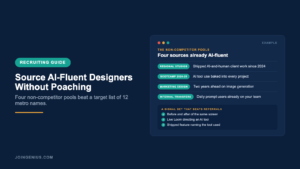
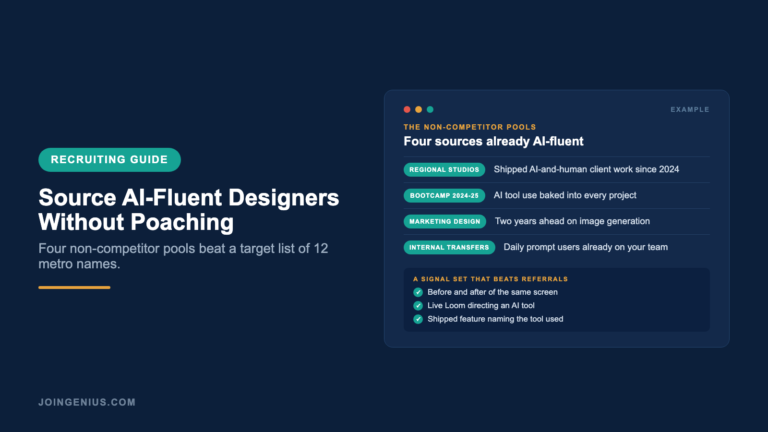
Pool one: regional studios and agencies. Small studios outside the metro hubs have been hiring remote AI-fluent designers for client work for two years. Regional agencies like Up North Media, a Michigan studio that publishes AI-and-human client case studies on its own site, show the real production output you want to see in a candidate’s portfolio.
A designer who shipped nine agency client sites in 2025 with documented AI involvement is often a better signal than a product designer at a metro brand who touched one AI feature.
Pool two: bootcamp cohorts from 2024 and 2025. Programs like Designlab and Memorise have published cohort directories where the student projects now show AI tool use as a baseline. The strongest 10 percent of each cohort typically has at least one side project on Dribbble that documents the AI workflow screen by screen.
Pool three: content and marketing designers transitioning into product. Marketing designers have been using AI image tools since 2023, which gives them two full years of hands on time that most product designers only got in 2024. The best ones already have adjacent product work on their portfolio sites.
Pool four: internal transfers from PM and marketing. Research seats are a third source worth checking. The non-designer who runs a V0 prompt every day is a closer design hire than a traditional designer who refuses to touch AI. Pre-screen these candidates against the same four fluency tests, not against years of design seniority.
Portfolio Signals That Beat A Referral From A Competitor
Polished Dribbble shots have never been less useful than they are in 2026, because AI image generators can produce the aesthetic of a polished shot without any underlying system work. Four signals are harder to fake.
One, before and after of the same screen with the AI role documented. The designer should narrate what AI produced versus what they kept or rebuilt.
Two, a working style token file that generated AI output stays consistent against. Three, a shipped feature in production that explicitly names the AI tool in its development notes.
Four, a Loom or screen recording where the candidate directs an AI tool live. The live recording filters out “I asked ChatGPT once” claims from “I run this workflow every day” ones in under 10 minutes.
Combine the four and you have a signal set strong enough to replace a reference check from a mutual contact at a competitor.
A Paid 30-Day Trial That Replaces The Counteroffer War
Even with the right pool and the right signals, the final step is still the one most teams fumble. Poaching plays end with a counteroffer war because the designer is already employed somewhere else and both companies are negotiating on the same comp band. The non-competitor path ends with a paid 30-day trial instead.
Scope the trial to one real problem on the roadmap that the designer can finish inside 30 calendar days of part time work. Pay the flat rate at your target comp, prorated. Ask for a Figma file and a Loom walkthrough. Add one user interview as the final deliverable.
Pay this out even if the trial does not lead to a full time hire, because the output is still real work the team can use.
The trial changes the economics on both sides. Your side gets to see production grade output in the actual stack, not a staged portfolio. The candidate side gets paid at a serious rate without quitting a current job, which lowers the switching cost that the poaching playbook has to buy out with counteroffer money.
Running the trial as a side engagement also protects the candidate’s current employer relationship, which matters when half of the design world now works at companies that overlap with yours three years later. Burned bridges in a tight community cost more than one counteroffer loss.
Hire AI-Fluent Designers Without Burning Your Pipeline
The companies winning the AI-fluent design race in 2026 are not the ones with the biggest sourcing budgets. They are the ones who built pipelines out of the four non-competitor pools before the poaching market priced them out. If your sourcing still starts and ends at the metro product designer, you are hiring from the smallest pool in the market.
Genius hires top one percent AI-fluent designers from the Philippines and LATAM at roughly 80 percent less than local comp, with no monthly fees and a six month replacement guarantee. We screen against the four fluency tests on this page before any candidate reaches a hiring manager, so your sourcing funnel stays clean and your counteroffer losses go to zero.