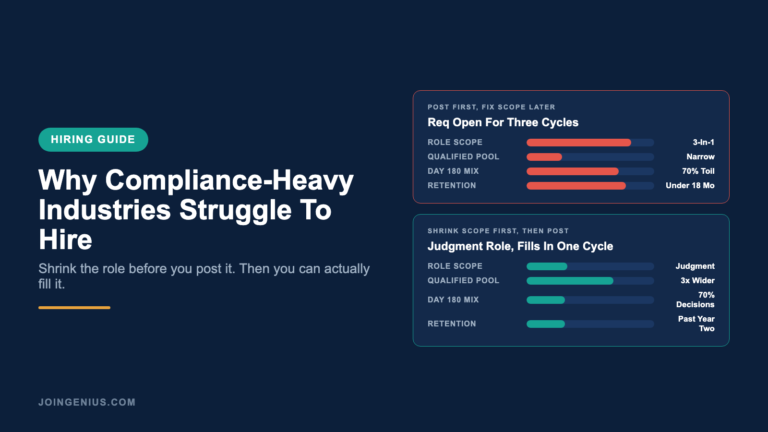
Compliance-heavy industries do not have a candidate problem. They have a role-definition problem. Teams in insurance and healthcare all look at the same market and conclude the pool is dry, and the pattern repeats in financial services and public sector programs. The real issue is that the role being posted has grown into a job description no single human was built to do, and no amount of recruiter polish fixes a req that is quietly asking one person to be three people.
The right move almost never starts with another credentialed hire. It starts with shrinking the role so the person you post for is scoped against work only a human can do. Modern hiring workflows have cut time to hire for operations roles sharply, but speed does nothing if the role itself is scoped against a job description that no one can actually clear. Below we cover why the compliance-heavy req stalls, what three forces are quietly compounding the problem, and the one lever that reliably compresses time to fill without lowering the bar.
The Hiring Pool Is Already Small And The Role Keeps Getting Bigger
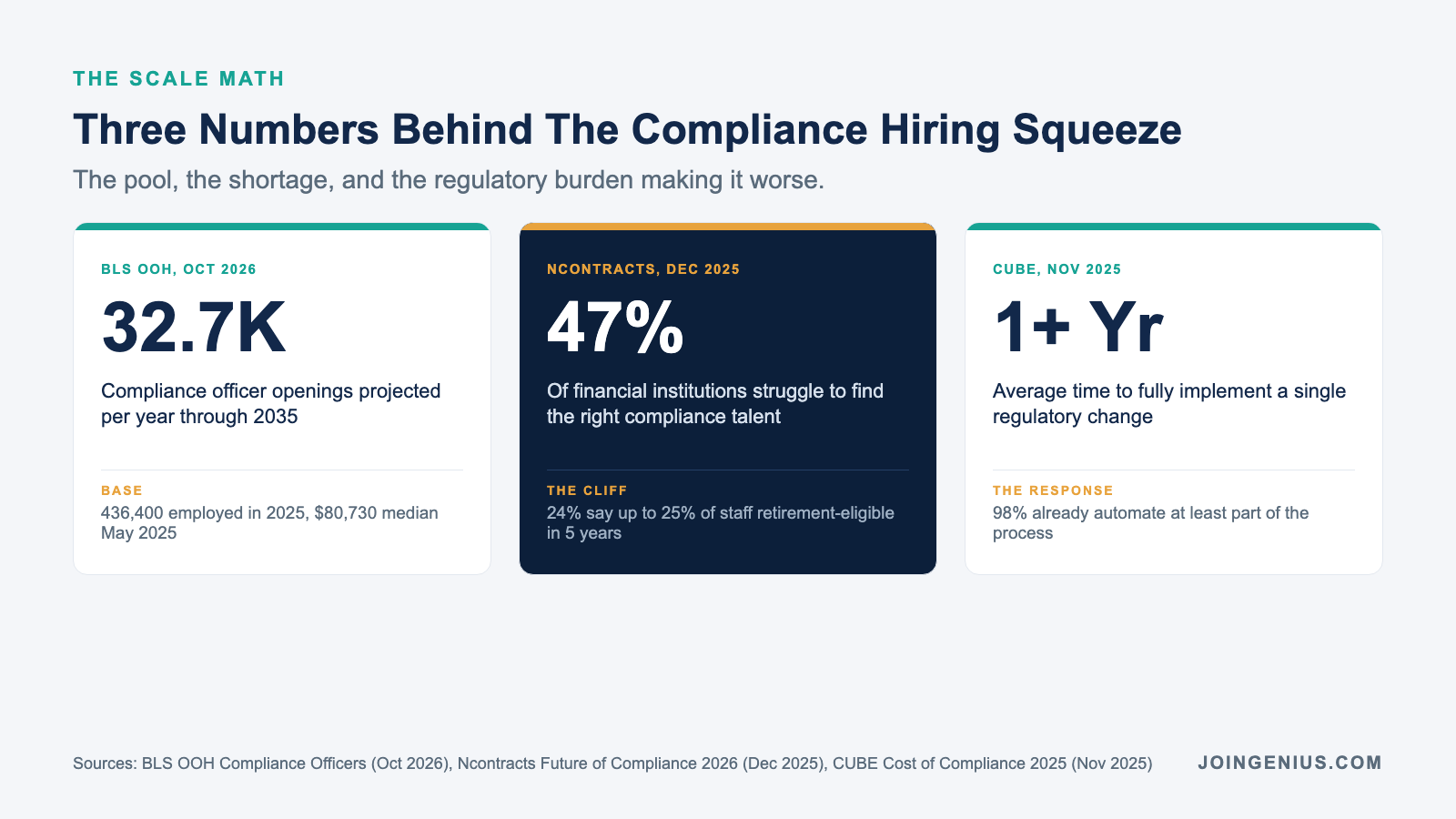
The US Bureau of Labor Statistics Occupational Outlook Handbook for Compliance Officers, updated October 29, 2026, counts 436,400 US compliance officers in 2025 and projects about 32,700 openings a year through 2035 at a median wage of $80,730 as of May 2025. The replacement rate inside that number is the one that matters for hiring managers, because most of those openings are backfills against people leaving the field rather than new seats being created. The pool is roughly flat while the demand per seat keeps rising.
The Credential Layer Narrows The Pool Before Recruiting Even Starts
Compliance-adjacent roles sit on top of a credential layer that is already narrow. A healthcare member service lead needs HIPAA fluency the day they start. A life insurance new business processor needs working knowledge of state-level filing requirements before they touch a policy. A banking client service specialist needs enough BSA and KYC literacy to not create a reportable incident in their first week. Those are not resume items. Those are table-stakes requirements the ATS filter is already stripping candidates against before a recruiter sees them.
The Role Scope Grows Every Quarter Until It Is Three Jobs In One
Then the role scope expands. Every quarter, another compliance-adjacent task gets added because no one else can safely absorb it. By the time the req is written, you are hiring a licensed specialist and a de facto compliance analyst wrapped around a customer-service generalist in one headcount. The pool that fits all three filters is tiny, and the ones who do fit are already employed.
The Backfill Risk Compounds The Hiring Risk
The req you post today is often a backfill for someone who left inside eighteen months. The exit interview almost always points at the same thing: a scope that grew without the compensation or title that would make the person stay. Posting the backfill at the uncompressed scope is a signal to the next hire that the pattern will repeat.
What Actually Makes These Roles So Hard To Fill
Three forces compound each other. Any one of them would be a hiring challenge. The three together create reqs that stay open for cycles.
The Credential Funnel Is The First Filter
Series licenses and FLMI designations gate life and annuity new business. State-level insurance appointments gate anyone servicing policies across borders. HITRUST and HIPAA training gate anyone in a healthcare member interaction. FINRA Series 6 or 7 gate anyone in securities-adjacent conversation. Each layer of credential requirement cuts the pool. A role that needs two of them cuts it further, not additively but geometrically. The ATS does not care that the resume shows adjacent experience. The compliance posture does.
The Domain Context Tax Pushes Hiring Managers To Over-Filter
New hires in these roles do not get to be useful on day one. A healthcare claims analyst spends months learning CPT and HCPCS code families and payer rules. An insurance underwriter trainee spends a year working with a senior before independent authority. The ramp is expensive and visible, so hiring managers over-filter at the top of the funnel to avoid it. That over-filtering closes the funnel on exactly the candidates who would have grown into the role in year two.
The Retirement Cliff Is The Shortage Nobody Talks About
The Ncontracts 2026 Future of Compliance Survey, published December 4, 2025 against responses from 180+ US financial institutions, found that 47% of compliance leaders struggle to find the right compliance talent and 25% can find it but cannot afford it. The sharper number in the same report is that 24% of institutions say up to a quarter of their compliance team is retirement-eligible within five years. That is not a labor-market story. That is an institutional-knowledge-exit story that no job post alone will solve, because the knowledge walking out the door is the knowledge the next hire needs to ramp against.
The Scope Creep Problem Is The Most Self-Inflicted
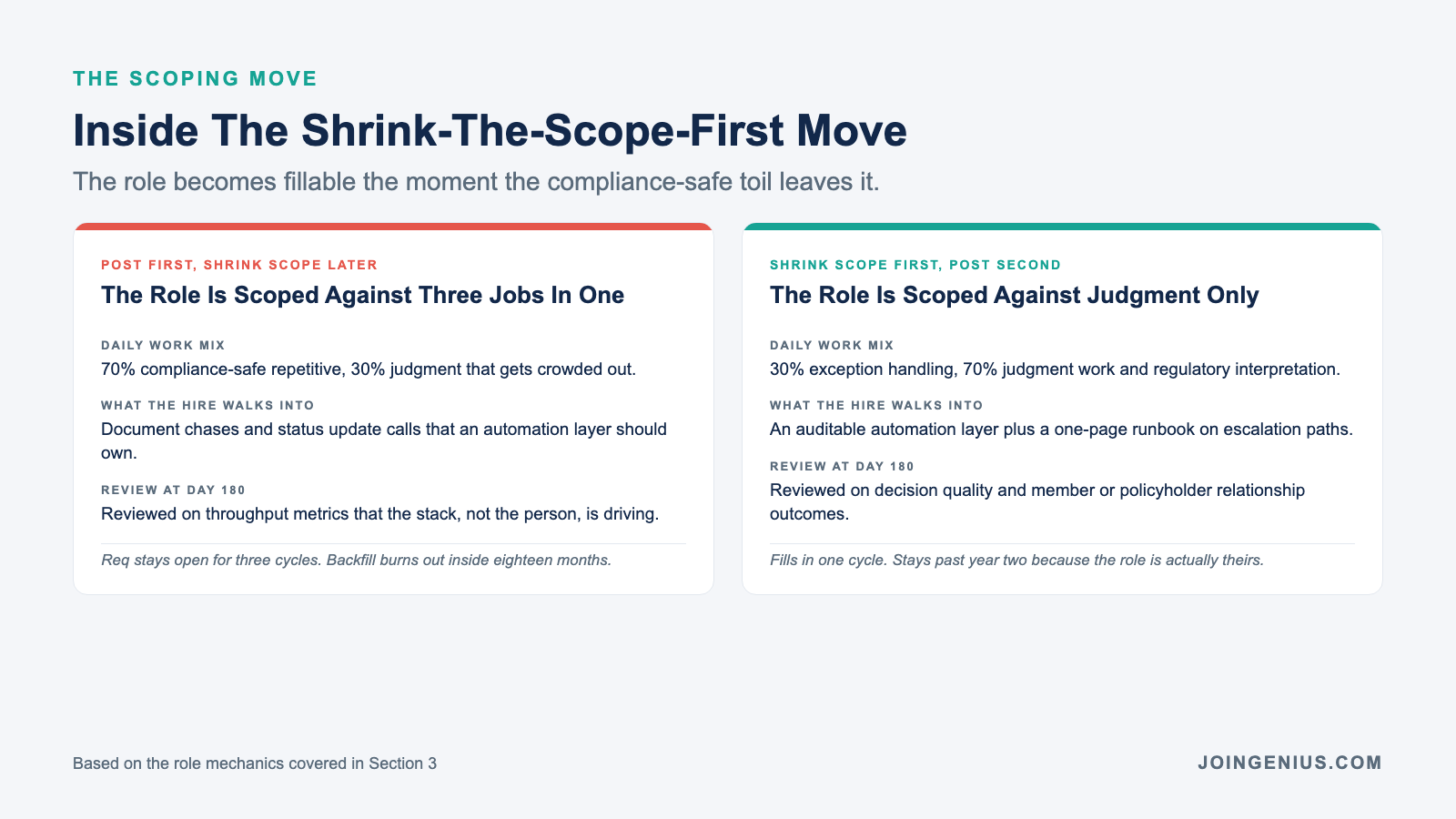
The role absorbs every compliance-touching customer interaction the team is nervous to automate. Status update calls and enrollment reminders go into the role first. Then document collection follow-ups and routine policy change confirmations. Then anything else that could theoretically expose the company to a regulatory issue. The role ends up 70% repetitive compliance-safe work and 30% actual judgment, which is both unfillable and unretainable. The scope is a hiring tax the organisation imposes on itself.
The Lever Most Teams Miss
Shrink The Role Before You Open The Req
Before you open the req, pull the compliance-safe customer interactions out of the role scope and route them through an experience automation platform like Ushur that is built for regulated industries and that handles the auditable layer natively. The platform runs for health payers and P&C insurers, and the same stack covers banks and public-sector programs with the same compliance posture. The role you can hire against that automation layer is a very different and much more fillable role than the one you can hire against a backlog of document chases and status update calls.
The point is not that automation replaces the compliance-trained human. The point is that automation absorbs the compliance-safe repetitive work the role was never meant to swallow in the first place, so the human can be scoped against the judgment work only they can do. That role is smaller and more senior-tilted, which also makes it far easier to describe in a job post. The CUBE Cost of Compliance Report 2025, published November 6, 2025 against over 2,000 senior compliance and risk officers at 1,300 financial institutions, found that 98% of organisations already automate at least part of their regulatory change process, which means the question has moved from whether to automate to which parts of the role still deserve a human.
What Day 180 Looks Like When You Get It Right
The difference between the two approaches shows up in the day 180 review, which is also the moment the hiring manager finds out whether they posted the right role.
The Before Version
In the before version, the new hire has spent six months doing document collection follow-ups and status update calls at a pace a well-scoped automation layer could have handled. Their judgment work is behind, and the review conversation is about response-time metrics that are a stack problem rather than a performance problem. The role stays open as a backfill risk inside eighteen months, which lands the organisation back in the same req pool it just struggled to clear. Low morale at work often sits highest on compliance-heavy teams whose managers are reviewed on failure rates that the stack, not the person, is driving.
The After Version
In the after version, the new hire has spent six months on the exit-ramp work only a credentialed human should own. Exception handling on complex claims and escalations where regulatory interpretation is in question come first. Member or policyholder relationships that need a real person come second. Training the automation layer on new edge cases the business is seeing comes third. The review conversation is about judgment calls and relationship outcomes, which is the conversation that keeps a senior compliance-trained hire past year two.
A Four-Move Playbook For Compliance-Heavy Hiring
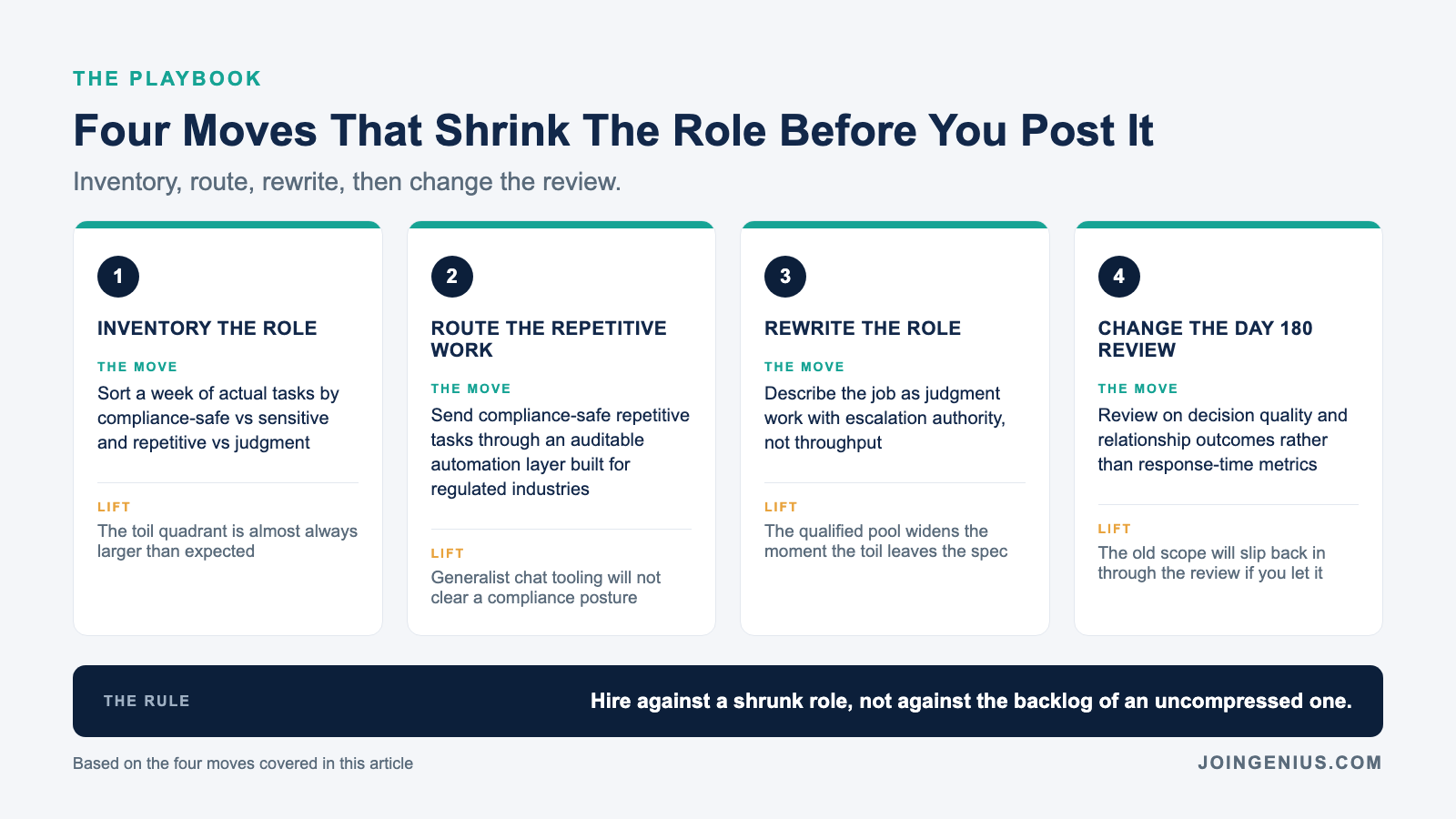
The four moves in order.
1. Inventory The Role As It Exists Today
Pull a week of actual work from a sitting team member and sort every task by two axes. Is it compliance-safe or compliance-sensitive, and is it repetitive or judgment-required. The ratio is almost always worse than hiring managers expect, with the repetitive compliance-safe quadrant eating most of the week. The inventory is also the artifact a hiring manager uses to make the case for the move internally, because the quadrant map makes the problem legible to the people writing the headcount budget.
2. Route The Compliance-Safe Repetitive Work Through Automation
Send the compliance-safe repetitive work through an automation layer built for regulated industries. The platform needs to be auditable by default and native to the compliance posture of the vertical, which is why generalist chat tooling has stalled every attempt I have seen in insurance and healthcare. The platform choice is a hiring decision, not just an operations one, because the role you can post downstream is directly a function of what the platform can safely own.
3. Rewrite The Role Against What Is Left
The job description should read as judgment work with escalation authority. The headline competencies should be domain fluency and decision quality rather than throughput. A structured hiring process is worth zero if the role it hires for is still scoped against the uncompressed backlog, which is why rewriting the role is the step most teams skip and most reqs get stuck on.
4. Change The Day 180 Review
Move the review conversation from throughput metrics to decision-quality metrics and relationship outcomes. Hiring managers who do not update the review will inherit the old scope through the back door inside a year, because the metrics the person is reviewed on are the metrics the person optimizes toward. The review is where the shrunk role is either preserved or quietly handed back.
The playbook is in the image below.
The One-Page Check Before You Post The Role
Before you post the next compliance-heavy role, ask one question. If you removed the compliance-safe repetitive work from the scope today, would the role you are left with be fillable in the market as it stands?
If the answer is yes, the role was never the problem. The scope was. Fix the scope by routing the repeatable work through an automation layer built for regulated industries, then post the role you can actually fill. The hire you make against that role will stay longer and ramp faster, and they will move the judgment work the business needs. The hire you make against the uncompressed role will leave inside eighteen months and you will be back where you started.
Conclusion
Compliance-heavy hiring is a role-definition problem that most teams misdiagnose as a labor-market problem, and the misdiagnosis costs an open req for cycles and a backfill who leaves inside eighteen months. Shrink the role by routing the compliance-safe repetitive work through an auditable automation layer. Rewrite the job description as judgment work. Move the day 180 review to decision quality. Then post the role you actually need, which is a judgment hire against a working system, not a cleanup hire against a backlog of document chases.
We built Genius so operators in regulated industries can staff the judgment work their automation layer uncovers. We place the top 1% of operations and client-service talent from the Philippines and Latin America, at around 80% less than comparable local hires. The relationship stays direct, with no monthly agency fees and a 6-month replacement guarantee on every placement. If the next compliance-heavy hire is the one who finally stays past year two, see how we source and place the operations talent that compounds.