AI in talent acquisition is changing the way companies find, evaluate, and hire new employees. From streamlining candidate searches to matching individuals with company culture, AI tools are making the talent acquisition process smarter and more efficient.
In this article, we’ll look at the latest trends, key stats, and real-world stories of AI in action. If you’re in hiring or HR, you’ll get practical insights to stay ahead in this evolving field.
TL;DR: AI In Talent Acquisition
- 81% of companies use AI in virtual recruitment. This speeds up the screening process and makes hiring more efficient.
- 76% of candidates are okay with AI-driven onboarding. People are becoming more comfortable with AI handling parts of the hiring process.
- 67% of HR professionals think AI has a positive impact on recruitment. AI is helping with better decision-making and making hiring easier.
- Data privacy and bias in AI are major challenges. Regular checks and strong security are needed to keep things fair and safe.
- AI helps you find top talent globally while cutting costs. It’s a valuable tool for growing your team without breaking the bank.
9 Trends In AI Talent Acquisition
As AI continues to change how companies hire, several trends are emerging that are reshaping the recruitment landscape. Here are nine key trends to keep an eye on.
1. AI automatically analyzes resumes & shortlists candidates based on set criteria.
AI tools quickly scan resumes to find candidates who meet specific qualifications. This speeds up the hiring process and improves accuracy. In fact, AI can cut the time spent on resume screening by up to 75%, according to a study by Phenom.
What This Means For You
- Keeps the screening process consistent by applying the same criteria to every resume.
- Lowers the chances of overlooking qualified candidates.
- Spots patterns in candidate profiles that human recruiters might miss.
2. AI algorithms search job boards and social media to find potential candidates
AI can search through job boards, LinkedIn, and other platforms to find candidates with the right skills. With 67% of companies using AI since 2022, finding qualified candidates has never been easier.
What This Means For You
- Expands your talent pool beyond traditional methods.
- Lets you quickly spot and connect with top candidates, even those not actively job hunting.
- Uses AI insights to help you personalize your outreach.
3. AI chatbots interact with candidates to answer questions, schedule interviews, & provide application updates
AI chatbots are changing how companies connect with job applicants. These chatbots handle everything from answering basic questions about the job to scheduling interviews that fit the candidate’s schedule and even keeping applicants in the loop with real-time updates. They also cut down on endless email chains and phone calls, streamlining the whole process.
What This Means For You
- Keeps candidates engaged with fast, automated responses.
- Manages multiple candidates at once without breaking a sweat.
- Gathers valuable data from candidates that you can use to improve future hiring strategies.
4. AI uses historical data to predict a candidate’s success & suitability in specific roles
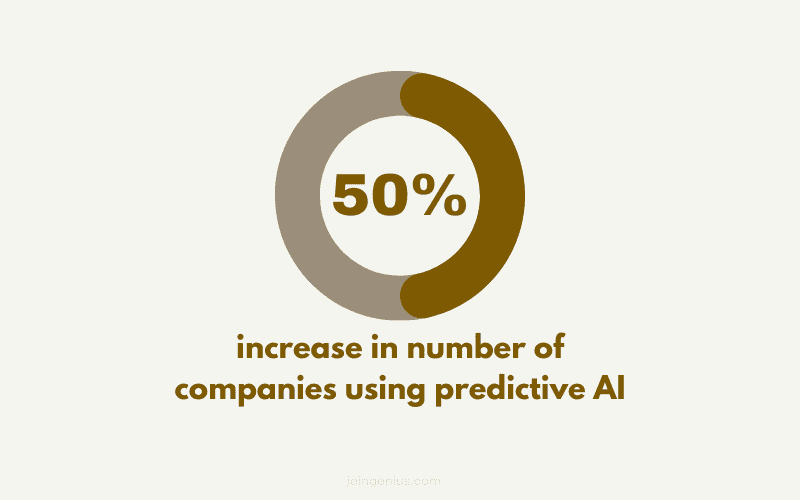
AI looks at past hiring data to predict which candidates are likely to do well in specific roles, helping you make smarter hiring choices. This method increases the chances of finding the right person for the job. In fact, over 50% of companies have started using AI for these predictions in the past few years because it leads to better hires.
What This Means For You
- Helps you make better hiring decisions based on data.
- Lets you focus on candidates who are likely to stay and thrive in your company.
- Reduces turnover by helping you hire the right fit from the start.
5. AI identifies & reduces biases in the hiring process
AI can help make talent acquisition processes more fair by spotting and reducing biases that humans might overlook. For example, when we review resumes, our own unconscious preferences can sometimes influence decisions without us even realizing it.
AI steps in to analyze resumes, job postings, and interview processes without those biases, focusing only on the candidate’s skills and experience. This is backed by CIPD research, which shows that 39% of bosses believe that AI can help lessen bias and improve diversity and inclusion within the workplace.
What This Means For You
- Builds a fairer hiring process by reducing unconscious bias.
- Lets you attract a wider range of candidates by avoiding biased language in job postings.
- Boosts your efforts to build a diverse team.
6. VR technology creates immersive virtual interviews that simulate in-person interactions
Virtual reality (VR) is now being used to create interview experiences that closely mimic face-to-face meetings. This technology helps interviewers assess body language and communication skills more accurately, even from a distance.
What This Means For You
- Offers a more engaging and realistic interview experience, even remotely.
- Lets you assess candidates’ non-verbal cues without an in-person meeting.
- Helps you stand out as an innovative company to top talent.
7. AI personalizes recruitment processes based on candidate behavior & preferences
AI can customize the hiring process based on how candidates interact with your job listings and their personal preferences. For example, suppose someone shows interest in specific types of jobs or responds better to certain communication styles. In that case, AI can adjust the approach to suit their needs, like using a more casual and approachable tone of voice.
What This Means For You
- Simplifies the recruitment process by tailoring it to each candidate’s unique preferences.
- Lets you connect with candidates on a more personal level, improving response rates.
- Enhances your employer brand by making the hiring process feel more human.
8. AI matches candidate skills more accurately with job requirements
AI can take a close look at a candidate’s skills and directly compare them to what a job needs, helping you find a better match for each role. Instead of relying on manual reviews or gut feelings, AI can scan data to spot candidates who have the exact skills for the job. This reduces mismatches and improves the chances of a successful hire.
What This Means For You
- Matches candidates’ skills with job needs more effectively.
- Reduces the risk of hiring the wrong fit, saving time and resources.
- Speeds up the hiring process by quickly identifying the top candidates for the job.
9. AI systems continuously improve & update based on new data to enhance recruitment accuracy
AI recruitment tools learn and improve over time by continuously incorporating new data. As more data comes in – like details from candidate profiles, resumes, and the results of previous hires – the AI updates itself to improve its accuracy. This means they become better at spotting the best candidates for your job openings over time.
What This Means For You
- Minimizes hiring bias as AI learns and improves.
- Adapts quickly to shifts in the job market.
- Increases long-term hiring success with better predictions.
15 AI Talent Acquisition Statistics To Look Out For
Here are 15 important AI talent acquisition stats that you’ll want to keep an eye on as the world of hiring continues to change in 2024.
1. 30% of companies use AI to create job descriptions
30% of companies are using AI to write more accurate and appealing job descriptions. AI can help you highlight key details and tailor the language to resonate with the right candidates. This makes job descriptions more clear and compelling and helps attract talent that truly fits the position.
What This Means For You
Using AI to write job descriptions can save you time and make your job postings clearer and more attractive. This helps you draw in candidates who are a better fit for the role and reduce the chances of mismatches later on.
2. 57% of hiring managers say AI makes writing job descriptions faster
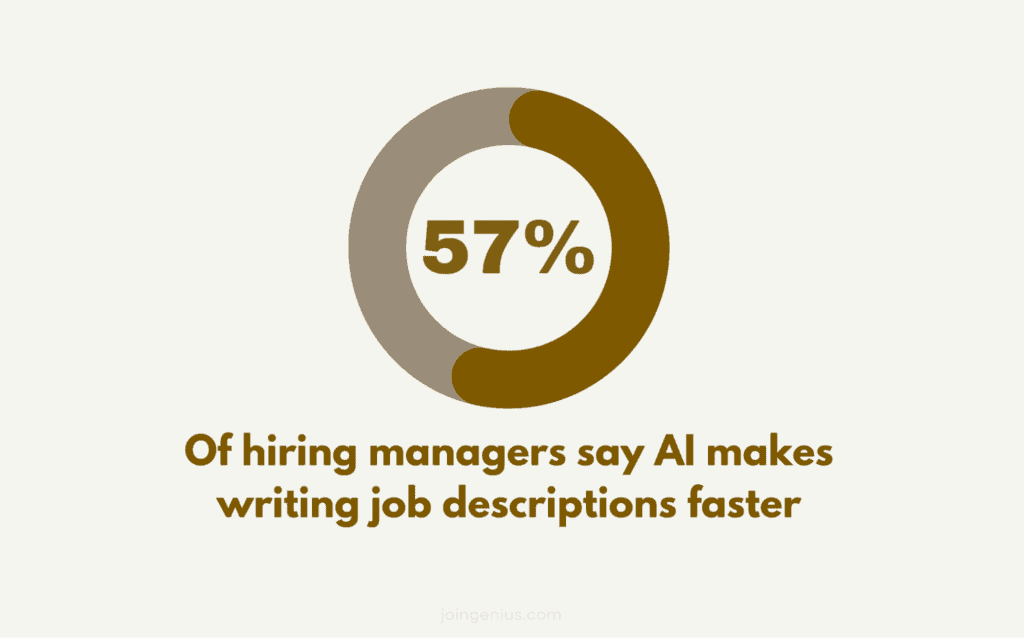
More than half of hiring managers (57%) say that AI helps them write job descriptions more quickly. This shows that AI can take over time-consuming tasks and give managers more time to focus on other hiring duties.
What This Means For You
AI can speed up how you create job descriptions, making it easier to post jobs faster. This efficiency lets you spend more time on candidate evaluation and decision-making, improving your overall hiring process.
3. 81% of companies use virtual recruitment for screening
Virtual recruitment has become the norm, with 81% of companies now using it to screen candidates. This change shows how digital tools are making the hiring process faster and easier.
What This Means For You
Using virtual recruitment is a more efficient way to connect with a wide pool of potential candidates, no matter where they’re from. You can also save on costs associated with in-person interviews, like travel expenses, bills, and even meal allowances.
4. 38% of companies use AI for sourcing & engaging talent

AI is becoming more popular for finding and connecting with potential candidates, with 38% of companies using it for this purpose. This trend shows how AI is improving the way companies build strong talent pipelines.
What This Means For You
Using AI for sourcing can help you find and connect with top talent more effectively. It lets you create a pipeline of qualified candidates so that you’re always prepared with great candidates when a position opens up.
5. 60% of organizations use AI for managing talent in 2024
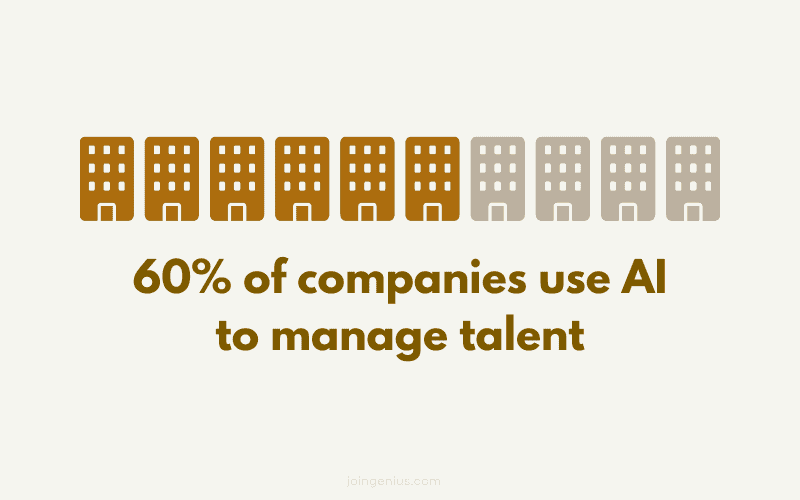
As of 2024, 60% of companies are using AI to help manage their talent. This shows just how important AI has become in keeping track of employee performance, development, and overall management.
What This Means For You
Using AI to manage talent can simplify how you monitor and support your team. It helps keep everyone on track and aligned with company goals, making it easier to manage employee growth and performance.
6. 76% of people are open to being onboarded by AI
76% of people are okay with going through an AI-driven onboarding process. This means they trust that AI can handle the process smoothly and provide a positive experience for them.
What This Means For You
AI can make the onboarding process faster and more consistent. New hires can get up to speed quickly, which lets your HR team focus on more personal interactions and support during their initial days.
7. 42% of companies use AI for high-volume hiring with an ATS
In high-volume hiring situations, 42% of companies using an applicant tracking system (ATS) also add AI recruiting software to the mix. This combination helps manage large numbers of applications more smoothly.
What This Means For You
Pairing AI with your ATS can make it easier to handle a large influx of candidates. This approach speeds up the sorting process, so you can find the right people faster without getting overwhelmed.
8. 67% of HR professionals believe AI positively impacts recruitment
67% of HR professionals believe that AI has a positive effect on recruitment. This shows that there’s a growing trust in AI as a tool that can streamline hiring, reduce time spent on manual tasks, and improve the accuracy of finding the best candidates.
What This Means For You
Embracing AI in your recruitment efforts can make the hiring process smoother and more effective. It’s a chance to improve how you find and attract top talent, automate repetitive tasks like resume screening, and focus your team’s energy on personal interactions that really matter during the hiring process.
9. 79% of recruiters think AI will soon make hiring and firing decisions
A large majority – 79% of recruiters – think that AI will soon be involved in making decisions about hiring and firing. In other words, they believe AI will play a role in evaluating employee performance, choosing new hires, and even deciding when to let someone go based on data.
What This Means For You
Getting familiar with AI’s potential now can help you prepare for its increasing role in HR. Understanding how AI can help you with decisions will keep you ahead as these tools become a bigger part of everyday life.
10. 35% of recruiters worry AI might overlook candidates with unique skills
Around 35% of recruiters are concerned that AI could miss out on candidates with unique skills and experiences. This shows that there’s a need to balance AI with human input when making hiring decisions.
What This Means For You
While AI can make the hiring process more efficient, it’s still important to review candidates manually to avoid missing out on special talents. Combining AI with human insight helps create a more complete and fair hiring process.
11. 47% of TA teams cite a lack of system integration as a barrier to AI adoption
47% of talent acquisition (TA) teams say that issues with system integration are a major hurdle in adopting AI for talent acquisition. This problem can slow down the use of AI tools throughout the company.
What This Means For You
Getting your systems to work together smoothly will help you adopt AI with less hassle. It also allows you to take full advantage of its time-saving benefits.
12. 30% of job seekers are exploring new roles because of generative AI
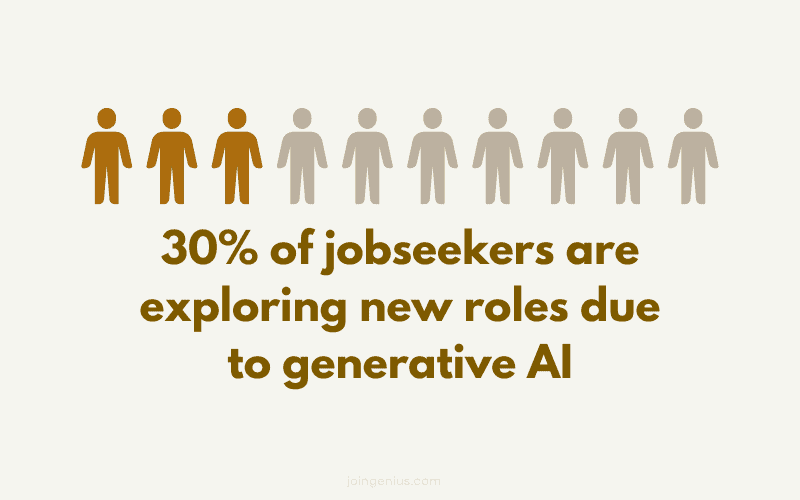
About 30% of jobseekers are now venturing into other jobs, even those not in their field. This trend started shortly after generative AI became popular. This shows that AI is changing both how companies hire and also how people think about their careers.
What This Means For You
Seeing how AI is influencing job seekers can help you attract talent who are excited about working with these technologies. If you want to draw in forward-thinking candidates, consider mentioning AI-driven opportunities in your job postings.
13. 24% of workers worry AI could make their jobs obsolete
Nearly a quarter of workers (24%) are concerned that AI might replace their jobs. This shows the anxiety some employees feel as AI becomes more common in workplaces.
What This Means For You
As a leader, it’s important to reassure your team that AI is there to assist, not replace, their roles. Offering training on AI tools can help employees feel more confident and see AI as a helpful resource rather than a threat.
14. 42% of companies don’t plan to use AI in talent acquisition
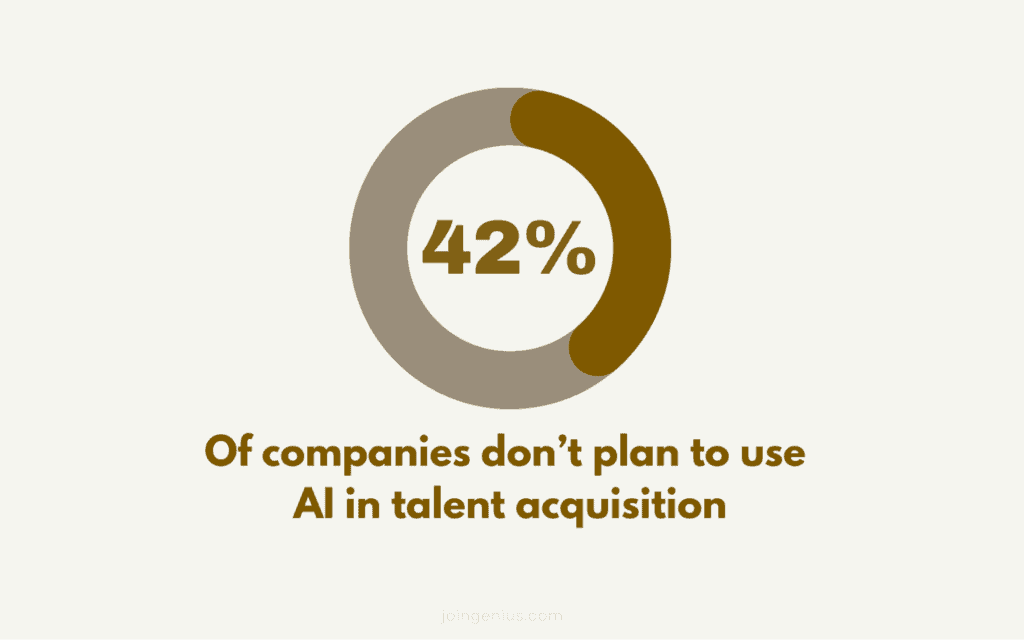
Despite the obvious benefits, 42% of surveyed companies say they have no plans to use AI in their hiring strategies. This shows a significant gap in AI adoption across the industry.
What This Means For You
Choosing to use AI now can give you a clear advantage over competitors who are hesitant to adopt it. You can benefit from AI to improve hiring efficiency while others hold back. Staying informed and flexible will help you take full advantage of AI as it continues to grow in importance.
15. Only 14% of companies use AI as part of their TA technology stack
Even with all its potential, only 14% of companies have added AI to their talent acquisition technology. This shows that many organizations are still hesitant to fully adopt AI in their hiring strategies.
What This Means For You
Adding AI to your hiring process now could put you ahead of others who are slower to adopt this technology. It can help you find and attract the right candidates more effectively, giving you an edge in the talent market.
How To Implement AI Talent Acquisition In Your HR Workflow + Examples
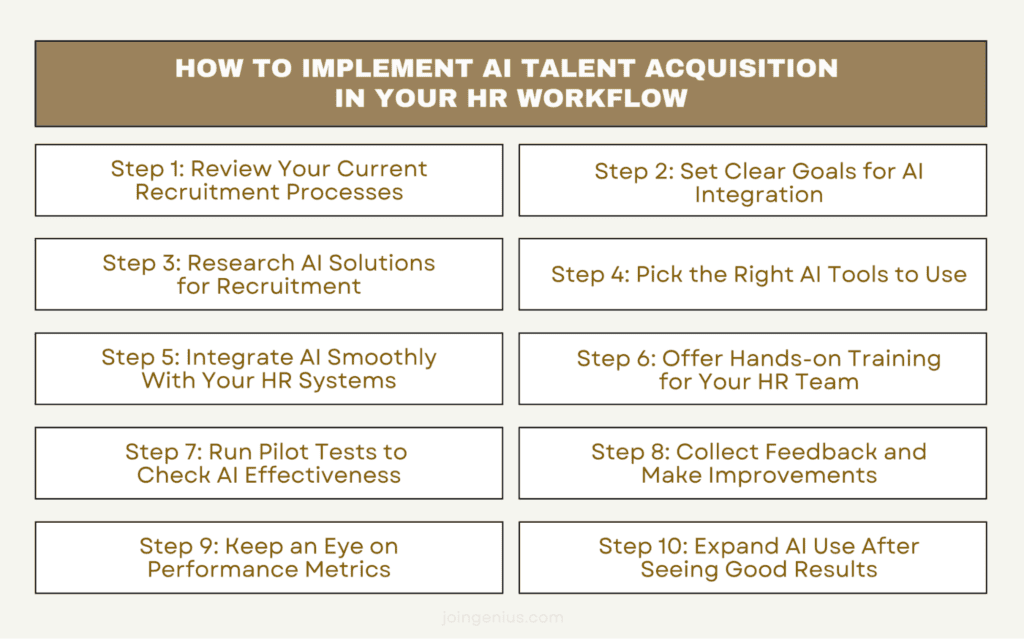
Ready to bring AI into your talent acquisition process? Here’s how to get started.
Step 1: Review Your Current Recruitment Processes
Start by taking a close look at how you currently hire. Identify where things slow down, like long screening times or missed chances to connect with top candidates. Knowing these problem areas will help you see where AI can make the most impact.
Example: Review the time it takes to screen resumes for a specific role, like a software engineer. If it currently takes your team 10 hours to go through 200 resumes, AI could reduce this to 1 hour by automatically filtering out unqualified candidates. Track how long each step of the process takes and pinpoint areas where AI could save time.
Step 2: Set Clear Goals for AI Integration
Decide what you want to achieve with AI in your hiring process. Do you want to speed up screening, cut down on bias, or better engage candidates? Having specific goals will help you come up with a better AI strategy.
Example: If your goal is to improve diversity in hiring, set a target like “Increase the diversity of candidate shortlists by 20% within 6 months.” This gives you a measurable outcome to aim for and helps you choose AI tools that specialize in reducing bias in candidate selection.
Step 3: Research AI Solutions for Recruitment
Look into AI tools designed specifically for hiring. Find the ones that offer automated resume screening, candidate matching, and predictive analytics. Check out how other companies have used these tools and what results they’ve seen.
Example: Suppose you’re interested in AI that improves candidate engagement. Research platforms like Paradox or HireVue use AI chatbots to answer candidate questions in real time. Read case studies to see how companies like yours have reduced candidate drop-off rates using these tools.
Step 4: Pick the Right AI Tools to Use
After researching, choose the AI tools that match your goals and fit with your current processes. Focus on those that work well with your existing HR systems so that there’s no disruption. Look for tools that are easy to use so your team can get up to speed quickly.
Example: If you’re looking for an AI tool that integrates well with your current HR systems, consider something like Lever. It syncs easily with your existing ATS, allowing you to automate tasks like resume reviews and candidate tracking without disrupting your workflow.
Step 5: Integrate AI Smoothly With Your HR Systems
To get your AI tools working well within your HR setup, make sure they blend seamlessly with your current systems. Start by sitting down with your IT team to map out a clear plan for how the AI tool will connect with your existing platforms. Do a test run to spot any issues early on. Keep an eye on how well the AI tool works so that you can tweak things as needed.
Example: If you’re using Workday, make sure your chosen AI tool can easily sync information like candidate profiles and employee records without needing you to manually intervene. Work closely with your IT team to tackle any technical challenges early, so the integration process goes off without a hitch.
Step 6: Offer Hands-on Training for Your HR Team
Your HR team should feel comfortable and confident using AI tools. Schedule training sessions that focus on both the technical and practical sides of the AI software. This will help your team understand how to use the tools in their daily work.
Example: Set up workshops where team members can practice using the AI tool. For example, let them try automating candidate screening or analyzing AI-generated reports. Follow up with Q&A sessions to clear up any questions or concerns.
Step 7: Run Pilot Tests to Check AI Effectiveness
Before rolling out AI across your whole organization, test it in a smaller, controlled environment. A pilot program lets you see how well the AI tool works in real situations and helps you identify any adjustments needed before going all in.
Example: Try using the AI tool in one department, like IT recruitment, and monitor how it handles resume screening and candidate matching. Compare the results with your usual methods over a month, and use this data to fine-tune the tool before expanding its use.
Step 8: Collect Feedback and Make Improvements
Get feedback from both your HR team and job candidates to improve the AI tools. Like any other tool, they also need to be continuously tweaked to achieve their full potential. Knowing how these tools affect everyone involved will help you make the right adjustments.
Example: After the pilot, ask your HR team and candidates how they felt about using the AI tool. Did it make the process easier? Was it user-friendly? Use their feedback to adjust settings, tweak algorithms, or provide extra training if needed.
Step 9: Keep an Eye on Performance Metrics
Monitor key metrics to see how well your AI implementation is working. Track things like time-to-hire, candidate satisfaction, and the diversity of applicants to check if AI is helping you reach your goals.
Example: Create a dashboard to track time-to-hire before and after using AI. If you see the process speeding up, the AI tool is doing its job. Also, check the quality of hires and any changes in candidate demographics to make sure you’re hitting your hiring targets.
Step 10: Expand AI Use After Seeing Positive Results
Once you’ve seen success with AI in a pilot program, consider rolling it out to other parts of your organization. Take what you’ve learned and apply it to meet the unique needs of each department. Keep gathering feedback from different teams so you can keep improving and get the most out of AI across the board.
Example: If the AI tool worked well in reducing hiring time for the IT department, consider using it in other areas, like sales or customer service. Tailor the AI settings to fit each department’s needs, using what you’ve learned from the pilot to guide the process.
5 Challenges To Consider In AI Talent Acquisition

Here are 5 key challenges you might come across when using AI in talent acquisition.
I. Ensuring AI Algorithms Are Bias-Free in Candidate Evaluation
One challenge you might face is keeping AI algorithms free from bias during candidate evaluations. AI can unintentionally pick up biases from the data it’s trained on. This can lead to unfair hiring practices. To tackle this, regularly check the AI’s results for any patterns that seem unfair. If needed, adjust the data or algorithms to keep things balanced.
Involve a team with different perspectives in developing and testing the AI to help spot issues early. Regular training for your HR team on spotting and reducing bias in AI processes can also keep your recruitment fair.
II. Handling Data Privacy and Security Concerns in AI-Driven Recruitment
Data privacy and security are the biggest concerns with AI taking on more roles in recruitment. AI tools handle a lot of sensitive candidate information which can be at risk of breaches. To protect it, use strong encryption methods and make sure all AI tools follow data protection laws.
Regular security checks are also important. Stay updated on the latest cybersecurity practices. Training your HR team on handling data privacy will help reduce risks and keep candidate information safe.
III. Seamlessly Integrating AI With Diverse HR Software & Systems
Integrating AI tools with your existing HR systems can be tricky. Sometimes, different software platforms don’t work well together and can cause disruptions. To avoid this, pick AI tools that are built to work smoothly with what you already use. If needed, look into custom integration solutions.
Start with a small test run before fully implementing the AI tools. This can help you spot potential problems early. Work closely with your IT team to plan how the AI will fit into your current processes. This way, everything can work together without a hitch.
IV. Managing Initial & Ongoing Costs for Implementing AI Solutions
The cost of implementing AI can be a hurdle. The initial investment, plus ongoing maintenance, can add up quickly. To manage these expenses, set a clear budget. Look for AI options that let you start small and expand as needed.
Consider AI vendors who offer flexible pricing, like pay-as-you-go or subscriptions. This can make AI adoption more affordable. It can also lower the financial risks that come with new technology.
V. Closing the Skills Gap to Use & Maintain AI in HR Practices
A gap in AI skills within your HR team can make it hard to get the most out of AI tools. Your team may not yet have the expertise to fully leverage these systems. To bridge this gap, invest in training programs that teach the necessary skills to use AI effectively.
You can also team up with AI experts or bring in new hires who already know their way around AI. Encourage your team to keep learning so they stay sharp and up-to-date. This way, they’ll be better equipped to handle the latest trends in AI-driven hiring and keep your recruitment process sharp.
Conclusion
AI in talent acquisition is changing the way you find and hire top talent, and the statistics show just how much impact it’s having. From speeding up recruitment to helping you make smarter hiring choices, AI is becoming a must-have tool in today’s job market.
At Genius, we’re here to make global talent acquisition easier and more affordable for you. We connect you with the top 1% of talent worldwide while saving you 80% on salaries. With no monthly fees and a 6-month talent guarantee, you only pay a one-time fee if you make a hire.
Ready to transform your hiring process? Get in touch with us today and see how we can help you find the perfect fit for your team!
FAQs
How does AI help cut down on bias in hiring?
AI can help reduce bias by focusing on job-related skills and qualifications, ignoring things like gender, age, or race. However, it’s important to regularly check these AI systems to ensure they aren’t unintentionally reflecting biases that might be present in the data they use.
Can AI make the hiring process better for candidates?
Yes, AI can improve the candidate experience by speeding up responses and automating tasks like scheduling interviews and sending personalized messages. AI-powered chatbots can also answer questions around the clock, making the process smoother and more engaging for candidates.
Is AI effective for hiring creative or leadership roles?
AI works well for roles with clear skill requirements, but for creative or leadership positions, it should support, not replace human judgment. These roles require a deeper look at personality, creativity, and leadership abilities, which AI alone may not fully capture.
Can AI help me find passive candidates?
AI can search job boards, social media, and other platforms to find passive candidates who aren’t actively looking for jobs. It matches their skills and experiences with your open positions, helping you connect with top talent who might not have applied on their own.