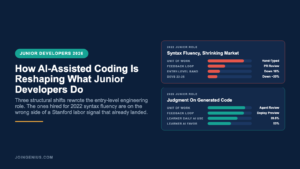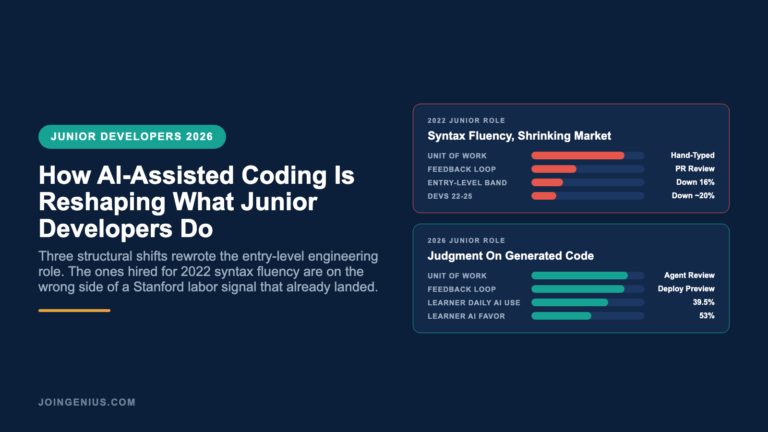
Every engineering manager running a team of juniors in 2026 knows the pattern. The onboarding plan that worked for the 2022 cohort does not work for the current one. The junior who ships a working feature in week three is now asking why they should hand-write the boilerplate at all. The one who ships nothing in week eight is still staring at a prompt box.
The reason is not a generational one. It is a structural shift in what the job of a junior developer actually is, and the shift happened fast enough that most hiring rubrics still screen for the 2022 version of the role.
This post walks through the three shifts, the employment signal behind them and what to hire and develop for in 2026 so the junior on your team lands on the compounding side of the AI curve instead of the contracting one.
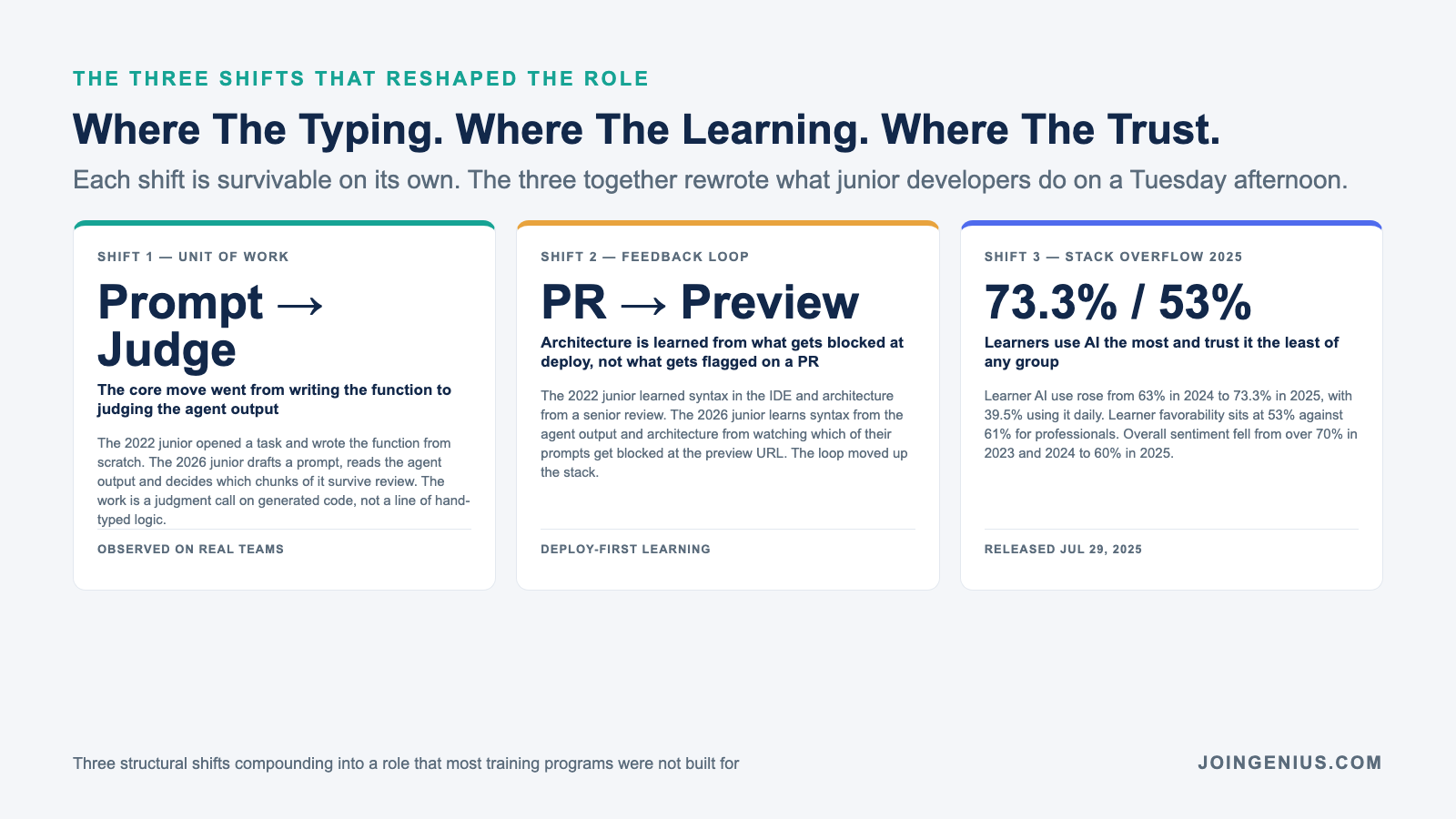
The Three Shifts That Reshaped Junior Developer Work
Shift one is where the typing happens. The 2022 junior opened a task, read the ticket and wrote the function from scratch. The 2026 junior opens a task, drafts a prompt and reads the agent output before deciding which chunks of it survive review. The core unit of work is a judgment call on generated code, not a line of hand-typed logic.
Shift two is where the learning happens. The 2022 junior learned syntax in the IDE and architecture from a senior review. The 2026 junior learns syntax from the agent output and architecture from watching which of their prompts get blocked at preview. The feedback loop moved from the pull request to the deploy preview.
Shift three is where the trust gap lives. The Stack Overflow 2025 Developer Survey reports that learners’ use of AI in their development process rose from 63 percent in 2024 to 73.3 percent in 2025, and that 39.5 percent of learners now use AI tools daily. The overall favorability number tells the other half of the story. Positive sentiment on AI tools fell from over 70 percent in 2023 and 2024 to 60 percent in 2025, and the most distrustful group of all is the one learning to code at 53 percent favorable against 61 percent for professionals.
Juniors use the tools more and trust them less. That is not a contradiction. It is the signal that the 2026 junior spends most of the day reviewing AI output they do not fully believe, which is a different job than the one most training programs are built for.
The Employment Signal Behind The Shift
The signal that the shift has already happened is in the entry-level labor data. The Stanford Digital Economy Lab’s November 2025 paper Canaries in the Coal Mine reports that early career workers aged 22 to 25 in the most AI-exposed occupations have experienced a 16 percent relative decline in employment since the widespread adoption of generative AI. The study is drawn from ADP payroll records and authored by Brynjolfsson, Chandar and Chen.
Software developers in the 22 to 25 age band are the sharpest case in the paper’s secondary coverage. Employment for that cohort is reported down roughly 20 percent from its late 2022 peak. The adjustment did not land on wages. It landed on headcount. Firms are hiring fewer juniors, not paying juniors less.
The paper is careful. It frames the finding as consistent with a disproportionate AI effect on entry-level workers rather than proof of one. The decline concentrates in occupations where AI automates work rather than augments it, and the result holds when tech firms and remote-friendly jobs are excluded from the sample.
The implication for anyone building a 2026 junior pipeline is direct. The hiring bar did not go up. The role did. The juniors who get hired and stay hired in 2026 are the ones whose skill set maps to the shifted role, not the 2022 one.
The Deploy And Review Layer Where Juniors Now Actually Work
The quiet place where most of the junior learning now happens is the preview and deploy surface. The 2022 junior spent most of the week inside an editor. The 2026 junior spends most of the week inside a review loop against a deployed preview, because that is where the agent output meets reality.
A junior working on an AI deploy platform like Netlify, which runs AI coding agent output and hand-written pushes through the same preview and rollback pipeline, closes the production feedback gap that otherwise shows up as a junior who can prompt their way to a demo but cannot ship the same code behind a URL that survives a rollback.
Fixing the review and deploy loop is the single highest return move an engineering manager can make on a junior in 2026. It does not require a new curriculum. It requires one senior who treats the first 60 days of every new junior as a judgment training problem, not a syntax one.
The economics are direct. A junior who lands the first production deploy inside two weeks of start date compounds against the agent loop on every task after it. A junior who spends eight weeks writing code that never leaves a local branch is reviewing output they will never see land, and the job the market now pays for is the opposite one.
Day 180 Before And After On A Junior Hire
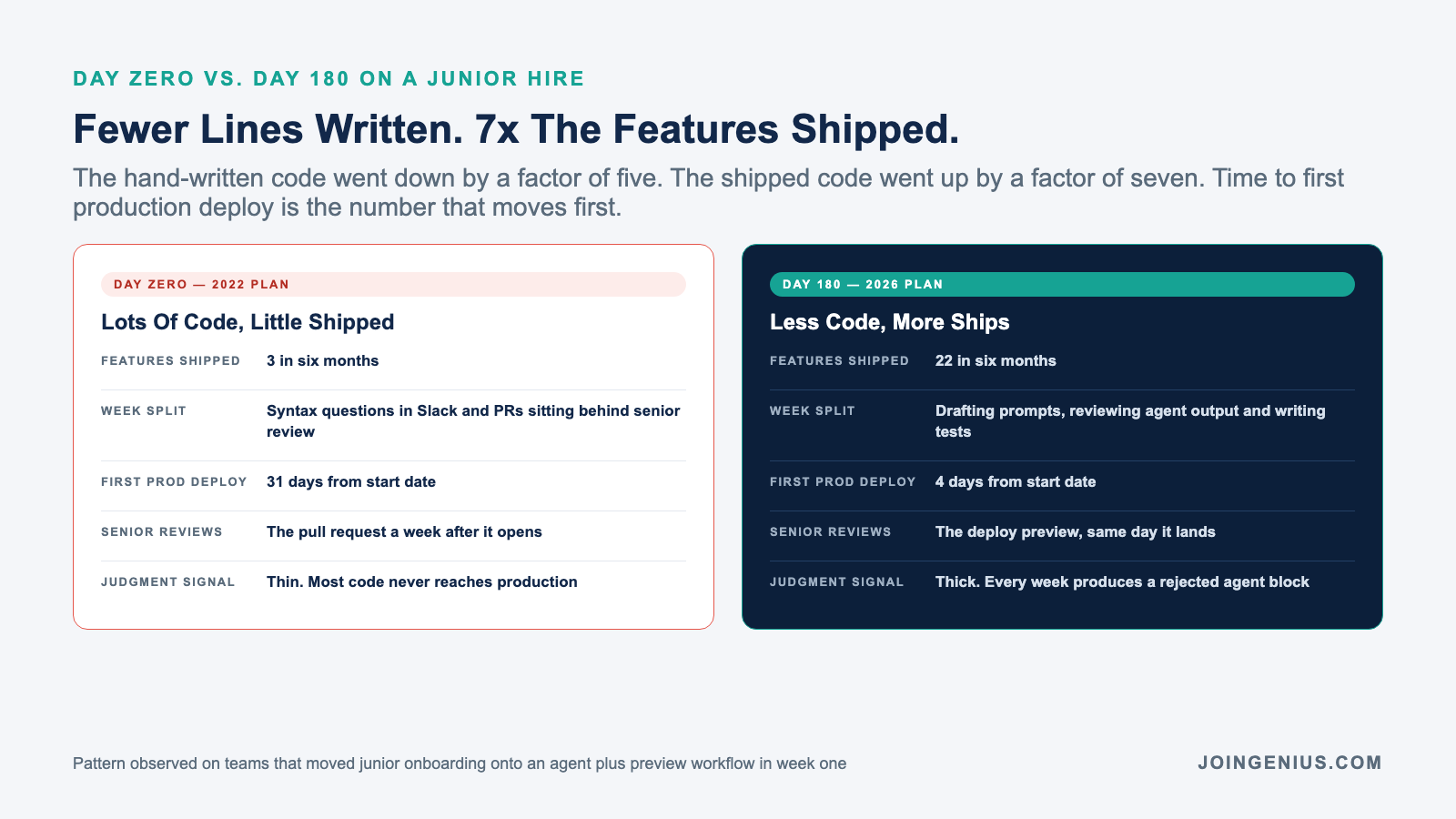
The before picture is the one most engineering managers describe. The junior has shipped three features in six months. Most of the week went to syntax questions in Slack and to pull requests that sat for days behind senior review. The junior writes a lot of code and ships almost none of it.
The after picture at day 180 looks different on every metric. The junior has shipped 22 features in six months. The week is split between drafting prompts, reviewing agent output on deploy previews and writing the tests that catch the two or three places the agent got the business logic wrong. The senior reviews the preview instead of the PR.
The code written by hand went down by a factor of five. The code shipped went up by a factor of seven. The team got that result by moving the junior onto an agent plus preview workflow in week one instead of month three, and by writing the onboarding plan around judgment on generated code instead of fluency on written code.
The number that changed first was time to first production deploy. It moved from 31 days to 4 days. Every downstream number moved on the lag of that one.
The Four Move Playbook For Developing A Junior In The AI Era
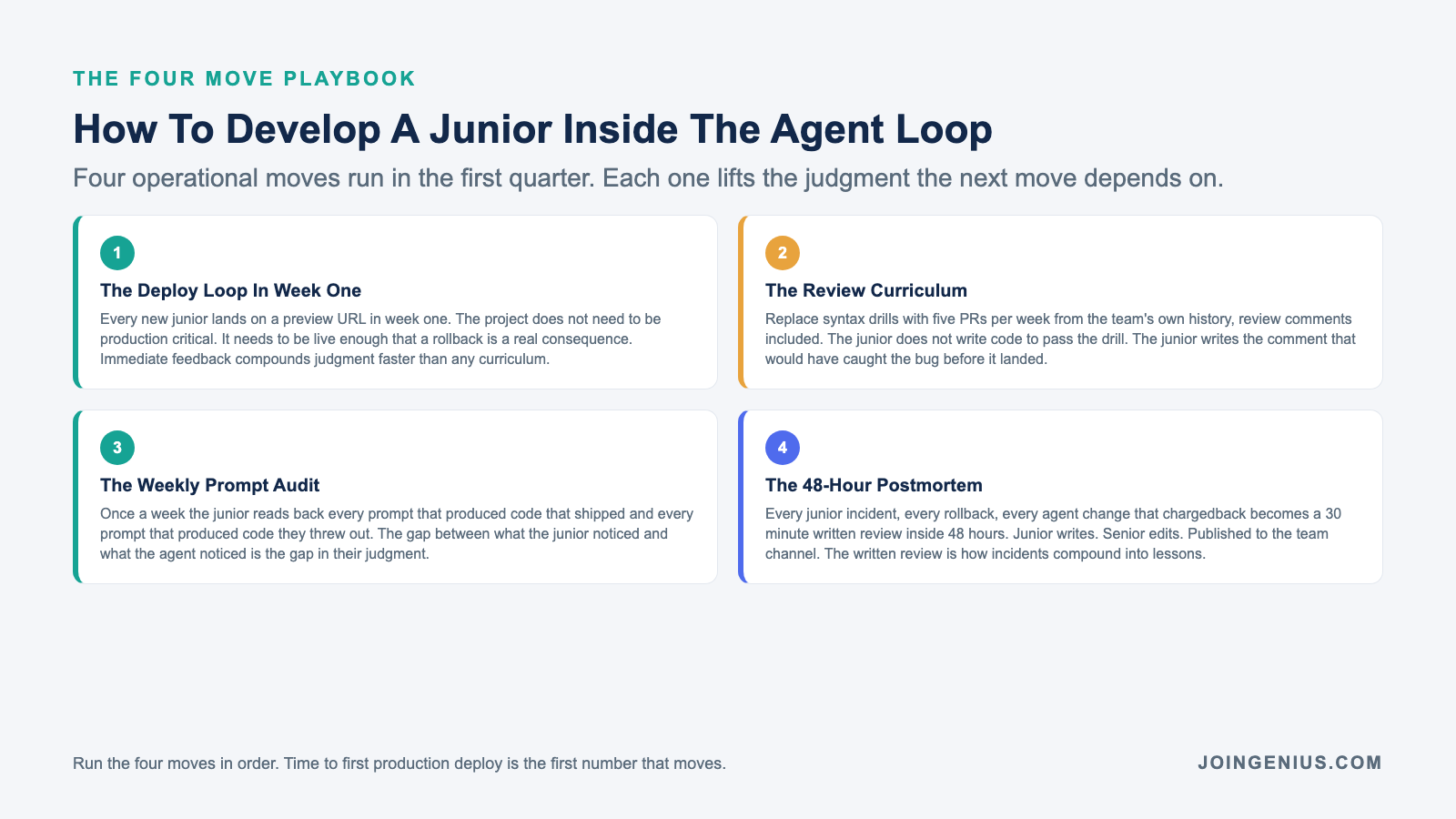
Move one is the deploy loop. Give every new junior a project that lands on a preview URL in week one. The project does not need to be production critical. It needs to be live enough that a rollback is a real consequence. Juniors who learn the deploy loop early learn judgment on generated code faster because the feedback is immediate.
Move two is the review curriculum. Replace the 2022 syntax drills with a reading list of five pull requests per week from the team’s own history, with the review comments included. The junior does not write code to pass the drill. The junior writes the review comment that would have caught the bug before it landed.
Move three is the prompt audit. Once a week the junior reads back every prompt they sent that produced code that shipped and every prompt that produced code they threw out. The point is not the prompt. The point is the pattern of what the junior noticed versus what the agent noticed, because that gap is the gap in their judgment.
Move four is the production postmortem. Every junior incident, every rollback, and every chargeback on an agent generated change becomes a 30 minute written review inside 48 hours. The junior writes it. The senior edits it. Published to the team channel. The written review is the single fastest way to turn an incident into a transferable lesson.
A One Page Weekly Check On Junior Development
The replacement for the quarterly performance review is a weekly five metric read owned by the senior or the engineering manager. The point is to make the real signal visible before the junior stalls, not after.
Metric one is features shipped to production in the trailing 14 days. Metric two is the ratio of agent generated lines merged to agent generated lines rejected, because the rejected line count is the signal the junior is actually reading the output. Metric three is time to first review comment on pull requests the junior opens, because a stalled review loop is the fastest way to lose a junior’s momentum.
Metric four is incident count attributable to the junior’s merged work, with severity. A junior with one incident a quarter is learning. A junior with zero is probably not shipping anything meaningful. Metric five is the junior’s prompt audit score on last week’s sample, measured as the percent of agent output they correctly flagged for revision before merge.
Scan these five every Monday, flag the two biggest week over week moves, and walk the junior through the hypothesis before the one to one. The conversation changes from “how is the junior doing” to “which specific judgment call did the junior get right this week,” which is the only conversation that moves a junior up the curve. Build this expectation into your interview rubric for the junior hire.
Hire Juniors Who Can Work Inside The Agent Loop
The teams that compound on juniors in 2026 are the ones that stopped hiring for 2022 syntax fluency and started hiring for 2026 judgment on generated code. They are the ones that put every junior on a preview and deploy loop in week one. They are the ones with a senior whose job is to coach the junior on which parts of the agent output to trust.
The labor market is still open. The US Bureau of Labor Statistics counts 1,905,400 software developer, QA analyst, and tester jobs in 2025, with a 10 percent growth projection through 2035, roughly 106,100 openings per year, and a median wage of $134,040 as of May 2025. The macro demand for the role is intact. The shape of the entry-level job inside it is what changed.
Genius hires top one percent engineering talent from the Philippines and LATAM at roughly 80 percent less than local comp. There are no monthly fees and the placement comes with a six month replacement guarantee.
We screen on the four judgment tests described on this page before any candidate reaches a hiring manager, so your sourcing funnel brings you juniors who ship on a preview URL in week one, not juniors who need eight weeks to clear the local branch.