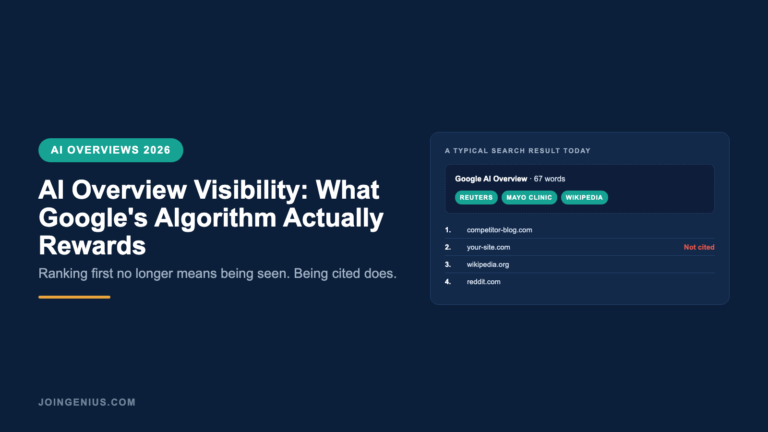
You still rank in the top three for your money keyword, but traffic is down. The reason sits above you. Google’s AI Overview answers the query in a paragraph that cites three or four sources. Your post is often not one of them. AI Overview visibility now decides whether anyone clicks through to your page.
Below, we cover what the AI Overview actually pulls from, where it looks when it skips the top organic result, and how to write pages it wants to cite. Then we get into measurement, because none of this works without numbers, and the right hiring process for whoever will own it.
What AI Overview Visibility Means In 2026
Visibility in an AI Overview is the chance that your page shows up as one of the handful of links cited inside the generated answer at the top of the search. It is a different race from classic ranking.
Citation Share, Not Position One
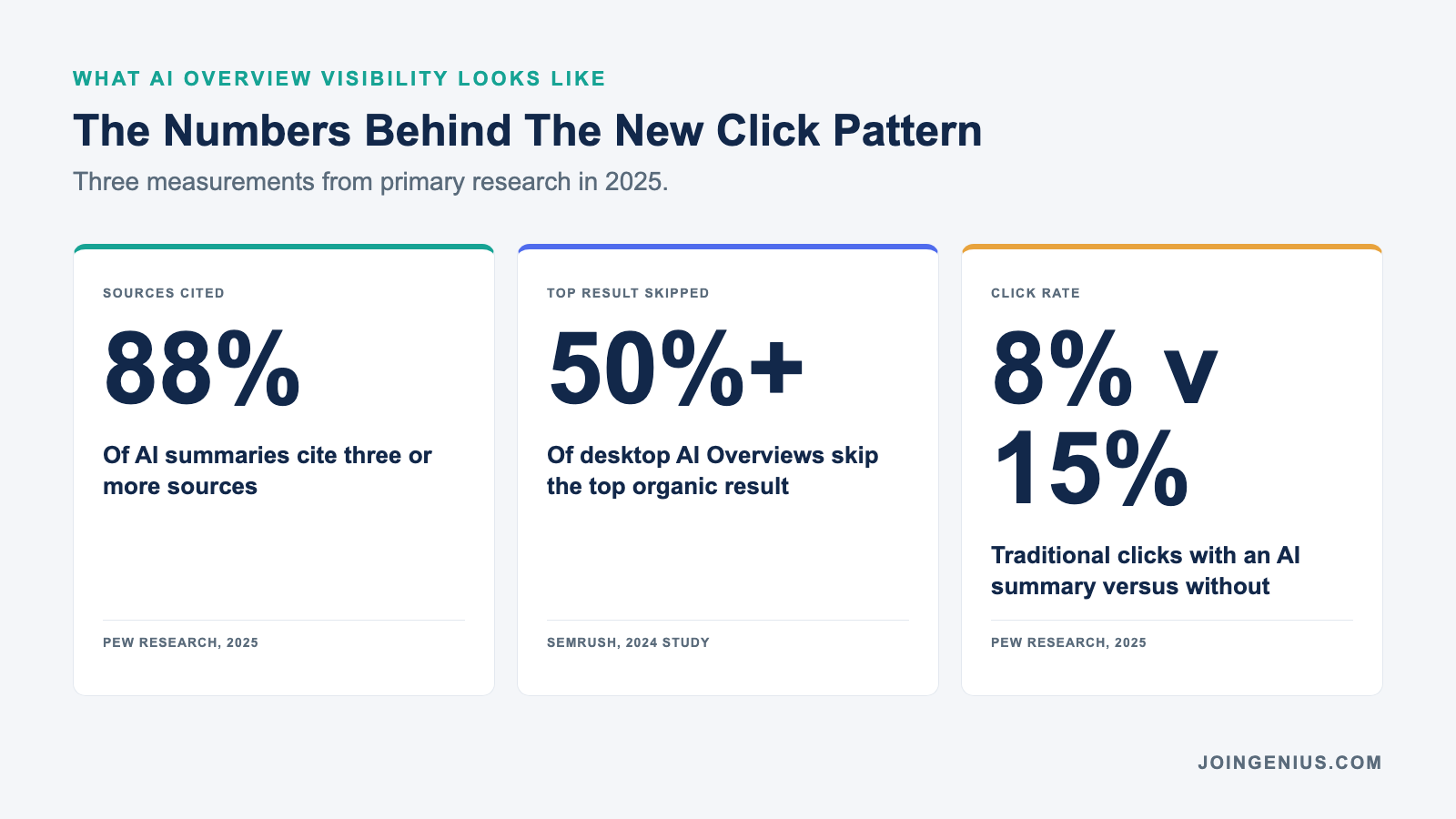
The AI Overview rarely pulls from a single page. A 2025 Pew Research study of 900 US adults and 68,879 Google searches found that 88 percent of AI summaries cited three or more sources, with a median summary of 67 words. The game is to be one of those three sources, not to be first on a list.
The top organic link is often absent too. A Semrush study of 200,000 US keywords in September 2024 found over half of AI Overviews on desktop did not link to the top organic result. On mobile that figure was 60 percent. Semrush sells SEO software, so read the numbers with that caveat.
Why Click-Through Rate Falls Even When You Rank
When an AI Overview sits above your result, fewer people reach your page even if they were going to click. Pew found users clicked a traditional result on 8 percent of visits with an AI summary, versus 15 percent without. They ended the session on 26 percent of pages with a summary, versus 16 percent without.
Your rank has not changed, but the attention has. Ranking well without being cited now means the reader reads the overview and moves on.
What Google’s Algorithm Actually Rewards In An AI Overview
You cannot read Google’s AI Overview ranking model. You can see what tends to get cited across tens of thousands of queries, and the signals repeat.
Pages That Answer The Question Directly In The First Lines
The overview is built from short passages that already answer the query. Pages with a one-paragraph answer near the top, followed by the detail, get pulled more than pages that build up to the answer over 400 words.
That is a writing change, not a technical one. The first 60 words of each page should contain the specific answer a user asked for, in their own words, before any background.
Specificity Over Generic Advice
Overviews cite pages that contain the exact number, step or definition the query needs. A post about “how to price a yoga class” that gives a range in dollars and a worked example will get cited over a post that discusses pricing philosophy. Depth helps, but precision matters more.
This is why some high-authority pages lose to smaller sites in AI Overviews. The smaller site wrote the direct answer; the bigger site wrote around it.
Credible Signals The Model Can Verify
Overviews lean on sources that look checkable. Reuters and Mayo Clinic get cited for the same reasons people trust them: a named author, a date, references to primary data, and a page that stays on topic.
Semrush’s data also shows that the overview averages 11 links per answer and pulls from a broad mix of sites. Wikipedia, YouTube and Reddit together account for 15 percent of AI summary sources per the Pew study, which hints at how heavily user-generated content is used when the topic is open to interpretation.
Where AI Overview Visibility Breaks Down On Most Sites
Most sites are not failing because of their content quality. They fail at steps that are easy to fix once you know where to look.
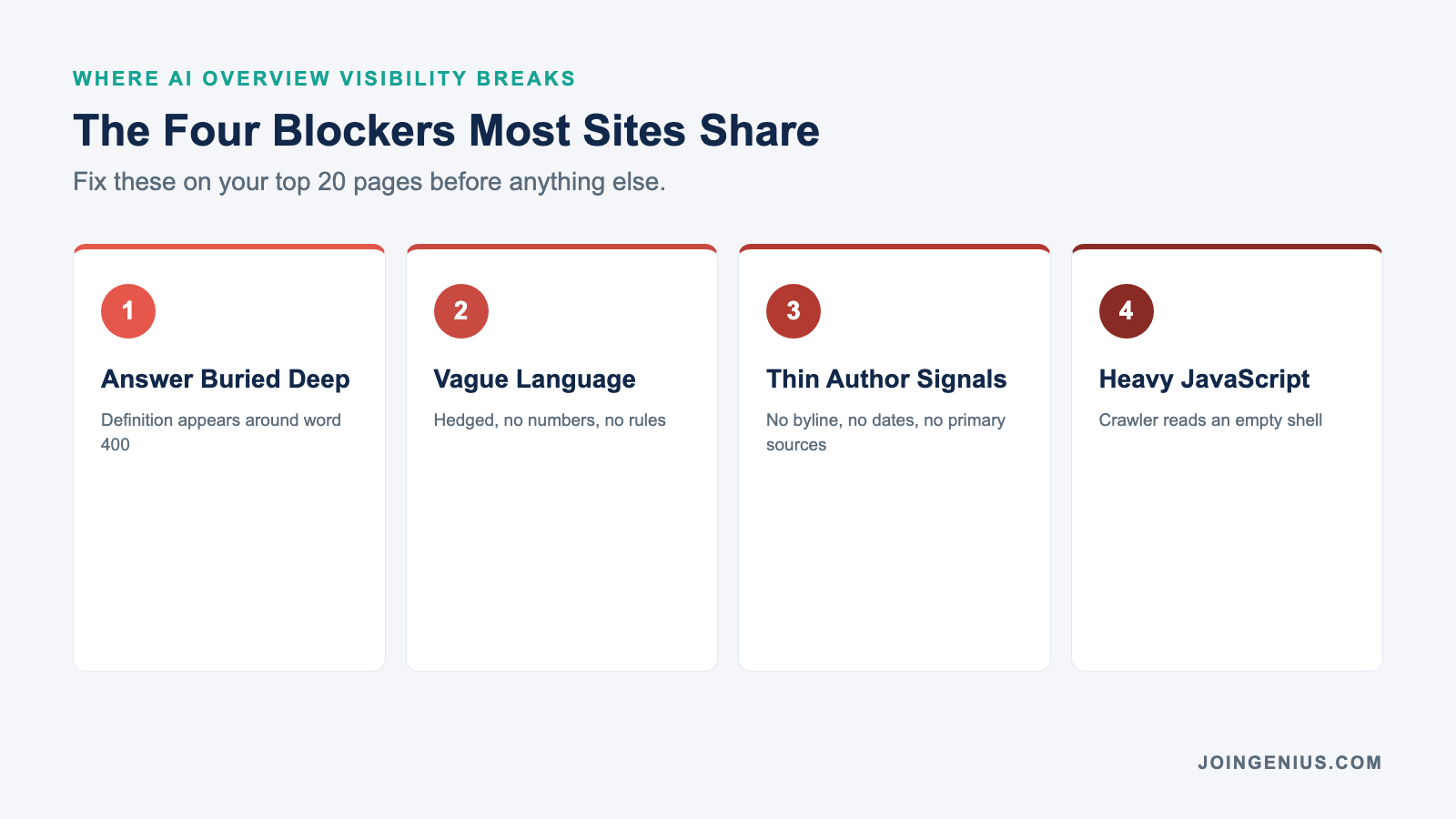
The Three Most Common Blockers
| Blocker | What It Looks Like | Why Overviews Skip It |
|---|---|---|
| Answer buried deep in the post | Long introduction, definition appears around word 400 | The model samples short passages and cannot find a clean answer |
| Vague, hedged language | Sentences full of “it depends” with no number or rule | Nothing specific enough to quote in a 67-word summary |
| Thin author and source signals | No byline, no dates, no linked primary data | Credibility checks fail, so the model prefers a competitor |
| Heavy JavaScript rendering | Content loads client-side without server-rendered fallback | The crawler reads an empty shell and cannot sample your text |
A single afternoon of edits can clear the first three on your top 20 pages. The fourth is a developer task.
Thinking About Query Variations
Each page should answer more than one phrasing of its query. Overviews are built from paraphrased questions and voice-style searches, not just your head term.
If your post ranks for “how to price a yoga class” but never uses the phrases “what to charge for a yoga class” or “yoga class pricing”, the overview may still use a competitor who covers both. A simple H3 that covers the related phrasings fixes this without bloating the page.
How To Measure AI Overview Visibility Over Time
Classic rank trackers show you position one through ten. They do not show whether the AI Overview above position one cited you, which is where visibility is now won.
What To Track Each Week
Set up a simple weekly check for your top queries. Record whether the AI Overview appears, whether you are cited, and which competitor is cited when you are not. That three-column answer is enough to tell you where you are gaining or losing visibility week over week.
You also want share of voice across a set of queries. Being cited in 10 of your 50 target queries is a different conversation than being cited in 40 of 50. The trend matters more than the single number.
The Tools That Separate Rank From Citation
Most SEO tools added an “AI Overview” column in 2025. Only a handful report citation share at the query level. A dedicated AI Overview rank tracker such as Rankscale shows which search terms trigger an overview and whether your brand or URL is cited. It also compares your share of voice with competitors over time. Rankscale is a paid product.
The point is not the tool. It is that classic rank data is now an incomplete picture of search performance, and your reporting should reflect that before anyone asks why traffic fell.
Who Should Own AI Overview Visibility Inside Your Team
This is usually a shared job between content and SEO, with a single named owner. The owner does not need to write every page, but they decide which pages get the direct-answer rewrite first.
The Role Mix That Keeps Visibility Growing
Most small teams need one person who understands how overviews pick sources, one writer who can produce the short direct answer at the top of each page, and one developer who can fix the rendering issues that hide text from crawlers. The owner is usually a senior SEO, often someone who already worked in content.
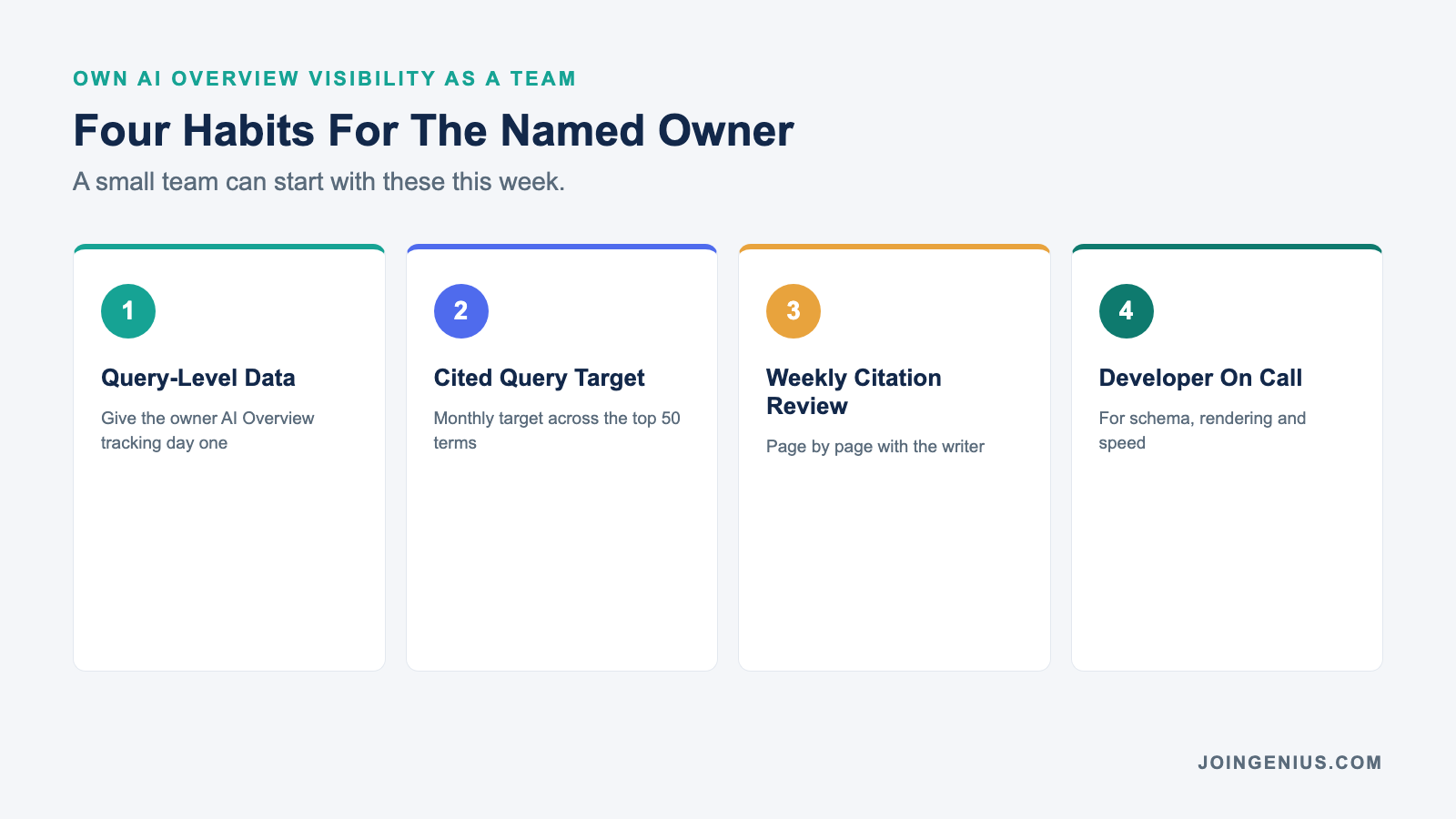
- Give the owner access to query-level AI Overview data from day one.
- Set a monthly target for cited queries across your top 50 terms, not just rank.
- Review overview citations with the writer every week, page by page.
- Keep a developer on call for schema, rendering and site speed fixes.
Hiring the owner is where most teams slow down. If you need help running the search, a marketing recruitment agency can source candidates, and our post on how to hire SEO specialists covers the screening questions worth asking.
Budget Context For This Hire
Senior SEO and content roles sit inside the broader marketing analyst category. The US Bureau of Labor Statistics puts the median wage for market research analysts and marketing specialists at $78,760 in May 2025. It projects employment to grow 7 percent from 2025 to 2035, much faster than the average, with about 82,000 annual openings over the decade.
That growth rate is why time to hire matters now. A good AI Overview owner is in demand, and the hiring process you built in 2022 for a classic SEO role is probably too slow.
Conclusion
Treat AI Overview visibility as a separate scoreboard from classic rank. Pick 50 queries that drive your business, check them this week, and rewrite the three pages most often skipped to put the direct answer in the first 60 words. The lift shows up inside a reporting cycle, not a quarter.
Here at Genius, we place the senior SEO and content hires who do this work. We source top one percent marketers from the Philippines and LATAM at roughly 80 percent less than local comp. There are no monthly fees, and every placement comes with a six month replacement guarantee. Talk to Genius about adding an AI Overview owner this quarter.