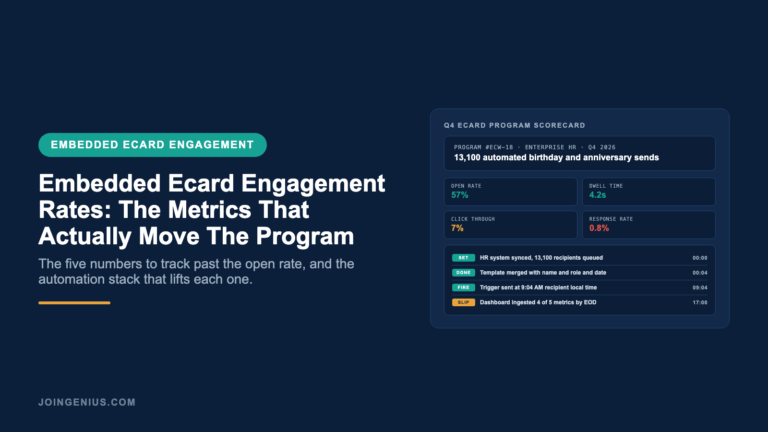
Embedded ecards keep showing up as a tactic HR and marketing teams reach for when every other channel is saturated and nothing feels personal anymore. Then the open rates come back strong, the question of whether anyone actually did anything with the card gets vague, and the program drifts toward a vanity metric. Engagement rates on an embedded ecard look obvious until the team tries to improve them and realizes there are at least five different numbers in that one phrase. This post sorts out which numbers matter and which ones mislead and what the automation stack has to do to actually move the ones that matter.
Why Embedded Ecards Outperform Standard Email And Why That Is Not The Point
Open rates are the first number anyone looks at and the first number to go flat on itself.
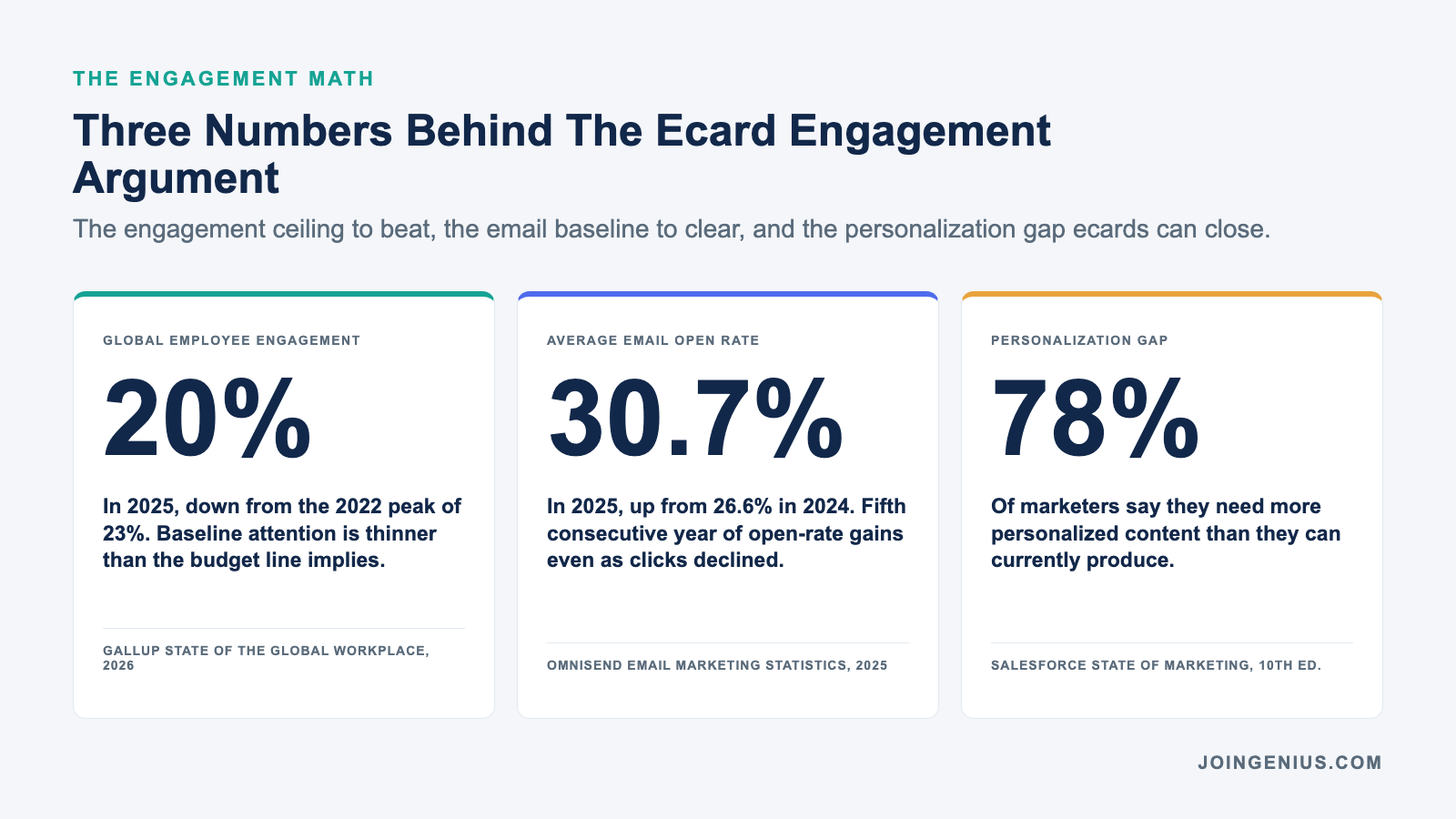
The Gallup State of the Global Workplace 2026 report, based on 263,810 respondents including 141,444 employed people across 2025, put global employee engagement at 20%, down from the 2022 peak of 23%. Recognition programs are trying to raise that floor.
Omnisend’s 2025 email marketing statistics reported that the average email open rate rose for the fifth consecutive year, climbing from 26.6% in 2024 to 30.7% in 2025, even as click rates declined across the same send base.
Embedded ecards consistently open at rates well above that baseline, but the lift tells you less than the baseline tells you.
If the standard email is at 30.7%, an ecard at 55% is a lift that could come from novelty as easily as from strategy. The headline open rate is where ecard programs pat themselves on the back and then stop asking the next question.
The declining click rate inside Omnisend’s data is the other half of the story. Open rates are up while click rates are down, which means attention is easier to earn and action is harder to earn.
The next question is what the recipient did after the card loaded. An embedded ecard has five measurable surfaces beyond the open, each one a different signal from a different part of the experience. Skipping any of them is how a good-looking open rate masks a dead program.
The marketing managers running these programs stop reporting on opens the moment leadership asks whether the ecard drove behavior. Behavior means a click to a milestone page or a reply from the recipient or a reshare into a team channel. Behavior is where the program either justifies itself or gets quietly killed at the next budget review.
Five Engagement Metrics To Track On Every Embedded Ecard
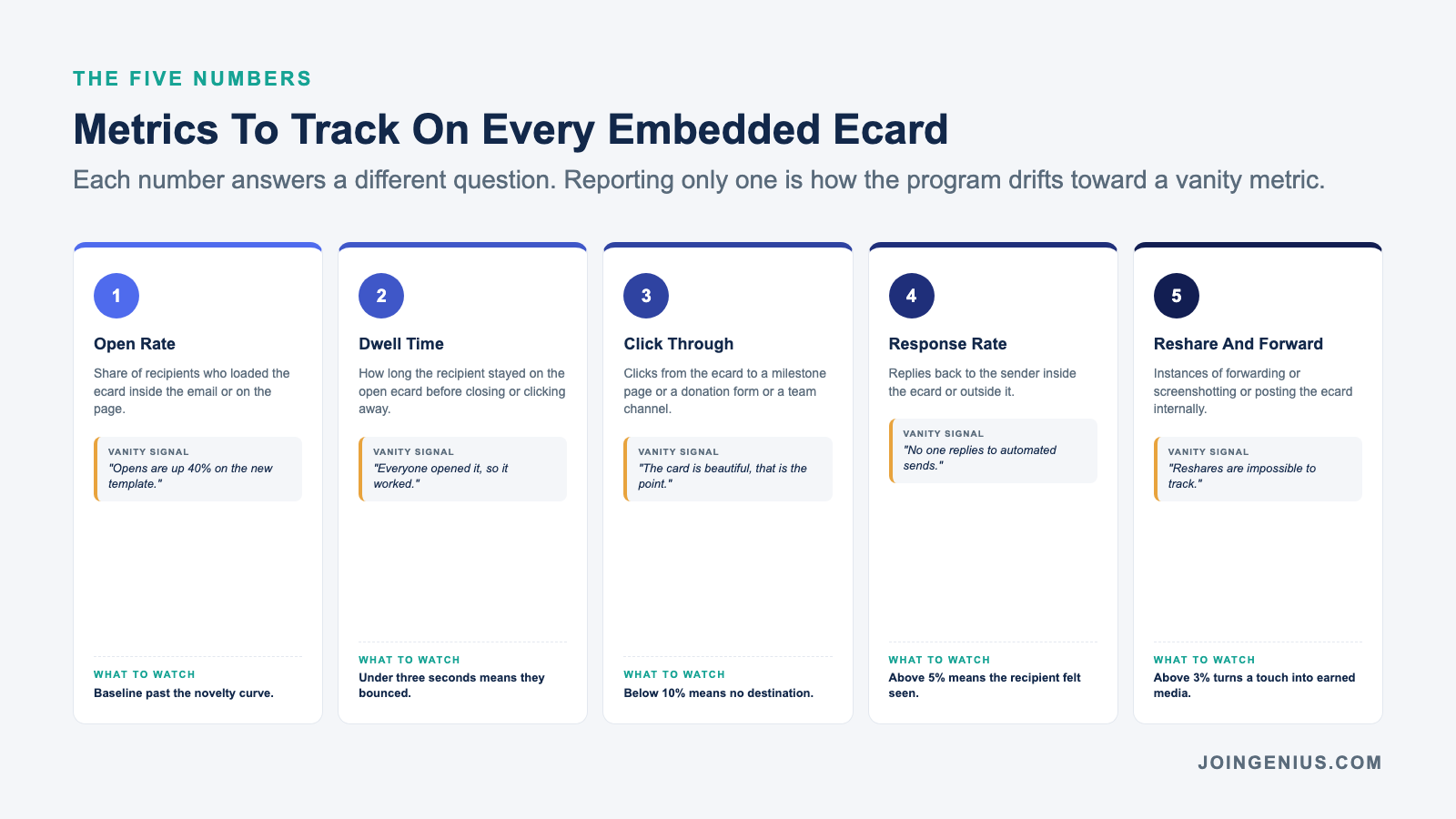
Each of the five numbers below answers a different question about the embedded ecard program, and each one has a benchmark a team can hit. Reporting all five keeps the program from gaming any one of them, because an ecard that opens often but gets closed in two seconds is not winning, no matter how high the open rate climbs.
| Metric | What It Measures | Program Health Signal |
|---|---|---|
| Open Rate | The share of recipients who loaded the ecard inside the email or on the page. Novelty inflates this number on the first run. | A rising baseline open rate means the sender name and subject line are earning attention past the novelty curve. |
| Dwell Time | How long the recipient stayed on the open ecard before closing or clicking away. Separates glance from engagement. | Dwell under three seconds is a signal the ecard loaded and the recipient bounced before reading. |
| Click Through To Owned Page | Clicks from the ecard to a linked milestone page or a donation form or a team channel. The first true behavior signal. | A click rate below 10% means the ecard is pretty but has no destination the recipient wants to reach. |
| Response Rate | Replies back to the sender inside the ecard or outside it. The highest-signal engagement metric for recognition programs. | Any response rate above zero on a bulk send is meaningful. Above 5% says the recipient felt specifically seen. |
| Reshare And Forward Rate | Instances of the recipient forwarding the ecard or screenshotting it or posting it internally. Measures earned reach. | Reshares above 3% turn the ecard from a one-off touch into an owned-media asset. |
These five numbers sit on one dashboard or the program is not measurable. A team reporting only open rate is tracking the easiest number to earn and the hardest one to improve past the first month.
The digital marketing specialists who run embedded ecard programs at scale learned to report all five in the same monthly roll-up, because leadership will cut the program on a flat open rate even when dwell and click and response are all climbing.
What Makes An Embedded Ecard Actually Get Opened
The lift embedded ecards get over standard email is not magic. It is the result of three specific design choices that a generic email never makes, and the number that drives all three is personalization depth.
The Salesforce Tenth Edition State of Marketing, based on 4,450 marketing professionals surveyed across 26 countries from October 8 through November 17 2025, found that 78% of marketers say they need more personalized content than they are currently able to produce.
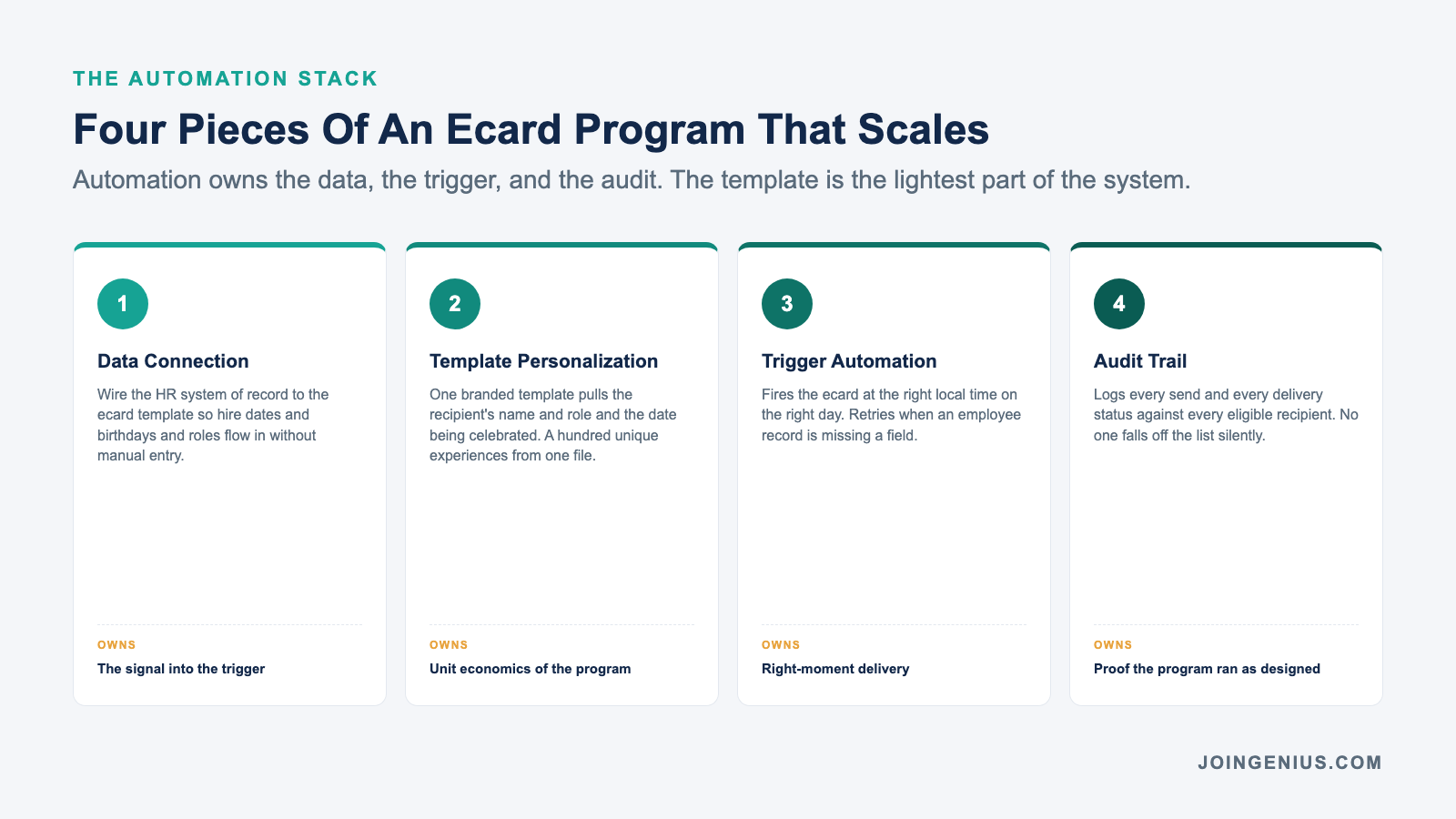
Embedded ecards close that gap on the cheapest unit of content a team ever ships. A single ecard template becomes a hundred unique experiences the moment it pulls the recipient’s name and role and the specific date being celebrated.
The production cost per personalized touch is near zero after the template is built, which is the only reason the program scales past the first quarter.
The three design choices that lift the open rate above standard email are specific. The sender line reads as a person at the company and not as a marketing automation account.
The subject line names the recipient and the occasion rather than the ecard itself.
And the preview pane shows the opening frame of the card and not a plain-text first line that gives away the content.
Timing is the fourth design choice people forget to count. A birthday ecard landing in the inbox three days after the birthday is not a personalization win. It is a tracking failure.
An ecard that arrives at 9:04 AM local time on the day itself gets opened at a different rate from the same card sent at 7 AM in the sender’s time zone and queued for a bulk 11 AM dispatch.
The Automation Stack That Scales The Program Without Losing The Personal Touch
The reason most ecard programs die after the first quarter is operations load, not creative fatigue. A content writer can draft 50 recognition messages in an afternoon. The problem is tracking which 50 employees have a birthday this month and which 40 have a work anniversary and which three need a thank-you for a specific completed project.
That tracking is what an automated stack has to own, not the ecard design. The eCard Widget automation platform wires the HR system of record to the ecard template so birthdays and anniversaries trigger a card without a human queuing it.
One enterprise HR team using that setup has sent roughly 13,000 automated employee birthday and anniversary cards in a single year without manual send decisions.
That scale is only possible when the ecard template is the lightest part of the system.
The heavy lifting is the data connection and the retry logic when an employee’s record is missing a role or a hire date and the audit trail that proves every eligible person got their card.
Programs that do not automate at that layer stall at the second quarter when the manual tracking spreadsheet becomes a second job for the person who owns the program.
How To Read The Numbers And Change The Program
Reporting the five metrics is the easy part. Acting on them is where most programs stall, because the levers for each metric are different and the team wants to pull one and watch all five move.
Open rate responds to the sender line and the subject. Dwell responds to the opening visual. Click responds to a specific call to action. Response and reshare respond to the recipient feeling specifically seen.
The practical read is to pick one metric per quarter and let the other four run as controls. A quarter spent moving click rate from 8% to 14% is a quarter the team can point to. A quarter spent chasing every number at once is a quarter the program drifts back to reporting opens and nothing else.
The community managers and HR partners who run healthy ecard programs set a single quarterly target on one of the five numbers and write the ecard brief around moving that number.
The brief changes every quarter, which is how the program avoids becoming a template graveyard where the same card ships in rotation for two years and the engagement rate quietly collapses.
Engagement Is The Metric, Not Send Volume
The teams that keep ecard programs alive past the first year stop reporting send volume on the monthly roll-up. Sending 13,000 cards is a logistics win and nothing more if the engagement numbers behind those sends are flat. The number that justifies the program is the five-metric roll-up, not the headline on how many cards shipped.
Open rate alone will keep a program on life support until the budget review. Dwell and click and response and reshare together make the case that the ecard is doing the work the team hired it to do.
Genius builds the HR and marketing talent that runs those programs every day, whether that is the writer who drafts the templates or the specialist who reads the five numbers and decides which lever to pull next quarter.