The AWS Solutions Architect Associate badge used to open doors. In 2026 it mostly opens tabs. The pool of certified engineers has gotten so large that the line on the resume no longer tells a hiring manager anything about cost awareness or blast radius. The teams that keep shipping into AWS, usually led by a senior DevOps engineer, stopped sourcing by badge count and started sourcing by a short list of behaviors a resume cannot preview. This post covers why the signal faded. It covers which tier of certification still predicts output. And it covers the 48-hour trial brief that catches five behaviors in one artifact.
Why The AWS Cert Line Stopped Being A Signal
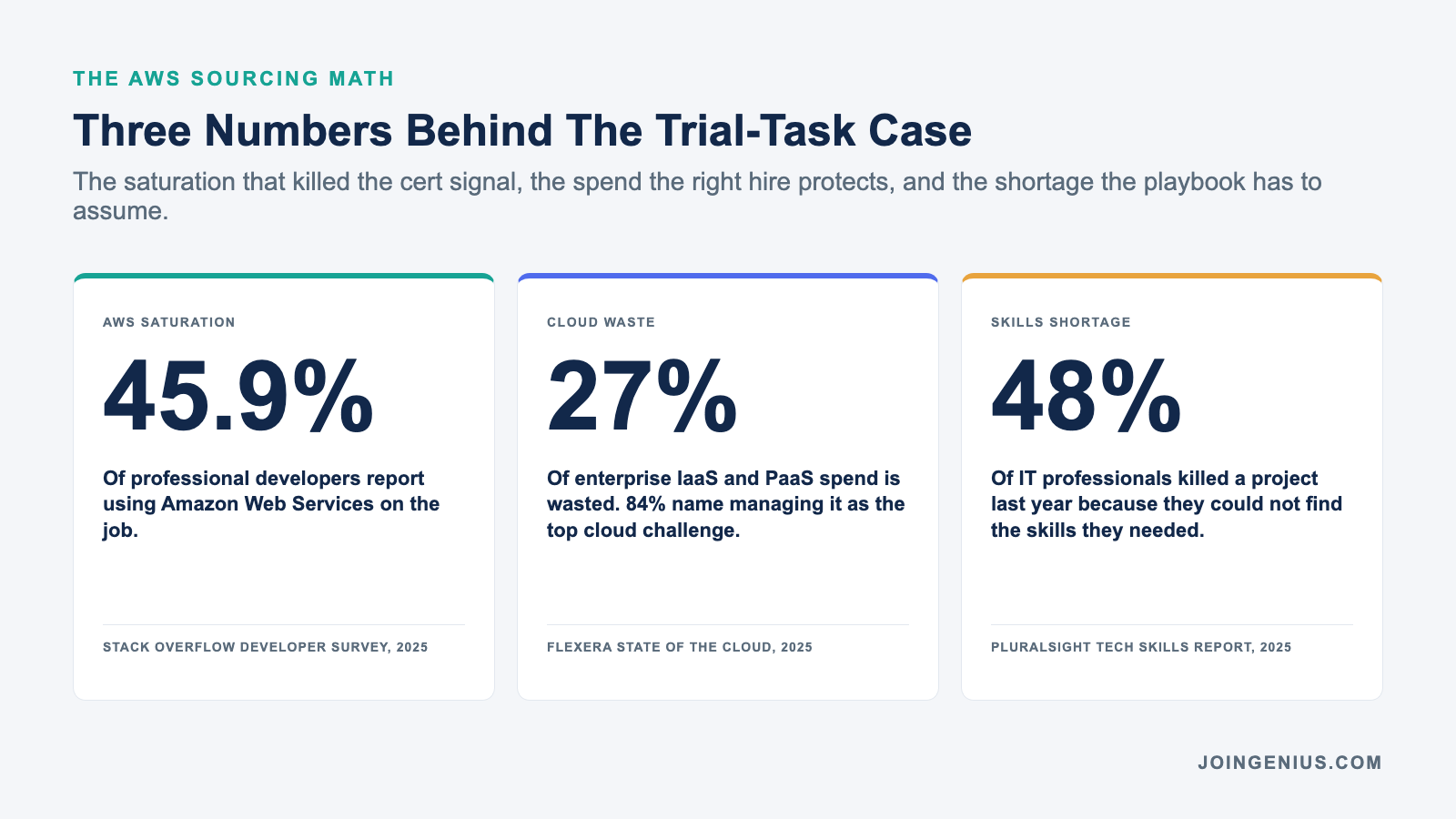
Stack Overflow’s 2025 Developer Survey, based on over 49,000 respondents from 177 countries and published July 29, 2025, found that 45.9% of professional developers report using Amazon Web Services on the job.
Nearly half the professional developer population is on AWS somewhere in their stack. That means an AWS certification line on a resume signals participation in the mainstream, not specialization.
A resume with the Associate badge next to React and Python is no longer a differentiator. It is the median.
The resume screen that filters by cert count is filtering for the modal candidate. The resume screen that filters by what the engineer has actually shipped into a real AWS account is filtering for the one you want.
The hiring market caught up to the certification. The sourcing playbook has not.
What You Hire An AWS Engineer For When Certs Stop Signaling
The job behind the req is not someone who knows AWS. It is someone who can look at a messy, over-provisioned account and make it leaner without taking the product down.
Flexera’s 2025 State of the Cloud Report, based on 759 cloud decision-makers and users worldwide, found that enterprises waste roughly 27% of their IaaS and PaaS spend. 84% named managing cloud spend as their top cloud challenge, up from prior years.
The engineer you actually want on the team can read a Cost Explorer report before writing any Terraform. The engineer the resume screen sends you can draft the Terraform first and fight the finance team about the bill later.
The gap between those two engineers rarely shows up in a 60-minute system-design interview. It shows up on Monday of the first full sprint, when a candidate who looked strong on the whiteboard turns in a change that doubles the NAT gateway bill.
Sourcing back-end engineers with an AWS line on the resume is a wide pool. Sourcing the subset who read the bill first is the narrow one.
The whole point of a trial task is making that subset visible before the offer goes out, not after the second quarter of overshoot.
The Cert Tier That Predicts On-The-Job Output
Which tier of certification is worth something in 2026 is a different question from whether certification is still a strong signal. There is a surprising answer in the audit data coming out of FinOps-heavy engineering orgs.
Associate-level AWS certifications correlate with cost-conscious architecture decisions more consistently than Professional-level ones in real audits, which is also why a cloud cost optimization partner can often replace the Professional-tier hire a team was about to make.
The reading is counterintuitive on the surface. The Professional path is heavier on reference-architecture theory and lighter on the weekly cost-reporting discipline. The Associate path forces breadth across services in a way that keeps engineers asking which service is cheapest for the actual job.
The other reason the Associate tier predicts better is recency. The Associate exam has to be renewed every three years and the content is updated more often than the Professional one, so a current Associate badge usually means the engineer has sat down with the newest cost models inside the last cycle.
The practical move is to screen for the Associate tier at the resume layer. Then score the real decision-making on a trial that simulates a week of production AWS work.
The next two sections cover what the trial looks like and how to grade it without rewarding pretty Terraform.
Five Behaviors A Real AWS Trial Task Surfaces
Each behavior below is invisible on a resume and hard to fake in a 60-minute interview. A good trial task surfaces each one on the same deliverable from the same inputs, so comparison between candidates is apples to apples.
| Behavior | What It Looks Like In The Trial | Why It Predicts Shipping |
|---|---|---|
| Reads The Bill First | Opens Cost Explorer before opening Terraform. Flags the top three line items and writes one sentence per item. | The engineer who starts at the bill writes cheaper infra by default. |
| Scopes The Blast Radius | Names what the change could break before writing it. Tags account and environment on every resource touched. | Senior engineers do this out of habit. Juniors do it only when asked. |
| Picks The Boring Service | Chooses RDS over a managed AI service when the workload fits. Ignores the fashionable option. | Boring services have ten years of production patterns behind them. |
| Writes For Rollback | Includes a rollback path in the first PR. Comments the exact command at the top of the change file. | The teams that keep shipping are the ones who ship with a rollback by default. |
| Names The Next Unknown | Ends the brief with one sentence naming the question the current data cannot answer. | Senior engineers ship past the current task. Juniors treat ship as the finish line. |
Data engineers running the grading usually name all five by the second batch of submissions. The behaviors are not AWS-specific. They are infrastructure-mature.
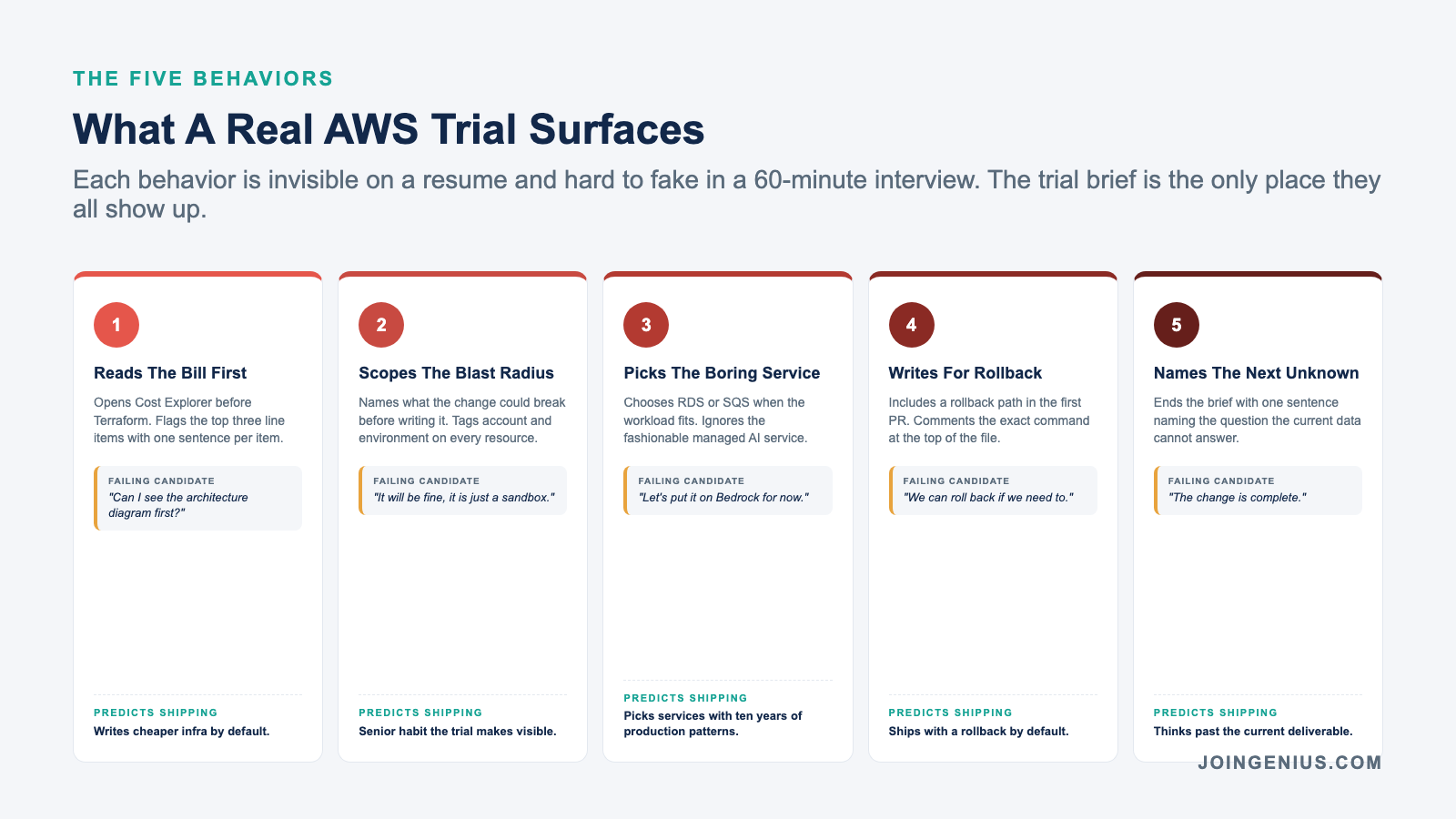
The common thread across all five is that they happen before the code is written, not after. The candidate who shows up on day one already doing them is the one the trial surfaces.
The 48-Hour Brief That Catches All Five
The inputs matter more than the rubric. Pluralsight’s 2025 Tech Skills Report, based on 1,500 respondents across the US and the UK and India, found that 48% of IT professionals killed a project last year because of a skills shortage. The hardest-hit skill domain was cloud infrastructure.
A scalable AWS-engineer sourcing playbook has to assume supply of senior cost-conscious engineers is thin. The brief is designed to find them fast.
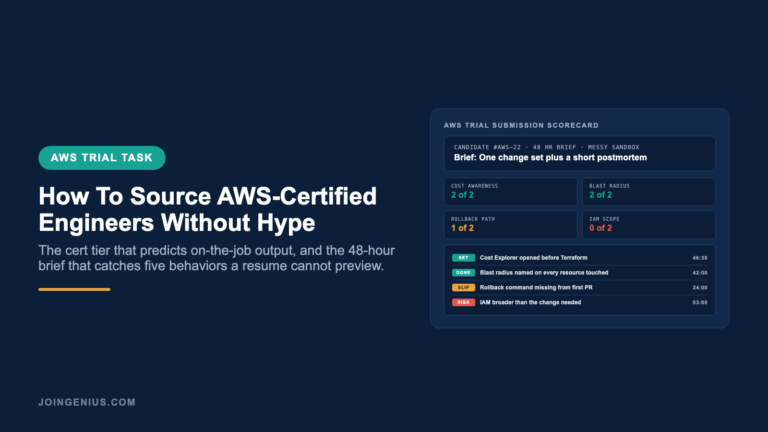
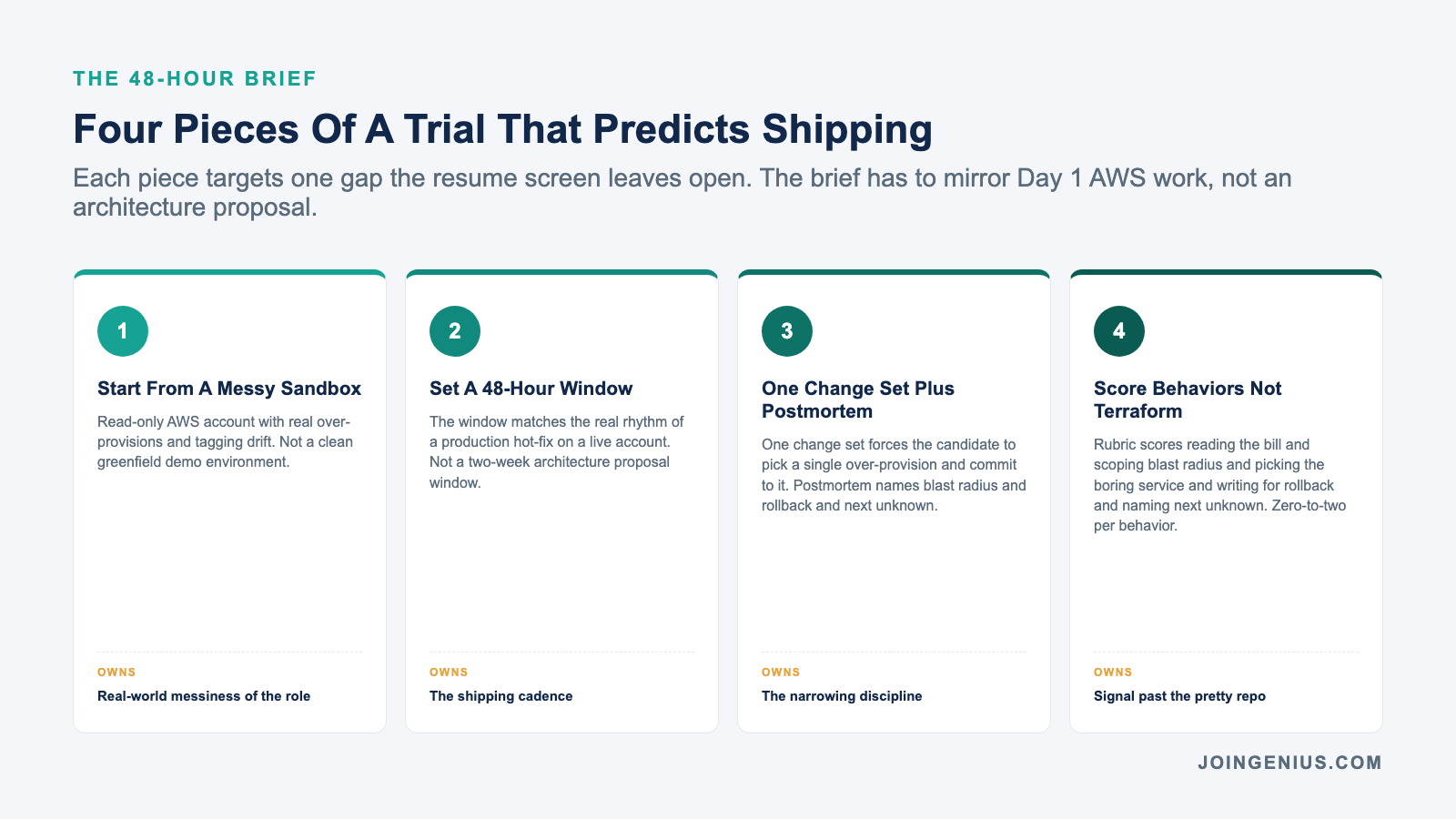
Hand the candidate read-only access to a messy real-ish AWS sandbox. Give them 48 hours. Ask for one change set and a short postmortem.
The change set targets a specific over-provision the Cost Explorer surfaces. The postmortem names the blast radius and the rollback path. The last line names the next unknown the current data cannot answer.
Terraform is optional. Software engineers who have shipped production AWS can do this in a day, and the write-up will tell the hiring manager everything the resume could not.
How To Grade The Trial Without Rewarding Pretty Terraform
The rubric is where most trial tasks fail. A deck-pretty Terraform repo scores 100 on aesthetics and tells a hiring manager nothing about shipping.
Score each behavior on a zero-to-two scale. Zero if it is absent. One if it is present but shallow. Two if it is present and specific to the sandbox account the candidate was given.
Weight all five behaviors equally. A candidate who nails Cost Awareness and Blast Radius but misses Rollback is a junior who will cost the team a Saturday within the first quarter.
Weight the write-up at zero. The write-up is a read-only artifact for the grader. Pretty slides and clean diffs are not the job.
The grader bias to watch for is familiarity. An engineer who writes in the same style as the hiring manager will score higher than an engineer who writes clearly but differently, unless the rubric forces attention onto the five behaviors and nothing else.
The candidate whose change set scores eight of ten or higher is the one the Associate-tier filter already told you to call.
Shipping Is The Skill, Not The Certificate
The teams that come through a quarter with their senior AWS seats filled are not the teams that collected the most certifications. They are the teams that stopped treating certification as the signal.
Shipping is the skill. The cert is a prerequisite, and only at the Associate tier. The rest is behavior, and behavior only shows up on an artifact.
The sourcing playbook that works has three steps. Screen for the Associate tier at the resume layer. Hand the candidate a messy sandbox and 48 hours. Score the change set on five behaviors, never on Terraform line count.
Conclusion
The AWS certification line is not useless. It is just no longer the signal it used to be. The Associate tier still predicts cost-conscious decisions. The Professional tier mostly predicts a longer resume.
The teams that come through the next quarter with their senior AWS seats filled are the teams whose trial task caught the five behaviors a resume could not preview.
Genius helps teams find those engineers, and the posts here keep the sourcing playbook honest.