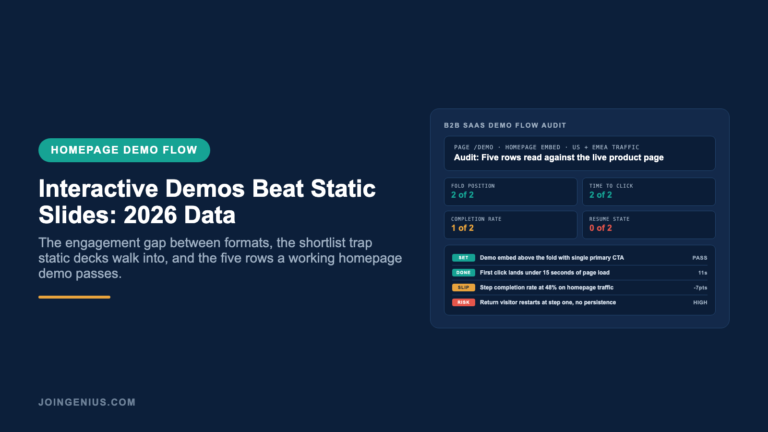
The homepage walk-through has replaced the static sales deck as the first thing a B2B SaaS buyer touches, and the engagement data from 2025 and 2026 has finally caught up to the behavior. Buyers click through a product tour without a rep in the room and qualify themselves against the feature list and arrive at a sales call with a working mental model. A senior SEO specialist leading the homepage conversion flow in 2026 is now briefing on demo engagement, not static-asset click-through. Interactive beat static on every signal that moves a pipeline, and the deck is not dead, it just stopped being the hook.
Why Static Slides Lost The Homepage
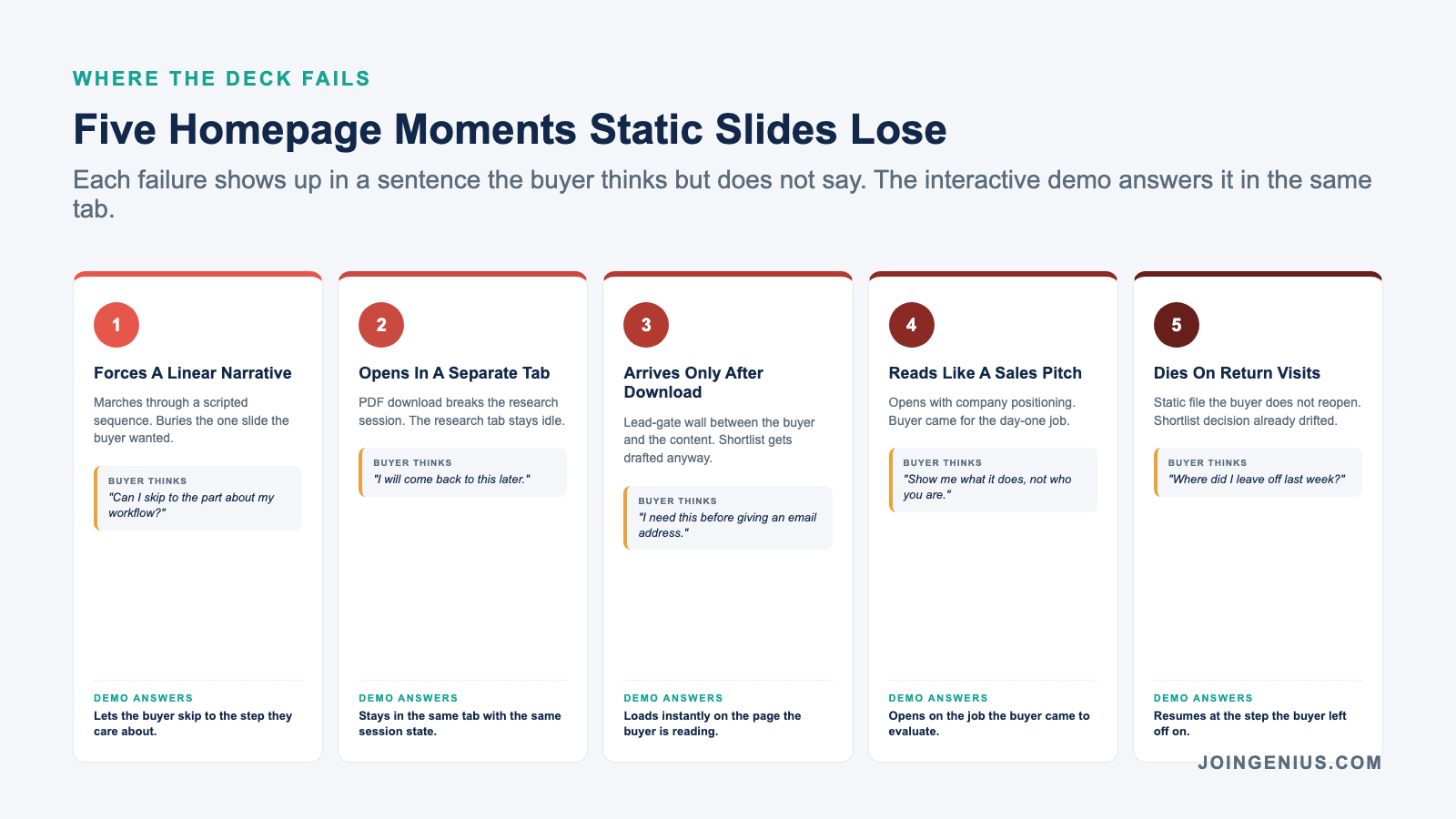
A static slide deck never had a chance against a clickable walkthrough on a homepage because the buyer wants to control the pace and the depth. The slide forces a sequence. The walkthrough lets the buyer skip to the step they actually care about.
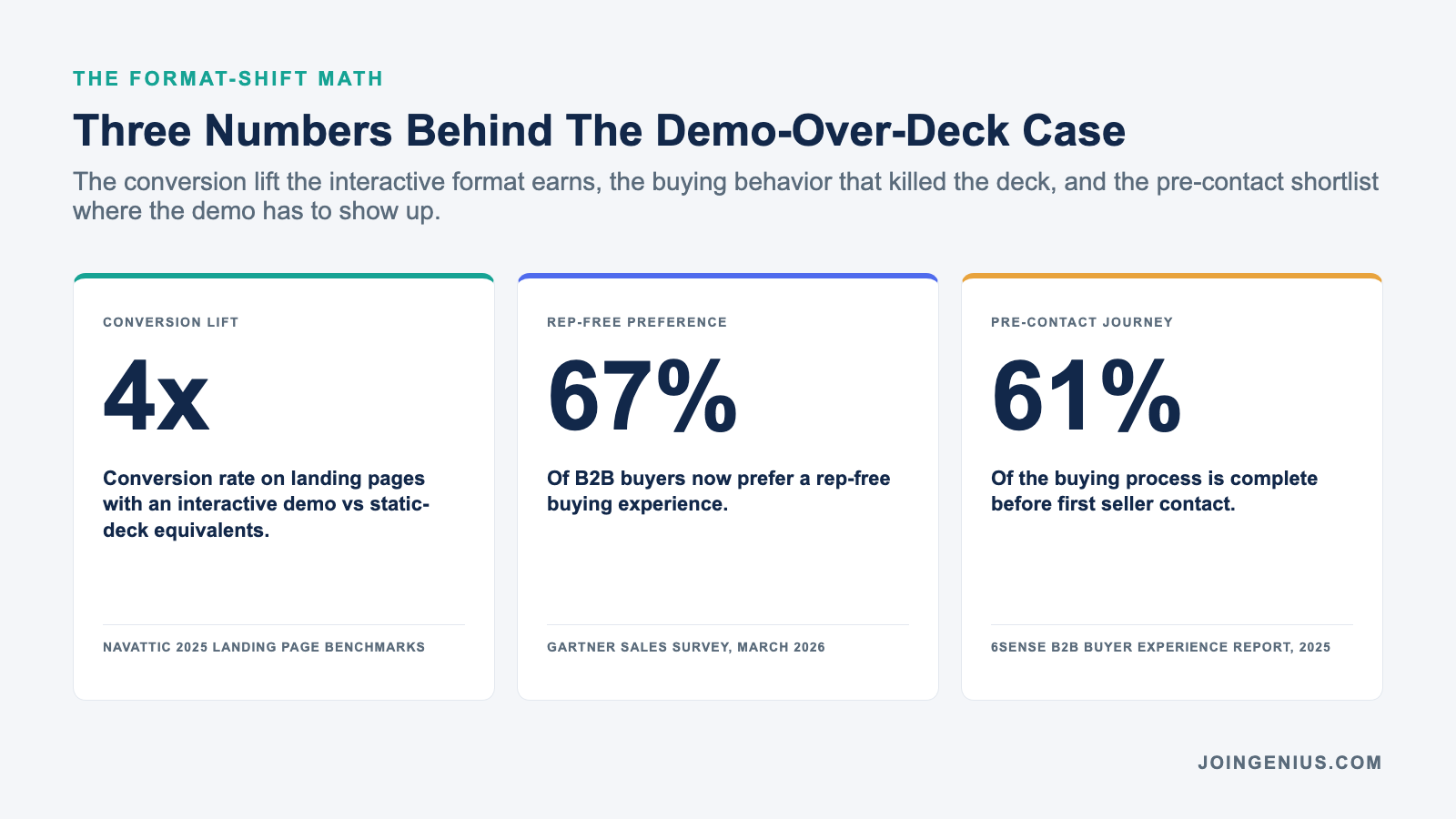
Gartner’s March 2026 Sales Survey found that 67% of B2B buyers now prefer a rep-free buying experience, with 70% preferring a completely digital self-service purchase path. Any homepage asset that assumes a rep has already entered the conversation is now out of place.
The deck became the wrong format the moment the buying journey started in private tabs. The interactive demo is the format that stays in private tabs with the buyer, because the buyer never has to leave the research session to look at it.
A front-end developer shipping the embed sees it in the first week of analytics data: median session depth on the demo is four times the median session depth on the deck download. The interactive layer is doing the qualifying.
The deck still shows up in enterprise sales cycles, but it enters after the discovery call, not before it. The order of the assets on the website matters more now than the production quality of any single one of them.
The Engagement Gap Between Demo Formats
The engagement gap between a clickable walkthrough and a static deck shows up first in conversion, not in time on page. The buyer who touches both formats is often converted by the demo before they ever open the deck.
Landing pages with an interactive demo convert buyers at roughly 4x the rate of their static-deck equivalents, which is why interactive product demos, built with tools like Navattic, have moved from a “nice-to-have” to the default first-touch asset on B2B SaaS homepages. The lift is the single most reliable upside number in the format-change conversation.
Navattic’s own 2025 landing-page benchmarks, built from the Fivetran case study, back the 4x conversion ratio. The gap holds across industries because the mechanism is the same: the interactive asset lets the buyer prove the fit to themselves in the two minutes they actually have between calendar blocks.
The static deck was built for a room with a projector and a quiet audience. The walkthrough was built for a tab in the middle of a busy afternoon. Only one of those matches the 2026 buying session, and the buyer no longer apologises for the other.
What A Working Interactive Demo Actually Covers
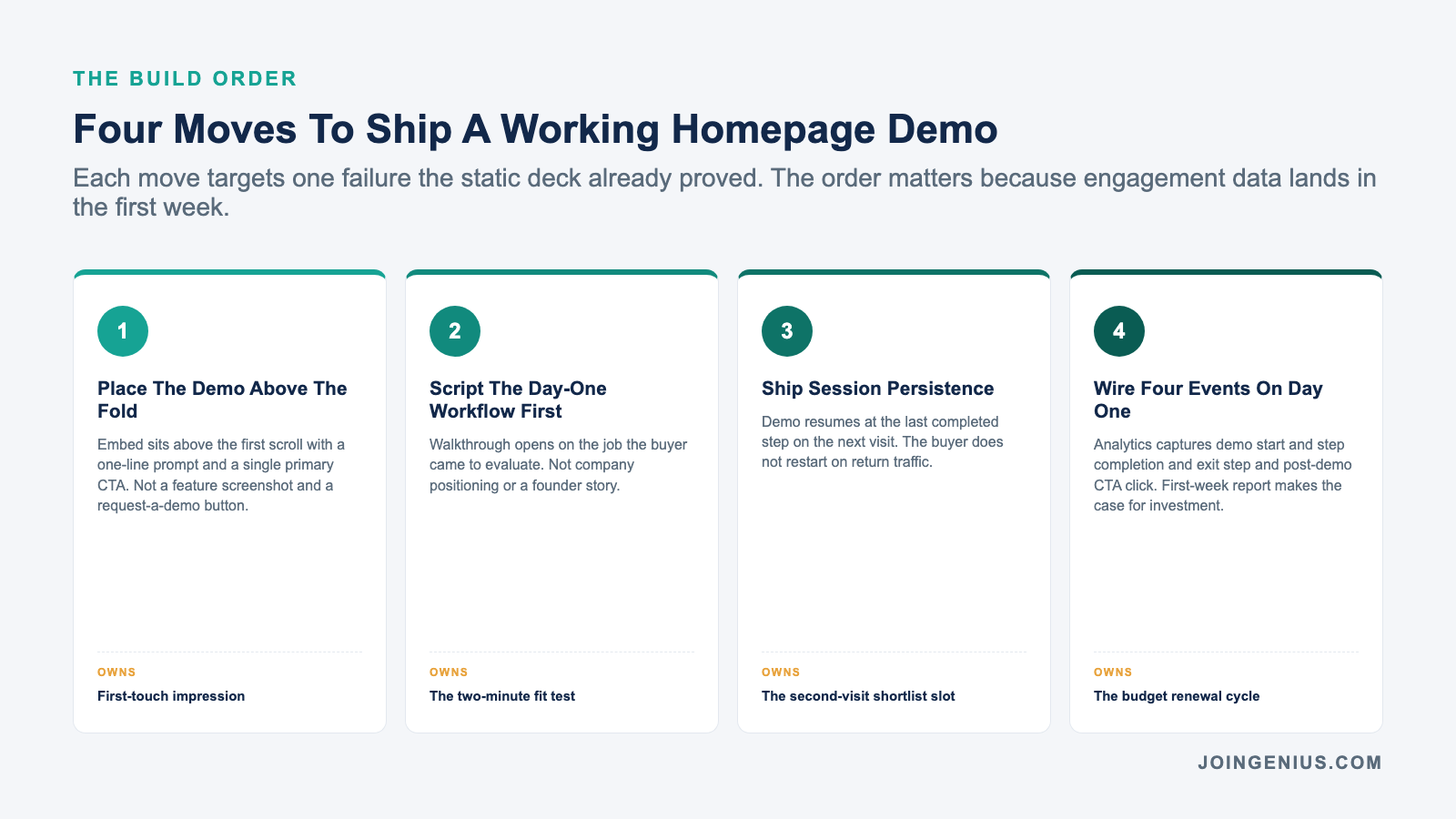
A working homepage demo is not a feature tour. It is a buyer-side simulation of the job the product does on day one, and it earns its place on the homepage by compressing a 30-minute discovery call into two minutes of clicks.
The structure that works most consistently in 2026 covers five elements, each built to answer one question the buyer would otherwise bring to a sales call. The order matters because the buyer leaves at the moment they get the answer they came for.
Teams that try to port the deck narrative straight into the walkthrough end up with a demo that reads like a slide show with buttons. The walkthrough that converts starts from the user’s day-one workflow and reverse-engineers the story the buyer needs to hear.
A capable web developer wires the embed so the demo resumes where the buyer left off on the next visit, which is the single highest-impact UX detail in the format and one the deck cannot replicate on any channel.
The tell that the demo is the right one is simple. A buyer who completes the walkthrough can describe the product to a colleague without opening the website again. That is the standard a static deck has never hit on a cold download.
The Shortlist Trap Static Decks Walk Into
The B2B buying process now decides most of itself before a seller joins the conversation. Vendors that do not show up during self-serve research get removed from the shortlist, and the shortlist is where most of the deal is won.
6sense’s November 2025 B2B Buyer Experience Report put the number inside the pattern. First seller contact now happens when buyers are 61% of the way through the buying process, four of the five vendors on the final shortlist were already on it before any seller contact, and the pre-contact favorite wins the deal roughly 80% of the time.
A static deck does not have a chance to earn the shortlist slot because the buyer does not download it until after the shortlist is drafted. The interactive demo earns the slot while the buyer is still in evaluation mode and still swapping vendors in and out of their comparison grid.
The post-demo retargeting asset is still often a slide deck, which is where the static format earns its second place. The deck becomes the reference the champion forwards internally, and that asset needs to match the demo narrative line for line.
The practical implication for the homepage is that the demo has to be the first asset visible above the fold. If the deck is above the fold and the demo is below, the buyer forms their shortlist opinion from the deck.
A Scorecard For Grading Your Demo Flow
Scoring the current demo flow against the five signals buyers read on a homepage turns the format conversation from taste into data. Each row below reads one signal from the current embed and grades it against the standard a shortlist-earning demo already hits in 2026.
| Grading Step | Signal Read | Pass Threshold |
|---|---|---|
| Position On The Homepage | Fold position of the demo embed | Above the fold with a one-line prompt and a single primary CTA |
| Time To First Click | Seconds from page land to first demo interaction | Under 15 seconds for a visitor who scrolls to the embed |
| Resume State Handling | Session persistence across return visits | Demo resumes at the last completed step on the next visit |
| Step Completion Rate | Share of demo starters who finish the primary flow | Above 55% for homepage traffic and above 70% for paid traffic |
| Post-Demo Conversion | CTA click rate after demo completion | At least 2x the CTA click rate from non-demo traffic on the same page |
Running the scorecard monthly catches the drift that kills demo engagement when the product changes but the walkthrough does not. The row that fails most often in practice is the resume state because most embeds are shipped without session persistence by default.
What To Instrument When The Demo Goes Live
The interactive demo generates roughly three times the per-visitor event volume of a static deck download, which means the measurement conversation has to be set up before the embed ships. Otherwise the dashboard looks noisier than the deck without anyone knowing what to do with the data.
The four events that matter most are demo start and step completion and exit step and post-demo CTA click. A software engineer running the analytics layer can wire each one in an afternoon, and the first-week report makes the case for further investment without a slide deck of its own.
Attribution still needs to connect demo completion to opportunity creation downstream in the CRM. The link is the only way the demo budget survives a renewal cycle, and the link lives in the engineer’s event layer, not in the dashboard.
The exit-step signal is the single highest-value one of the four. It tells the product team which feature in the walkthrough was the one the buyer wanted to see and which one they bailed on. That is a feedback loop the static deck never offered.
The sales handoff improves too when the rep can open the first call already knowing which demo step the buyer finished and which one they skipped. That context used to come from a discovery call. Now it comes from the demo analytics in the five minutes before the call starts.
Conclusion
The static sales deck is not finished, but it is now a secondary asset. The homepage asset that qualifies and converts and earns the shortlist slot is the interactive demo, and the 2026 engagement numbers no longer leave room for a format argument.
Teams that still lead with the deck on the homepage are losing the shortlist slot to teams that already made the switch.
For teams staffing the demo rebuild, Genius sources the senior developer or marketer who can take the homepage from static to interactive in a single release cycle.