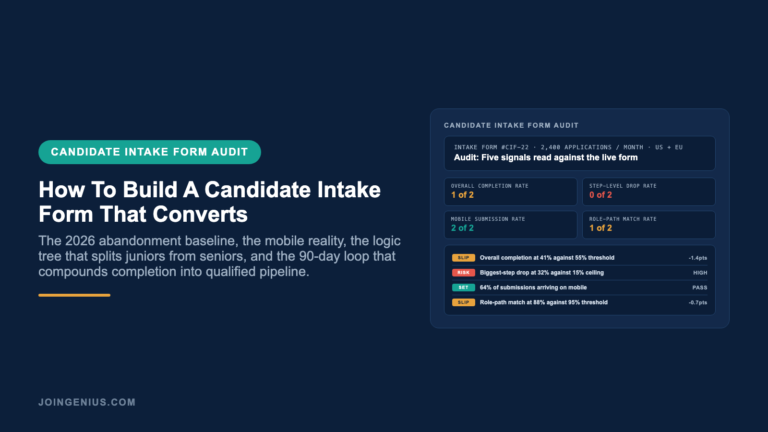
A candidate intake form in 2026 is not a screening gate. It is the first conversion surface of the hiring funnel, and 46 percent of job seekers walk away from it when it feels tedious. The recruiter who builds a form that converts is doing the work of a growth marketer, treating every question as a cost against completion rate. This guide covers the 2026 abandonment baseline, the mobile reality that already decided the form factor, the logic tree that splits juniors from seniors by track, the five-row scorecard for grading the form, and the 90-day loop that compounds completion into qualified pipeline.

The 2026 Application Abandonment Baseline
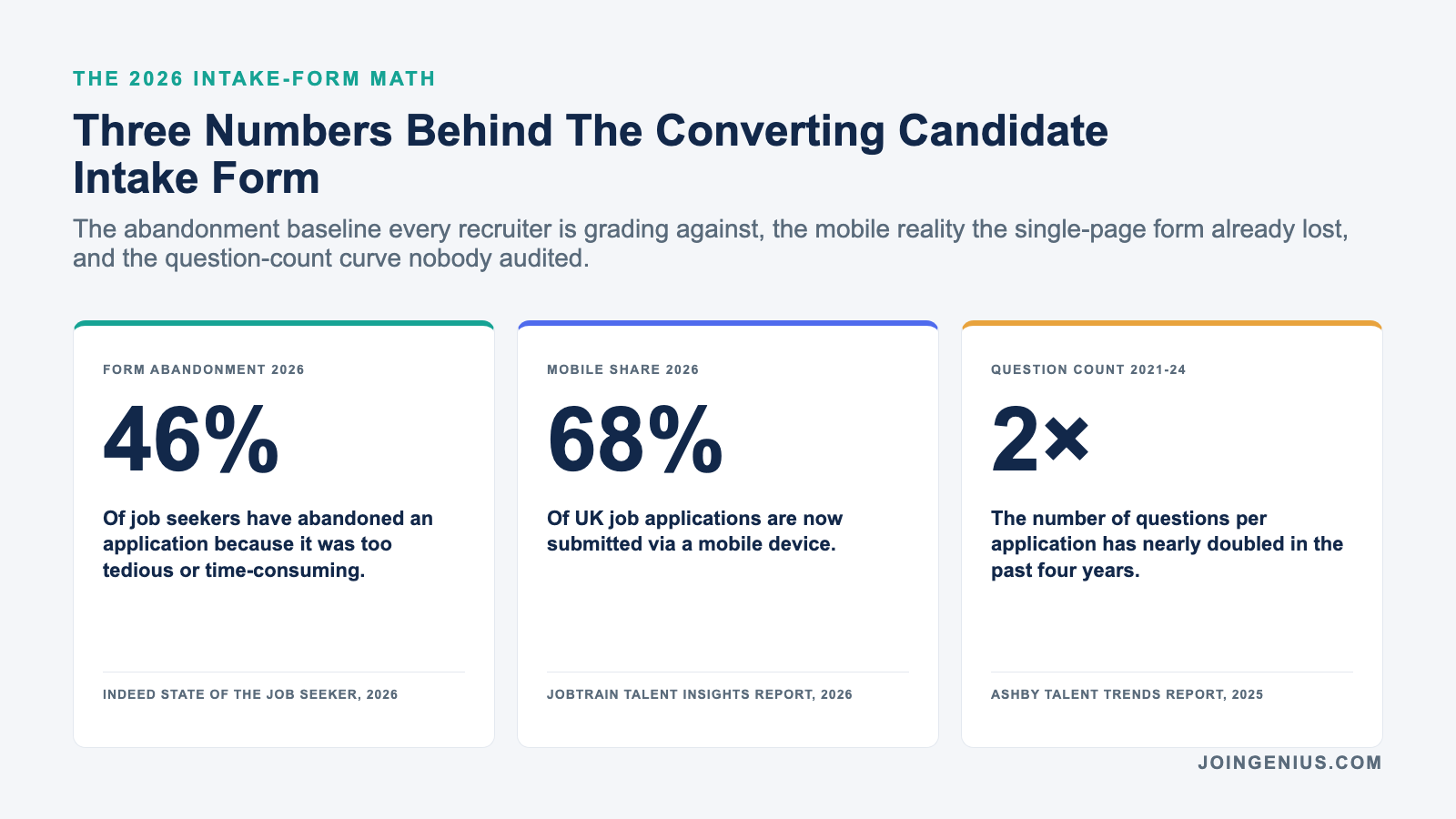
A candidate intake form is a conversion funnel before it is a filter. The Indeed State of the Job Seeker survey, published 29 September 2026, polling 1,501 US job seekers online via YouGov in August 2026, found that 46 percent of job seekers have abandoned an application simply because it was too tedious or too time-consuming.
The 46 percent is not evenly distributed. Early-career applicants drop at a higher rate than senior ones, because the reward for finishing feels smaller and the question path feels generic. A form that reads the same way for a junior engineer and a staff engineer is a form that loses the junior half of the funnel first.
The baseline is not a fixed cost of doing business. It is a design problem a converting form solves before week one. Every question that survives the form has to earn its place against the 46 percent abandonment risk.
A converting form inherits that baseline and treats it as a design constraint, not a market condition. The recruiter who ships the form is the operator closest to that constraint and has the fastest feedback loop on it, which is why the form belongs to recruiting, not to IT.
The Mobile Reality The Single-Column Form Already Lost
The single-page application form was built for desktop. The applicant is on a phone. Jobtrain’s Talent Insights Report, published April 2026 and reading 20,000 live UK vacancies against 12,500 jobseeker survey responses, found that 68 percent of UK job applications are now submitted via a mobile device.
Mobile completion punishes long forms harder than desktop does. Thumb scrolling through a 40-field survey in a shaky coffee shop is the moment the 46 percent abandonment rate compounds against your funnel. The growth marketing manager reading this dataset in another product category has already rebuilt around multi-step for the same reason.
The mobile reality rewrites what a converting intake form looks like. One question per screen. A progress bar the candidate can read with a glance. A keyboard that matches the field type without the candidate switching modes. Every tap counts.
The desktop-first form has a second problem the single-column layout hides. A candidate who starts on mobile and switches to desktop loses their progress most of the time, and the abandoned mobile session was the one that counted toward the 46 percent in the first place.
Why Application Forms Keep Getting Longer (And Why That Hurts)
The baseline tells you candidates drop at 46 percent. The length data tells you why.
The Ashby Talent Trends Report’s Application Questions chapter, published 18 March 2025, analyzed 4.8 million applications submitted through Ashby-powered job postings between January 2021 and December 2024. It found that the number of questions per application has nearly doubled in the past four years.
Nearly half (46.8 percent) of 2024 application forms included at least one long-form free-text question. These are the fields that read fast on the recruiter’s screen and feel heavy on the candidate’s thumb. The form grew while the candidate’s patience did not.
The form grew because every stakeholder adds one question nobody removes. Compliance adds a box. Diversity adds a box. The hiring manager adds a dropdown that is only relevant for one track. By the time the form ships, it is asking the junior engineer about staff-level system design.
The question inventory has to get audited before the form can shrink. A field that was added for a 2021 compliance request and never removed is still costing the 2026 candidate a tap. The audit happens once per quarter, with every stakeholder present to defend the fields they added.
The Logic Tree That Splits Juniors From Seniors
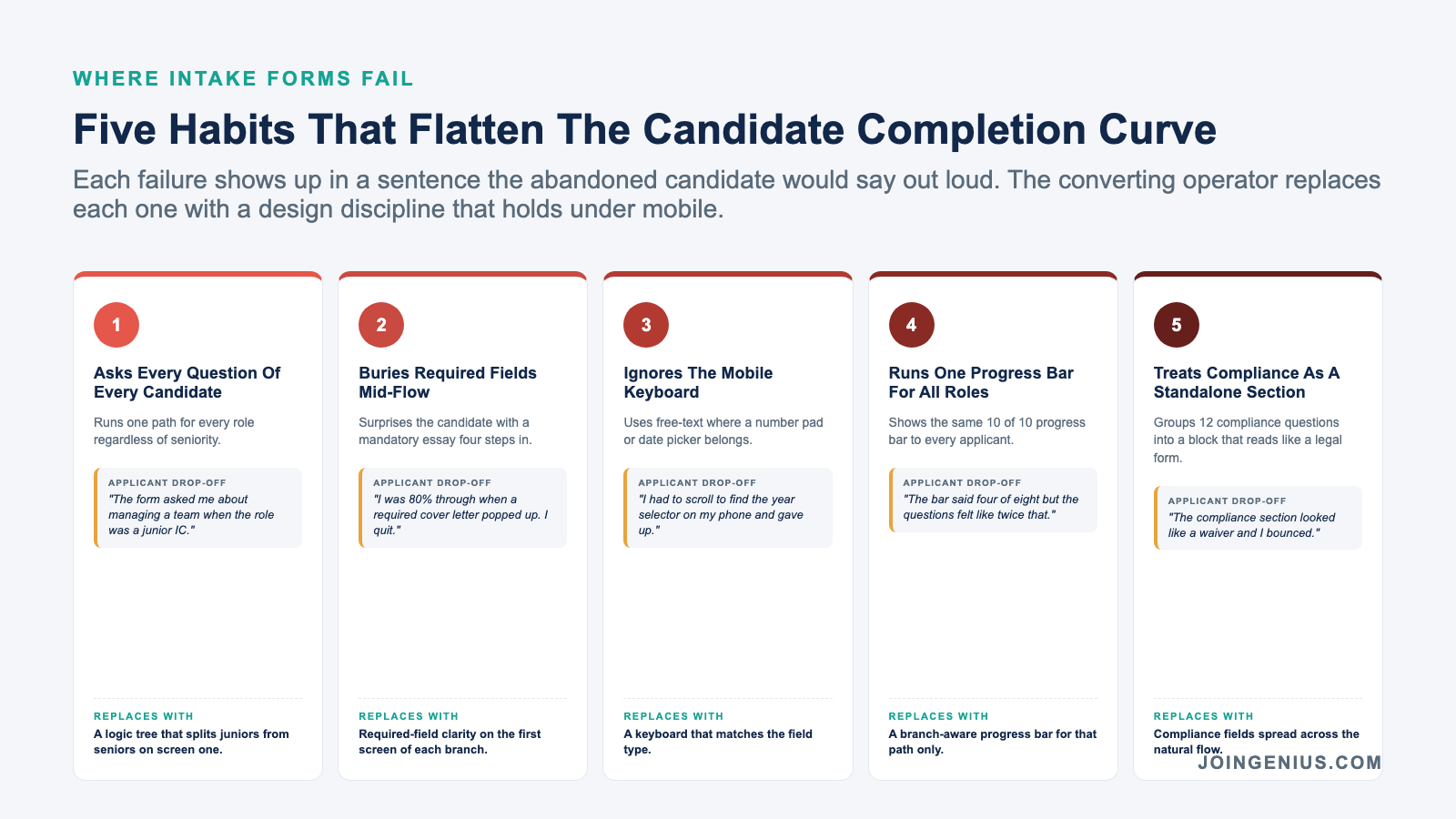
A 50-field survey that asks every question of every candidate is treating all applicants like the same person. The resilient intake form does not. It splits the candidate on the first screen by role and by seniority, routing each branch through a different question path tuned to what that applicant actually needs to prove.
A candidate intake form that actually filters starts with role and seniority on screen one, then branches to a different question path per track, which is why multi-step forms beat a single long survey for completion rate and data quality.
The junior engineer gets the junior path. The staff engineer gets a different path with system-design signals. The marketer gets the marketing path with portfolio and campaign questions. Each path is short because it was never trying to be long enough for every role at once.
The logic tree is not an ATS feature. It is a form-design decision that lives upstream of any system you plug into. A UX designer wiring the flow on paper gets more leverage on completion rate than any plugin added to the submission page.
Signals A Resilient Intake Form Catches Before It Abandons
A converting form is read on the metrics the single-page form never surfaced. Completion rate per step. Time on step. The step where the candidate first paused. The question type that triggered the abandon. The resilient form instrument captures each signal while the candidate is still on the page.
The data analyst reading those signals is not looking at a single number. They are looking at a step chart. A step chart tells you which question is losing the junior candidate at 30 percent and where the mobile user is dropping against the desktop baseline.
The form that catches the abandonment signal fixes the question that caused it. A free-text essay in step three gets replaced with a dropdown in step one. A required field that only applies to one track gets moved into the branch for that track. The 46 percent abandonment rate does not fall by accident. It falls by instrumentation.
A resilient form is also graded on what happens after submission. The yield rate against recruiter screen is the number that reveals whether the question path was tuned. A form that completes at 65 percent but yields 12 percent against screen is a form routing noise, not signal, to the recruiter.
Five Signals A Converting Intake Form Grades Each Quarter
A form that converts is graded on five signals the team reads on a monthly cadence. The table below pairs each signal with the behaviour it catches and the pass threshold the resilient team holds the form to every quarter.
| Grading Signal | Behaviour Caught | Pass Threshold |
|---|---|---|
| Overall Completion Rate | Share of starters who submit | Above 55 percent on mobile and desktop combined |
| Step-Level Drop Rate | Where candidates leave the flow | No single step losing more than 15 percent of its traffic |
| Mobile Submission Rate | Share of applications submitted on phone | At least 60 percent of total submissions |
| Role-Path Match Rate | Share of applicants routed correctly on step one | Above 95 percent land on the right branch |
| Qualified-Yield Rate | Share of completed applications that meet screen bar | Above 40 percent qualified at recruiter review |
The 15 percent step-drop ceiling is the one most forms miss first. A 32 percent drop on step four reads normal until the chart groups by role, at which point the junior track shows a 51 percent drop on the staff-level system-design question that was never meant for them.
The scorecard also tells the team which signal to fix first. A 38 percent completion rate outranks a strong role-path match rate every quarter, because completion is the ceiling the yield rate lives under.
The 90-Day Loop That Compounds Form Completion
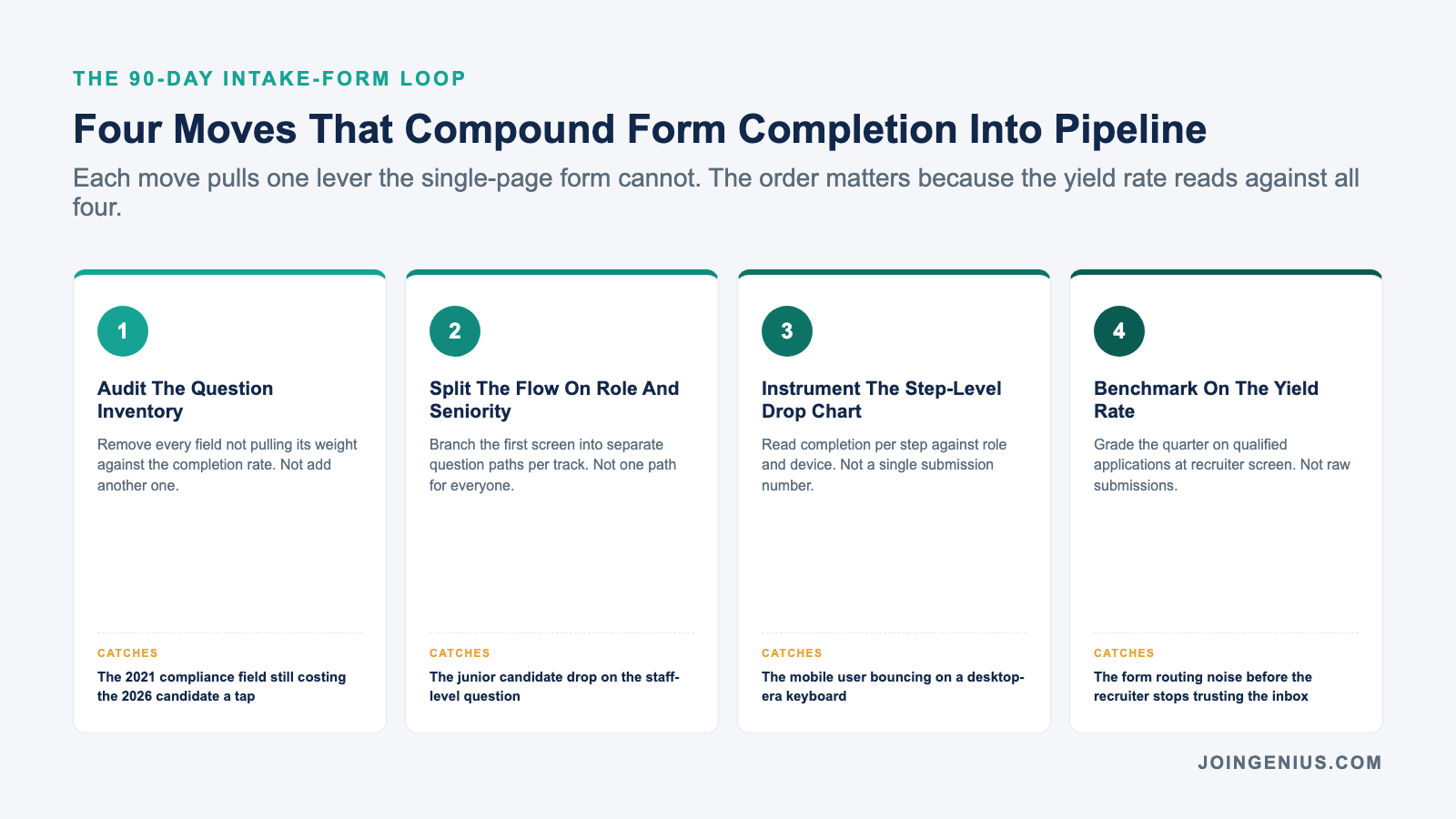
The converting intake form does not install in a quarter. It compounds over three sprints. The resilient team runs the loop monthly, grading the same five signals against the same thresholds.
Month one maps the question inventory and removes every field not pulling its weight. Month two splits the flow on role and seniority, routing each branch to its own question path. Month three instruments the step-drop chart and benchmarks the yield rate against the baseline.
The first 30 days are the slowest. Removing fields feels like giving up compliance leverage until the completion rate moves. The team that trusts the signal over the instinct is the team that ships the converting form by sprint three.
By the fourth sprint, the loop reads itself. The recruiter who starts the week on the form dashboard is not chasing abandonment. They are reading step-level completion against a target the team already agreed to hold the form to.
Conclusion
A candidate intake form in 2026 is not graded on how much data it collects. It is graded on how much qualified pipeline it ships to the recruiter at the end of the week.
The team that treats the form as a conversion surface, not a compliance form, is the team that keeps the top of the funnel full while competitors watch their 46 percent walk away. That team is scaling on talent built for the role, which is where Genius comes in.