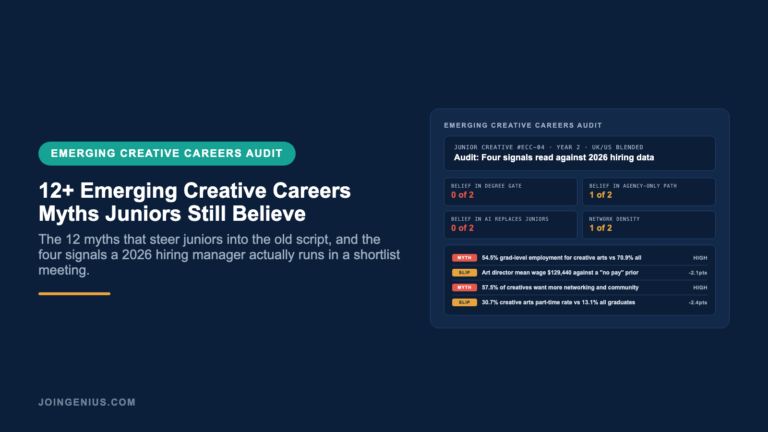
Emerging creatives walk into 2026 with a career playbook written for a market that no longer exists. The degree-to-agency-to-promotion path still shapes every guide, but the roles underneath have fragmented and the earnings curves have flattened, so the fastest climbers are people who stopped treating the old script as the law. This post pulls apart the 12 myths that still steer juniors wrong, grounded in three primary datasets published in 2026 and the patterns a hiring manager now looks for when they pick which graphic designer to shortlist on a Tuesday afternoon. Every myth below is matched to a move the next hire can actually run on Monday.

1. You Need A Creative Degree To Get In
The myth says the degree is the gate. Without a brand-name art school on the CV, the implicit rule goes, the early-career doors do not open.
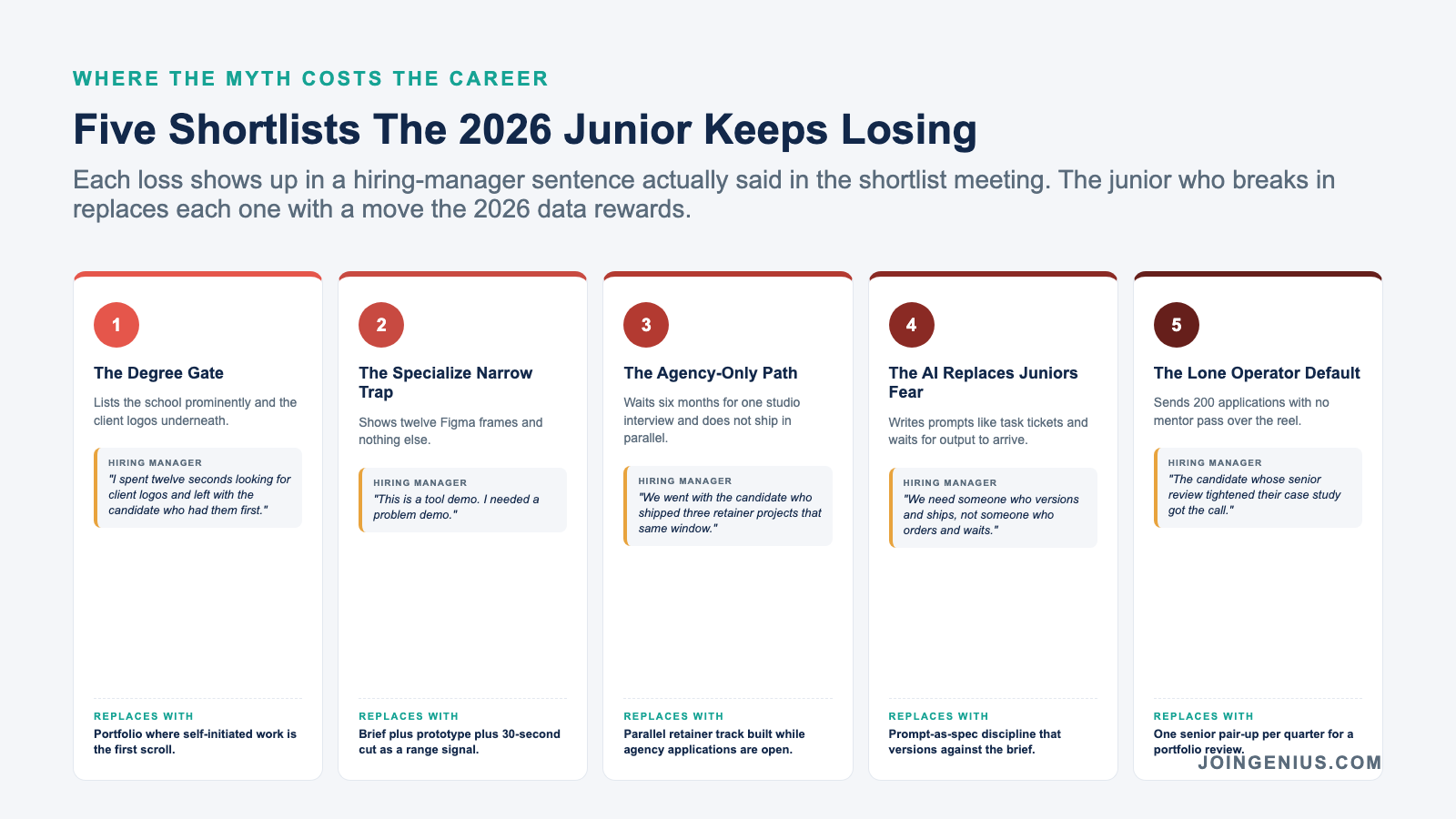
Hiring managers in 2026 shortlist on portfolio depth and platform fluency, not transcripts. A self-taught generalist who shipped three real client projects beats a first-class graduate whose only work is coursework.
The degree speeds up the first six weeks of a job search but does not decide who gets hired at month three. What decides the hire is which candidate can show the shortlister a project that looks like the next quarter’s work.
2. Creative Careers Do Not Pay
The myth reads that creative work is a love tax, with low ceilings and lower floors.
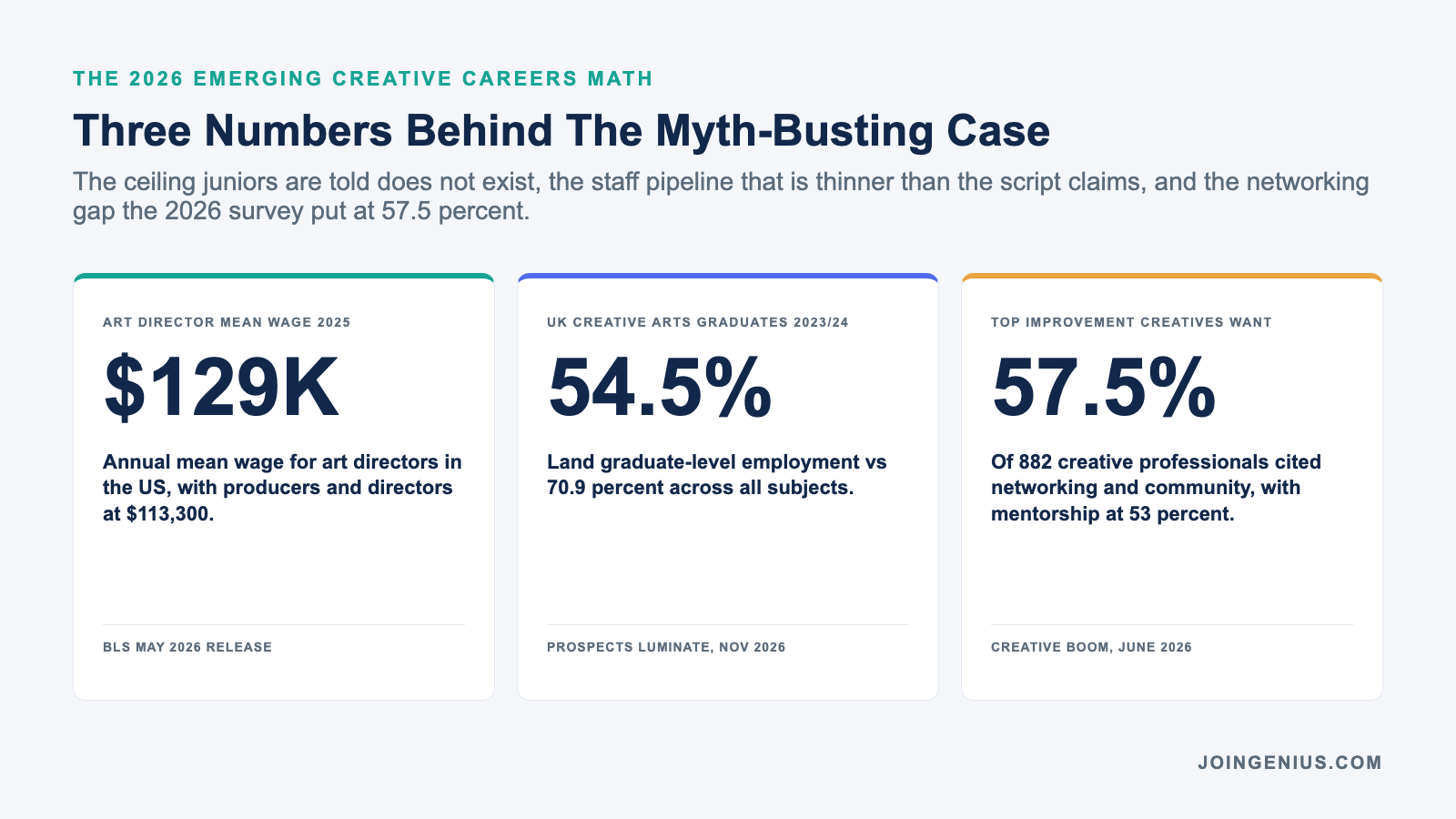
The Bureau of Labor Statistics May 2026 release lists art directors at a $129,440 annual mean wage and producers and directors at $113,300. Both sit inside the top 20 percent of US earners.
Those ceilings land on operators who learned to run a brief rather than only execute one, which is why the next UX/UI designer a team hires gets judged on judgment, not pixel craft. The ceiling is high. The path to it just does not match the staff-bench slide.
3. Specialize Narrow Or You Will Not Get Hired
The myth tells juniors to pick one tool and commit. One narrow spike, the thinking goes, is the only legible hire signal.
The actual signal in 2026 is problem range. A junior who can brief a client on brand and prototype in Figma, then film a 30-second cut on top of that, earns calls back.
A junior who only knows one tool gets outcompeted the moment the tool shifts, and that happens every quarter now. The hire signal is whether the candidate can hold a problem long enough to pick the right tool for it, rather than hold a tool long enough to find a problem for it.
4. A Portfolio Is Just Your School Projects
The myth frames the portfolio as a record of what school asked for.
A 2026 portfolio is a record of what the junior asked themselves for. The reel that wins interviews pairs self-initiated work with unsolicited pitches to brands the junior admires.
Those projects prove the candidate can set a brief without being told what to build, which is the exact move the first month of the job will demand. The school archive gets the junior a first look. The self-initiated shelf closes the second interview.
5. Agency Staff Is The Only Real Path
The myth paints staff at a big agency as the default career, with everything else labeled fallback.
The 2026 data breaks that framing. The Prospects Luminate November 2026 analysis of UK creative-arts graduates found that only 54.5 percent land graduate-level employment, against an all-subjects average of 70.9 percent.
Another 30.7 percent work part-time versus 13.1 percent across all graduates. The structural signal is that staff slots do not scale to the pipeline. Juniors who build portfolios of clients and retainers hit the same earnings ceiling without waiting on the slot bottleneck.
6. You Must Move To A Creative Capital
The myth says you have to live in a top-three creative capital to have a real career.
The 2026 reality is that discovery is distributed. Clients find juniors through portfolio aggregators and social channels the same week, whether the junior sits in Lisbon or Cardiff.
The payoff for relocating is one extra pub introduction. The payoff for consistent public work from anywhere is a monthly call volume that used to require a postcode. The city still shapes the ceiling on senior salaries. It no longer decides whether the first calls come in at all.
7. AI Replaces Juniors First
The myth tells every junior that generative AI eliminates the entry rung.
The 2026 pattern looks different. Teams still hire a content writer who can brief AI tools well and edit outputs faster than they could draft.
What vanishes is the junior who treats a prompt like a task. The junior who treats a prompt like a spec and versions it against the brief until it ships still gets paid for the same arc. The rung moved up rather than away.
8. Internships Are The Main Entry Route
The myth frames the summer internship as the only serious on-ramp into the industry.
The 2026 route map is wider. Many juniors break in through freelance commissions or short contracts with small studios that saw their work on a portfolio site before the junior ever applied.
The internship is one route among many now. The junior who treats their public portfolio as their application has the same odds without the gatekept quota slot, and the small studio that hires them tends to pay on day one rather than after the ninety-day review.
9. Your First Job Defines Your Trajectory
The myth treats the first title as destiny.
The 2026 reality is that a junior switches sub-discipline inside their first two years with no career cost. A copywriter who moves into UX writing or content strategy carries the same core skill forward: making words move a reader through a decision.
First titles are shaped by whoever had an opening that quarter, not by what the junior was best at. The shape of the career is set by the second and third moves, where the junior picks the direction with more information than they had at twenty-two.
10. Networking Is Not For You
The myth lets introverted juniors off the hook. Real work speaks for itself, the saying goes, with no small talk required.
The Creative Boom June 29 2026 state-of-the-industry survey of 882 creative professionals worldwide reports that when respondents were asked what would genuinely improve their working lives, networking and community came top at 57.5 percent, with mentorship close behind at 53 percent.
The juniors who hide in the quiet corner get fewer callbacks than the ones who pair up with a senior every quarter, even when the quiet corner work is objectively tighter. The signal is not extroversion. It is visibility.
11. Freelance Equals Unstable
The myth treats freelance as a fallback for people who could not land staff.
In 2026 the structural picture is reversed. Staff roles concentrate single-client risk into one quarterly review. Freelance portfolios of three to five regular retainers spread that risk across the whole year.
The juniors who learn contract rhythm early, with invoicing and a simple pipeline tracker in place, carry a steadier income curve than the staff junior whose role gets rebadged every annual budget cycle.
12. Staying Quiet About Pay Is Professional
The myth tells juniors not to discuss rates with peers, as if quiet makes them more hireable.
The juniors who close the fastest learn public rate ranges before their first negotiation. A social media manager in London compares retainer ranges with two peers before quoting a new client, and the quote lands higher than the one pulled from a job board average.
Silence protects the hiring side of the table. A circle of three peers who share real numbers protects the junior side. The myth is a legacy of a market where the employer held all the salary data. In 2026 the data is public for anyone who asks the right peer.
What Emerging Creatives Who Break In Actually Do
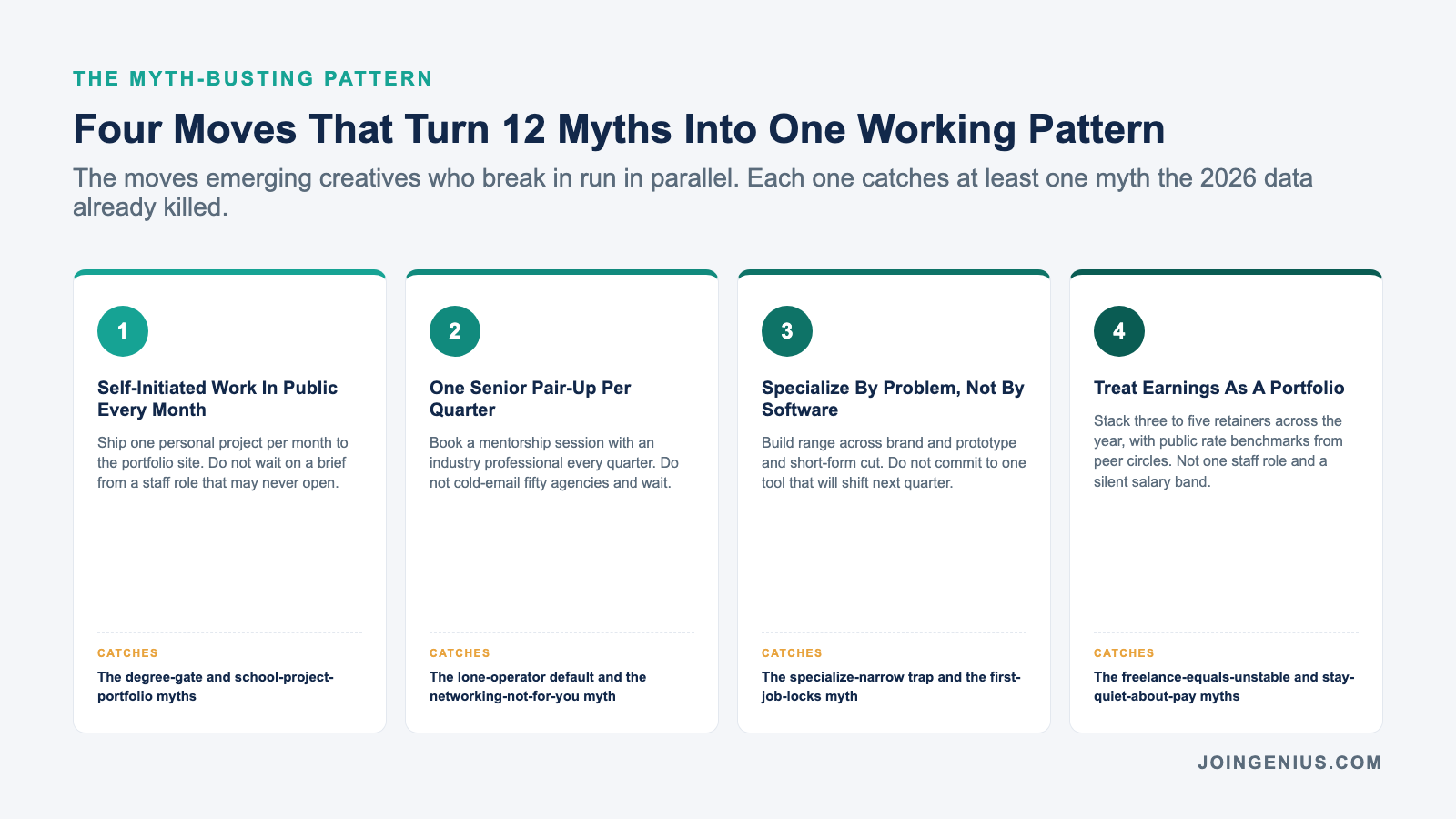
The pattern underneath every busted myth is the same. Juniors who break in treat visibility and mentorship as one system with their actual work, rather than as favors they ask for separately.
They put self-initiated work in public every month. They pair up with one senior per quarter for a portfolio review. They quote from a peer-shared rate range rather than guesswork.
Platforms like Creative Lives in Progress match emerging creatives with industry professionals for portfolio reviews and career advice, which is how the 57.5 percent networking pattern Creative Boom flagged gets built outside the junior’s immediate team.
The mentorship rate on the same survey sat at 53 percent, so the same channel fills both the networking gap and the review gap. That is the one step most of the 882 respondents said they wanted more of.
It is also the step a junior can book this week without needing to switch jobs or move city.
Conclusion
The 12 myths above share one failure mode. Each one accepts a definition of a creative career that has not held since the staff bench shrank and the earnings curves flattened, with the junior pipeline rebuilt around visibility on top of that.
The next junior who picks a different working rule on Monday closes the gap faster than a cohort still working to the old script. Partner with Genius when the next hire needs to understand the new rules.