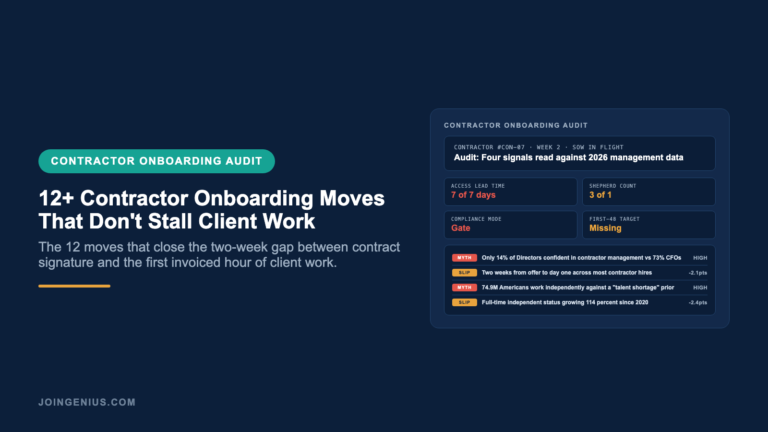
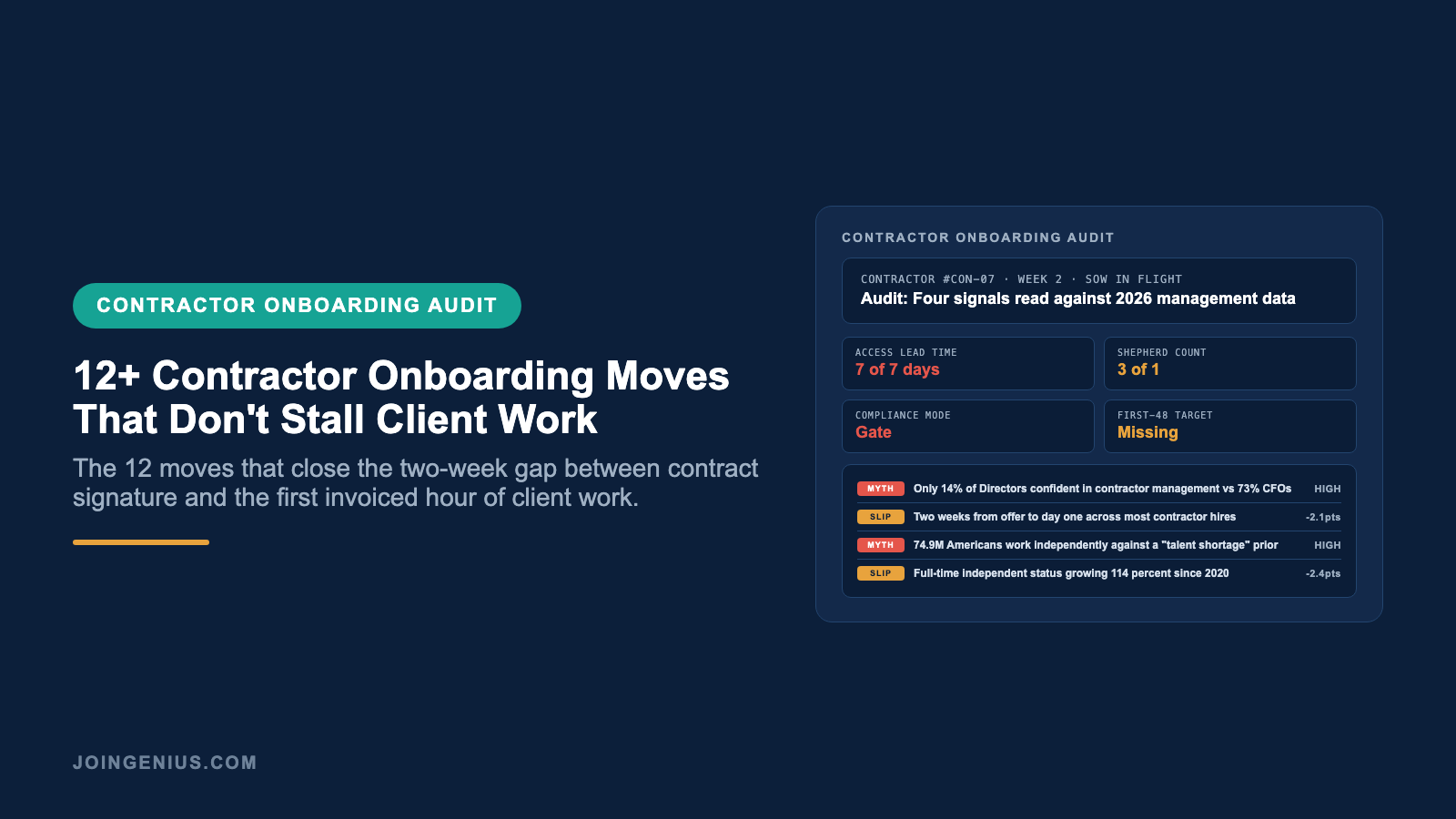
A contractor signs on Friday. The client expects progress on Monday. Three weeks later, the contract is finally countersigned. The laptop lands two days after that. The first pull request opens the week after. The client has already been invoiced for a month of work the contractor could not legally start. The 2026 data says the problem is not sourcing and not pricing. It is the twelve places the onboarding pipeline quietly stalls, and the patterns the teams who break the stall actually run. One of them hires a software engineer on a Monday and ships real client work that same week.
1. Pre-Approve the Access Stack Before the Contract Is Signed
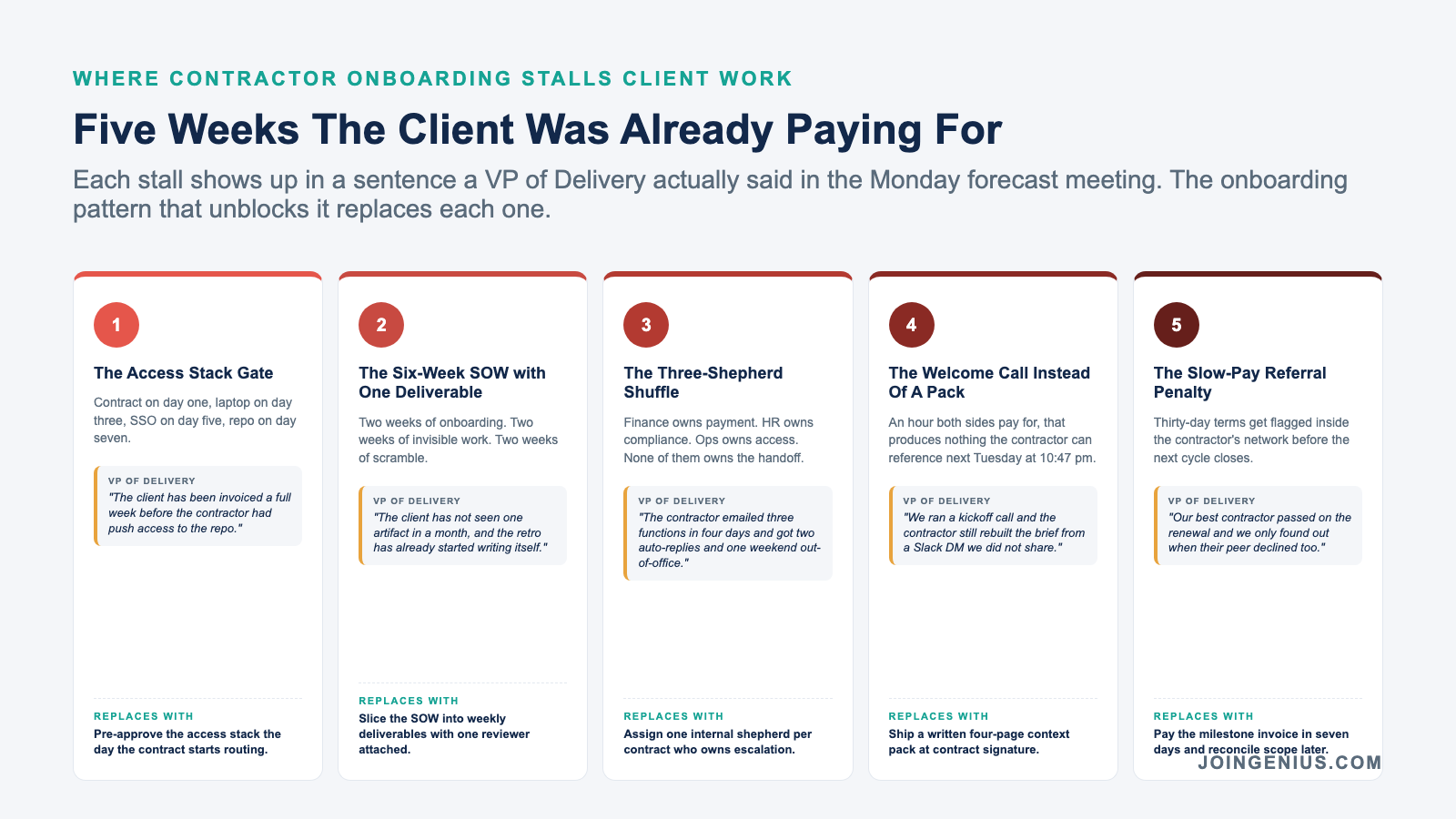
The stall that never shows up on the SOW is access provisioning. The contractor signs on day one. The laptop is ordered on day three. SSO lands on day five. The repo invite lands on day seven. By then, a week of billable time has been invoiced to a client who cannot see output.
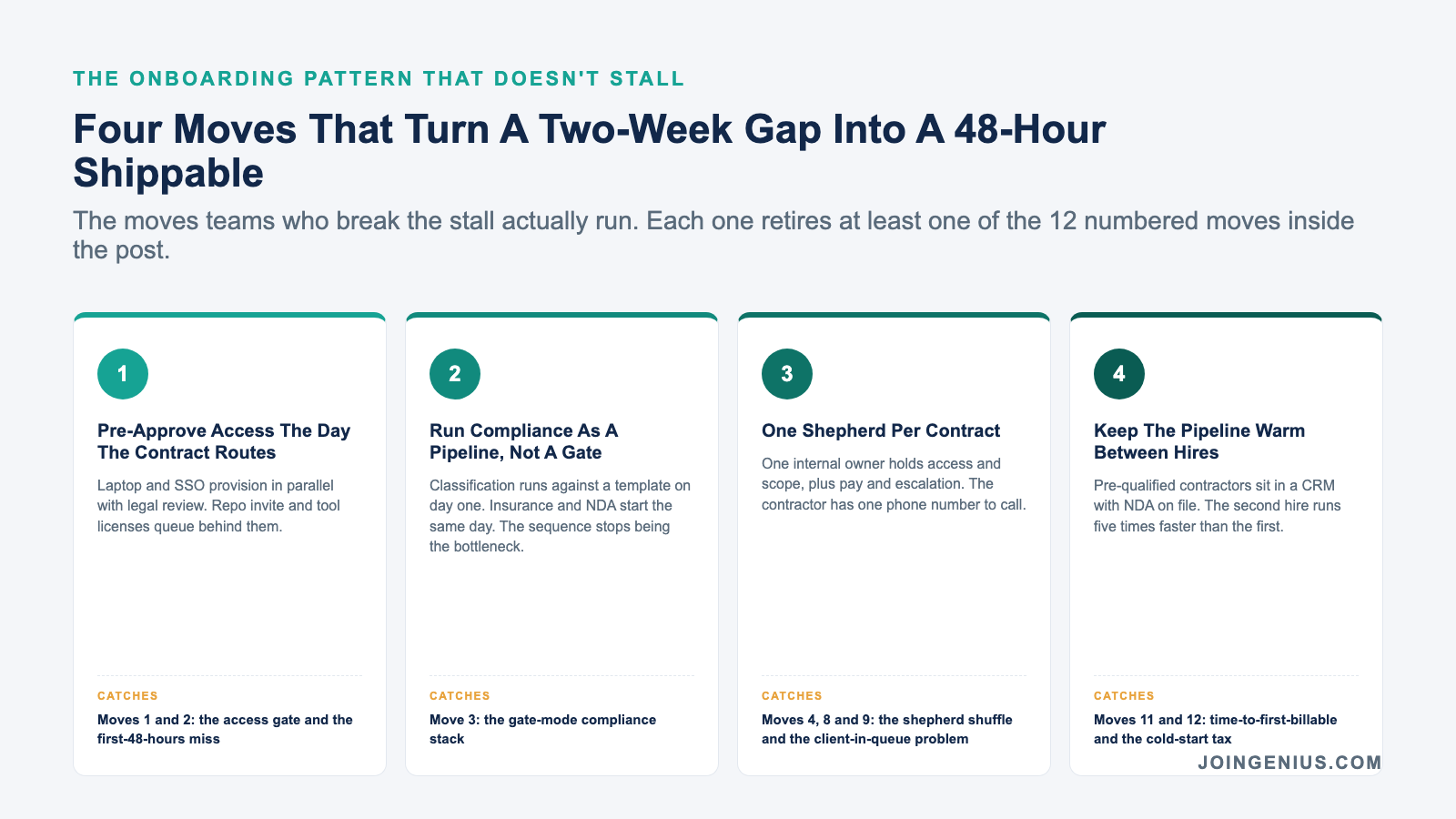
Pre-approve the access stack the same day the contract starts routing for signature. Provision the laptop and the SSO account in parallel with legal review. Queue the repo invite and the tool licenses behind them. The signature gate still exists, but the access gate moves to day zero.
A DevOps engineer who inherits a half-provisioned environment on day eight costs the same as one who starts on day one. The first ships twice as much output. The access checklist is the single cheapest piece of the onboarding spend.
2. Ship a First-48-Hours Target, Not a First-Week One
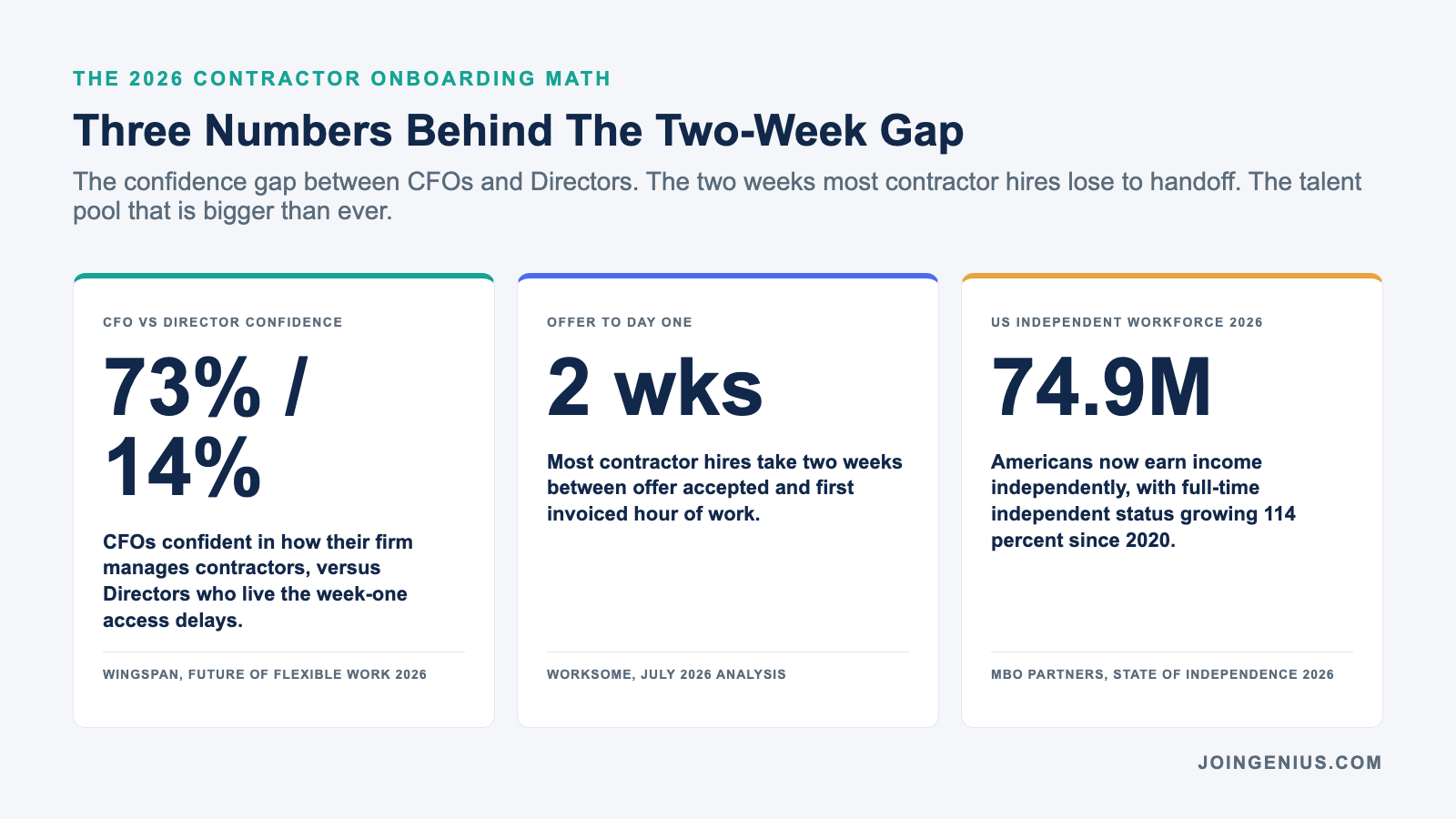
According to Worksome’s July 2026 analysis of the contractor hiring bottleneck, most contractor hires take two weeks to go from offer to day one. The delay sits in the handoff from contract to access, and from access to the first assigned task. Sourcing is not the slow part.
Set a first-48-hours target instead. The contractor commits to one visible deliverable inside two working days, no matter how small. A refactored config file. A documented bug reproduction. A single landing page copy pass. The target forces the handoff to the measurable thing: did output ship, yes or no.
A web developer who ships a two-hour change in forty-eight hours has proven the environment works. A web developer who ships nothing in a week has proven the opposite, and both parties are learning it later than they should.
3. Treat Compliance As a Pipeline, Not a Gate
The compliance stack has four pieces. Classification. W-9 or UTR collection. Insurance verification. NDA signature. Treated as a gate, none of them starts until the previous one finishes. On an eight-day contract, day six can still be stuck waiting on insurance paperwork.
Treat it as a pipeline. The four pieces run in parallel against a template. Classification is a questionnaire the contractor fills on day one. Insurance is a certificate request sent on day one. NDA is a standard template that assumes the common case. The contractor is not the bottleneck. The sequence is.
4. Assign One Internal Shepherd, Not Three
Wingspan’s 2026 Future of Flexible Work report surveyed 500 plus US finance and operations leaders across February and March 2026. It found 73 percent of CFOs feel very confident about how their company manages contractors. Only 14 percent of Directors agree. That gap is where the stall lives.
CFOs see the invoice totals. Directors live inside the week when a contractor cannot log into the staging environment. Three shepherds across three functions means no one shepherd owns the handoff.
Assign one internal shepherd per contract. That person owns access and scope, and escalates compliance or payment blockers to the right function. The contractor has one phone number to call. That single change pulls director-level visibility back toward the CFO-level confidence number.
5. Carve the Statement of Work Into Runnable Slices
A six-week SOW with one deliverable at the end is a six-week stall risk. The first two weeks go to onboarding. The next two go to work that no one can see. The last two go to a scramble that uncovers an assumption no one wrote down.
Slice it into runnable weekly deliverables. Each slice names a visible artifact and an acceptance criterion, with one reviewer attached. Week one is the environment plus a reference task. Week two is the smallest end-to-end feature. The client sees forward motion every seven days, not every forty-two.
6. Replace the Welcome Call With a Written Context Pack
Welcome calls are performative onboarding. They cost an hour on both sides and produce nothing the contractor can reference next Tuesday at 10:47 pm when they hit the config they do not understand.
Replace the call with a written context pack that ships at contract signature. Give it one page on the client and one on the product. Add a page on team conventions. Another on the deliverables the contractor owns. A UX/UI designer landing in a brand mid-project needs the same pack a backend engineer does.
7. Stop Making Contractors Reconstruct the Client’s History
The second email every contractor sends is “where can I read the old brief.” They cannot find it. It lives in a Slack DM from June that no one has permission to share. The contractor recreates context from a kickoff call that never gets recorded.
Build a client folder that outlasts the project. The current brief. The previous brief. Signed-off creative. Access credentials for client-side systems. Every contractor on the account points there. Context stops being an onboarding step. It becomes a bookmark.
8. Separate Onboarding From Performance Review
Day-four performance reviews are onboarding problems in disguise. A contractor who has not shipped by Thursday of week one is not underperforming. They are waiting on access, or on the written answer to the question they emailed on Tuesday.
Separate the two timelines. The onboarding scorecard runs from day zero to the first shipped deliverable. Performance review starts after. Mixing them turns week-one blockers into week-six grievances, and the contractor never gets a chance to show what they actually do.
9. Keep the End Client Out of the Contractor’s Queue
The client expects to see output. The contractor is onboarding. The two problems are unrelated, so do not route them through the same channel. A client ping that lands in the contractor’s inbox on day three gets answered with half-informed guesswork.
Route all client communication through the account lead until the contractor has shipped twice. The account lead already knows the history. The contractor is still building it. One week of channel discipline keeps the client on the retainer-grade experience they bought.
10. Pay Fast and Reconcile Later
Contractors talk to each other. A thirty-day payment term becomes a referral penalty from the top of their network within two cycles. The contractor who waited forty-five days last time does not accept the next contract, or accepts it and starts slow.
Pay first and reconcile after. Milestone invoices pay within seven days of submission against the slice they cleared. Reconciliation against the full scope happens at the end of the engagement, not inside each cycle. Fast pay is the cheapest piece of onboarding most firms refuse to buy.
11. Track Time-to-First-Billable, Not Time-to-Hire
Time-to-hire is a recruiting metric. It stops the clock when the contract is signed, which is the moment the client stops seeing any progress. Teams that optimise for time-to-hire have no reason to notice the two-week gap that follows.
Track time-to-first-billable instead. The clock starts at offer acceptance and stops at the first invoiced hour of client-facing work. Hiring a marketing manager contractor is the moment you start measuring the metric, not the moment you finish.
12. Keep the Onboarding Pipeline Warm Between Hires
According to the MBO Partners 2026 State of Independence report, a record 74.9 million Americans now earn income independently, with full-time independent status growing 114 percent. The talent pool is not the constraint. The internal pipeline is.
Keep the onboarding pipeline warm between contracts. Pre-qualified contractors sit in a lightweight CRM with NDA on file. Access templates are pre-built per role. When the next brief arrives, the new contractor reactivates against a template instead of rebuilding one. The second hire is five times faster than the first.
What To Do When Contractor Onboarding Costs More Than a Retainer
Twelve onboarding moves get a contractor from offer to billable fast. There is one case where the math still does not work: the ongoing site-support brief that needs a specialist every week forever. The repeated onboarding tax outweighs the hourly rate.
Agencies that run the retainer alternative solve this at the delivery layer. Specialist firms like Envisage Digital publish monthly support packages for ongoing eCommerce and WordPress work, so the client buys the delivery capability instead of onboarding a new contractor for every ticket.
The retainer pattern retires the first three moves because the agency has already paid them. Access is live. Compliance is standing. The account manager is the shepherd. When contractor economics stop working, retainer economics start.
Conclusion
Contractor onboarding that stalls client work is a design problem, not a staffing problem. The access stack can be pre-approved. The SOW can be sliced. The compliance stack can run as a pipeline. One shepherd can own the handoff. Fast pay and time-to-first-billable become the metrics that matter.
The twelve moves above are not optional extras. They are the replacement for the two-week gap that every client is already paying for and nobody has told them about. Genius builds the version of that pipeline that ships on Monday.