10+ Team Collaboration Bottlenecks Slack Can’t Solve

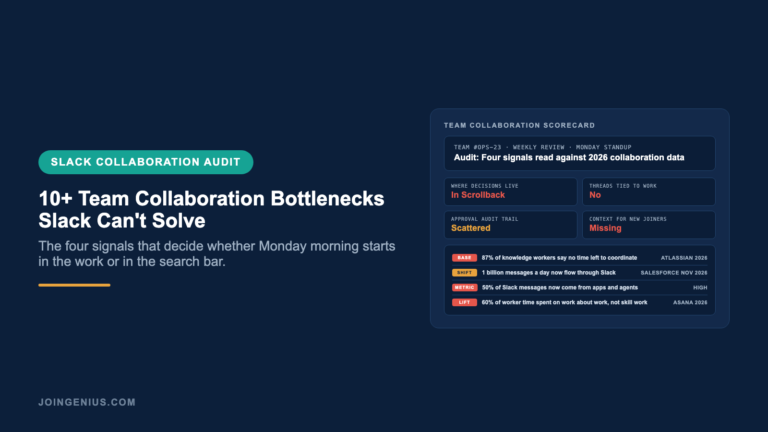
Genius cover for 10+ Team Collaboration Bottlenecks Slack Can't Solve showing a Team Collaboration Audit scorecard for a fictional Team number OPS-23 weekly collaboration review read against four signals an operations lead should be checking before Monday standup and scored as Where Decisions Live In Scrollback slip because the pricing call from Thursday is a message seven replies deep that nobody can cite, Threads Tied To Work No slip because feedback on the mockup is in Slack and the mockup is in Figma and the task is in the tracker on three separate tabs, Approval Audit Trail Scattered amber because the only record of the sign-off is a thumbs-up emoji in a thread that has scrolled, and Context For New Joiners Missing slip because the search bar is where the new hire finds out what the team decided in February, with the four grounding figures underneath being Atlassian's State of Teams 2026 report finding 87 percent of knowledge workers say with everyone in execution mode they lack the time or capacity to coordinate and putting the fragmentation tax on the Fortune 500 at 161 billion US dollars a year from a survey of 12,035 global knowledge workers and 173 Fortune 1000 executives in January and February 2026, Salesforce's November 2026 Slack by the Numbers page reporting that users send a billion messages a day on the platform and that 50 percent of those messages now come from apps and agents rather than from people, and Asana's Anatomy of Work Index on the April 2026 Why Work About Work Is Bad brief showing 60 percent of a knowledge worker's time is spent on work about work and only 27 percent on the skilled work they were hired for.
Table of Contents
Table of Contents

Slack opens. Someone pings. The thread forks. The decision scrolls. The ops lead starts Monday by asking three people where last week ended. The Atlassian State of Teams 2026 report finds 87 percent of knowledge workers say with everyone in execution mode, they lack the time or capacity to coordinate. The ones Slack was supposed to unblock are the ones most stuck. The problem is not Slack. The problem is that the collaboration bottlenecks that stall a team live under the chat layer, in the handoffs and decisions Slack is not built to carry. This list is what a good project manager spends the week unsticking.

cover

Bottleneck #1: The “Where Was That Decided?” Tax

The ops lead on a Monday is almost always running an archaeology project. Where did the pricing change get approved? Which thread did the decision live in? The answer is “in the #product channel, scroll up on Thursday.” Slack keeps every message. It does not keep the decision.

The 2026 Atlassian study, State of Teams 2026, surveyed 12,035 global knowledge workers and 173 Fortune 1000 executives, and put the “fragmentation tax” on the Fortune 500 at 161 billion US dollars a year. The bill lands on the agency and the in-house team too.

A seasoned operations manager treats “where was that decided” as a signal the decision needs a home outside the thread it was made in.

Bottleneck #2: The Channel Count That Buries The Work

The reflex to a collaboration problem in Slack is almost always another channel. A new squad gets one. The next workstream wants one too. Every external client ends up with their own. The count keeps climbing. The signal-to-noise does not improve. The ops lead now has twenty places the one thread they need could be.

In Slack by the Numbers, published November 3 2026, Salesforce reports users send a billion messages a day on the platform. Fifty percent of them now come from apps and agents rather than from people. The page headline is “Half of Slack Messages Are No Longer From People.”

Half the volume is automated chatter. Adding another channel does not fix that. The actual human team conversation is now a minority of what shows up in the feed.
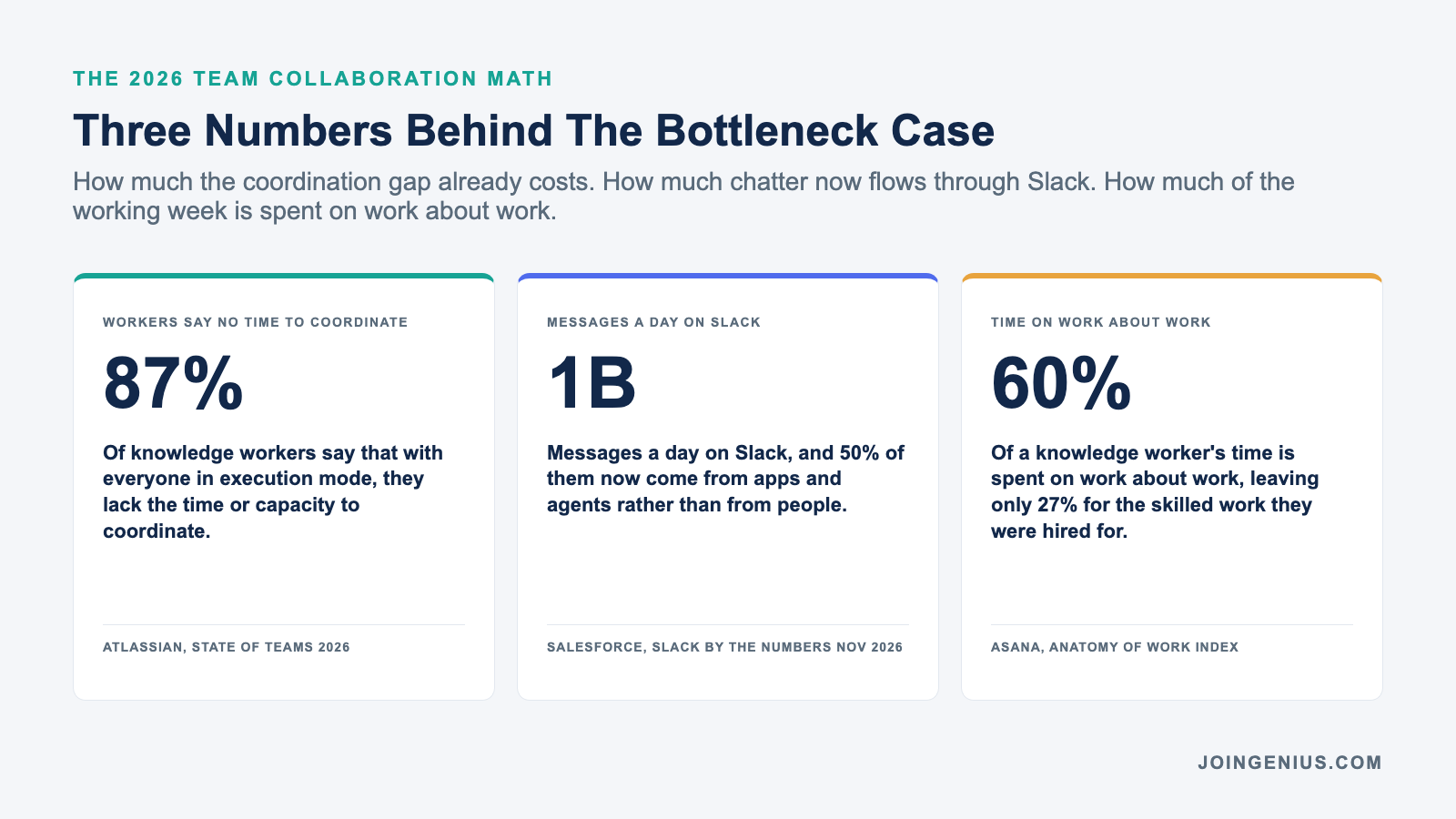
Three primary source numbers behind the 2026 case that the team collaboration bottlenecks a manager fights on a Monday live under the chat layer and not inside Slack itself: 87 percent of knowledge workers reporting that with everyone in execution mode they lack the time or capacity to coordinate per Atlassian's State of Teams 2026 report published April 27 2026 and based on a survey of 12,035 global knowledge workers plus 173 Fortune 1000 executives in January and February 2026 which puts the fragmentation tax on the Fortune 500 at 161 billion US dollars a year, 1 billion messages a day sent on Slack per Salesforce's Slack by the Numbers page updated November 3 2026 with 50 percent of those messages now coming from apps and agents rather than from people under the headline Half of Slack Messages Are No Longer From People which is the scale at which adding another channel to fix a collaboration problem stops being a fix at all, and 60 percent of a knowledge worker's time spent on work about work rather than on skilled work per Asana's Anatomy of Work Index as cited on the April 2026 Why Work About Work Is Bad brief leaving only 27 percent of the week for the skilled work people were actually hired to do, read together as the three pressures that explain why the team collaboration bottlenecks a project lead fights on Monday morning live under the chat layer and will not be fixed by a bigger ping.

Bottleneck #3: The Permanent @channel Fatigue Nobody Reads

The second reflex to a collaboration problem in Slack is @channel. Everyone sees it. Nobody reads it. The ops lead who needed to flag the client approval sent it at 9:14, and by 9:15 it was below three other @channels from three other projects.

The notification layer has become the work. Asana’s Anatomy of Work Index puts the share of a knowledge worker’s time spent on “work about work” at 60 percent. Chasing clarifications and waiting on the one person who has not seen the ping is the kind of work they mean.

The permanent @channel is a sign the team has run out of other signals. The fix is almost never a bigger ping. The fix is a status surface the asker can look at without pinging the room again.

Bottleneck #4: The Conversation Lives In One Place And The Work Lives In Another

The feedback on the mockup lives in the #design channel. The mockup itself lives in Figma. The task that tracks the revision lives in the project tracker.

The next person has to open each tab to find which one holds the thread that mattered. The chat layer became another place to lose the decision rather than a place to make it.

Platforms like ProofHub keep the discussion and chat threads inside the same workspace as the task and the file the thread is about, so the conversation stops living on a separate tab from the work it refers to.

In ProofHub, feedback on a task or file goes directly on that item, keeping the comments alongside the work they refer to.

Broader project conversations, such as scope changes or client updates, happen in project discussions.

This keeps the conversation and the decisions made in one place for everyone to refer back to.

For quick questions, there’s chat where you can clear your doubts in the real time.

The staffing effect is not that the tool replaces the project lead. The lead stops Monday morning in the thread archaeology business and starts it in the work itself.

Bottleneck #5: The Approval That Scrolled Off The Top

The approval request goes in the thread at 10:03. The approver is in a call until 11. By the time they are back, the thread has eight more messages and the approval sits below the fold the asker set it on.

The problem is not that the approver missed it. The problem is that the record of the approval, when it happens, is a thumbs-up emoji seven replies deep. A seasoned executive assistant does not consider that an audit trail.

The fix is a surface where the approval request is visible until acted on, and where the approval itself is a state change, not an emoji on a message that will scroll.
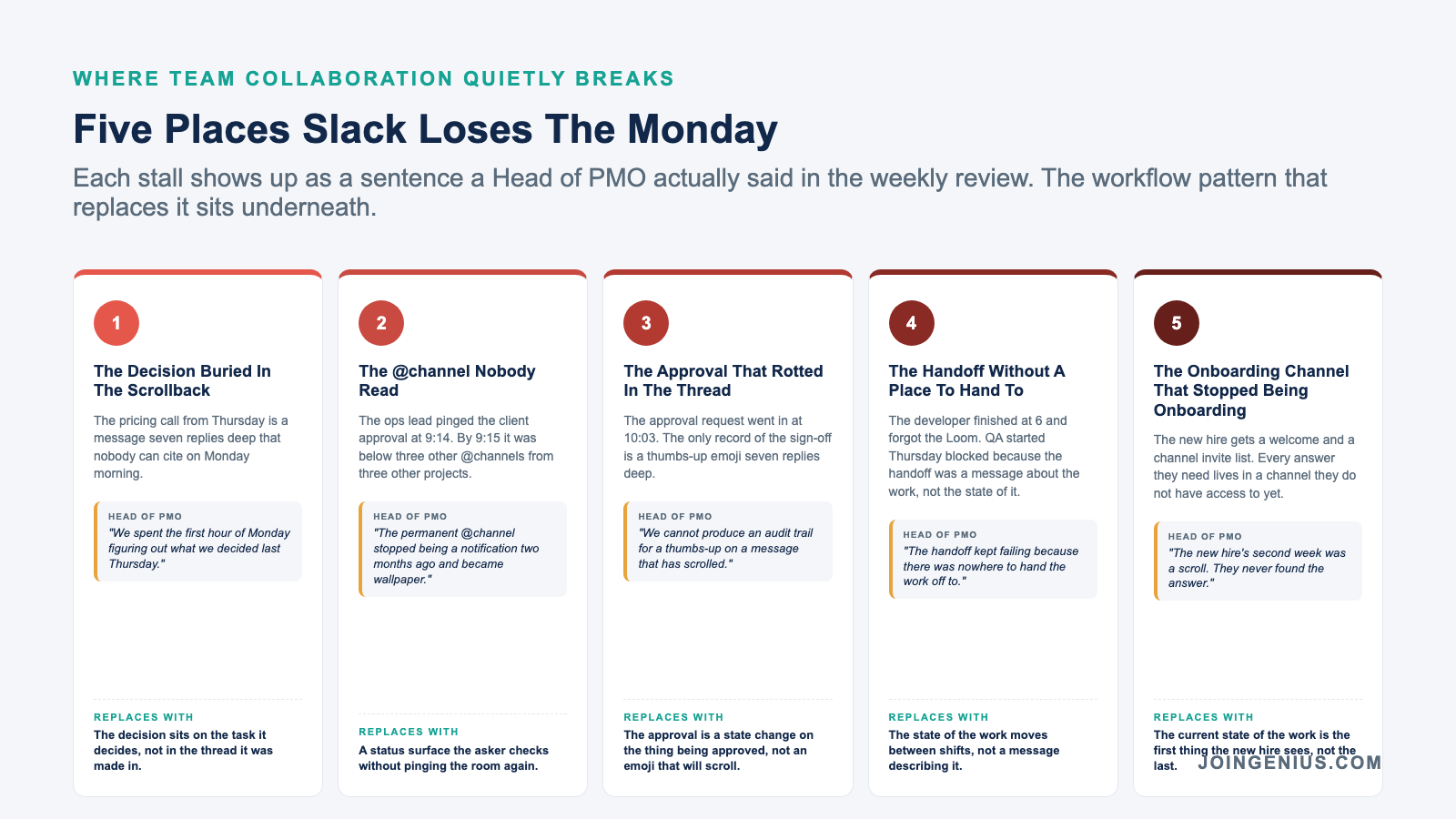
Five places team collaboration quietly breaks against the 2026 Slack and coordination baseline, each shown through a sentence a Head of Project Management Office actually said in the weekly review, and the workflow pattern that replaces it: The Decision Buried In The Scrollback where the pricing call from Thursday is a message seven replies deep that nobody can cite on Monday morning and the Head of PMO says we spent the first hour of Monday figuring out what we decided last Thursday and the pattern that unblocks it puts the decision on the task it decides rather than in the thread it was made in, The @channel Nobody Read where the ops lead who needed to flag the client approval sent an @channel at 9:14 and by 9:15 it was below three other @channels from three other projects and the Head of PMO says the permanent @channel stopped being a notification two months ago and became wallpaper and the pattern that unblocks it replaces the ping with a status surface the asker can look at without pinging the room again, The Approval That Rotted In The Thread where the approval request went into the thread at 10:03 and the approver was in a call until 11 and the thread had eight more messages by then with the only record of the sign-off a thumbs-up emoji seven replies deep and the Head of PMO says we cannot produce an audit trail for a thumbs-up and the pattern that unblocks it makes the approval a state change on the thing being approved rather than an emoji on a message that will scroll, The Handoff Without A Place To Hand To where the developer finished at 6 and forgot the Loom and QA started Thursday blocked because the handoff was a message about the work rather than the state of the work and the Head of PMO says the handoff kept failing because there was nowhere to hand the work off to and the pattern that unblocks it moves the state of the work between shifts rather than a message describing it, and The Onboarding Channel That Stopped Being Onboarding where the new hire gets a welcome and a channel invite list and a search bar and every answer the new hire needs is in a channel they do not have access to yet written by a person who left in February and the Head of PMO says the new hire's second week was a scroll and the pattern that unblocks it surfaces the current state of the work as the first thing the new hire sees instead of the last thing they find after four days of searching.

Bottleneck #6: The Async Handoff That Never Actually Handed Off

The async handoff sounds clean on the diagram. Developer finishes at 6. Writes the Loom at 6:15. QA picks it up at 9. In the actual thread, the developer finished at 6 and forgot the Loom. QA started Thursday blocked.

The handoff is not the message. The handoff is the state of the thing being handed off. A good virtual assistant building a daily handoff routine will insist that the status of the work, not a message about the work, is what moves between shifts.

Slack can carry the message. It cannot carry the state. The team that pretends it can is the team whose Thursday morning starts with a fifteen-minute call to find out what Wednesday night actually finished.

Bottleneck #7: The Status Update Loop Nobody Wins

Every team has the Monday status ritual. Every team also has the question that follows at 2pm on Tuesday: “wait, did that ship?” The weekly post was outdated by lunch on Monday. The team now runs two parallel systems. One is the post. The other is the pings asking what the post missed.

The ritual did not fail because the team is lazy. It failed because the post is a push at a point in time. A customer service representative answering a client question on Tuesday afternoon needs a pull, not the post.

The fix is a status the client or the manager can read on demand, that updates when the work updates. The post becomes a summary of a surface that already exists. The pings go away.

Bottleneck #8: The Cross-Timezone Thread That Dies Overnight

The product manager in New York asks the engineer in Berlin a question at 5pm. The engineer answers at 11pm New York time, which is 5am Berlin. The PM wakes up to the answer, replies at 8, and the engineer is already offline for the day.

The thread took two calendar days to cover ninety seconds of actual back and forth. The second question is already sitting in the thread, waiting on another overnight cycle. The team shipped nothing on Tuesday because of Monday’s five o’clock question.

The fix is not a shared working hour. The fix is a structure where the question and its full context sit next to the decision the asker needs, so both sides can act without waking the other up.
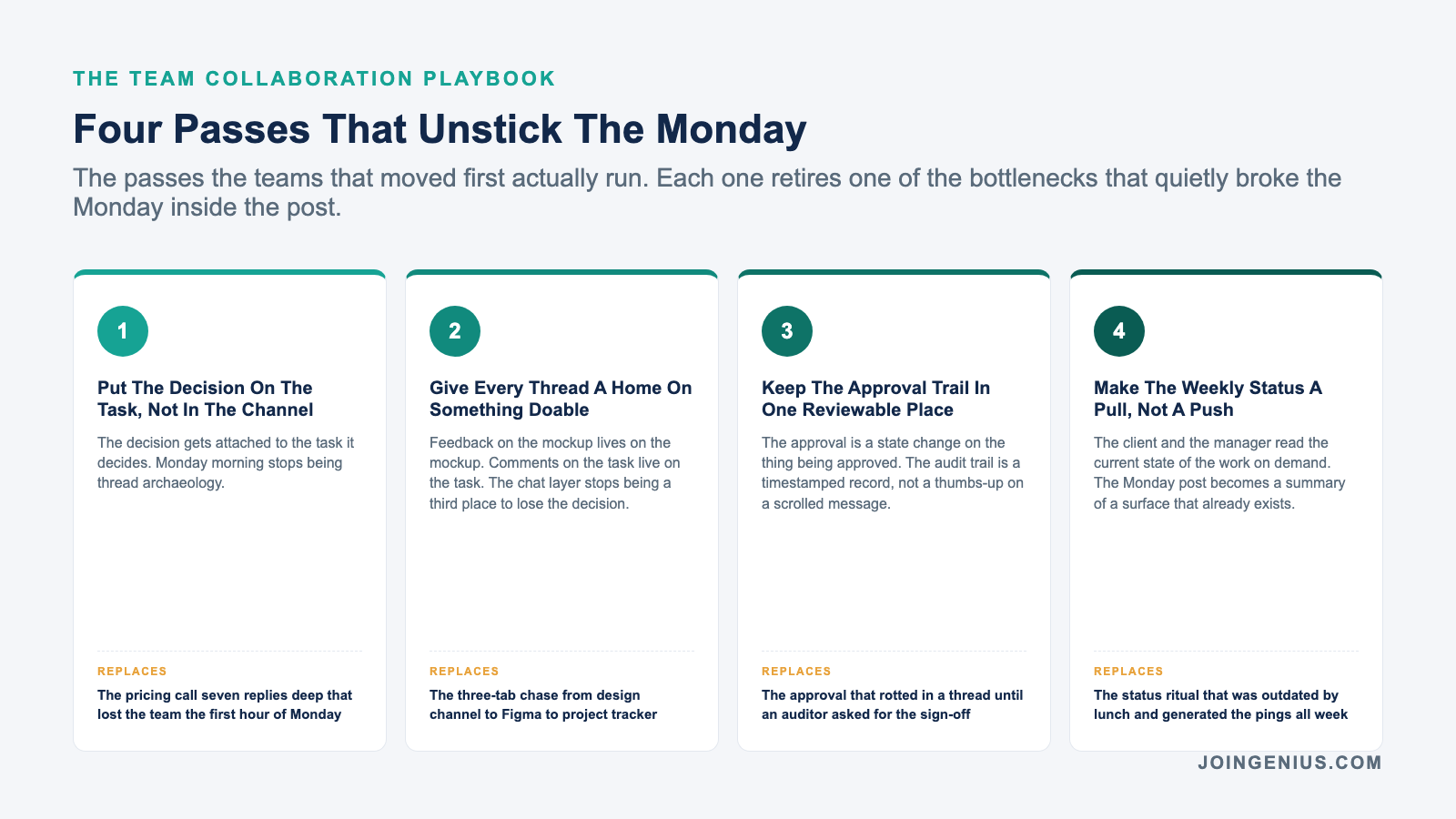
Four passes that retire the team collaboration stalls against the 2026 coordination baseline, each one retiring at least one of the bottlenecks that quietly broke the Monday inside the post: Put The Decision On The Task Not In The Channel where the decision gets attached to the task it decides so Monday morning stops being thread archaeology which replaces the pricing call buried seven replies deep that the team spent the first hour of Monday trying to cite, Give Every Thread A Home On Something Doable where the feedback on the mockup lives on the mockup and the comment on the task lives on the task and the chat layer stops being a third place to lose the decision which replaces the three-tab chase from the design channel to Figma to the project tracker that lost the next person the first hour of the morning, Keep The Approval Trail In One Reviewable Place where the approval is a state change on the thing being approved and the audit trail is a timestamped record rather than a thumbs-up emoji seven replies deep which replaces the approval that rotted in a thread until an auditor asked for the sign-off, and Make The Weekly Status A Pull Not A Push where the client and the manager read the current state of the work on demand on a surface that updates when the work updates and the Monday post becomes a summary of a surface that already exists which replaces the status ritual that was outdated by lunch on Monday and generated the pings all week asking what the post missed.

Bottleneck #9: The File Version Scramble No One Can Audit

The client wants the deck. The account lead pings the designer. The designer sends the pdf. The pdf is version six. Version seven shipped earlier that morning to the production channel. The client gets the wrong deck. Nobody notices until the Friday review.

Slack is fine at sending files. Slack is not fine at tracking which one was current when. The “latest” in the account lead’s dms is never the “latest” in the design channel. The audit after the fact is a scroll through four conversations.

The fix is a single versioned surface the deck lives on, where the share is a link, not a file. The client always sees the current version. The scramble ends, because there is nothing to scramble through.

Bottleneck #10: The Onboarding Cliff When Someone New Joins

A new hire in week one gets a welcome and a channel invite list, then is left with the search bar. The welcome is nice. The channels are overwhelming. The search bar is where the week actually happens, because every answer the new hire needs lives in scrollback.

The onboarding cliff is the moment the new hire realizes the institutional memory lives in a channel they do not have access to yet, written by a person who left in February. Slack surfaces messages in order of recency, not context.

The fix is a surface where the current state of the work is the first thing the new hire sees, not the last place they find after four days of scrolling. The onboarding becomes a map rather than a search.

Conclusion

The ten bottlenecks are not a case against Slack. Slack is good at what Slack is for. The bottlenecks are places the team needs a different surface. The decision belongs with the task. The task belongs with the file. The status belongs where the asker and the doer can both pull it. A visit to Genius is the staffing side of the same move. The right project lead is the one who notices which of the ten shows up first on Monday.

Get an unfair advantage by hiring the top 1% of overseas talent for your sales & marketing, IT, data & engineering, finance & accounting, and VA & customer support needs.

  • We find you high-performing remote workers for 80% less
  • Enjoy our 6-month Perfect Hire Guarantee
  • And $0 monthly middleman fees

Get your personalized list of pre-vetted candidates and see exactly what caliber of talent you can access at 80% less than US rates.

IG Rosales
Genius' Head of Content, shaping HR narratives for 10+ years. Her secret weapons? A keen eye for talent (hired through Genius, of course) and a relentless quest for the perfect coffee.

Related Articles and Topics

Leave a Reply

Your email address will not be published. Required fields are marked *

Comment policy: We love comments and appreciate the time that readers spend to share ideas and give feedback. However, all comments are manually moderated and those deemed to be spam or solely promotional will be deleted.

By submitting this form: You agree to the processing of the submitted personal data in accordance with Genius Privacy Policy, including the transfer of data to the United States.

Get Elite Talent and Cut Hiring Costs by 80%

Get your personalized list of pre-vetted candidates and see exactly what caliber of talent you can access at 80% less than US rates.

Download a PDF version.

By submitting this form: You agree to the processing of the submitted personal data in accordance with Genius' Privacy Policy, including the transfer of data to the United States.

By submitting this form, you agree to receive information from Genius related to our services, events, and promotions. You may unsubscribe at any time by following the instructions in those communications.

Browse A-Player employees that cost 80% less than US equivalents