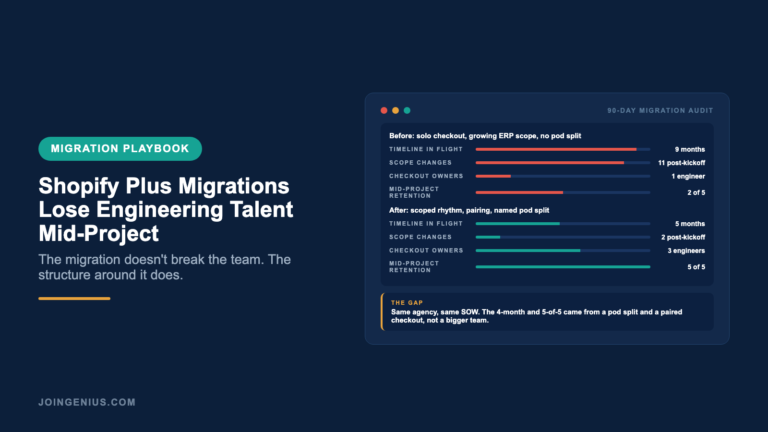

Shopify Plus migrations are sold as replatforms. They turn into rebuilds by month three. Scope grows when the ERP vendor shows up, the checkout logic lives in a Script that Shopify is retiring, and the engineer who knows the current store owns three sprints nobody put on the board. By month five, the lead developer is interviewing elsewhere, and the project is six weeks behind. The real story is almost always a scope and pairing problem that could have been named in the SOW. This guide covers five patterns that drive engineering talent off mid-project and a short playbook for keeping the team on through launch.
Why Engineers Walk Off Shopify Plus Migrations
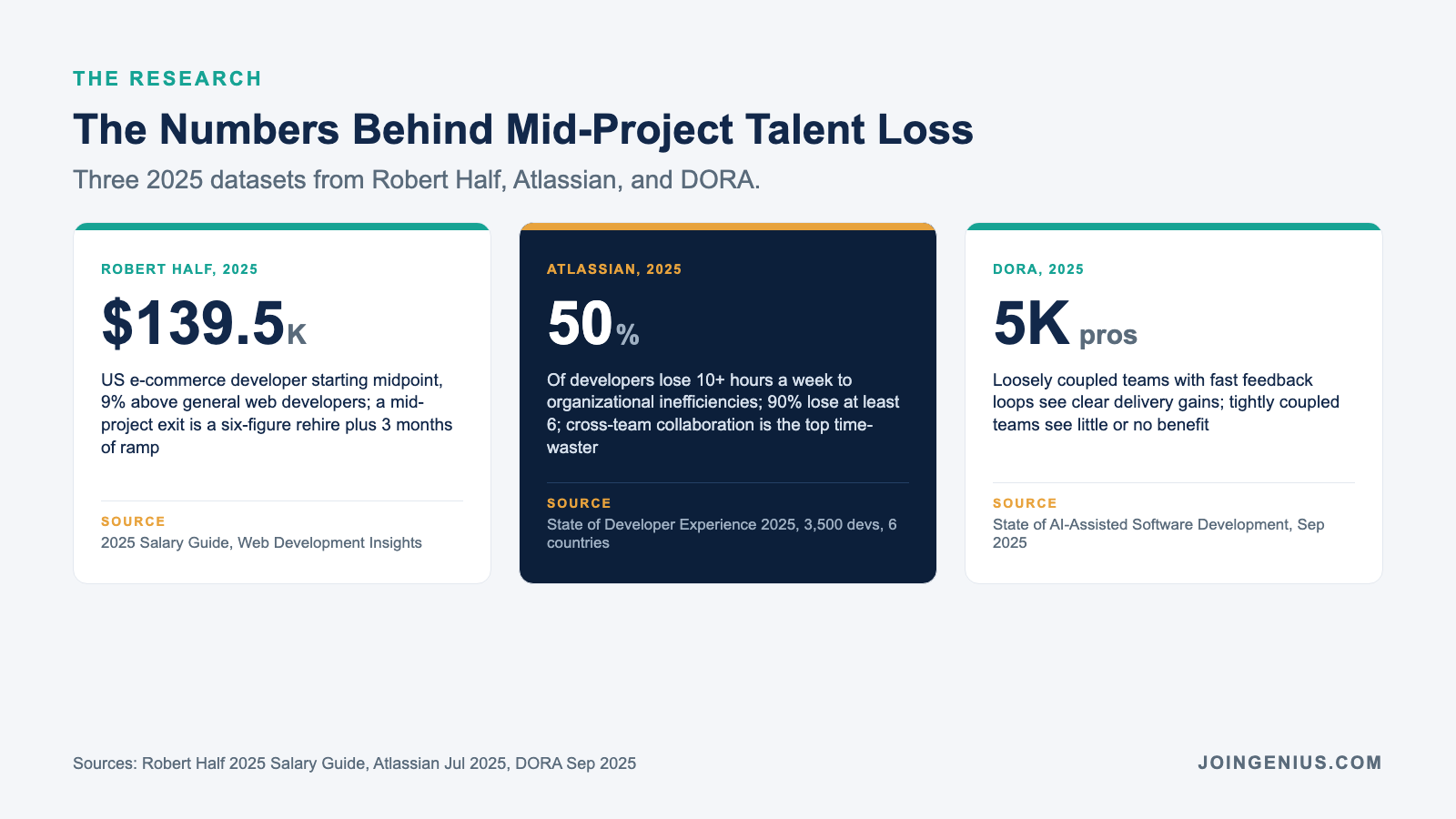
Three 2025 datasets explain why a mid-project migration is such a fragile place. Replacing the engineer is expensive, the team around them is losing hours a week to cross-team friction, and the project structure most ecommerce shops run is the one that drops a hand mid-project.
Replacing An Ecommerce Developer Is A Six-Figure Bill
The Robert Half 2025 Salary Guide puts the US e-commerce developer starting midpoint at $139,500, about 9% above general web developers.
A mid-project resignation is not a scheduling problem, it is a six-figure rehire bill plus the three months the replacement needs to read the migration. Agencies that ignore that math are optimizing for the wrong number.
Half Of Developers Lose Ten Hours A Week To Friction
Atlassian’s 2025 State of Developer Experience report, a survey of 3,500 developers across six countries, found that 50% lose 10 or more hours a week to organizational inefficiencies and 90% lose at least six.
Cross-team collaboration passed technical debt as the top time-waster. Shopify Plus migrations are cross-team by default, so the time cost per engineer in month four is quietly worse than their resume suggests.
Loosely Coupled Teams Are The Ones Who Finish
Google’s DORA 2025 State of AI-Assisted Software Development report, drawn from nearly 5,000 professionals, found that loosely coupled teams with fast feedback loops see clear delivery gains while tightly coupled teams with slow processes see little benefit from the same investments.
Most Shopify Plus migration teams are tightly coupled by accident: one checkout engineer, one ERP engineer, one PM holding both. The data says that structure is the one that drops a hand mid-project.
Five Patterns That Push Engineers Off The Build
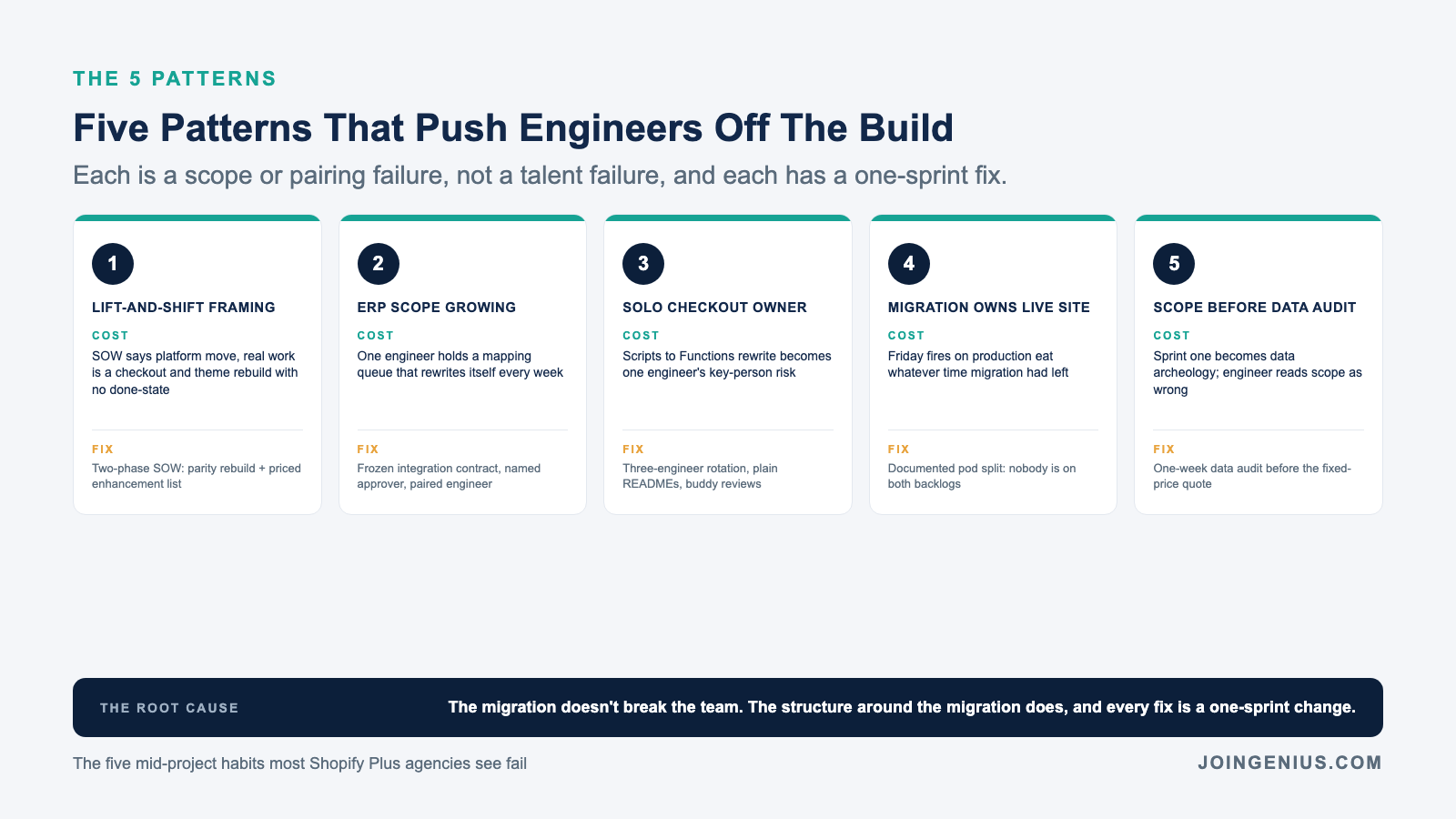
Every Shopify Plus migration that loses engineers mid-flight has some version of these five patterns. Each has a one-sprint fix, and every one of them is cheaper than hiring the replacement.
1. The Lift-And-Shift Framing That Hides A Rebuild
The SOW promises a platform move. The real work is a checkout rewrite, a theme rebuild in Liquid or Hydrogen, and a data model rework that nobody scoped. The engineer signed up for a three-month project and finds themselves nine months in with no definition of done.
The fix is to split the SOW into two phases on day one, a scoped parity rebuild and an opinionated enhancement list, with the enhancement list priced and queued separately. Engineers stay when the next two sprints are visible.
2. The ERP Integration That Keeps Growing
Mid-market Shopify Plus migrations with five or more integrations consistently push past twelve months in multiple agency benchmarks. The ERP connector is usually the one that grew. Each new field request from finance rewrites the mapping, and the integration engineer owns the queue alone.
The fix is a frozen integration contract by the end of discovery, a change-request process with a named approver on the client side, and a second engineer paired on the integration from the first sprint. No engineer should own a growing queue solo past month two.
3. One Engineer Owns The Checkout Logic
Shopify is retiring Scripts, with Shopify Functions as the replacement, and the April and June 2026 cutoffs made that part of every mid-migration conversation. The engineer who rewrote checkout in Functions becomes the only one who can read it, and the ownership is implicit rather than documented.
The fix is a three-engineer rotation on checkout from sprint one, a plain-English README for every custom Function, and a buddy review before any Function merges to the staging store. A Shopify ecommerce metrics dashboard helps the whole team see the checkout the lone engineer does not have to explain.
4. The Migration Team Still Owns The Live Site
On most Shopify Plus migrations, the same two or three developers keep the current store running, fix the Friday bugs, and build the new store. The on-call rotation did not change when the project started, so the migration backlog gets whatever time is left after production fires.
The fix is a documented split for the migration window. One pod owns live-site bugs and app updates. One pod owns the migration. Nobody is on both. An onboarding plan for a remote developer who inherits the production rotation often closes the gap.
5. Discovery Signed Off Before The Data Audit
Discovery often signs off on a rebuild plan before anyone opens the metafields, the custom app table, or the five-year-old return policy logic in the theme. The first sprint of the build is a data archeology run, which the client reads as “slow start” and the engineer reads as “the scope was wrong.”
The fix is a one-week data audit sprint before the fixed-price number, with a written list of custom entities, apps, and logic that a cross-team integration contract commits the agency and client to in writing.
The Playbook That Keeps The Engineers
Every pattern above comes back to one habit: the migration team is set up to lose, not to finish. Two moves swing the odds back toward launch and toward the engineer staying through it. One is about who runs the project. The other is about the weekly rhythm the project actually keeps.
The lesson is the same one crypto teams learned about engineer retention after a token launch: the project does not break the team, the structure around the project does.
Where Grumspot Fits
Grumspot is a Shopify and Shopify Plus agency where the founding engineers who run the project are the ones who stay on it from the first call through launch.
Migrations are run on a staging store while the old store keeps trading, with a 301 redirect for every URL, so the team working the checkout rewrite in month four is the same team that scoped the migration in month zero.
A Sustainable Migration Rhythm
A sustainable rhythm is not a methodology, it is a pattern that fits on one page. Every sprint has one scoped goal, two engineers paired on every critical path, and one demo to the client. Scope changes go through a written form, not a Slack thread.
Friday afternoons are reserved for the migration pod, not for live-site fires. The PM protects a quiet Thursday for design review. By month three the team knows what is in, what is out, and what the client will see at launch.
The sprint goal is the engineer’s shield, not the PM’s trophy. When a stakeholder asks for a new feature mid-sprint, the answer is a change form and the next sprint’s queue. The engineer who signed the SOW is the one who ships it, because the rhythm did not make them carry three roles for nine months.
Metrics To Watch Mid-Project
A migration that is going to lose an engineer gives at least four signals weeks before the resignation gets filed. Watch these numbers in the standup board and the Slack logs from month two onward, and treat any target miss as a reason to open a conversation this week.
Four Numbers That Signal Engineer Drift
Two of these are about the project itself, and two are about the team around it. Any single number outside its target for more than two consecutive weeks is a signal to open the next conversation, not to wait for the exit interview.
| Metric | Target | Owner | Audit Cadence |
|---|---|---|---|
| Scope change requests per sprint | Under 2 | PM | Per sprint |
| Engineers pairing on checkout Functions | At least 3 | Tech lead | Weekly |
| Migration pod hours lost to live-site fires | Under 4 per week | PM | Weekly |
| Days since last client demo | Under 14 | PM | Weekly |
| Engineers assigned to only one major path | 100% | Tech lead | Weekly |
| Written scope-change forms vs Slack asks | Over 90% | PM | Monthly |
The number that moves first is almost always migration pod hours lost to live-site fires. When that creeps past six per engineer per week, the next resignation is six to eight weeks out.
Warning Signs Your Lead Engineer Is Checking Out
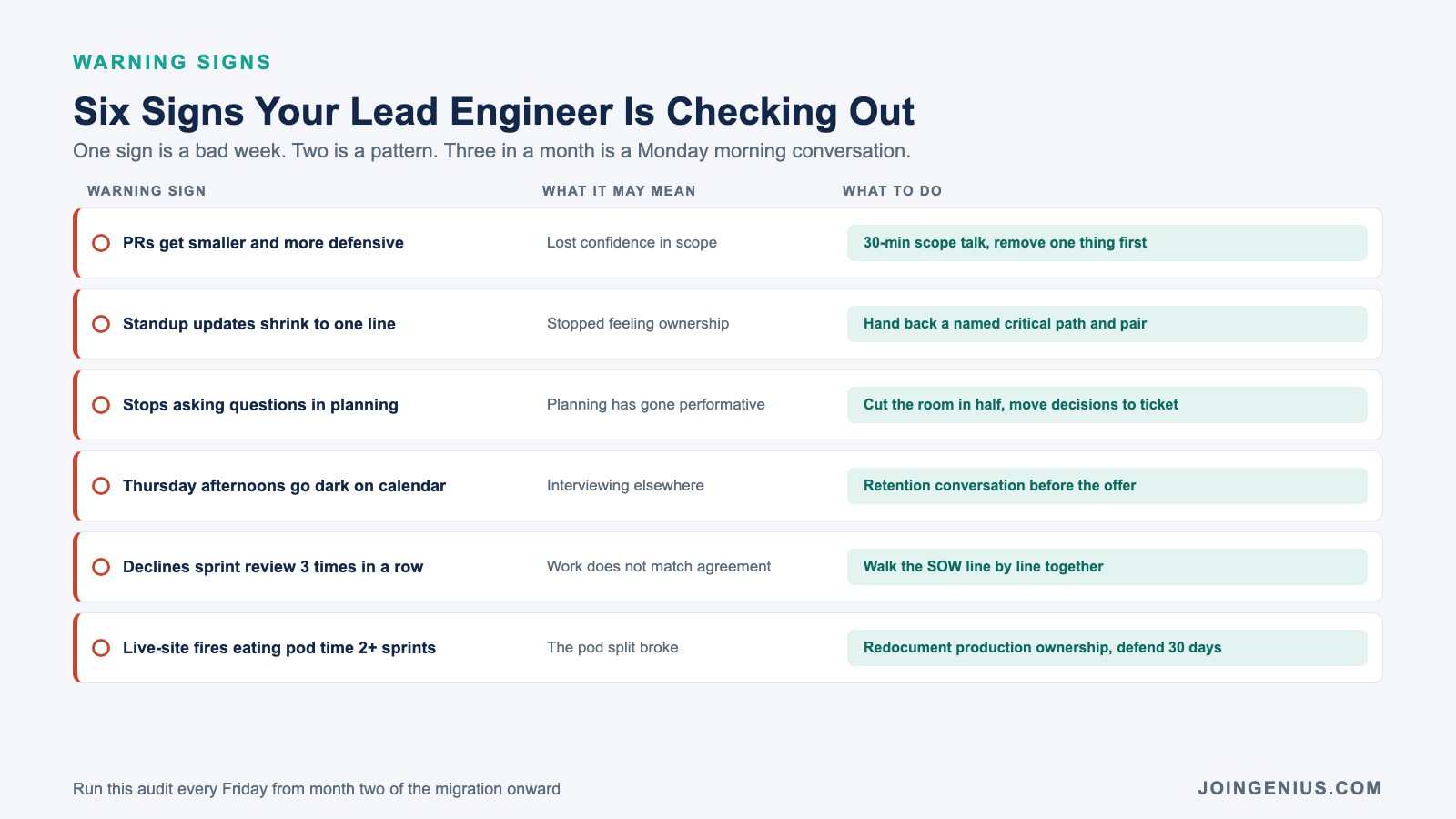
Lead engineers rarely quit a Shopify Plus migration without first giving six to eight weeks of quiet signals. These are the ones a careful PM or founder would read in October, not the ones HR reads in a December exit interview.
Every signal below has a one-conversation fix if it gets a Monday morning, not an email thread on a Thursday. The founders, tech lead, or delivery partner who notices first is almost always the one who keeps the launch intact.
Pull requests get smaller and more defensive. Standup updates shrink to one line. The engineer stops asking questions in planning meetings.
Thursday afternoons go dark on the calendar. The engineer declines the sprint review for the third time. Any one of these is a bad week. Two in the same sprint is a pattern. Three in a month is a conversation to have on a Monday morning, not a resignation to receive on a Friday afternoon.
Conclusion
Shopify Plus migrations lose engineering talent in the middle because the structure of the project rewards the engineer for carrying everything and punishes them for handing anything off. Scope grows, the checkout lives in one head, and the live site keeps asking for Friday time nobody protected.
The five patterns in this guide each have a one-sprint fix. Every fix is cheaper than replacing the engineer and much cheaper than rebuilding the migration after they leave. For more playbooks for operators running ecommerce builds, see joingenius.com.