
A sales rep starts the day with six unanswered messages trying to find a time with prospects, two calls that turn out to be poor fits and a CRM with no notes from yesterday. None of it is selling. That is an illustration, not a case study, but it describes the scheduling overhead this guide covers: the work around a meeting that is not the meeting itself.
This guide explains why AI voice agents may reduce that overhead for sales teams and what to check before you trust one. It covers what scheduling overhead is, why speed matters, what a voice agent does in the chain, where it can add work instead, how to run a pilot and a table of warning signs.
What Scheduling Overhead Means for a Sales Team
We define scheduling overhead as the time a team spends on the steps around a meeting: finding a time, deciding whether the meeting is worth having, reminding people and recording what happened. That definition is ours, not a standard. A rep may do all of it by hand, or it may be split between reps, assistants and tools.
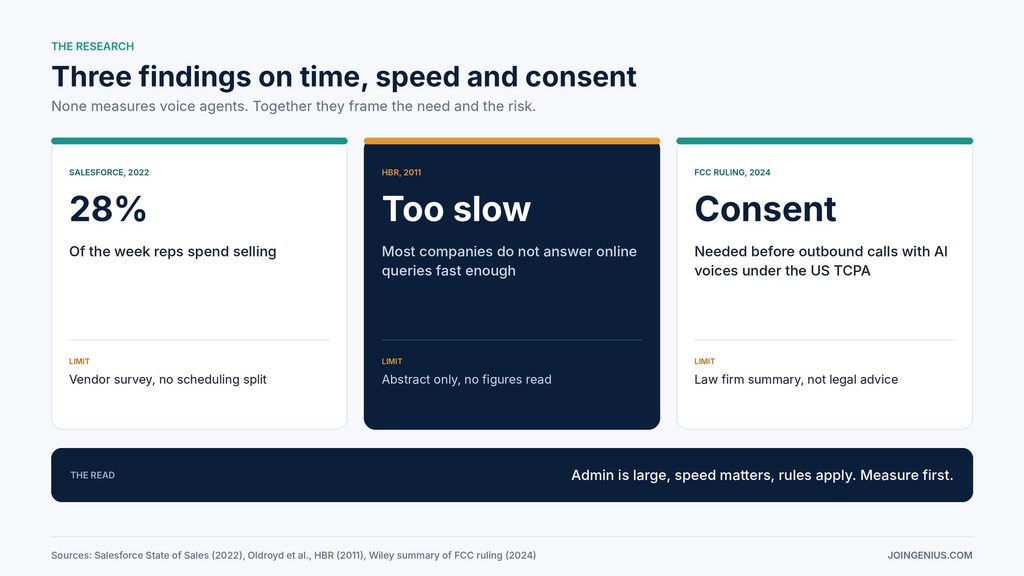
The closest data we found is broader. Salesforce’s State of Sales report, a 2022 survey with 7,775 responses from sales professionals, says reps spend 28% of their week actually selling, with most of the rest going to tasks such as deal management and data entry. The limits matter. Salesforce sells sales software, the data is self-reported and several years old, and it gives no figure for scheduling alone. We use it to show that non-selling work is large, not to size the saving from any tool. Our guides to sales process mapping and how to qualify leads cover how to see where the time goes.
Why Speed and Availability Matter
Speed is the usual argument for automating first contact. A 2011 Harvard Business Review article by James Oldroyd, Kristina McElheran and David Elkington says most companies are not responding nearly fast enough to online queries. We read only the abstract, which gives no figures or method, and the article is about 15 years old.
Our reasoning is that a prospect who can book a slot during the first conversation avoids a wait for a rep to reply, and the rep avoids a round of messages. Whether that raises booked meetings is something to measure, not assume. Our guide to sales cadence covers follow-up timing after the first touch.
What a Voice Agent Does in the Scheduling Chain
A voice agent can take part in several links of that chain. Famulor’s page on AI appointment setting says its agent “calls prospects or takes their call, checks the fit and books the meeting straight into the right calendar.” The page says qualification comes first, so the agent asks questions before reserving time. It names Google Calendar, Calendly, Cal.com, HubSpot and Salesforce, says a warm transfer lets a team member hear a short briefing before taking the call and adds that confirmations and reminders go out by SMS or email.
In practice, the rep gets a qualified, booked meeting with a short briefing instead of a thread of messages to chase.
Our reasoning is that each step could remove a piece of overhead. Booking during the call removes the message back-and-forth, asking qualifying questions first reduces time on poor-fit meetings and logging to the CRM reduces manual notes. Each is plausible, and the page shows none of them.
Where Voice Agents Can Add Work Instead
A voice agent can also create work. Three cautions follow from the sources we found.
First, reliability. The τ-bench paper by Shunyu Yao and colleagues tested language-model agents on customer service tasks in retail and airline settings. It reports that the best function-calling agents succeed on fewer than 50% of tasks, and that the best agent’s pass^8, the chance of solving the same task correctly on all eight tries, fell below 25% in retail. The benchmark is text only, uses simulated users, covers two domains and is a 2024 preprint, so it says nothing about voice or booking in particular. Our reasoning is that an agent that is right most of the time still needs someone to find the times it was wrong.
Second, customer preference. A Gartner survey of 5,728 customers in December 2023 found that 64% would prefer companies not use AI in customer service, and 53% would consider switching to a competitor if they learned a company was going to use it. Gartner sells research on this topic, the page gives no method details and the survey covers service, not sales. It suggests that a warm handoff to a person may matter.
Third, consent. A Wiley law firm summary says the FCC ruled in February 2024 that calls made with AI-generated voices count as artificial or prerecorded voice calls under the US Telephone Consumer Protection Act, so callers need prior express consent, plus identification and opt-out options. That is a summary of a US ruling, not legal advice, and other countries differ. If an agent makes outbound calls, check consent first.
Run a Two-Week Pilot Before You Commit
These steps are our suggestions, not findings. Pick one call type, such as inbound demo requests, and one lead source. Before launch, record a baseline over a few weeks: time from inquiry to booked slot, share of inquiries booked, show rate and the hours reps log on scheduling. Write the escalation rules first, including when the agent transfers to a person and what the briefing contains. Then run the agent on a slice of volume and listen to a sample of calls each week.
Check calendars for conflicts and compare CRM entries with what was said on the calls. Compare results with your baseline or with a cohort handled by people, and remember that seasonality, campaigns and team changes affect both. Small teams may see few bookings a week, so judge over several weeks, not one. Our guide to sales metrics and KPIs covers what to track, and our list of sites to hire appointment setters covers the human alternative if the pilot does not hold up.
A Four-Step Plan to Pilot a Voice Agent
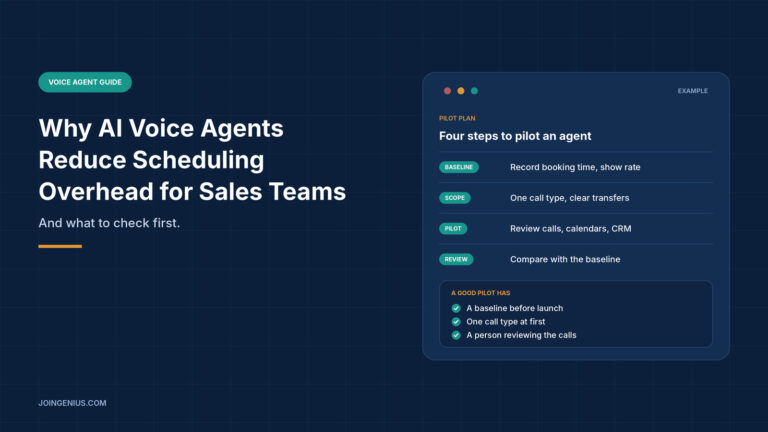
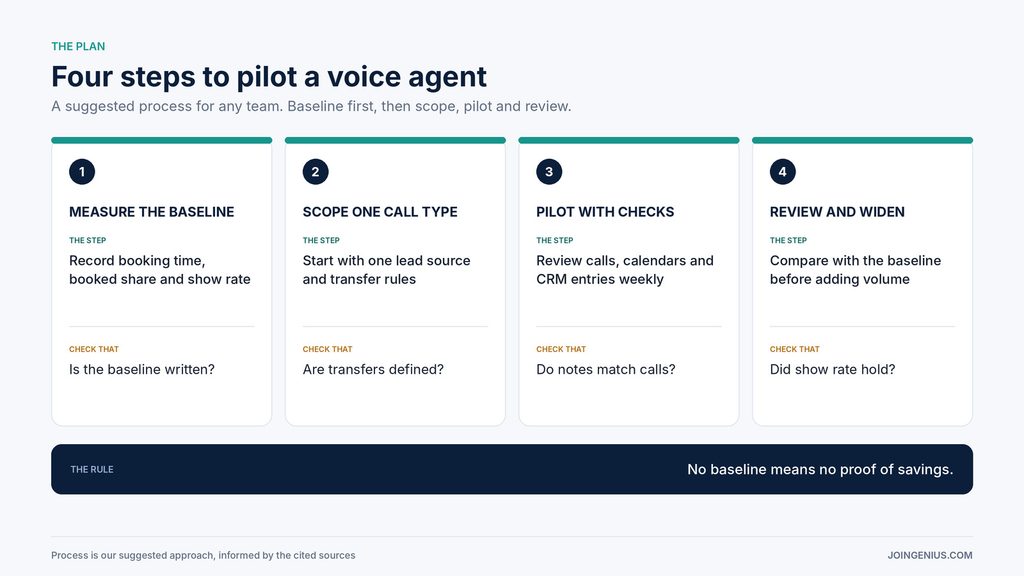
Use this four-step plan before you hand any scheduling to an agent. It is our suggested process, informed by the sources above.
- Measure the baseline. Record booking time, booked share, show rate and rep hours first.
- Scope one call type. Start with one lead source and clear transfer rules.
- Pilot with checks. Review calls, calendars and CRM entries every week.
- Review and widen. Compare with the baseline before adding volume.
The order matters because a pilot without a baseline can show that the agent works, but not that it saved anything.
Measure Whether Overhead Fell
Track time from inquiry to booked slot, the share of inquiries that become booked meetings, show rate, the hours reps spend on scheduling, the calls that needed correction and the share transferred to a person. A drop in scheduling hours means little if show rate or call quality falls, so read the measures together and judge over several weeks. These measures are our suggestions, not findings.
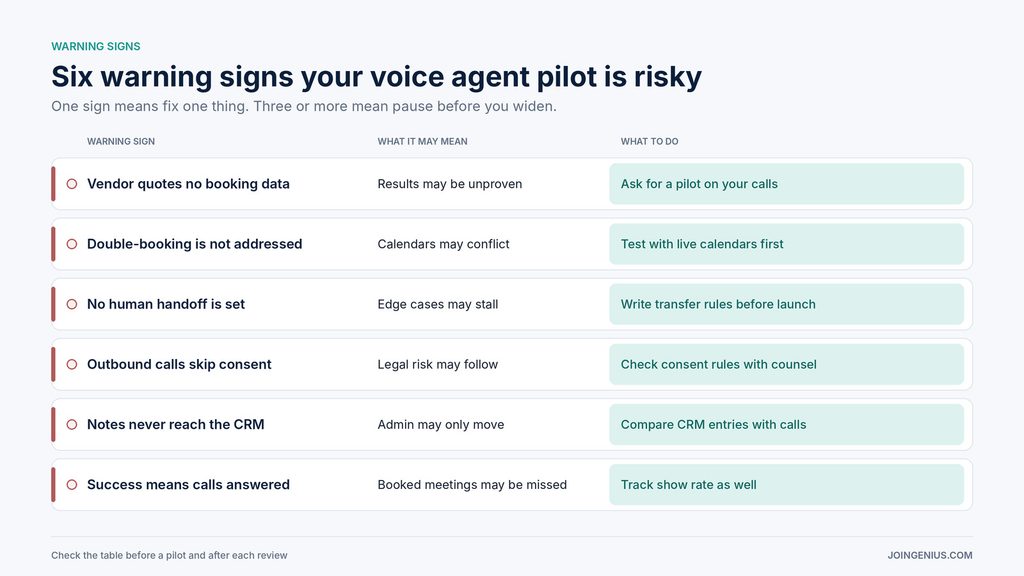
Warning Signs Your Voice Agent Pilot Is Risky, and What to Do About Each
Check this table before you start a pilot and after each review. One sign means fix one thing. Three or more mean pause before you widen.
Measure First, Then Hand Over the Calendar
An AI voice agent may reduce scheduling overhead, not on an independent study. Measure a baseline, scope one call type, pilot with checks and widen only if the numbers hold. We found no study proving that voice agents cut scheduling work for sales teams, but each step replaces a hope with a check. If bookings rise, show rate holds and reps log fewer scheduling hours, you have a better reason to keep the agent than any vendor claim.