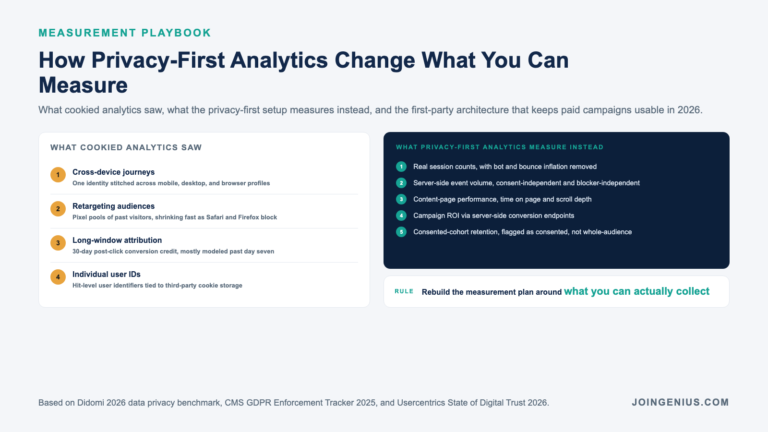
Privacy-first analytics change what you can measure before they change what you report. The old setup promised a single clean view of every visitor across every device for 90 days. The new one tells you what actually happened on the site this week, which is often more useful anyway.
This guide walks marketing leads and site owners through two shifts: the measurements that change and the architecture that keeps paid campaigns usable without forcing a cookie wall. We borrow one page from our brand content strategy playbook for the discipline that applies here. The rest unpacks each measurement shift in turn.
What Privacy-First Analytics Actually Measure Differently
Privacy-first analytics measure the session and the page, not the person across sessions. That one change ripples through every downstream report, from acquisition cost reports to campaign attribution views.
The cookied model stitched a single visitor identity across devices and ad touchpoints. It let marketers report a 30-day attribution window and a cross-device journey as if those numbers were observed rather than modeled. In 2026, the observed share of that picture is smaller, and what remains after consent drop-off is often the honest baseline.
The privacy-first setup flips the default. The baseline measure is what actually happened on your own site this week, and the extrapolations are flagged as extrapolations, not reported as truth. Decisions made on that ground tend to survive quarterly reviews better than the old numbers.
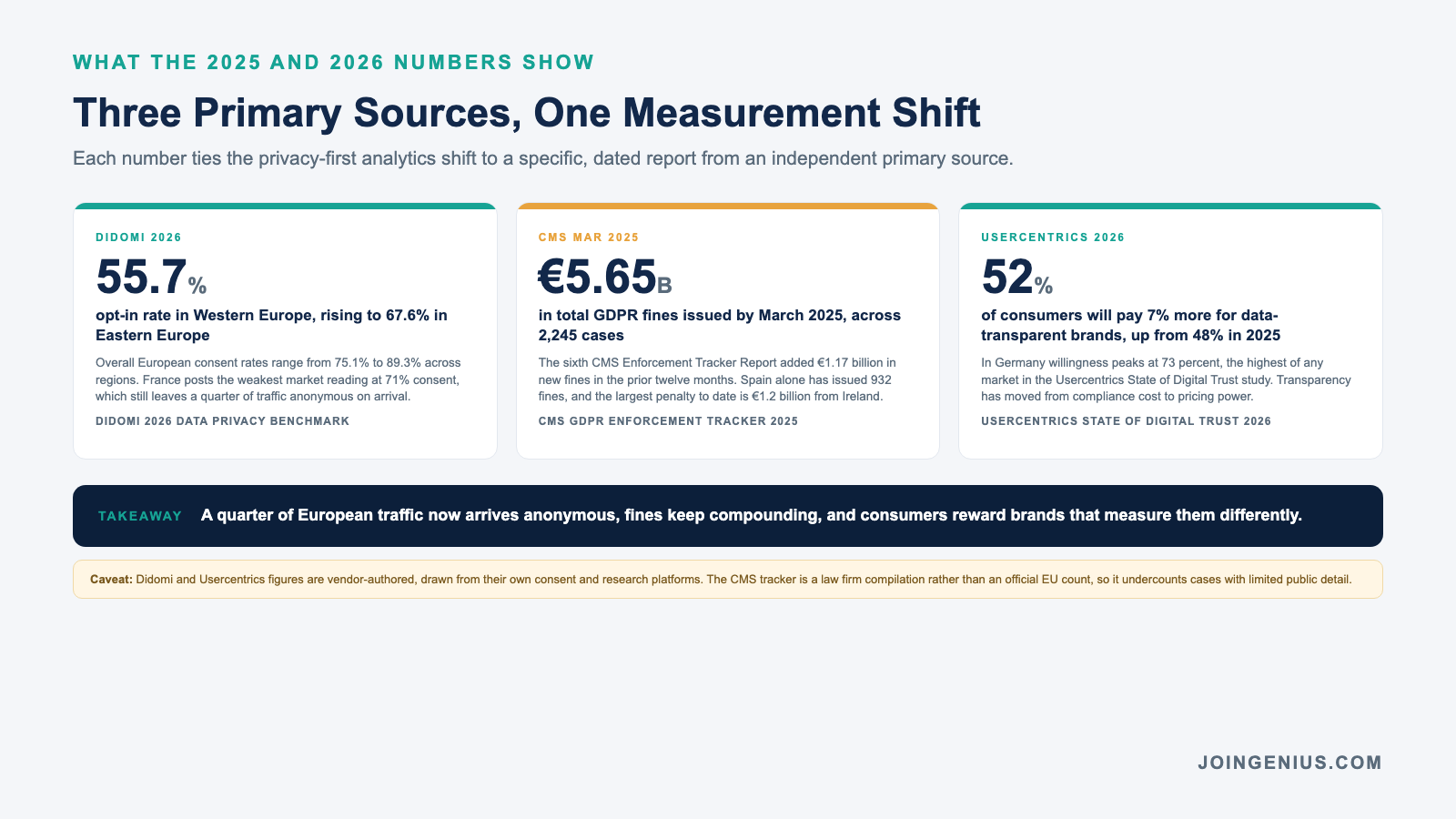
The math is simpler than it looks. The CMS Enforcement Tracker counted 2,245 GDPR fines totaling 5.65 billion euros by March 2025, a 1.17 billion euro jump from a year earlier, so the cost of building a measurement setup on cookies you cannot defend compounds every quarter.
The Four Things Cookied Analytics Can See That Privacy-First Setups Cannot
Four specific capabilities live inside third-party cookie infrastructure and nowhere else. Losing them is the price of the compliance model, and naming them in advance keeps the quarterly review honest.
Cross-Device Journeys
The old model knitted a mobile tap into a desktop purchase three days later into a single conversion. Privacy-first setups cannot do this without logged-in user accounts, so a cross-device journey becomes a logged-in cohort analysis instead of an open-web view.
Retargeting Audiences
Third-party cookies build the pixel-based audience pool that powered the retargeted display ads of the 2010s. Those pools shrink fast as Safari and Firefox block the cookies by default, and server-side conversion APIs replace the audience-build mechanic for Meta and Google.
Long-Window Attribution
The classic 30-day post-click, 1-day post-view window assumed cookie persistence that no longer holds. Privacy-first attribution runs 7 days or even 1 day at most, because the data past that window is modeled, not measured.
Individual User IDs
User-level IDs let legacy GA stitch events into a single customer. Privacy-first setups aggregate at the session or the page level and keep personally identifiable data out of the hit, which is the whole reason the cookie banner stops asking in the first place.
| Metric | Cookied Analytics View | Privacy-First View | Decision It Supports |
|---|---|---|---|
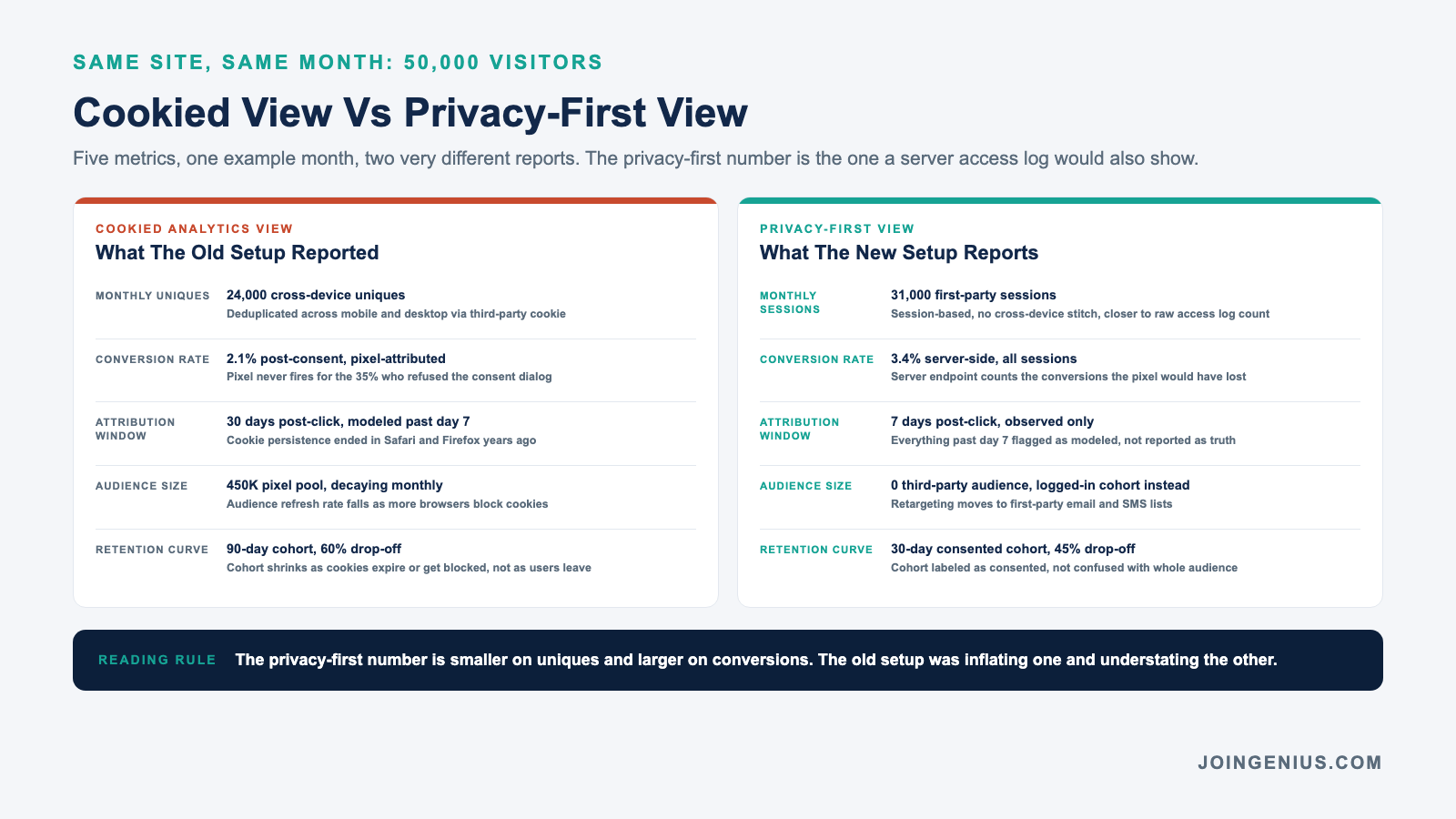
| Monthly uniques | 24,000 cross-device uniques, pixel-deduplicated | 31,000 first-party sessions, access-log aligned | Content investment allocation |
| Conversion rate | 2.1% post-consent, pixel-attributed | 3.4% server-side, all sessions | True conversion baseline |
| Attribution window | 30 days post-click, modeled past day 7 | 7 days post-click, observed only | Honest campaign evaluation |
| Audience size | 450K pixel pool, decaying monthly | Zero third-party audience, logged-in cohort instead | Retire pixel-based retargeting plan |
| Retention curve | 90-day cookie cohort, 60% drop-off | 30-day consented cohort, 45% drop-off | Consented retention benchmarking |
The Four Things Privacy-First Setups Measure More Honestly
What this gives back is the metric set that actually informs a weekly decision. Four categories hold more signal in the privacy-first setup than they ever did in the cookied dashboard.
Real Session Counts
Cookied session counts inflated for two reasons. Third-party scripts fired on bounced loads and double-counted cross-domain hops, so the total was often 20 percent above the true count. First-party session counts cut that noise, and the number on the dashboard tracks closer to what a server access log would show.
Server-Side Event Volume
A server-side event fires from your infrastructure after a user takes an action. It is consent-independent and blocker-independent, often capturing the conversion that a client-side pixel would lose in the consent dialog. Server-side counts miss nothing except what the user actually did not do.
Content-Page Performance
Page-level content performance was always the real content signal, and it survives any browser’s tracking protections. Time on page and scroll depth stay observable from first-party JavaScript along with internal navigation signals, which is why publishers who moved early kept the editorial decision-making machinery working.
Campaign-Level ROI Without Consent Drop-Off
Server-side conversion endpoints like Google Enhanced Conversions and the Meta Conversions API report paid campaign performance even when the client-side pixel never fires. Measured conversion rates in server-side setups tend to be higher than client-side rates because consent drop-off no longer silently discards 30 percent of the funnel.
Why Chrome Doesn’t Save The Old Model
Google reversed the planned third-party cookie removal in Chrome in April 2025 and kept the current choice model instead. That decision does not restore the cookied dashboard, because Safari and Firefox still block third-party cookies by default, and the EU consent obligations come from GDPR regardless of what any browser does.
The First-Party Replacement Architecture
The replacement architecture has three layers: a first-party site analytics plugin on the WordPress install, and a pair of server-side services for conversion endpoints and tag routing. Each layer picks up a piece of the cookied dashboard without triggering a consent dialog.
The Site Analytics Layer
Site analytics covers sessions and conversions on your domain, plus referrer and page-level context on top. A privacy-friendly analytics plugin that runs entirely on your own WordPress install keeps the data on your infrastructure and drops nothing to consent, so the baseline traffic view stays measurable even during a paid push.
Usercentrics 2026 research shows 52 percent of consumers now pay more for data-transparent brands, up from 48 percent in 2025, so the first-party setup doubles as a brand asset rather than just a compliance move.
The Server-Side Conversion Layer
The conversion layer sends hashed user events to Google Ads and Meta via their server-side APIs. This is where recovered conversions appear, because the server never needs the user’s consent to fire a conversion it already observed with first-party context.
The Server-Side Tag Manager
A server-side tag manager runs between the site and the conversion endpoints. It handles filtering and hashing before the event routes to Google or Meta, so no third-party pixel executes in the user’s browser, and the consent dialog stops being the measurement bottleneck.
Consent Banner Math: What 2025 And 2026 Opt-In Rates Mean For Your Funnel
Consent banner math is the number one reason the cookied dashboard understated conversion rates by 30 percent or more. The 2026 benchmarks show how much of your funnel is above or below the consent line, and the planning math flips once you see it.
Opt-In Rates In Europe
Didomi’s 2026 data privacy benchmark puts opt-in rates between 55.7 percent in Western Europe and 67.6 percent in Eastern Europe, with overall consent rates ranging from 75.1 percent to 89.3 percent across regions. The remainder arrives on your site anonymous, and only privacy-first analytics still counts them accurately.
What The Gap Does To Attribution
If 35 percent of visitors drop off the consent banner, your cookied view already underreports conversions by at least that share. A privacy-first analytics setup counts the same visitors on the first-party side, then uses server-side conversion endpoints to recover the paid attribution the pixel would have dropped.
How To Plan Campaigns Around The Gap
Plan the top of the funnel in the privacy-first view where the full visitor count is visible. Plan the bottom of the funnel in server-side conversions where the paid attribution still works, and read our PR strategy playbook for the earned-media layer that runs independent of either.
How To Rebuild Your Measurement Plan Around What You Can Actually Collect
Rebuilding the measurement plan is less work than most teams expect, because most of the vanity metrics were never driving real decisions. The practical version has three moves.
Document What You Stop Reporting
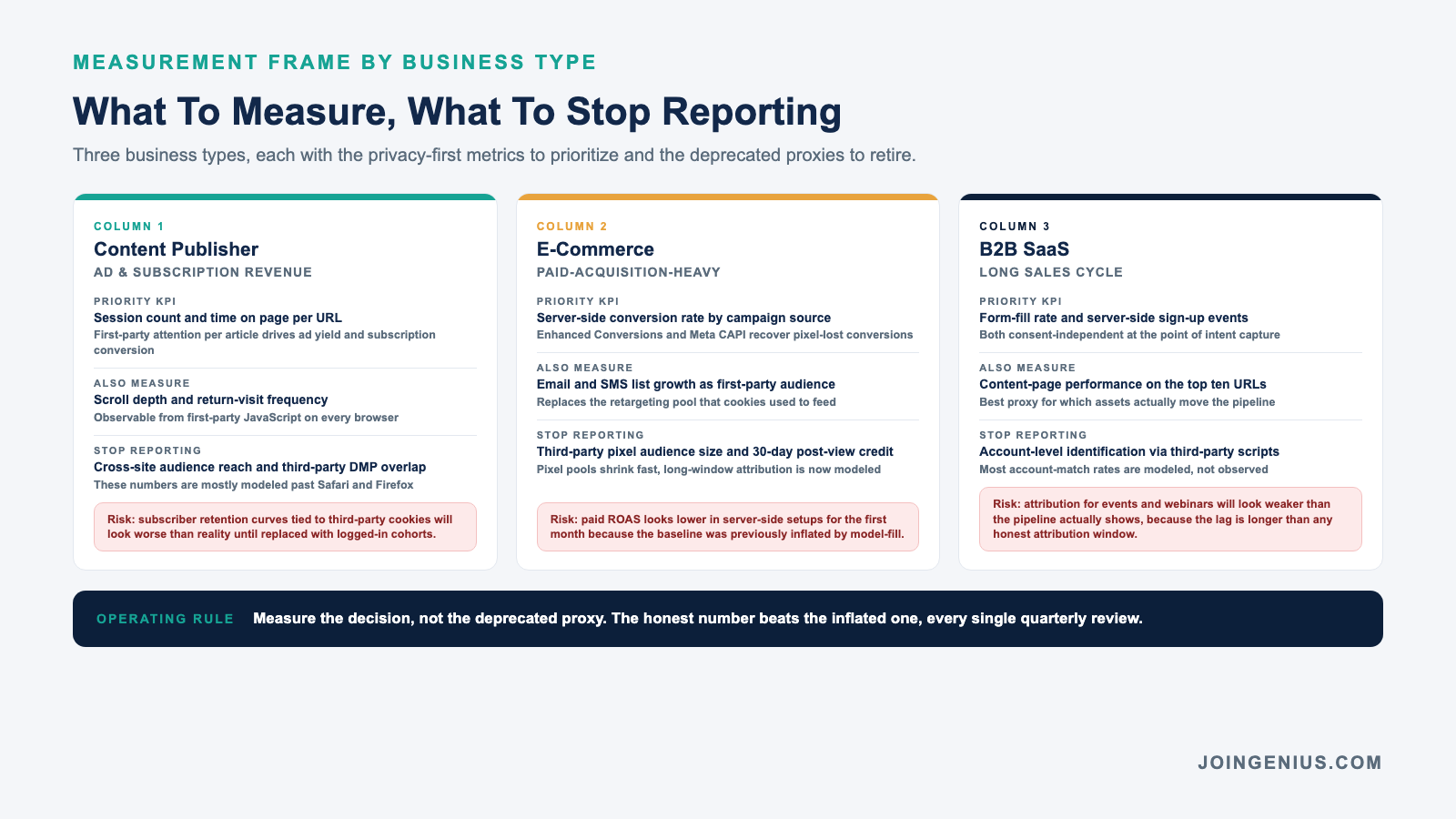
List every dashboard that depended on cookied cross-device data or long-window attribution. Flag those plus any retargeting audience numbers as modeled estimates going forward, and stop citing them in quarterly reviews. The credibility of the remaining numbers goes up the moment the unreliable ones go down.
Rebuild Around Three Honest Metrics
Real sessions per content piece and server-side conversion rate by campaign are the two decisions-ready metrics. Consented-cohort retention adds the third dimension, and that covers the entire marketing decision tree for most sites. Add a fourth only when an experiment demands it.
Set A Baseline Period For The New Dashboard
Run the privacy-first dashboard in parallel with the cookied one for a full quarter before switching sources. That parallel period gives the team the reference points they need to retrain stakeholder expectations, and it exposes any transition anomaly before it becomes a boardroom question.
Resource The Setup Through A Specialist
The migration from cookied to first-party is a one-time build that benefits from specialist help. Teams that staff the gap through the Genius outsourcing playbook and the offshoring strategy framework tend to ship the server-side layer two months faster than the in-house route.
Conclusion
Privacy-first analytics change what you can measure, but the measurement set that survives is the one that supports actual decisions. The old setup promised a single clean view and delivered a modeled approximation past day seven. The new setup gives you a smaller observed view and treats everything past that as model, which is harder to misread.
Teams that want to run the first-party rebuild without a full-time analytics hire can staff the gap through Genius. We place top 1% talent from the Philippines and LATAM at about 80 percent less than a local hire, with no monthly fees and a 6-month talent guarantee.