A company pays a year-end cash bonus to its sales team. A month later, one of its best account managers resigns. The bonus was real money, and it did not hold her. That is an illustration, not a case study, but it raises the question this guide asks: when does a cash bonus keep people, and when might a benefit they use all year keep them longer?
This guide looks at whether travel and lifestyle benefits can beat cash bonuses for retention. It covers what cash does well, what research says about non-cash rewards, how to choose and test a travel benefit, how to measure it and a table of warning signs. We found no study that compares travel or lifestyle benefits with cash bonuses on retention, so the title’s claim is a hypothesis to test, not a finding. The evidence here concerns performance and general turnover, and the link to retention is our reasoning. It is general information, not legal or tax advice, and rules differ by country.
What Cash Bonuses Do Well
Cash is flexible, and it can retain people. RAND’s 2010 study of cash incentives in the US military found that reenlistment bonuses improved the rate at which soldiers extended their Army service after a first term. Effects varied by service, positive for the Navy and Marine Corps and less helpful for the Air Force. About 80% of Army and Marine Corps soldiers reenlisting at the end of a first term received a bonus in 2007. That is the armed forces, with fixed contracts and a single employer, so it does not show what a bonus does at a private company. It does show that “cash does not retain” is too strong.
Staff may also prefer money. The Incentive Research Foundation’s review of award programmes cites a 1998 survey in which more than 80% of people earning under $100,000 said they preferred cash. The figure is old and comes through a secondary summary, but it is a reminder that a perk nobody asked for can land badly.
What Research Says About Non-Cash Rewards
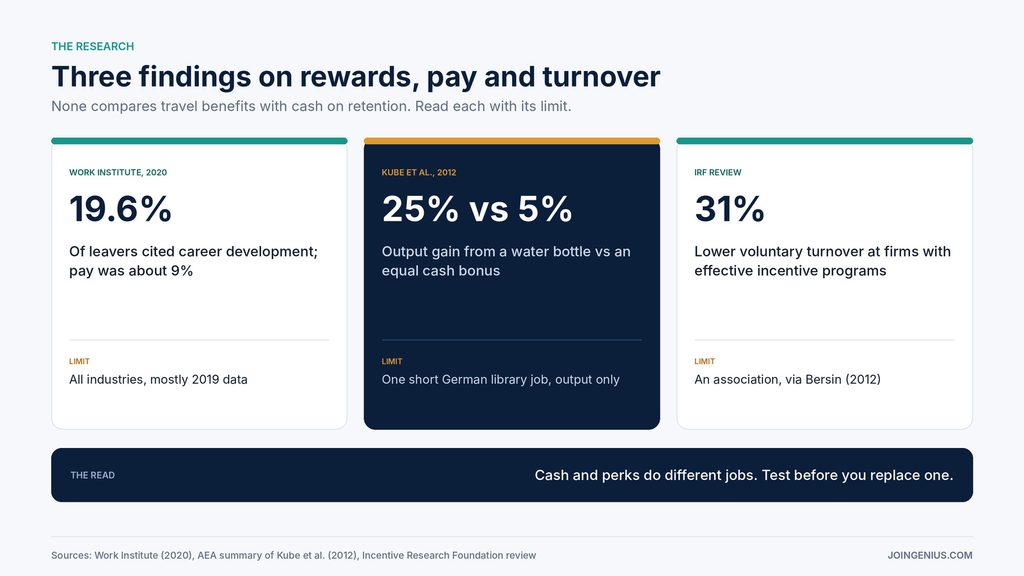
The best-known experiment we found measured output, not retention. Sebastian Kube, Michel Maréchal and Clemens Puppe ran a field experiment in Germany, published in the American Economic Review in 2012, with library workers entering book data for 12 euros an hour. Workers who received an unexpected 7-euro cash bonus entered about 5% more characters than a no-bonus group. Workers who received a water bottle of the same value entered about 25% more. Cash presented as origami, a folded note with a coin, produced about 30% more, and workers who knew the bottle’s price performed about the same as those who did not. The summary published by the American Economic Association does not report the sample size or how long the effect lasted, and it covers a single short job. It suggests that how a reward is presented may matter as much as whether it is cash, which is a reason to design the benefit with care.
The Incentive Research Foundation (IRF) review goes further. It cites research finding that tangible non-cash rewards deliver equal or greater returns than equivalent cash in most circumstances. It also cites a semiconductor plant study in which performance fell below its starting level only in the cash group after the rewards were removed. And it reports that firms with effective incentive programmes had 31% lower voluntary turnover, citing Bersin & Associates (2012), which is an association and not proof that the programmes caused it. The review is a secondary summary with no new data, it is undated apart from a 2022 page edit, and some of its citations are dated or inconsistent. It names Incentive magazine as a research advocacy partner and quotes practitioners from companies that sell rewards, so weigh its conclusions accordingly.
One more finding from the review helps explain the appeal. In a call centre study it cites, employees thought about non-cash rewards more often than cash ones, and the authors linked that to better performance. A benefit used often may stay in mind longer than a one-off payment. That is our reasoning, not a retention finding.
A caution about pay and perks both comes from the Work Institute’s 2020 Retention Report, based on exit interviews with more than 233,000 employees from 2010 through 2019. It lists career development as the top reason for leaving at 19.6%, with compensation at about 9%, and says pay is a cause sometimes but not always. It covers all industries and mostly 2019 data, so it is not about travel or bonuses. It suggests that neither a bonus nor a perk will fix a problem that is really about growth.
Offer Travel Benefits Your Staff Will Actually Use
Travel is easy to understand and hard to fit to everyone. Dragonpass sells a corporate travel membership that, according to its page, gives employees airport lounge access, Fast Track security, a travel eSIM, dining credits and airport transfers. Employers buy memberships in tiers, each traveller gets a set number of passes a year and billing is annual per traveller. The page is aimed at businesses that send staff on work trips, such as sales teams, consultants and senior leaders. That suits a travel benefit for people who already travel, not a general lifestyle perk for everyone.
The page also makes retention claims, and they are Dragonpass’s own. It calls the membership “A retention lever, not just a perk” and says 48% of employees report that better travel benefits would make them more likely to stay. A related Dragonpass article attributes similar figures to its own research, including 21% of employees having considered leaving an employer over travel. Neither page gives a sample, dates or a method, and we found no independent evaluation of the product. Treat the figures as the vendor’s claims. We do not quote prices here, so check the current terms yourself.
Before buying any travel benefit, ask the provider who pays and when, how many passes each person gets, whether they can be shared or carried over, which airports and regions are covered and how usage is reported to you. Ask your own adviser how the benefit is treated for tax and employment purposes where your staff live, because we are not giving that advice. A benefit that covers lounges at airports your staff never use will not retain anyone.
Test the Benefit Before You Scale It
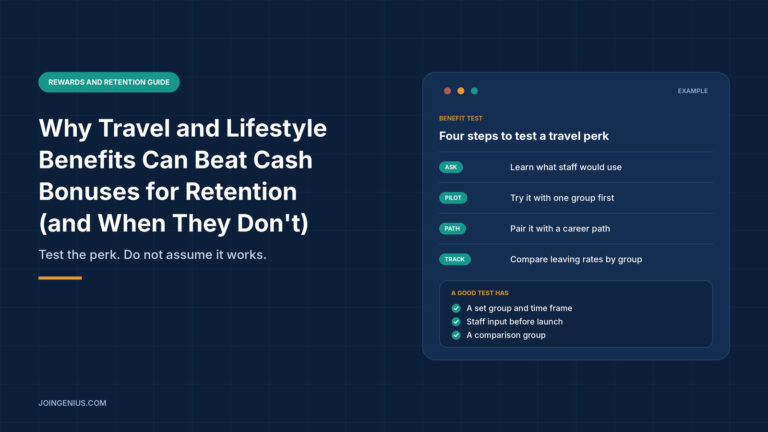
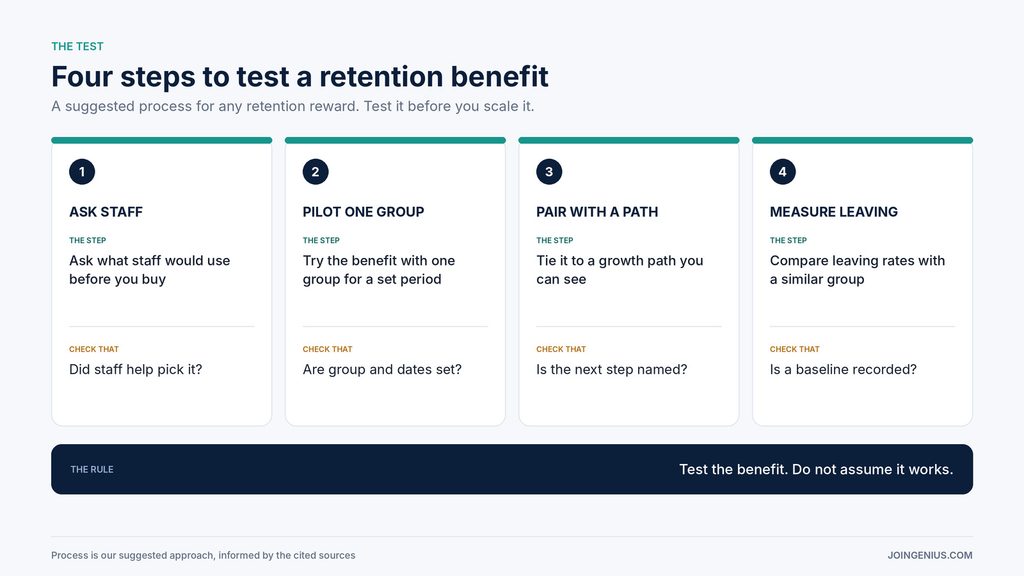
Use this four-step plan to compare a travel benefit with a cash bonus. It is our suggested process, informed by the sources above.
- Ask staff. Find out what they would use before you buy, since many people say they prefer cash.
- Pilot one group. Try the benefit with one team for a set period and keep a similar team as a comparison.
- Pair it with a path. Add a growth conversation, since career development outranked pay in the Work Institute data.
- Measure leaving. Compare leaving rates and benefit use across the groups.
Cash and benefits do not have to compete. A small bonus for reaching a goal and a travel benefit for staff who travel can sit together, which is our reasoning, but say which one the pilot is testing. If you change both at once, you will not know which one worked. Our guide to the employee benefits package covers what else to include, and the list of employee incentive program ideas shows low-cost options to test beside it.
Measure Whether It Works
Track the share of pilot staff who leave over six and twelve months against the comparison group, how often the benefit is used, what staff say about it in stay interviews and the reason each leaver gives. A single resignation proves little, and a small team can swing on one person, so look for a pattern over several quarters. Ask leavers and stayers the same questions so the answers can be compared.
Our guide to stay interview questions shows how to ask. For context, see the employee retention rate explainer, our data on employee recognition statistics and our piece on why attracting and retaining talent is important.
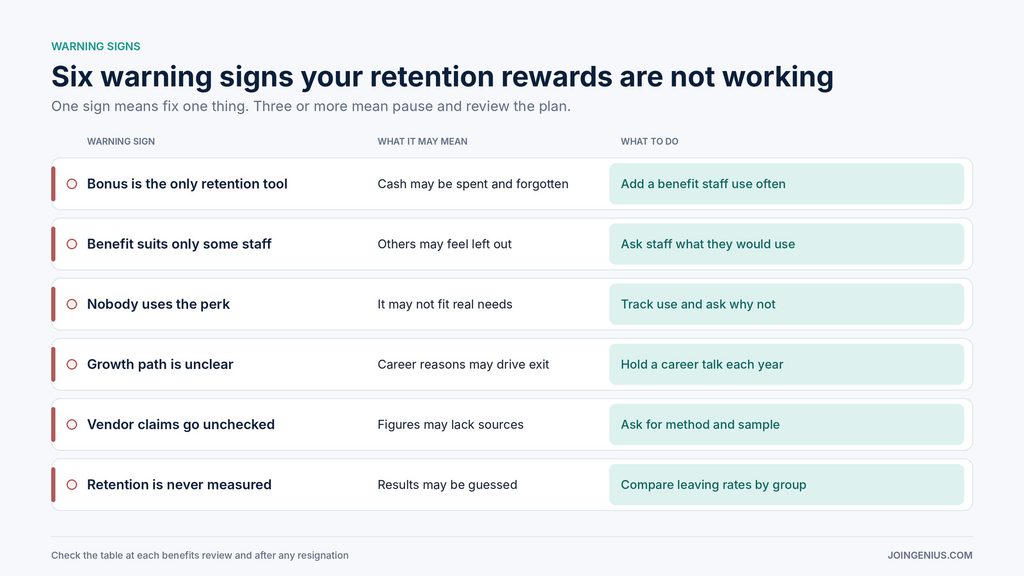
Warning Signs Your Retention Rewards Are Not Working, and What to Do About Each
Check this table at each benefits review and after any resignation. One sign means fix one thing. Three or more mean pause and review the plan.
Test Before You Replace Cash
Cash and benefits do different jobs. Cash can retain people, as the military data shows, and a benefit used often may keep an employer in mind longer, though no study we found proves it. Ask staff what they value, pilot one benefit against a comparison group and pair it with a real growth path. If the pilot shows that staff use the benefit and leave at a lower rate than the comparison group, you have a better reason to keep it than any vendor figure.