CS teams churn faster than account executives because the operating model never caught up. CSM tenure fell sharply through 2025 and 2026, while AE tenure held or stabilized. The gap is not about effort or empathy. AEs got a tooling and comp rebuild five years ago. The CS function did not.
This guide walks CS ops leaders and VPs of Customer Success through where the burnout curve actually starts and how to rebuild the function around automated at-risk flags instead of heroic CSMs. We borrow the discipline on operating-model gaps from our performance management playbook, because the rebuild only sticks when the review cadence does. The rest unpacks each layer.
Why CSM Tenure Became A C-Suite Problem In 2026
The customer success function stopped being a quiet cost center in 2024 when NRR became the number that moved the stock price. By 2026, the tenure line is tracked inside the quarterly board deck next to pipeline coverage, and every CFO knows the save rate depends on the same people cycling through the role.
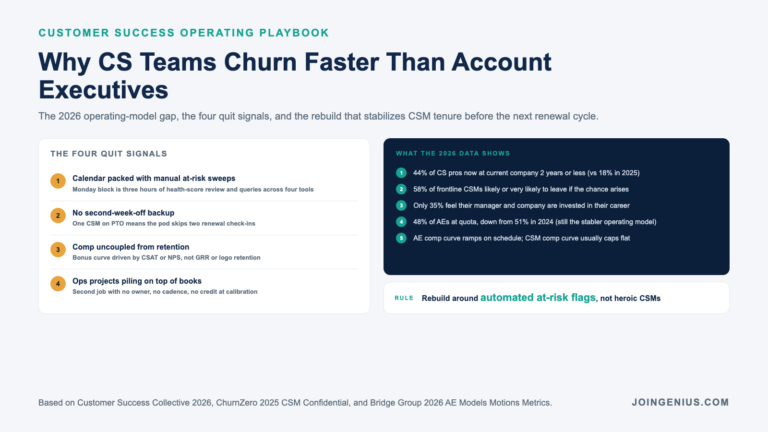
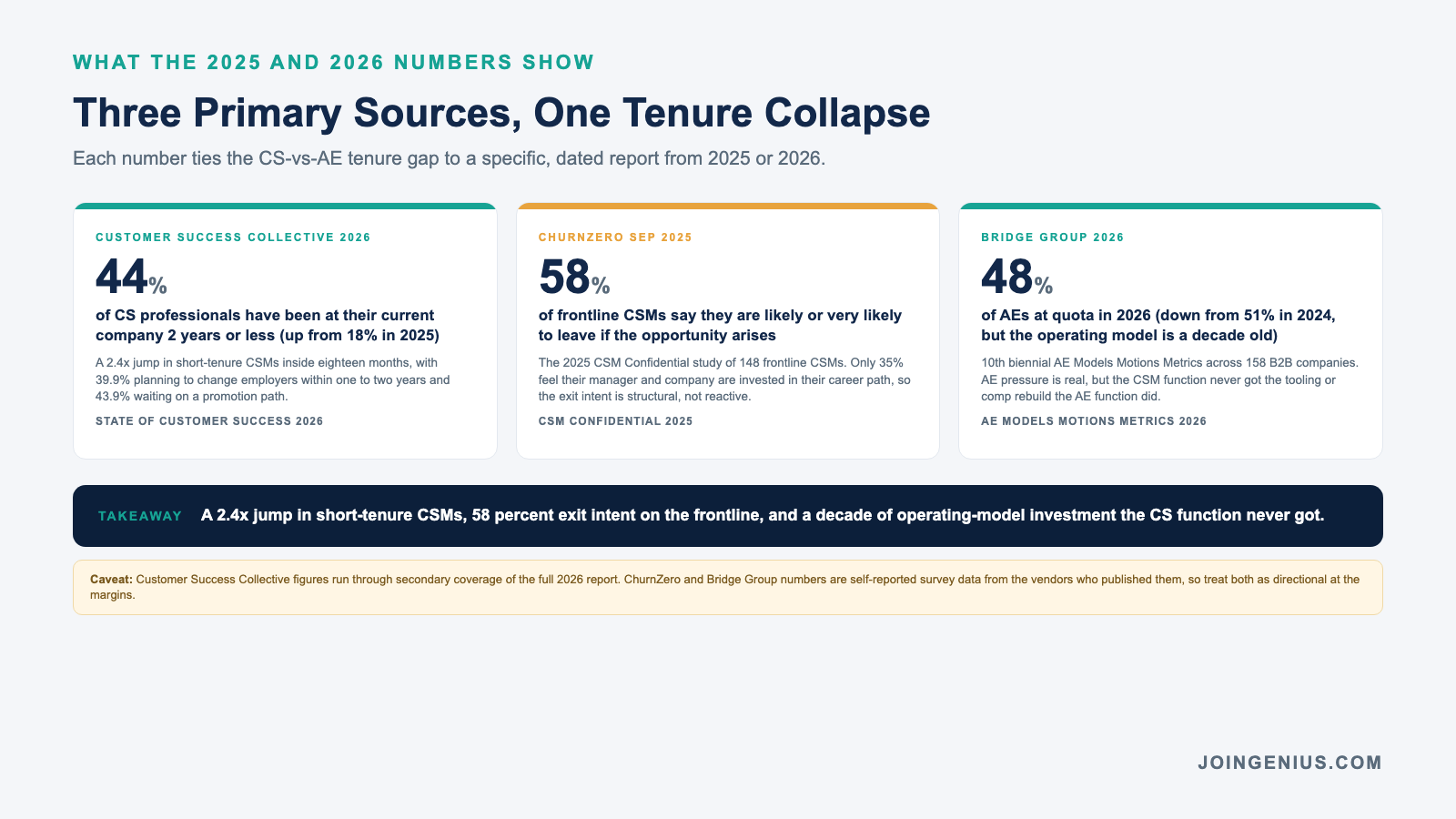
Three numbers reframe the problem. Customer Success Collective reports that 44 percent of CS professionals have been at their current company for two years or less in 2026, up from 18 percent in 2025. That is a 2.4x jump in short-tenure CSMs inside eighteen months, and the shift hits the renewal book directly.
The 2025 ChurnZero CSM Confidential study of 148 frontline CSMs found that 58 percent say they are likely or very likely to leave their role if the opportunity arises, while only 35 percent feel their manager and company are invested in their career path. The exit intent is baked in, not reactive.
Account executives read differently. Bridge Group’s 2026 AE study of 158 B2B companies reports 48 percent of AEs at quota, down from 51 percent in 2024, but the AE operating model has eight years of polish on it. CSMs do not. This is why CSM tenure became a C-suite problem while AE pressure stayed inside the sales org.
Where The 11-Month Burnout Curve Actually Starts
The exit intent in the ChurnZero data does not fire in month one. It compounds across eleven months of specific friction that the operating model was never redesigned to catch.
CSMs enter the role pattern-matching from support or sales, and the first three months feel like growth. Month four introduces the manual at-risk sweeps, and by month eight the comp disconnect becomes obvious to anyone comparing the quarterly bonus pool to the AE team next door. Month eleven is when the LinkedIn profile gets updated.
CS tenure collapses because reps spend 60 percent of their week hunting churn signals by hand, and the ops leads who rebuild the function around automated at-risk flags (the same kind that B2C operators use to reduce churn in member businesses) finally give their CSMs time for the actual save work.
The practical test is a calendar audit. If the CSM team’s week shows more hours in a reporting dashboard than in customer conversations, the function is still building the leak detection by hand. The rebuild question is whether the Thursday renewal call starts with a clean at-risk list or with the CSM building one on Wednesday night.
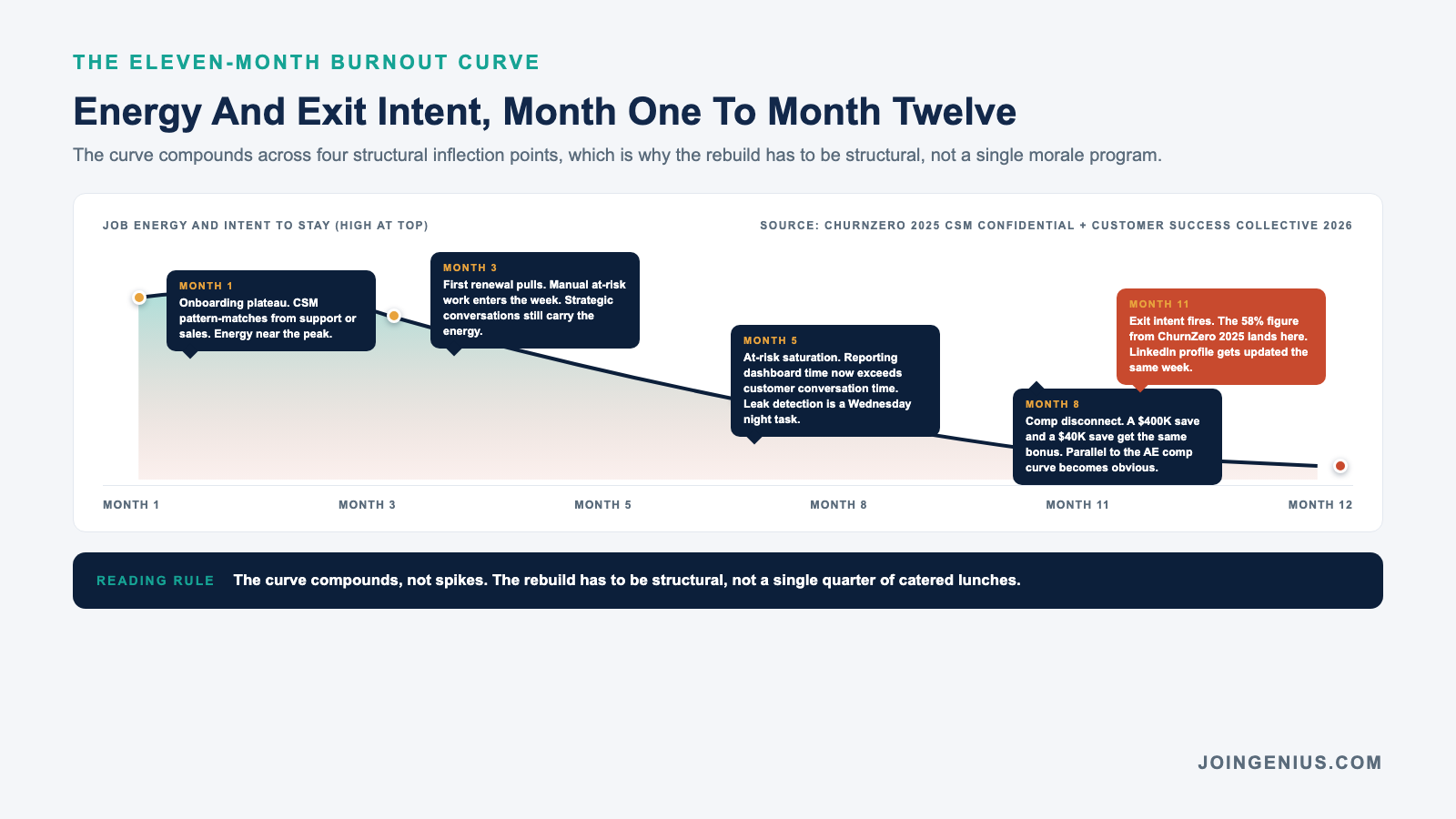
The Four Signals A CSM Is 90 Days From Quitting
Every CSM exit signals itself in the quarter before. Four patterns show up consistently across the ChurnZero data and the Customer Success Collective report, and all four are structural, not personal.
Calendar Packed With Manual At-Risk Sweeps
The first signal is the calendar. A CSM whose Monday block is three hours of manual health-score review and data queries across four tools is burning the week on work that should be a Monday morning report. Automation moves that block to Thursday review, and the CSM gets Friday back for actual save plays.
No Second-Week-Off Backup
The second signal is backup coverage. If one CSM going on PTO means the pod has to skip two renewal check-ins that week, the function is single-threaded. The book-rebalance is overdue, and the CSM has figured out retention depends on their own attendance rather than a durable save-play library.
Comp Uncoupled From Retention
The third signal is pay. When a CSM’s bonus curve is driven by CSAT or NPS, not GRR or logo retention, the role becomes support in a different jacket. The CSM can read the renewal dashboard and see their actual save work is carrying someone else’s number.
Ops Projects Piling On Top Of Books
The fourth signal is scope. When “help us roll out the new playbook” and “pilot the new Gainsight workflow” fall on top of a book of forty accounts, the CSM is running two jobs. The second one has no owner, no review cadence, and no credit at the next calibration cycle.
What AEs Have That CSMs Don’t: The Operating-Model Gap
The reason AE tenure holds while CSM tenure drops is not tooling spend. Three operating primitives exist in sales orgs that most CS functions never got around to building, even though every CFO assumed they had.
A Pipeline Source Of Truth
AEs work from one CRM view that all parties agree is the number. CSMs work from a health score across the CSP and the CRM, plus a BI dashboard the BI team owns, and reconcile the discrepancy themselves. The CS function needs one agreed view the way the pipeline has one.
A Predictable Comp Curve
The AE comp curve ramps with quota attainment on a known schedule. The CSM comp curve often caps at a flat bonus unrelated to the save pipeline they are actually running. A CSM who closes a save worth $400K in ARR usually sees the same bonus as a CSM who closes one worth $40K.
A Defined Deal Review
Every AE deal above a dollar threshold goes through a weekly deal review. Most CSM save plays never get reviewed. They either close or they do not, and the save-play library stays trapped in one CSM’s head. The talent acquisition analytics discipline carries over here: metrics only matter if a review cadence exists to argue with them.
| Dimension | Typical AE Setup | Typical CSM Setup | What Flips After Fix |
|---|---|---|---|
| Source of truth | One CRM pipeline view, agreed by RevOps | Three dashboards, reconciled by the CSM | One health score the CSM can argue with |
| Comp curve | Quota attainment on a known schedule | Flat bonus unrelated to save pipeline | Save-weighted bonus tied to GRR |
| Deal review | Weekly deal review above a dollar threshold | Save plays reviewed informally or not at all | Weekly save review with a defined threshold |
| Enablement asset | Decade-old play library and call-script bank | Mentor-dependent tribal knowledge | Tagged save-play library the whole team shares |
| Weekly rhythm | Monday pipeline review, Friday forecast | Monday manual at-risk work, Friday firefight | Monday automated at-risk list, Friday save work |
Rebuilding The CS Function Around Automated At-Risk Detection
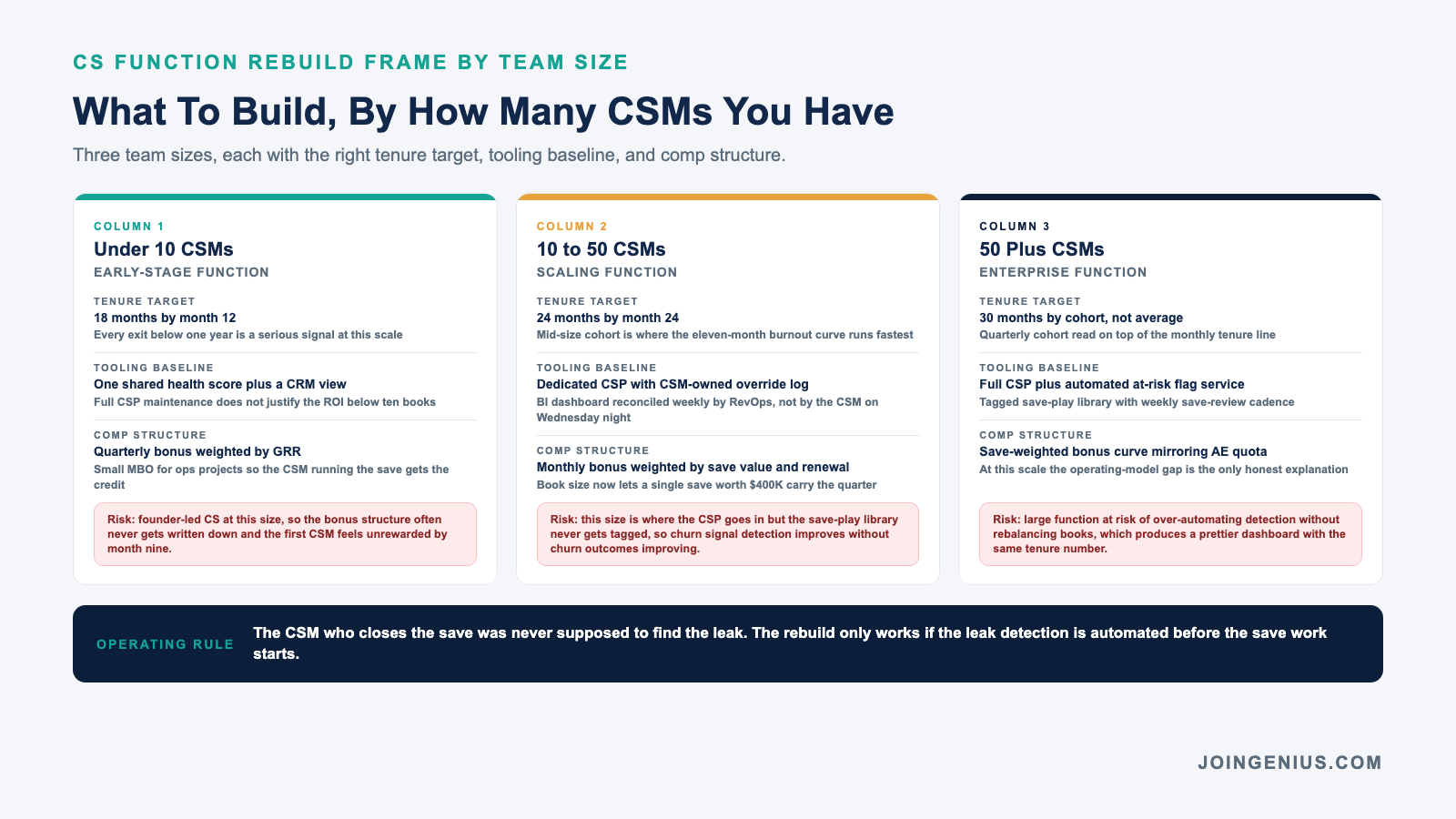
The rebuild is three layers deep, and all three have to go in at once for the tenure curve to flatten. Doing one in isolation produces the common failure pattern, which is a six-month health score project that nobody actually uses by month seven.
The Health Score Rebuild
The health score has to blend product usage and support ticket volume against contract timing, producing one weighted output the CSM can argue with. If the CSM cannot override the score and log a reason, the score becomes decorative and nobody trusts it inside ninety days. The CSM has to own the override log, not the data team.
The Book Rebalance
Books concentrate quietly. One CSM ends up with four of the top ten renewal risks because they inherited them, and by month eight their save ratio reads worse than a peer whose book had no risk at start. A quarterly rebalance by risk tier, not alphabetical, fixes this. The rebuild only matters if the cohort stabilizes after rebalance.
The Save-Play Library
Every successful save becomes a tagged play in a shared library. When a new CSM onboards they inherit twenty save plays instead of a single shadow mentor. The CS function can catch up to AE enablement inside two quarters if the tagging discipline is set from week one. Our outsourcing playbook on scale limits applies here directly.
Measuring Whether CSM Tenure Actually Stabilizes
The function has to track tenure the same way it tracks NRR. If the metric only shows up at exit-interview time, the rebuild never gets credit and the next quarter the budget line gets cut by a CFO who never saw the before number.
Ninety-Day Signals
The earliest signal is the Monday calendar review. If a CSM’s manual at-risk sweep block is under ninety minutes per week by day ninety, the tooling layer is holding. If not, the dashboard rebuild never actually shipped, and the CSM is doing the sweeps by hand with a new UI in front of them.
The Quarterly Cohort Read
Tenure reads quarterly by cohort, not monthly by average. The question is whether the 2026 Q3 CSM hire cohort is still in seat at Q1 2027, and whether their book NRR is in range. The cohort read beats the monthly average, because the average is dominated by long-tenure outliers who already made peace with the role.
The NRR Cross-Check
The final check is whether the tenure improvements show up in NRR a quarter later. If they do not, either the compensation structure is still broken or the save-play library is not getting used. Our offshoring strategy framework on retention cycles applies here directly, because the cadence is the same across functions.
Conclusion
The teams that stabilize CSM tenure are not the ones that pay more. They are the ones that rebuild the operating model so the CSM spends the week on save work instead of manual signal hunting. The AE function did this ten years ago. The CS function has one quarter to catch up.
Teams that want operational horsepower to run a CS rebuild without hiring full-time ops analysts can staff the gap through Genius. We place top 1 percent talent from the Philippines and LATAM at about 80 percent less than a local hire, with no monthly fees and a 6-month talent guarantee. Our customer service structural playbook carries the same operating-model logic.