
A job post asks for ROS, Arduino, and Jetson experience, and the applications roll in. Most résumés list all three. Far fewer of those applicants have ever made a real robot move across a real floor without something going wrong along the way.
That gap is the heart of robotics hiring. Keyword matching finds people who finished a tutorial or a course. The job needs people who have wired a sensor that misbehaved, chased a timing bug across firmware and software, and shipped something that worked outside a demo.
This guide covers what each of those three skills actually signals, how to find engineers who have built real things, and how to assess them fairly. If you are building a technical talent pipeline for a niche like this one, it helps to know what good evidence looks like before you start sourcing.
Why Robotics Hiring Is Harder Than It Looks
Robotics sits across software, electronics, and mechanics. Very few people are strong in all three, so most candidates lean one way and need to be matched to the right seat.
Job titles do not help. “Robotics engineer” can mean embedded firmware, motion planning, computer vision, or systems integration, and two postings with the same title can ask for very different people.
Demand adds pressure. Drones, warehouses, farms, factories, and vehicles all compete for the same small group of engineers, so the best candidates rarely stay unemployed for long.
The result is a market where speed and clarity both matter. Teams that know exactly which layer of the robot they need covered, and can explain it in plain language, attract better candidates than teams that post a long list of tools and hope for the best.
What ROS, Arduino, and Jetson Each Tell You
The three names in your job post cover three different layers of a robot. Treating them as one checkbox hides what you are really testing.
ROS tells you how a candidate structures a system. Someone fluent in the Robot Operating System understands how to split a robot’s software into nodes that publish and subscribe to messages, how to handle navigation and sensor data, and how to use the debugging and visualization tools that come with the framework.
Arduino and similar microcontrollers tell you about the hardware edge. Candidates who have worked here have read sensor data, driven motors, and dealt with timing and memory limits. They understand that a program that works on a laptop can fail on a small board for reasons that have nothing to do with logic.
Jetson tells you about edge AI. Running vision or inference models on a compact GPU board means thinking about power, heat, and speed at the same time. Engineers who have done this know the difference between a model that scores well in a notebook and one that runs reliably on a robot.
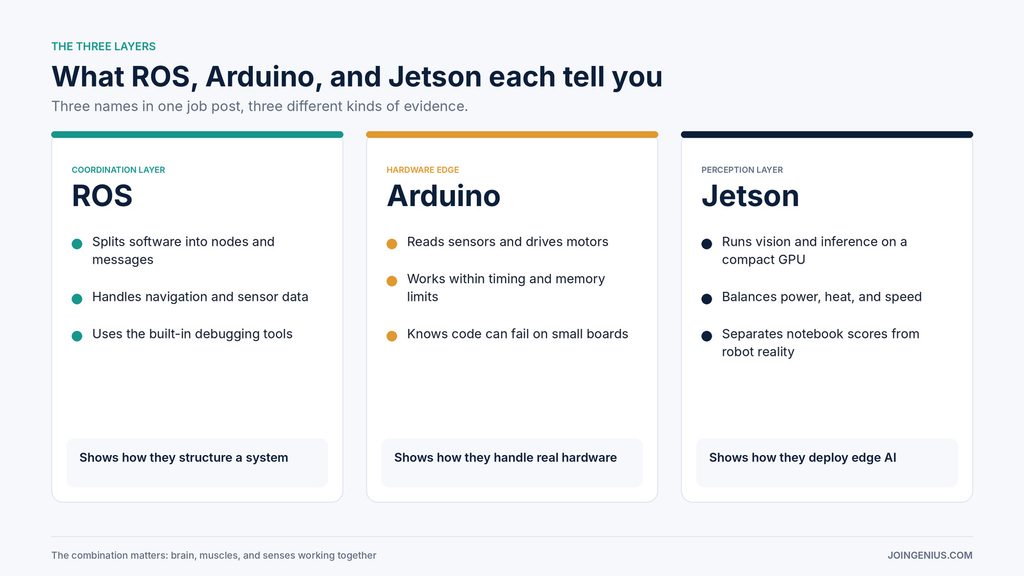
The combination is what matters. ROS acts as the coordinating brain, microcontrollers drive the motors and sensors, and edge compute handles perception. A candidate who understands how those layers talk to each other will solve integration problems that a specialist in one layer will not even see. For the vision and model side of the role, a guide on how to hire a machine learning expert covers what to look for in more depth.
Hands-On Platforms Show What a Candidate Has Actually Built
In robotics, a working robot is stronger evidence than a certificate. A project proves that someone can connect parts, resolve conflicts between software and hardware, and keep going when the first attempt fails.
That is why hands-on experience deserves more weight than most credentials. Real robots behave differently from simulations. A navigation stack that looks perfect in a virtual map can wander on a real floor with uneven lighting and slippery wheels. A sensor that reads cleanly on the bench can jitter once the motors start running. Each of these problems teaches something that no lecture can.
Candidates who have spent time on a hands-on robotics platform like Hiwonder’s ROS kits usually arrive with real debugging experience, not just coursework.
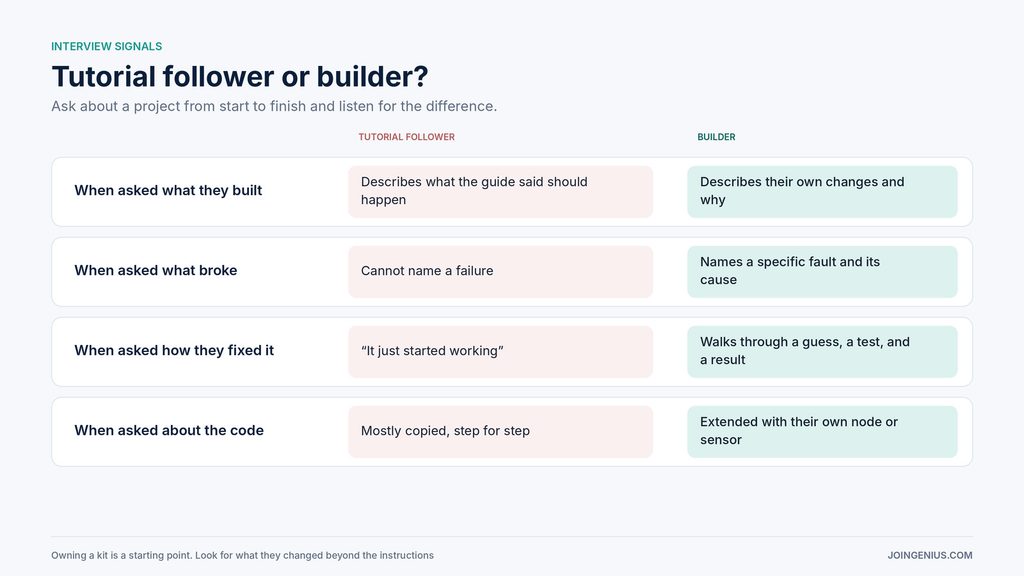
The easiest way to find out is to ask. Invite the candidate to describe a project from start to finish. What did they build, what broke first, and how did they find the cause? Strong candidates tell specific stories, such as a motor controller that reset the board or a lidar reading that drifted when the battery ran low. Weak candidates stay general and describe what the tutorial said should happen.
It is also worth being fair. Owning a kit is a starting point, not proof of skill. Look for what the candidate changed or extended beyond the instructions: a new sensor, a modified behavior, a node they wrote themselves, or a problem they solved that the guide never mentioned. Those changes show curiosity and judgment, which matter more than any particular platform.
Where to Find Robotics Engineers With Real Build Experience
Once you know what good evidence looks like, the next question is where to find it. Job boards will reach some candidates, but the best ones are often easier to find where robots are being built.
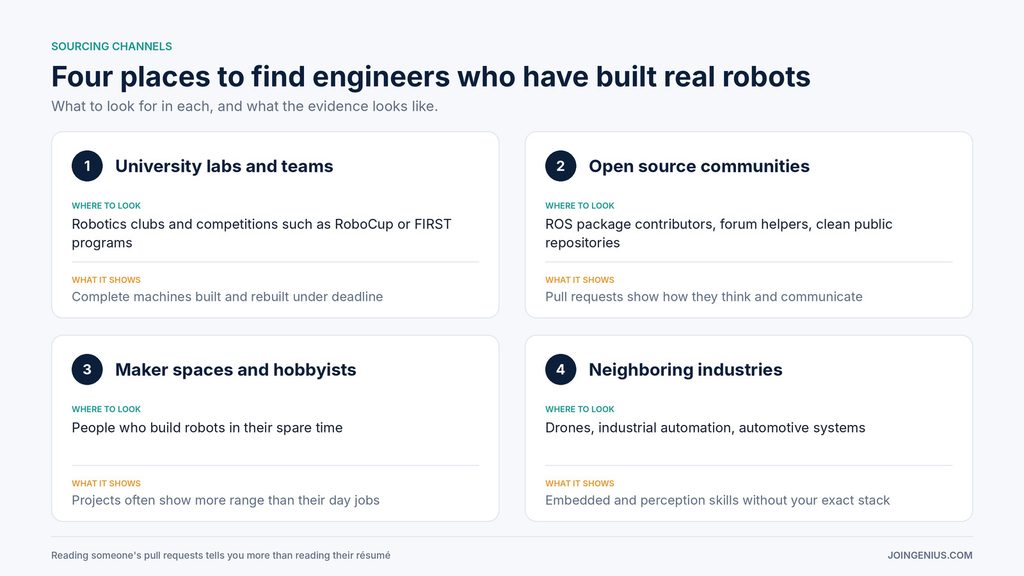
University labs and student teams are a strong starting point. Graduates of robotics clubs and competitions, such as RoboCup or FIRST programs, have often built and rebuilt complete machines under deadline. They tend to have the kind of integration experience that coursework alone does not provide.
Open source communities are another source. Contributors to ROS packages, people who answer questions on forums, and engineers who publish clean repositories leave a visible trail of how they think and communicate. Reading someone’s pull requests tells you more than reading their résumé.
Maker spaces and hobbyist groups deserve a look as well. Many capable engineers build robots in their spare time, and their projects often show more range than their day jobs.
However you find them, the outreach message matters. Engineers ignore generic recruiter notes. A short message that mentions a specific repository or project you admired, and says what your team is building, gets far more replies than a list of requirements.
Neighboring industries also hold talent. Engineers in drones, industrial automation, and automotive systems often have the embedded and perception skills you need, even if they have never used your exact stack.
When speed matters more than reach, a specialist partner can help. A guide to IT staffing agencies explains how to choose one and what to ask before you sign.
How to Screen and Assess Candidates
Assessing robotics candidates works best when it mirrors the work. A short, practical process gives you better signal than a long list of trivia questions.
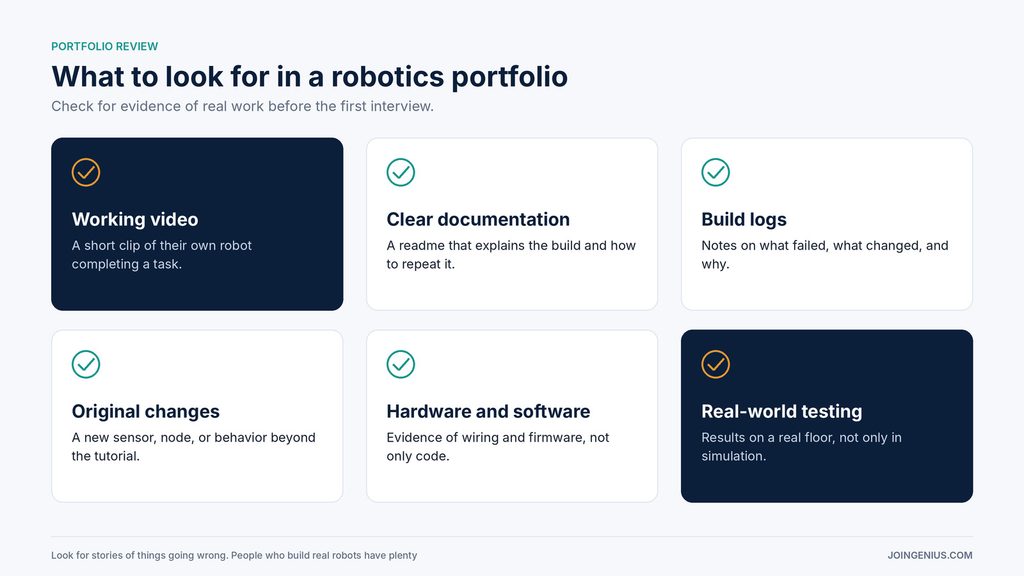
Start with the portfolio. Look for repositories with clear documentation, build logs, and short videos of the robot working. A candidate who can show a video of their own machine completing a task has already passed the first filter.
Next, give a practical task. This can be a small problem in simulation or on a physical robot, scoped to a few hours. A good task includes something that goes wrong on purpose, such as noisy sensor data or a message that arrives late, so you can see how the candidate reacts.
Then hold a debugging interview. Ask the candidate to walk you through a failure they fixed and how they isolated the cause. Listen for a method: forming a guess, testing it, and ruling things out. People who have really debugged robots describe a process. People who have not describe luck.
Finally, score every candidate against the same rubric. Four areas work well: systems thinking, hardware fluency, software quality, and debugging ability. A shared rubric keeps the decision fair and makes it easier to compare people who come from very different backgrounds.
Finish by letting the candidate ask questions about your robots. The questions engineers ask reveal how they think: whether they want to know about the sensors, the failure modes, the test setup, or only the salary. Curious candidates ask about the hard parts of the problem, and that curiosity usually predicts how they will behave once they are on the team.
Hire for What They Have Built
The strongest robotics hires are rarely the ones with the longest list of keywords. They are the people who have built real machines, watched them fail, and worked out why. Look for that evidence, source beyond job boards, and assess with practical work that mirrors the job.
A practical first step is to rewrite your job description around specific projects instead of a keyword list. Ask for a robot they built, a problem they solved, and a video of it working. If you are a small team making a first robotics hire, this guide to hiring for startups offers useful advice on moving quickly without lowering the bar.